$162M FY2027-2032 CIP Invests in Sewer and Stormwater Capacity Expansion, Delays Property Yard Replacement
Summary
The City government presented the FY2027-2032 Capital Improvements Program (CIP) covering six years of capital expenditures that total $162 million. The financial plan focuses primarily on maintaining current facilities and infrastructure and expanding sewage processing capacity. Larger projects, such as the $30 million Property Yard replacement, have been pushed beyond FY2032.
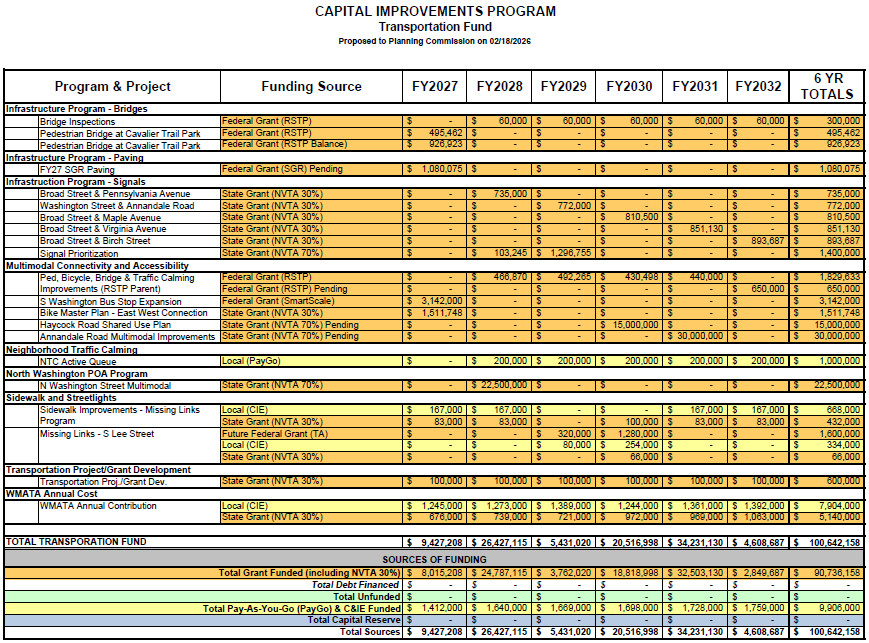
Transportation projects account for $100 million, 90% funded by State grants. These projects upgrade the City’s busiest roads and intersections with new signals, sidewalks, crosswalks, and bus shelters.
This CIP also reflects the City’s new focus on stormwater infrastructure, more than doubling the allocation compared to last year’s CIP. Again, a State grant allows the City to develop a Citywide flood resilience plan to identify and prioritize future stormwater projects.
The CIP will be presented to City Council at its regular March 23, 2026, meeting, which is open to public comment.
An overview of the FY2027-2032 CIP

The Capital Improvements Program (CIP) is a rolling six-year financial plan for replacing and upgrading the City’s infrastructure and other capital assets. For fiscal year 2027 which begins on July 1, 2026, the CIP covers FY2027 to FY2032. This CIP totals $162 million, significantly more than the $148 million CIP budget last year, which covered FY2026-2031. The increase is primarily due to two new transportation grants totaling $45 million.
The table summarizes the projects over the entire six years, and the graph shows the sources of funding. As always, the largest category is $100 million for transportation projects to inspect and replace pedestrian bridges, expanding roadways to be multimodal, redoing intersections, and installing neighborhood traffic calming facilities. Fortunately, 90% of the transportation funds are from grants.
The sewer CIP projects account for $33 million of the CIP budget that will require a total of $19.8 million of debt beginning in FY2028. $6.8 million from Pay-As-You-Go funds (PAUG) will be used to cover the shortfall in the sewer utility funds. The City is also turning its attention to its stormwater infrastructure this year, expanding stormwater projects from $3 million in last year’s CIP to $9 million this CIP.

The graph shows how the CIP will be financed. Grants make up almost 60% of the funding. The City will issue debt to cover 17% and fund $21 million from cash reserves and yearly tax revenues. Almost $5 million will be drawn from the Capital Reserves fund. The sewer and stormwater utilities have their own funds that will be used to pay for some of their projects.

The table shows how the $162.6 million plan distributes the spending over the next six years. (Note that $600,000 is unfunded even though it is included in the plan, hence the CIP budget amount is $162 million.) For FY2027, projects require $19 million, including $6 million for sewer infrastructure. FY2028 will be a big year for CIP at $44 million, primarily due to $26 million for transportation projects that are grant-funded and $13 million for sewer infrastructure financed by $10 million of debt.
Growth increases sewer needs, funding draws from City reserves
Now that the City has finalized its deal with Fairfax County to obtain greater sewage processing capacity for its thousand plus additional households and to accommodate future projects, the financial impact is showing up in the CIP.
Besides the $6.8 million the City agreed to pay to enlarge the sewer pipe at Barrett Road, Fairfax County, the City’s share of the facility upgrade cost at the AlexRenew, the Fairfax County wastewater treatment facility, has also increased. AlexRenew is expanding its capacity from 34 million gallons a day to 54 million gallons a day to handle the region’s growing needs. Over the next six years, the City’s share for AlexRenew’s capital expenditures will grow to $16.6 million, 75% more than expected in the last CIP.
The City is also enlarging 700 feet of sewage pipe in Tinner Hill at the cost of $1 million, to be funded by debt. The current program of relining the City’s sewer pipes continues with $750,000 allocated each year.
For FY2027-2032, the sewer CIP is $33.5 million, to be funded partially by $10.5 million in debt in FY2028 and rising to $19.8 million by FY2032. The sewer utility funds of $5.2 million will be utilized in FY2027, delaying the debt issue, and $1.7 million in sewer availability fees in FY2028. About $1million will be provided each year from the City’s cash reserves to make up for the shortfall. This CIP does not include the $8.8 million paid from sewer fees in FY2026 to Fairfax County to increase capacity limits.

Finally, stormwater infrastructure gets some attention.
Flooding from stormwater is a major concern of residents in the City. The existing pipes are not large enough for the increased building density, and thus far the City has been making small piecemeal improvements. The last “great flood” was in 2019, and Falls Church is overdue for a major storm event.
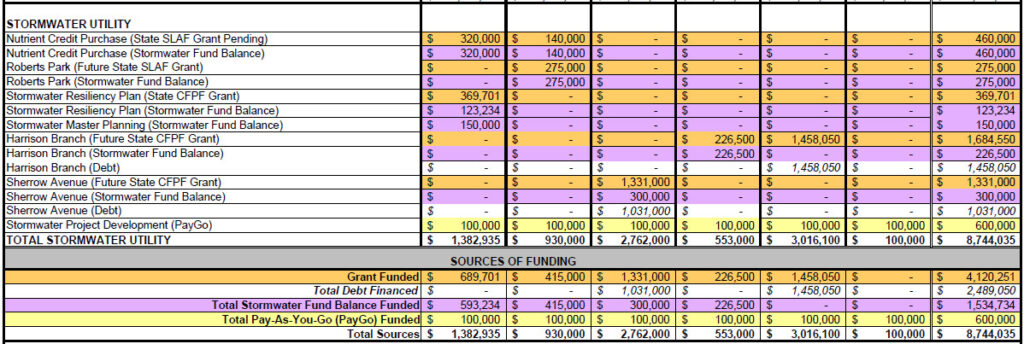
In the past, the City has focused on water quality due to recent State regulations that require the City to purchase nutrient credits for contributing to the pollution of the Chesapeake Bay. Nutrient credits cost $1.2 million in the CIP, to be paid in FY2027 and FY2028. Fortunately, State funds cover 50% of this cost.
To address the stormwater quantity issue, two large projects to replace stormwater pipes along the Harris Branch near Midvale Street ($3.4 million) and near Sherrow Avenue ($2.7 million) are planned, 50% funded with grants. $2.5 million in debt will be required due to insufficient reserves in the Stormwater Utility Fund.
City engineers have long called for the need to update the model of the City’s entire stormwater system. Mitigating flooding issues in one area may increase risks downstream. The City recently received a $500,000 grant from Virginia Department of Conservation and Recreation’s (DCR) Community Flood Preparedness Fund to develop a Citywide flooding resilience plan.
This grant will allow the City to complete its stormwater infrastructure model and database to assist with the planning. The City will then submit its resilience plan to DCR for approval, further opening up other funding opportunities from the State for stormwater projects. CIP Coordinator Caitlin Sobsey expects that the City will be able to increase the number of stormwater projects in future CIPs as a result.
Roadworks to continue in the City
City roads and intersections continue to be updated with major projects at Annandale Road, Haycock Road, and N Washington Street covered by $67.5 million in grants. Signal lights and intersections, especially along Broad Street, will be affected. The pedestrian bridge at Cavalier Park is on the list to be replaced. An ADA-compliant sidewalk is planned for S Lee Street. $200,000 will be set aside each year for Neighborhood Traffic Calming projects.
The CIP has $1.5 million in grants for building the East-West Connection bike route to enable students to reach the Secondary Schools campus from the W&OD Trail. Other routes on the Bicycle Master Plan have been tabled.
The Greening of Lincoln project phases C and D are not funded in FY2027-2032.
Public facilities and schools: Big projects postponed
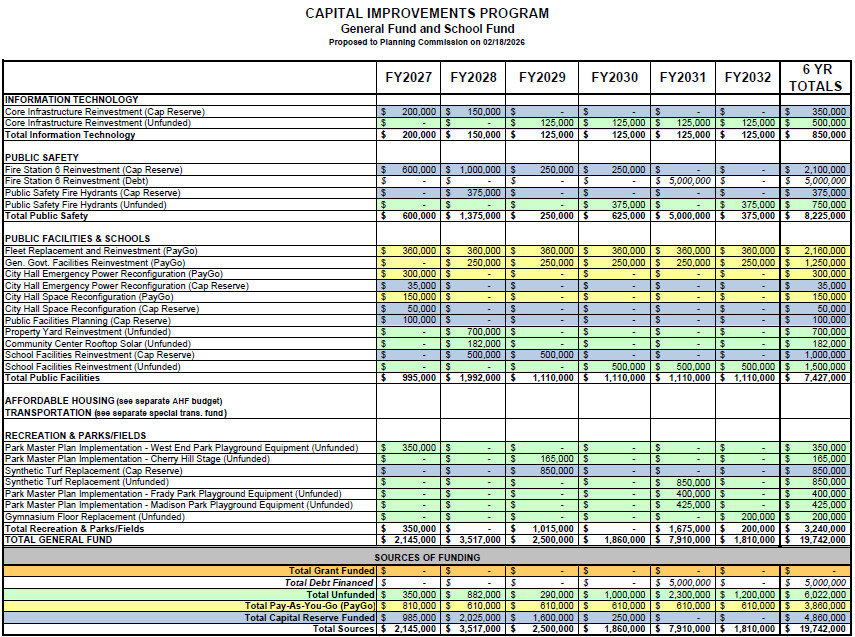
Funding is provided to maintain the existing public facilities and update information technology. Installing solar panels on the Community Center roof ($900,000) is in the CIP but unfunded. A new roof for the Fire Station is planned at a cost of $5 million to be covered by debt in FY2031.
The Falls Church City School Board contributes and plans for the CIP projects related to the schools, although it is included in the CIP. In this CIP, $500,000 has been proposed each year for capital investments.
The $30 million Property Yard project has been delayed beyond FY2032. Instead, the plan is to spend $700,000 to rehabilitate the current structure for the short term. Many smaller projects for Recreation and Parks are currently unfunded but are included in the CIP.
The City’s 10-year pipeline lists projects to be considered beyond FY2032. The pipeline includes a new Property Yard and a new Public Safety Headquarters Building, along with other projects that were not in the latest six-year plan.
FCCAN criticizes CIP for neglecting City’s Energy Action Plan
Falls Church Climate Action Network Chair Jeff Peterson spoke at the Planning Commission meeting, March 4, 2026, asking the City to include more projects to advance the strategies outlined in the City’s Energy Action Plan. “This is a serious underinvestment that will doom future efforts to meet the 2030 goals in the [City’s energy] plans. We are just simply not putting our money where our mouth is,” he said. Maya Anderson, Meridian High School student and FCCAN member, asked the City to fund the installation of solar panels on Mary Ellen Henderson Middle School (MEH) to take advantage of federal tax credits.
Ms. Sobsey responded that the facilities projects include the installation of charging stations and that replacement City vehicles will be more energy efficient models. These projects were funded in prior years and, though still ongoing, are not in this CIP. The MEH solar panel installation was dropped because of funding constraints, although it has been recommended for City Council consideration.
Next steps
The CIP was presented to the Planning Commission on March 4, 2026, for their recommendation to City Council. It will be presented to City Council and the public on March 23. A City Council vote on the FY2027 budget and the FY2027-2032 CIP is scheduled for May 11, 2026.
Extracts from the FY2027-2032 CIP
The full CIP document can be found at the City’s CIP webpage. The tables in this post are from that document.
References
- Planning Commission meeting, February 18, 2026. YouTube video.
- Planning Commission meeting, March 4, 2026. YouTube video.
- Planning Commission meeting, March 4, 2026. This official video will not display properly on a small screen as it contains the agenda.
- CIP Staff Report 03-04-2026.
- City webpage on the CIP. The proposed CIP FY27-32 can be found in a link on this website. The document contains more details on each of the line items listed in the CIP extracts above.