Growth Drives the City’s Proposed Utilities/Facilities Plan
Summary
- City staff are actively seeking comment on the revision of the utilities/facilities chapter of the City’s Comprehensive Plan.
- Last revised in 2005, the updated chapter responds to Falls Church’s considerable growth, changing service needs, and aging infrastructure.
- The plan emphasizes the need for additional government offices and workspaces, the creation of sanitary sewer and stormwater master plans, and ongoing analysis of service costs associated with major developments.
- The City Council is scheduled to approve this plan by March 2026.
Growth reveals facilities/utilities gaps
That Falls Church’s significant growth has overtaken current government and school facilities and utilities infrastructure is evident in the City’s latest long-range plan for these resources. Additional government offices and workspaces, the creation of sanitary sewer and stormwater master plans, and ongoing analysis of service costs associated with major developments top the list of priorities in the draft plan presented by staff to the City Council and the Planning Commission last month.
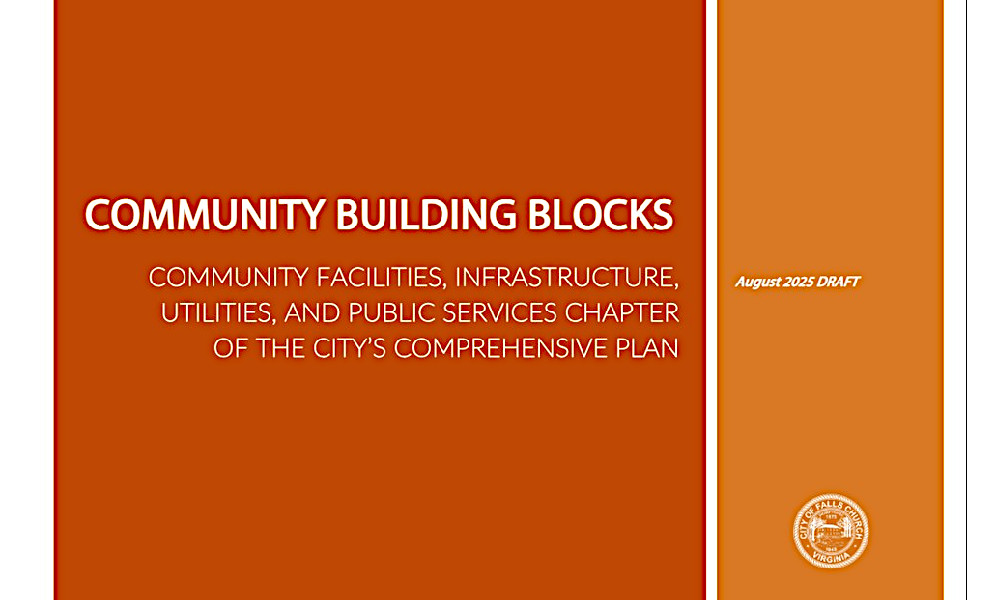
“The overall theme of this chapter is best captured by the increasing pressure on the City’s facilities due to growth, shifts in service needs, and aging infrastructure,” the planning staff concluded in its 65-page revision of Chapter 8 of the City’s Comprehensive Plan, now titled Community Building Blocks: Community Facilities, Infrastructure, Utilities and Public Services.
A scope broad and deep
Last revised and adopted in 2005, the utilities/facilities chapter covers and is newly organized around four topics: Government Services and Facilities, Public Safety, City Utility Services, and Third-Party Utility Services. As a result, its scope is broad and deep, ranging from general government and school buildings and facilities to police, fire, and rescue services and the sanitary sewer and stormwater systems.
Each section includes an overview of the existing facilities, utilities, and/or services; an evaluation of the needs in each area; and preliminary recommendations. The City’s future needs are summarized by the Falls Church Pulse in the accordion table below.
Summary of Future City Needs Over the Next Two Decades from the Revised Chapter 8 on Utilities/Facilities of the Comprehensive Plan, Compiled by the Falls Church Pulse
According to lead staff Planner Zoe Larive, the utilities/facilities chapter revision is based on the City’s 2024 population and employment projections, industry-specific best practices, and the existing infrastructure of multiple City agencies. The chapter is intended to inform strategic utilities/facilities planning and spending for the next two decades and serve as a guide for public investment and a reference for third-party utility providers and private development applicants.
Assessing whether growth pays for itself
The draft utilities/facilities chapter has been reviewed by some 30 subject matter experts on the City staff and its boards and commissions, including the Public Utilities Commission (PUC). The revision includes a new proposed vision statement, supporting guiding principles, and maps identifying City facilities, including schools, such as the one shown below. Among the chapter’s goals is to routinely conduct impact studies to determine the service costs for new major developments “to assess whether growth is paying for growth,” Ms. Larive said.
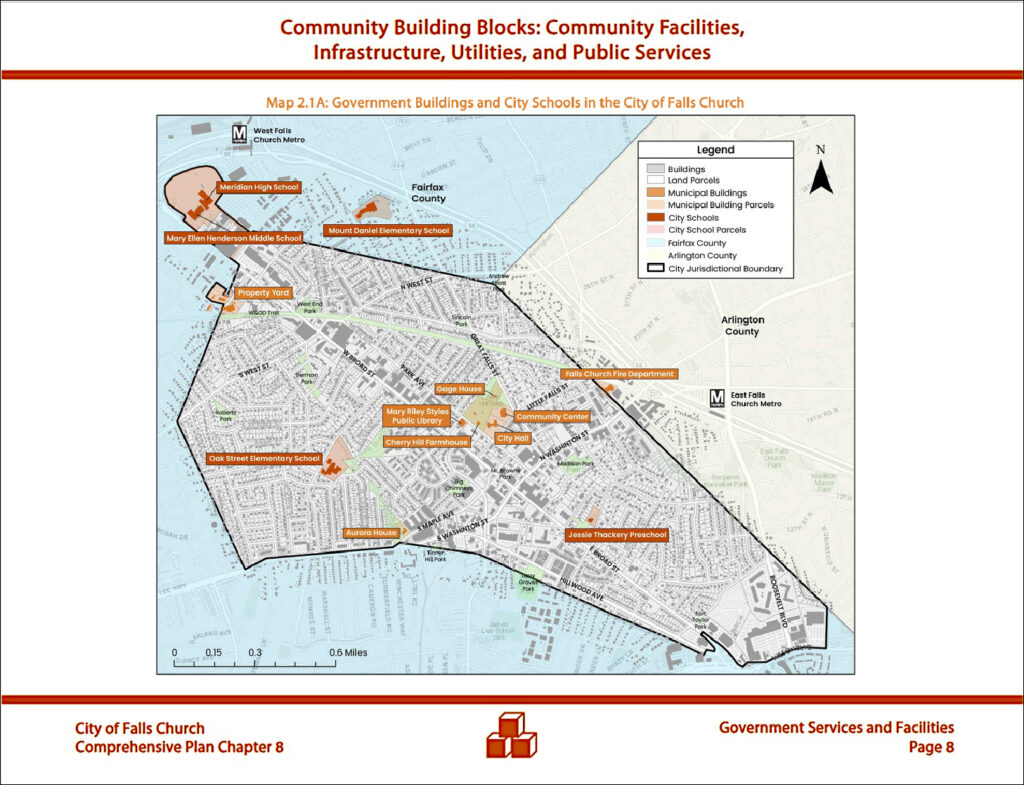
City staff list six priorities to achieve the goals of the proposed updated utilities/facilities plan. They include:
- Developing a Sanitary Sewer Master Plan, a Stormwater Sewer Master Plan, and a facilities maintenance manual, and reviewing existing facility master plans and updating or developing new ones as needed.
- Leasing additional office space to relieve short-term pressure on City workspaces that are at capacity.
- Compiling a Functional Needs Inventory for all City facilities.
- Conducting a study to provide detailed workforce projections and corresponding spatial needs.
- Working with an independent consultant to develop a plan for government facilities based on workforce projections and the Functional Needs Inventory with a focus on the Property Yard, Public Safety Facilities, and the Falls Church Hypothermia Shelter.
- Analyzing the service costs associated with major developments.
The plan also emphasizes conducting regular energy and security audits of civic facilities, continuing investments in green building practices, and exploring technologies that can enhance public services.
An urgent need for more appropriate workspace
“This document is pretty sobering in terms of the needs across facilities for the growth we’ve taken on and expect,” said Council Member Erin Flynn, following Ms. Larive’s presentation of the utilities/facilities plan to the City Council at its September 2, 2025, work session.
Council members expressed concern that the draft plan calls for leasing additional office space when City Hall reopened following a major renovation just six years ago. Mayor Letty Hardi said she would like to know the growth plans for the workforce by department before discussing short-term office leases. “When we embarked on renovating City Hall, we committed to it lasting for the period of the debt,” she said, reflecting the sentiment throughout the Council.
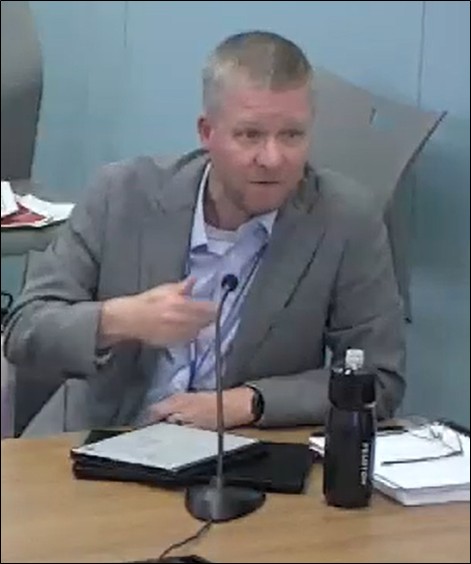
In response, Deputy City Manager Andy Young said the needs for a functional, collaborative workforce must be met sooner than the eight to ten years comprehensive planning and construction would take. City Manager Wyatt Shields reiterated during the Council’s September 8, 2025, regular meeting that “we may need to come to Council in the next 12 months with the need to lease space,” describing the requirement as “an issue of some urgency.”
Ms. Hardi replied, “All I’m saying is you need to make the case…we haven’t seen the case” for additional office space sooner rather than later. She asked that the roadmap the revised utilities/facilities chapter proposes add a “by when” column for the date by which future needs must be met. “Everything needs more work and more debt than we can afford,” Ms. Hardi said.
Support for master plans
The City Council supported several aspects of the plan, such as additional safety and security measures at the Community Center, and questioned others, like the addition to recreational facilities of an aquatic center unless a creative solution to funding, constructing, and staffing a pool can be found. All supported the creation of master plans for the sanitary sewer and stormwater sewer systems and agreed that the final report of the Urban Land Institute-Technical Assistance Panel (ULI-TAP) on the redevelopment of the Gordon Road Triangle inform the revision of this Comprehensive Plan chapter. [See the Pulse post City Discusses Final ULI Report, Plans Next Steps to Redevelop 15-acre Gordon Road Triangle, October 9, 2025.]
The draft utilities/facilities chapter provided a starting point for Council Member David Snyder to ask about solving the lack of a redundant power supply at City Hall and the status of adequate water pressure throughout the City for fire suppression. Council Member Laura Downs expressed support for housing all public safety personnel and functions in a centralized facility.
Advancing climate goals
Council Member Marybeth Connelly recommended that the approved Government Energy Action Plan be referenced throughout the document. Mr. Snyder asked that the plan address “what third-party utilities are doing to advance our climate goals.” In response to Ms. Connelly’s comment that “telecom wires are looped everywhere” throughout the City and “look just awful,” Mr. Shields said the staff are “working to hold companies accountable when they have their wires in the right of way.”
Noting that the City’s report card on what mixed use developments have brought to Falls Church is due to be updated this year, Ms. Flynn urged the staff to “verify that costs are being taken into consideration in the modeling we do” to anticipate the revenues and expenses these developments generate. [For more information on the biennial report card, see the Pulse post Falls Church City Mixed Use Development Projects, October 31, 2023.]
Community engagement beyond pop ups
Mr. Snyder also requested that rather than pop-up presentations at the Farmer’s Market and the Community Center to inform the public about long-term plans for City facilities and utilities, more formal townhalls be held where citizens can voice their opinions and have them recorded. Ms. Flynn suggested that along with the Community Center, Mary Riley Styles Public Library be used to host a community briefing since both locations are among the facilities covered in the plan.
At its September 8 meeting, the City Council voted unanimously to refer the draft utilities/facilities chapter to the Planning Commission for its recommendations and sought additional comments from the Public Utilities Commission (PUC), the Environmental Sustainability Council (ESC), Human Services Advisory Council (HSAC), and the School Board.
Planning Commission and PUC comments
At their joint work session on September 17, 2025, the Planning and Public Utilities Commissions also affirmed the call for sewer and stormwater master plans. PUC Chair Daniel Kirk said that in addition to accommodating growth, “the age of both systems requires maintenance and investment.”
Planning Commissioner Brent Krasner suggested that with regard to the sanitary sewer system, the staff acknowledge in the chapter those areas of the City that have had problems with sewer backflows “to show they are on the City’s radar screen.” He also urged additional work with telecommunications franchises to remove superfluous poles around the City, as did Commissioner Robert Kravinsky. Mr. Kravinsky further advocated for undergrounding all utilities. [See the Pulse post Dominion Energy Projects to Underground Power Lines and the Persistency of Utility Poles, July 7, 2025.]
Mr. Kravinsky echoed the City Council’s concern about the need for additional office space when City Hall was so recently renovated, asking “what did we get wrong?” Mr. Young responded that Council was clear in the need for the staff to present the data and make the case for short-term leases. Mr. Kravinsky also noted the major investment and footprint an aquatic center would require. Planner Larive called the pool “a want rather than a priority need” and indicated a public-private partnership model might be a way to develop such a resource.
Commissioner Philip Duncan suggested adding the Citizens Advisory Committee on Transportation (CACT) to the boards and commissions being asked for input on the draft utilities/facilities chapter and urged that pop-up events be held in the community rooms of some of the City’s multifamily buildings.
Investments needed due to growth or age?
Further, “in communicating this effort to the citizenry…are we having to do all the things [listed in this chapter] because of growth or because of the age of our infrastructure?” Mr. Duncan asked. Planning Director Matt Mattauszek noted that there are “improvements that density and growth can bring to infrastructure” and that the staff would “evolve the narrative” in its next draft of the utilities/facilities chapter.
Commissioner Sharon Friedlander described the chapter as “an incredible lift” for the staff. She also found that “some of [the draft] is really painful to read and almost embarrassing that some of our facilities have gone into such disrepair.” She expressed particular concern about the Emergency Operations Center, which “isn’t up to code” and “doesn’t have a generator.” Ms. Friedlander suggested that as a result, “we may need to accelerate” the development of a new Property Yard, bringing it forward in the next Capital Improvements Program (CIP). She also recommended that the City evaluate whether the Falls Church Homeless Shelter should be opened during hot as well as cold weather.
Planning Commission Vice Chair Tim Stevens urged that the master plan for stormwater move the City toward requiring developers to meet stormwater requirements not just on site, but also downstream. He asked the staff to emphasize the utilities/facilities chapter’s ties to the Government Energy Action Plan and to revive the City’s stormwater credit program that encourages citizens to implement green infrastructure on their properties.
Next steps
When the Council voted to refer the draft utilities/facilities chapter to the Planning Commission, members also approved the scheduling of a public hearing on the update for February 23, 2026. Meantime, the staff plans to gather feedback from boards and commissions, City employees, and the community in October and November and to incorporate what they learn in a second draft by the end of 2025. The staff’s goal is adoption of the updated utilities/facilities chapter by next March. The City webpage about this chapter can be found here.
References
- Planning Commission Meeting, September 17, 2025. This official video will not display properly on a small screen as it includes the agenda. Discussion of the revised utilities/facilities Chapter 8 of the Comprehensive Plan begins at timestamp 0:06:43 and ends at timestamp 1:06:30.
- Planning Commission Meeting, September 17, 2025. YouTube video.
- City Council Meeting, September 8, 2025. This official video will not display properly on a small screen as it includes the agenda. Discussion of the resolution to refer the revised utilities/facilities Chapter 8 of the Comprehensive Plan to the Planning Commission and other boards and begins at timestamp 3:00:37 and ends at timestamp 3:20:40.
- City Council Meeting, September 8, 2025. YouTube video.
- Resolution to Initiate an Amendment to the City of Falls Church 2005 Comprehensive Plan to Update Chapter 8, “Community Building Blocks: Community Facilities, Infrastructure, Utilities, and Public Services,” September 8, 2025.
- City Council Work Session, September 2, 2025. This official video will not display properly on a small screen as it includes the agenda. Discussion of the revised utilities/facilities Chapter 8 of the Comprehensive Plan begins at timestamp 0:01:20 and ends at timestamp 2:06:54.
- City Council Work Session, September 2, 2025. YouTube video.
- Staff Report and Resolution, September 2, 2025.
- Community Building Blocks: Community Facilities, Infrastructure, Utilities, and Public Services Chapter of the City’s Comprehensive Plan, August 2025 DRAFT.