New Tree Canopy Ordinance is Limited to 10%, But City Policy Can Go Higher
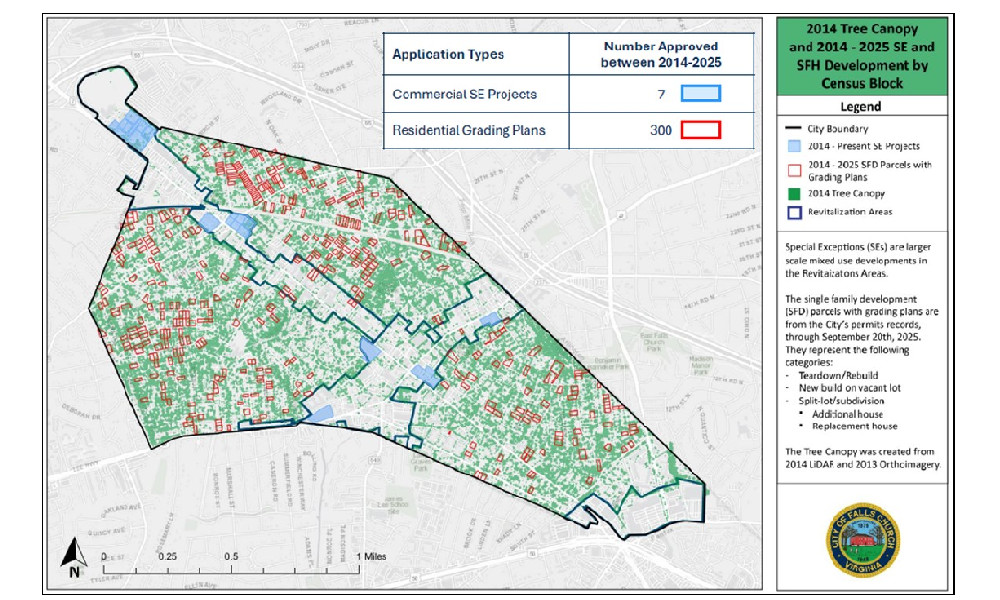
Image: 2014 Tree Canopy and areas impacted by redevelopment from 2014-2025. Source: Staff Presentation, November 17, 2025.
Summary
City Council voted (6-1) to update its tree canopy requirements for non-residential lots, including 10% minimum coverage, the highest allowed under State code. Yet, Alexandria, Arlington County, and Fairfax County have been able to specify higher limits using biodiversity code and policy tools. Staff recommend that the City take similar steps following approval of the new ordinance. Both will strengthen staff’s position when negotiating with developers about trees.
The tree canopy ordinance is the first time that street trees cannot be included for canopy credits. This only applies to the commercial districts, zoned B-1, B-2, B-3, T-2, O-D, and M districts, and transition zone (T-Zone), T-1, for non-residential uses only. They can still be included for residential lots and residential use of T-1 lots, such as the Park Avenue townhome developments.
The City does not track its tree canopy but relies on regional datasets and programs. One source, the Chesapeake Tree Network (CTN), estimates that the tree canopy coverage for the City is 41%, down from 46% in 2014 as per US Forest Service data available at that time. This decrease includes a net loss of 10 acres of tree cover on developed lands (the size of the West Falls development) from 2014 to 2021.
Background
The new tree canopy ordinance was first presented to City Council at the November 5, 2025, work session and covered in the Pulse post Increasing the City’s Tree Canopy, November 12, 2025. This post describes subsequent discussions at City Council meetings on November 17, 2025, and February 2 and February 9, 2026.
Protecting our diminishing tree canopy
Falls Church has flaunted its credentials as a Tree City USA since 1979. But for the last 25 years, whenever there has been a tussle between development and environmental conservation, development has won almost every time. (Fellows Park is one notable exception.) The outcome is the rapid deforestation of the City that has dramatically changed its character from a leafy village to an urban metropolis.
Staff have said that the “lack of prescribed regulations often led to difficult negotiations with developers.” The tree canopy ordinance is intended to strengthen staff’s position in future site plan applications for non-residential commercial sites.
Excluding street tree canopy from the calculation of canopy and requiring all trees to be within the property lines should further encourage developments to provide more greenspace. This critical change has long been advocated by the Urban Forestry Commission and needs to be extended to the residential zoning code.
City’s tree canopy ordinance is limited by State code
The City’s tree canopy ordinance has been crafted to comply with Virginia Code. This ordinance applies to commercial districts, zoned B-1, B-2, B-3, T-2, O-D, and M districts, and will be administered through the commercial site plan review process. For transition zones, T-1, also called T-Zones, the ordinance will apply if the use is non-residential. (For residential uses, the T-Zone ordinance has a similar 10-15% canopy requirement but allows the inclusion of adjacent street trees in the calculation.)
The key provisions of the new ordinance are:
- 10% minimum canopy coverage in 20 years with all plantings to be within the property lines, i.e. not including street trees planted in the City’s right-of-way. Trees must be listed on the City’s “Urban Forestry Site Plan Guide.”
- 25% bonus canopy for preserving a healthy native tree on-site. State code requires incentives to preserve existing trees.
- $2,000 fee per 250 sq ft canopy in lieu of achieving canopy requirement. State code requires that the City allow a reduction to this requirement in case of non-financial “hardship”. Council Member Arthur Agin pushed for a much higher fee that would dissuade applicants from opting for the hardship waiver. Staff said the fee reflected the cost of planting and maintaining a tree elsewhere in the City. A Tree Canopy Fund would be established with these funds.
Neighboring jurisdictions have tougher standards
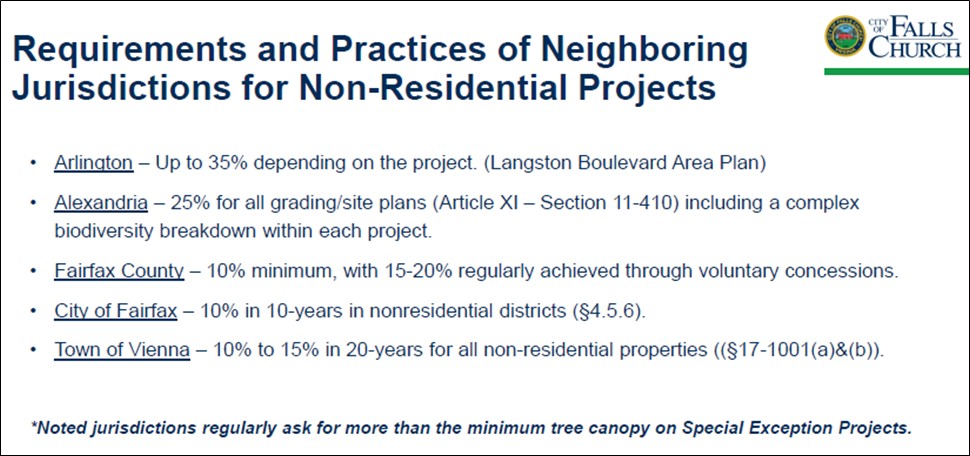
Staff’s research on the codes and policies of neighboring jurisdictions showed that their minimum canopy standards were higher than what was proposed in this ordinance. They were able to achieve this through other mechanisms and policies outside of their zoning ordinances. For Special Exception projects like the large mixed-use projects recently built in the City, Fairfax County has achieved a 15-20% canopy through voluntary concessions. Arlington County has set a goal of 35% canopy for buildings over 7 stories and 20% for lower buildings in the Langston Boulevard commercial area. Alexandria specified 25% canopy elsewhere in its biodiversity section code, and Fairfax City mandated that the 10% canopy must be reached in 10 instead of 20 years.
Staff see this zoning ordinance amendment as a first step. They recommend further exploring similar policy tools to yield a higher canopy coverage.
The City’s tree canopy is 49%, 40.5%, 39%, 34% or ?
The City does not have its own consistent verifiable analysis of what its tree canopy is currently. Staff have relied on datasets from various regional studies to provide estimates whenever they are available. Staff used iTree software to generate an estimated canopy of 49% in 2025, but this percentage does not appear supported by now available studies that assess the coverage to range anywhere from 34% to 41%. City Arborist Charles Prince believes the City’s tree canopy today is likely around 41% as per the analysis from the Chesapeake Tree Network.
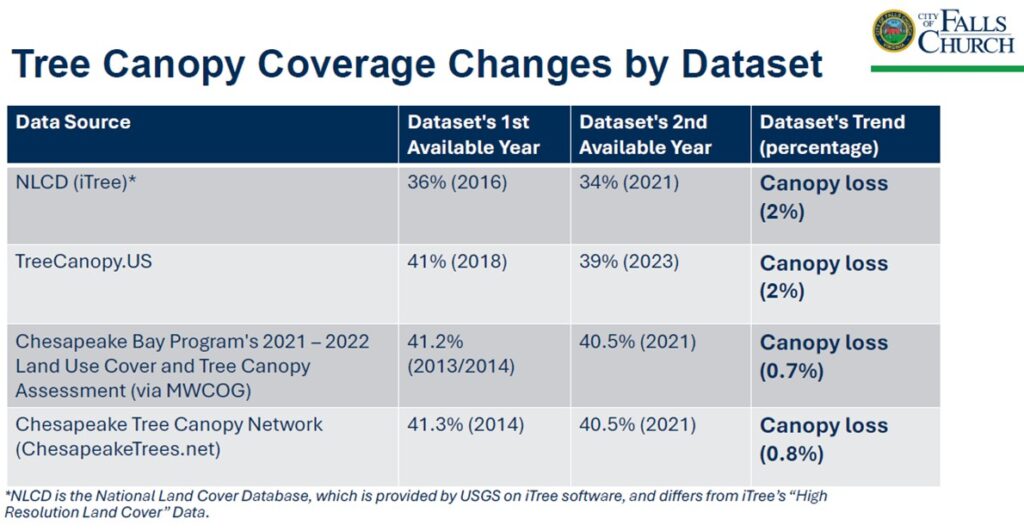
One consistent finding across all datasets is that there was significant canopy loss over a 5-7 year period even though these sources don’t agree on the exact amount. The 0.8% canopy loss recorded by the Chesapeake Tree Canopy Network is equivalent to 10 acres of canopy lost between 2014 and 2021. The TreeCanopy.US study estimates a loss of 28 acres in five years from 2018 to 2023.
The City’s residential areas account for 77% of its 2.2 square miles, but 92% of the City’s canopy in 2014. Subdivision, expansion, and rebuilding of detached single-family homes have led to much of the canopy loss. The large mixed-use projects have further exacerbated the problem.
City sets goal of 50% tree canopy
The City Comprehensive Plan’s Environment chapter lists protecting tree canopy and increasing overall tree coverage to 50% as a strategy for meeting its urban forest and biodiversity goal. Mayor Letty Hardi asked, “Is 50% even realistic or achievable for us?”
Planning Director Matt Mattauszek replied, “I think more broadly what your last point gets to is staff’s ability to effectively negotiate with the development community. If our goals are not as aggressive, if that isn’t reflected in all of our policy documents, small area plans, streetscape standards, and code, we can’t really even expect them to react in a way that helps us meet that [goal]. … I view it as something that helps me negotiate more effectively … The more we can highlight it, the more documents that it lives in, the more I think we actually have a chance [of] maybe getting something better.”
Passed first reading
On February 9, 2026, City Council voted 6-1 to approve the tree canopy ordinance. Mr. Agin dissented due to the low hardship fee. Second reading is scheduled for March 9, 2026.
Reference
- City Council Meeting, February 9, 2026. YouTube video.
- City Council Meeting, February 2, 2026. YouTube video.
- City Council Meeting, November 17, 2025. YouTube video.
- Tree Canopy Nov 17 Work Session Slides
- Tree Canopy Code Changes Staff Report , February 9, 2026.
- Urban Forestry webpage. Falls Church City government website.