Shared Mobility Devices Pilot Program Proposed
Summary
City staff have proposed reviving a 2019 pilot program to allow rented shared mobility devices such as e-scooters and e-bikes within the City. Today, an e-scooter or e-bike rented in neighboring jurisdictions cannot be ridden here. The dockless devices will cease to operate, and riders cannot terminate the trip, i.e. park, in the City.
Ending Falls Church City as a no-go area for shared mobility devices
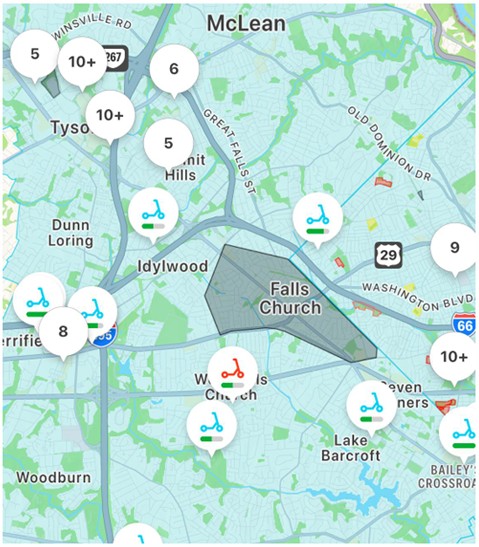
City staff have proposed reviving a 2019 pilot program to allow rented shared mobility devices such as e-scooters and e-bikes within the City. Such a program would permit riders to bring their devices into Falls Church. It would also allow companies that currently operate in neighboring jurisdictions to offer service within the City, enabling riders to end their rentals and leave their dockless devices here.
Today, an e-scooter or e-bike rented in jurisdictions where they are available cannot be ridden here.The City is a no-go area, as shown on the map found in the app of the e-scooter rental company Bird. If it crosses City boundaries, the device locks up or slows down dramatically, and the rider is not able to park, i.e. end their rental trip, in the City. These restrictions also apply to the W&OD section of Falls Church.
Background and motivation
In July 2019, the Virginia General Assembly allowed localities to regulate the use of motorized skateboards, scooters, and bicycles, also called shared mobility devices, for hire. The City started a year-long pilot program in December 2019 that both failed to attract any applications and was interrupted by the COVID-19 pandemic.
Renewed interest from shared mobility companies prompted staff to propose that the City start a fresh pilot program in 2026. The City’s policies and strategic plans outlined in the Comprehensive Plan and Bicycle Master Plan also support expanding transportation choice and connectivity and promoting mode share. After discussions with the Environmental Sustainability Council (ESC) and the Citizens Advisory Committee on Transportation (CACT) in 2025, Environmental Planner Kurt Lawrence presented a proposal for a Shared Mobility Devices Pilot Program to City Council on February 2, 2026.
Shared Mobility Devices Pilot Program proposal
Staff based their proposal on the experience of Arlington and Fairfax counties, Fairfax City, and Alexandria in drafting their proposal. These four localities have allowed shared mobility devices since 2019. All but Fairfax County ran a pilot program for one to three years before passing ordinances to regulate these devices. Alexandria ran a second pilot that banned sidewalk riding after feedback from the first pilot. Fairfax City, where these devices are popular at George Mason University, extended their pilot because of COVID.
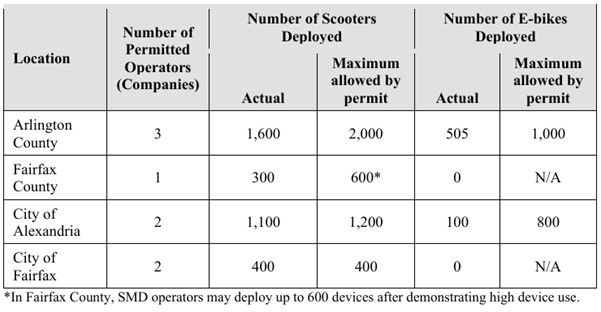
The companies operating in these localities are:
- Lime (Alexandria, Fairfax City, Arlington County)
- Bird (Fairfax County, Fairfax City, Arlington County
- Spin (Arlington County)
- GCOO (Alexandria)
In the proposed pilot, the City would issue 100 permits, one per device, and companies would be charged a permit fee of $5,000 to operate for 12 months. Any number of companies could apply for the permits, though staff expect that there will be one or two at most. Companies would also need to provide a cash bond of $2,500 for costs the City may incur if the company does not comply with the City’s requirements regarding moving and storing their devices. There would also be reporting and data sharing requirements.
The rules proposed for operating these devices in the City are as follows:
- Allowed on sidewalks. Riders of these motorized vehicles are required to observe a speed limit of 6 mph on the sidewalk. In contrast, Alexandria and Fairfax City do not allow e-scooters and e-bikes on sidewalks.
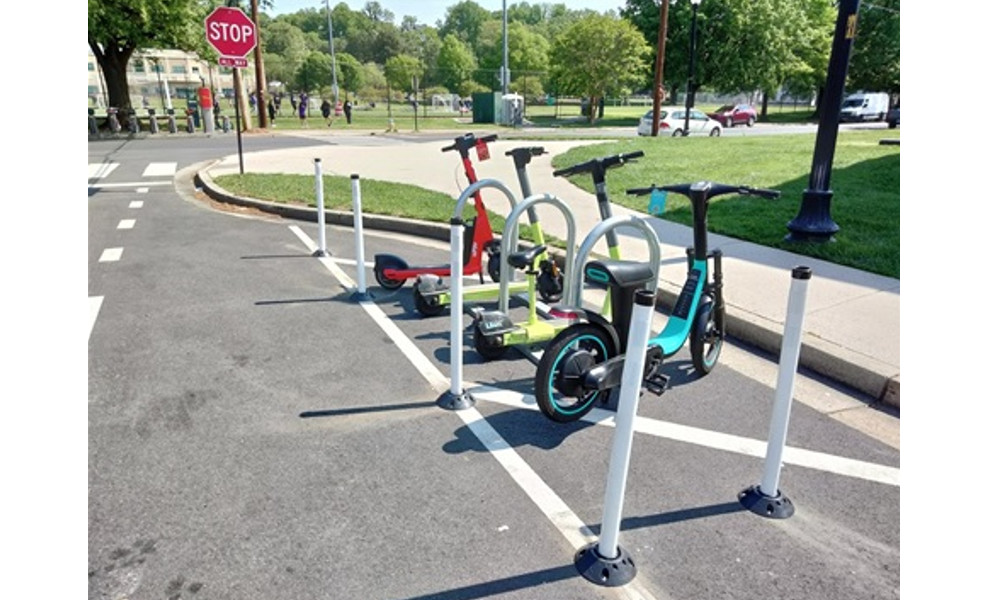
- Parking allowed on sidewalk. These devices may park but must not impede pedestrians and other traffic. Corrals may be provided by the City for parking e-scooters and e-bikes.
- Maximum speed limits. 20 mph for e-bikes, and 15 mph for e-scooters on the street; 6 mph on the sidewalk. (A casual walking speed is 2-3 mph.) Fairfax County has a 10-mph limit for e-scooters, other jurisdictions have a 15-mph limit. Signs may be posted to designate speed limits for certain roads, e.g. 6 mph for Old Town waterfront streets. Alexandria does not allow sidewalk riding.
- Safety features. Headlights, taillights, and speedometers are required.Helmets are encouraged. Only one rider is permitted per device.
- Minimum age of 16 years old for an independent rider. The company may also have their own age requirements. Lime, Bird, and Spin require all riders to be 18 or older.
- Equity Access. Companies are required to provide an option to access rides without the use of a smartphone. Instructions are to be provided in English and Spanish.
Staff plans to collect feedback from the community during the pilot program period.
Council discussion
Council Member Arthur Agin, who was the CACT chair until he was elected to the City Council, asked that e-bikes be limited to those that assist pedaling rather than the fully motorized bikes that middle- and high-school students have been using and that are not street legal. He asked about how the 100 devices would be managed.
Mr. Lawrence said that companies are required to place a certain number of devices in certain locations. Based on Arlington County’s experience, the companies have regularly redistributed devices and picked up devices that are not functioning. The City staff would contact companies about issues with their devices.
Mr. Agin asked about data on impaired riders. Mr. Lawrence said that the data show accidents tend to happen on Friday nights, which may indicate that riders were impaired. Research does suggest that alcohol is a factor in crashes.
Mr. Lawrence said that certain areas in the City could be restricted using geofencing, a feature that uses GPS data to create virtual boundaries on a map and that could trigger an alert or disable the device when it crosses into them. However, Mr. Lawrence added he would need to research whether geofencing could be applied temporarily or at regular periods such as every Saturday morning for the Farmers Market area.
Council Members Marybeth Connelly and David Snyder brought up concerns raised in the past by many in the community about the hazards of pedestrians sharing the sidewalk with e-scooters and e-bikes. Mr. Snyder worried about adding yet another set of users to the narrow City sidewalks studded with utility poles. Council Member Erin Flynn noted the difficulty of enforcing the sidewalk speed limit.
Mr. Lawrence said the companies could provide reminders about the speed limits on their apps, such as pop-ups, and that riders usually prefer to ride on the roadways anyway because it is a smoother ride. “One of the benefits of the City is that the speed limits are 20 mph in a lot of the City, so that makes the difference between scooter and cars pretty friendly for the scooter riders,” he said.
Council Member Justine Underhill said that she rides her e-bicycle on the sidewalk in many parts of the City because she does not feel safe on the roadway, adding that she rides at about 4 mph. She hopes that other riders would be as mindful of pedestrians.
Mayor Letty Hardi said she hopes permitting these devices will bring more people to businesses in the City. In particular, she hopes they would make the Eden Center more accessible to people coming to Falls Church by Metro.
Next steps
Mr. Lawrence said he would like to get the pilot program started in the first quarter of 2026 and listed the following dates for board and commission and further Council consideration:
- February 11, 2026, Citizens Advisory Council on Transportation
- February 19, 2026, Environmental Sustainability Council
- March 2, 2026, City Council work session
- March 9, 2026, City Council action
- April 2026: Demonstration project open for operator applications
References
- City Council Work Session, February 2, 2026. YouTube video.
- City Council Work Session, February 2, 2026. This official video will not display properly on a small screen as it contains the agenda.
- Shared Mobility Devices Staff Report, February 2, 2026.
- Shared Mobility Presentation, February 2, 2026.