Solid Waste Task Force Works on a Fee-Based Trash Collection Service
Summary
The Solid Waste Task Force has had three meetings to recommend a fee structure for the 3,107 homeowners who receive curbside solid waste collection. The final meeting is on July 21, 2025. The group will present their recommendations to the City Council at its August 4 meeting.
The group of nine includes three residents – owners of a detached single-family home, a townhome, and a condominium – to represent the interests of various homeowners.
Real estate property owners, commercial and condominiums, who currently do not use the City’s curbside collection service will receive a reduction in their tax payments to the City. Homeowners who currently receive services will also receive a tax reduction, but they will be charged a trash collection fee on their tax bill. Their net payments to the City will likely increase.
The group leaned toward excluding the cost of leaf collection from the fees, but including the cost of contractors, administration, and subsidizing the City’s food waste composting program. Providing a third organics bin is also being considered for inclusion in the fees, replacing the composting program.
Options are being evaluated for their net financial impact on homeowners as well as their potential to motivate residents to divert waste from the general waste stream to compost.
The task force examined the pros and cons of a flat rate fee structure versus a variable rate fee for two bin sizes. The latter can reduce the financial impact if a smaller solid waste bin is chosen.
Homeowners will not be able to opt out of the trash fees. Seniors who are currently receiving real estate tax relief will also likely be exempted from this fee.
Background
In 2024, staff were asked to present options to respond to condominium owners who say that their taxes are paying for a service they do not receive from the City, i.e. curbside solid waste collection. One option was to pay for this service through a fee imposed on users only.
During budget discussions earlier this year, a majority of Council members asked staff for a plan to implement a fee-based trash collection service for the 3,107 properties that receive curbside collection. Furthermore, this plan is to be implemented in FY2026, starting July 1, 2025, and included in the November real estate tax bill. The discussions are summarized in the Pulse post, Update: City Manager Proposes 3-Month Study of Fee-Based Trash Service, May 2, 2025.
City Manager Wyatt Shields proposed convening a Solid Waste Task Force to recommend a fee structure and possibly policy changes. Their report will be presented at the August 4, 2025, City Council meeting, when a decision is expected, in time for the fee’s inclusion in the first FY2026 real estate bill.
This post covers three of the four scheduled meetings of the Solid Waste Task Force. The task force members have discussed options, but no decisions have been made.
The Solid Waste Task Force
Deputy City Manager Andy Young leads the Solid Waste Task Force. Other staff members are Solid Waste Coordinator Lonnie Marquetti, three members of the Treasurer’s office that will be involved in the new billing process, Communications Director Mary Catherine Chase, and Deputy Finance Director Melissa Ryman.
The task force also includes three members of the community – Gabriella Abruzzi who owns a house in the City, Diane Bartley who owns a townhome, and Fred Thompson who owns a condominium. (Most condominiums have their own trash collection service and will not pay the City trash collection fee.)
Why the rush to implement in FY2026?
Staff had asked the City Council to delay the implementation of a solid waste tax until 2027, but Mayor Letty Hardi and other Council members pushed for immediate implementation. The stated plan is to make this change revenue neutral. Real estate tax rates for all City properties will decrease by the same amount that the new fees generate, so overall City revenue remains unchanged.
City staff expect the next year or two to be financially difficult ones because of the local economy and a possible slowdown in the increase in real estate values that have buoyed Falls Church’s coffers. Furthermore, the West Falls project is entering a lean period when there are no lease payments and the real estate taxes are not generating maximum income, while student enrollments are expected to increase from the new developments in the City.
At the April 7, 2025, City Council meeting, Ms. Hardi said, “So, if we don’t expect future tax rate cuts, making this change is that much harder because you don’t have the first 2.5 cents to help make it easier… That’s why I think the timing matters…”
In other words, a tax reduction to offset the fees may go unnoticed by residents if there is an overall tax rate increase next year. The City Council has already approved a 1-cent decrease in the tax rate in FY2026. Implementation this year would further decrease the rate by an estimated 1.5 cents, a total of 2.5 cents.
Who will pay solid waste collection fees?
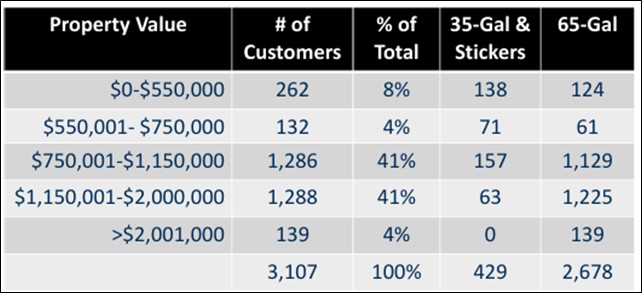
3,107 properties in Falls Church receive the City’s curbside collection service. These properties will now be charged a fee for that service. The table below shows the distributions of assessment values for these properties and the sizes of the bins used for regular trash.
Scant public feedback
To date there have been only 10 emails and comments submitted to the task force, according to the staff. Four are against moving to a fee-based system, two are in support, one would like to get rid of the yellow stickers, one suggested fees based on assessed value or floor area, and two emails retrieved from SPAM will be revealed at the 4th meeting. (Emails are verbally summarized by staff at the meetings and not made public, as has been the case in past City discussions.)
Residents on the task force have heard directly from friends and neighbors. At the July 9, 2025 meeting, one task force member said a neighbor had suggested putting the fee issue to a vote. “It sounds like the government has made their decision, and now we’re just kind of trying to figure out how we charge people and that doesn’t seem very democratic, is what this person told me.” She noted that the issue may have been around for 20 years, but has only appeared before the public in the last four months.
Can someone opt out of trash collection to avoid the fee?
NO. This fee will be included in the real estate tax bill regardless of whether a homeowner decides to take a bin. As City Treasurer Jody Acosta explained at the first meeting, the ordinance would be set up like the stormwater fees where payment submitted by a taxpayer is first applied to the stormwater fees and any subsequent fees before the real estate taxes are paid. Therefore, any shortfall would be regarded as unpaid real estate taxes and so would constitute a de facto lien against the property.
Comparison to neighboring jurisdictions
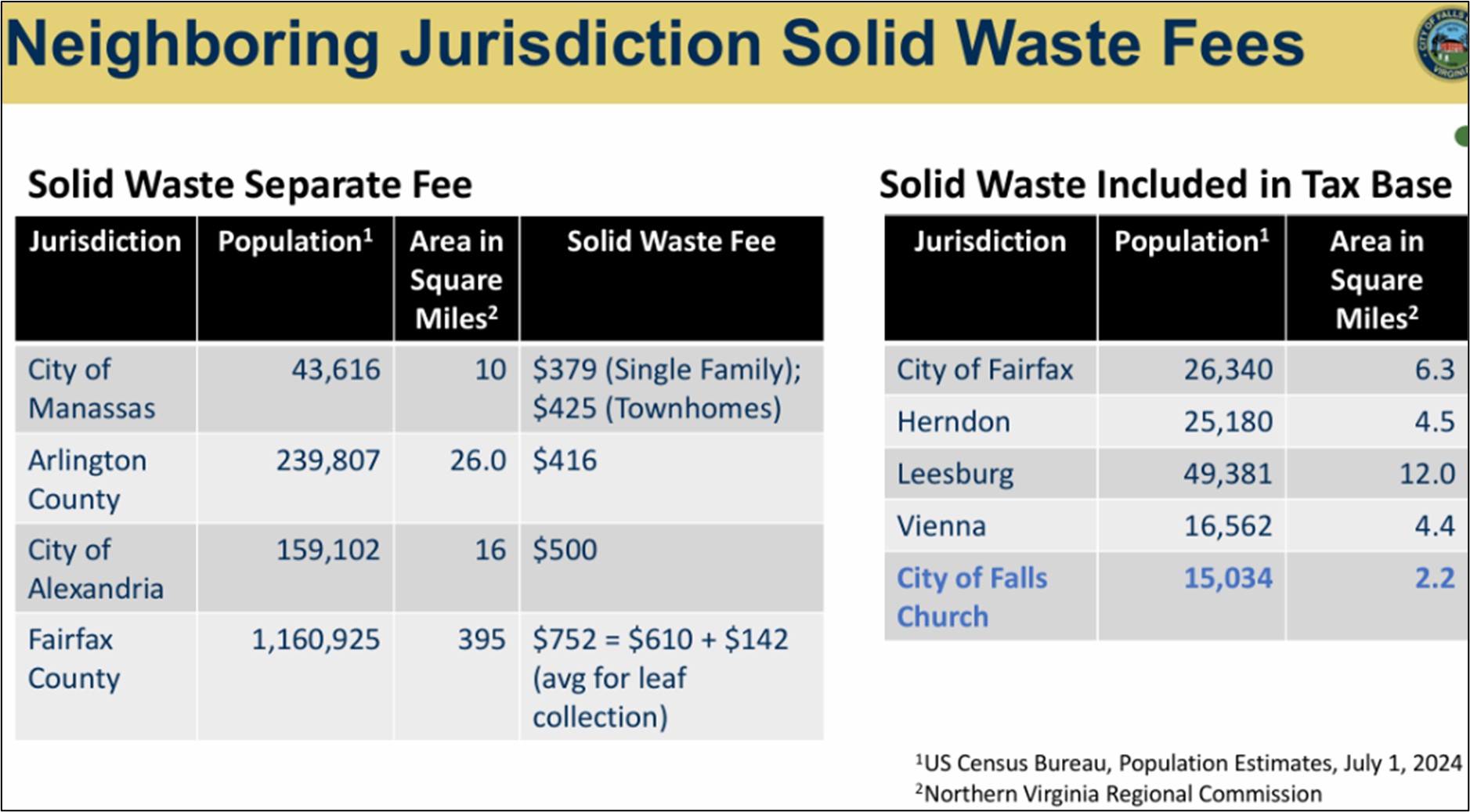
The City is the smallest in population and area among the Northern Virginia jurisdictions in the chart below. Today, the jurisdictions that collect a separate fee are the larger entities in both area and population.
Which solid waste costs to include in the fees?
Staff presented three options for the City’s solid waste annual costs that should be covered by the fees, as shown in the table below. Option I includes only the cost of the contracts for curbside collection. Option II includes the administrative costs incurred by the City. Option III includes the cost of the fall leaf collection.
The fees collected will cover the costs of the chosen option, and the City’s real estate tax collection will be reduced by the equivalent amount through a reduction in the real estate tax rate. The bottom line of the table shows the equivalent real estate tax rate reductions.

Fee-payers to bear the cost of subsidizing the City’s food waste composting program.
The City has a composting program that includes curbside food waste collection where households can opt-in for $96/year or $180/year, depending on bin size. (The City also has compost bins in the City Hall parking lot where residents can drop off food waste for free.) This program is subsidized by the City at a cost of $90,000 a year. Currently, 580 households have opted in. The plans assume this program continues, but the subsidy is paid by all 3,107 households regardless of whether they opt-in.
Is leaf collection a City benefit or a fee-payer benefit?
Some members thought leaf collection should be paid from general taxes, not fees, as it is a City-wide service covering all streets, City right-of-way, easements and public areas. Leaf collection also prevents leaves from blocking storm drains and affects the entire City. However, Diane Bartley pointed out that her homeowner’s association pays for leaf service so that would be a similar case of condo owners paying for another service they do not receive.
Include an organics bin in the cost?
The task force was asked to consider the inclusion of an organics bin for food waste and brush (yard waste). The goal is to divert more food waste from the general refuse stream to compost. Tipping fees for compost are half that of general refuse, and it is also more environmentally friendly.
This bin would replace the current composting program for $141,000. The present $90,000 composting subsidy cost could be diverted to partially cover this new program. Nonetheless, adding the third bin raises the cost of all three options by $51,000. Households would no longer pay the opt-in composting fee.
Adam Riedel, Manager of Arlington County’s Environmental Management Office, joined the task force’s third meeting on July 9 to share Arlington’s experience with providing an organics bin for their 33,300 households. Arlington periodically collects data on the contents of people’s bins. He said that people have been good at observing the ban on yard waste in the general waste bins. However, Arlington has not been able to get the food waste composting participation to rise beyond 20-25% of households despite many campaigns. He put it down to the “ick-factor” associated with throwing food into an unlined bin, with smells especially strong in the summer.
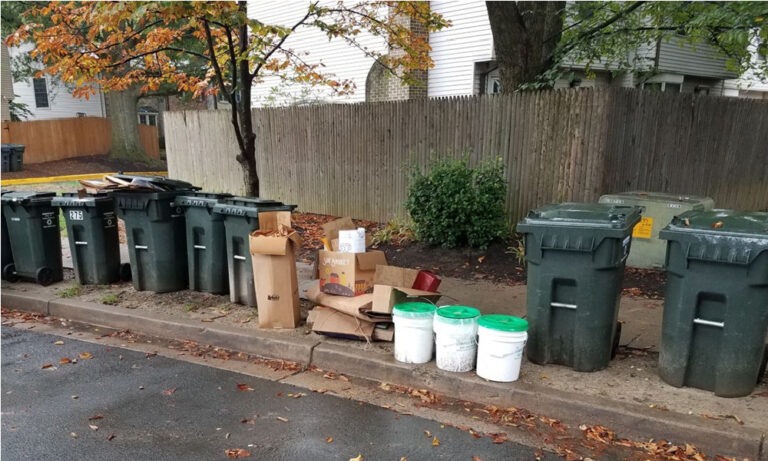
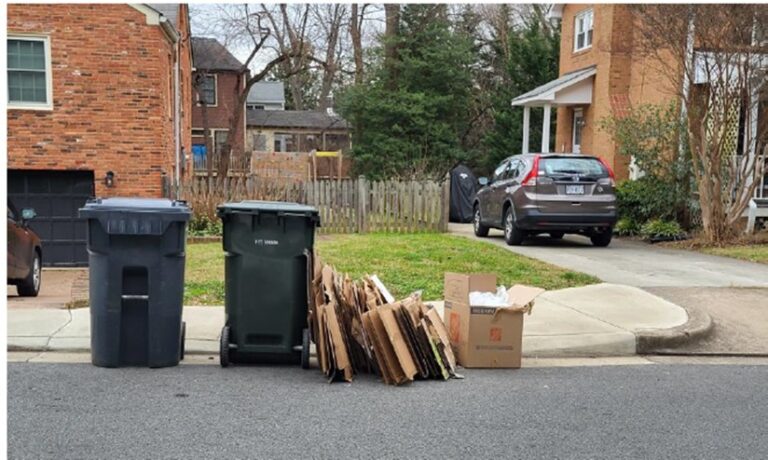
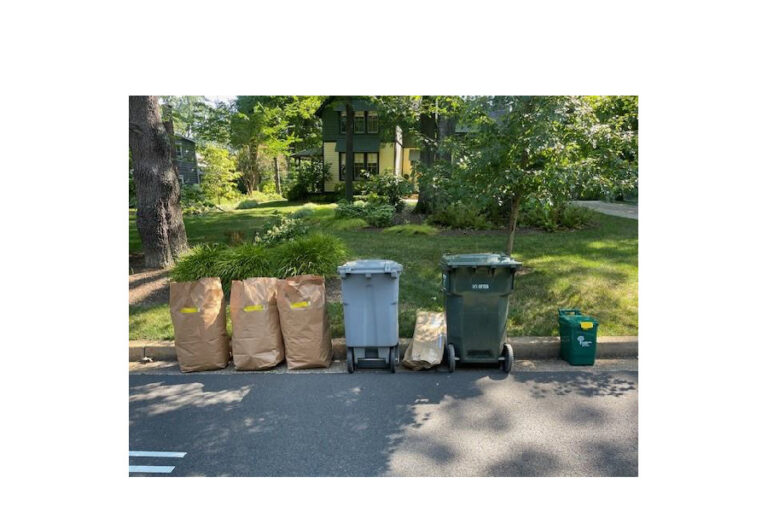
Falls Church residents are also not allowed to put yard waste in the trash bins. Today, yard waste can be put into large containers such as store-bought trash cans or paper bags for pickup. Brush can be bundled with string or put into bags. Bags must have the $1 yellow stickers to be collected but none are needed for brush in containers. The City’s food waste composting participation is 19%.
Flat- or variable-rate fee?
The task force must also recommend how the total cost will be apportioned among the 3,107 properties. Main factors being considered are:
- The net impact on households, i.e. the net increase in payments to the City by homeowners. The fee is offset by the real estate tax reduction to determine the net impact.
- Incentivizing residents to reduce the quantity of waste going to the general waste stream, for example, by diverting food waste to the compost stream.
One challenge the group and the City Council struggled with was that the fee-based structures considered would likely have the greatest net fiscal impact on homeowners with the smallest properties.
The flat-rate fee option:

The total cost would be divided equally among the 3,107 properties. For example, in option II with an organics bin, the total $1.2 million cost would be covered by imposing an annual fee of $385 for each household. For a property assessed at $550,000, the homeowner’s $385 fee would be offset by tax savings from the reduction in the City’s tax rate. This is a reduction of 1.8 cents to be revenue neutral. This property would save $99 in real estate taxes to offset the fee; the net impact is that the homeowner would have to pay $286 more to the City under this approach.
The table shows the net impact of the flat fee approach on five properties of different values. As is shown, lower-valued properties experience a disproportionately higher net impact. Owners of the largest properties stand to benefit from this approach.
The variable rate fee option:

To address the larger cost burden on smaller properties, variable rate options were considered. A lower fee would be charged for a smaller 35-gallon bin, more popular with smaller properties. City Attorney Sally Gillette cautioned against the use of assessed values or floor areas as the rationale for differentiating fees for legal reasons.
Staff proposed two variable rate approaches based on the size of the general waste bins, but the group showed a preference for a scheme that greatly differentiated the fees for the bins. 35-gallon bin users would be charged $256 and 65-gallon bin users would be charged $406. The sample net impact calculations for homeowners under this scheme are shown in the table. Homeowners can reduce their net impact by choosing smaller bins.
Relief for low-income senior homeowners
The task force also discussed relief for seniors who currently receive real estate tax relief, currently 29 residents. Staff recommended that they be granted relief from trash fees. It was not clear if their fees would be covered by higher fees on the remaining homeowners or by general taxes.
Next steps
The Solid Waste Task Force has a fourth public meeting on July 21, 2025. Their recommendations will be presented to the City Council at its August 4 meeting. City Council will need to decide on an approach to fee-based solid waste collection by the end of August or early September if the staff is to have time to implement the fee’s collection in this fall’s real estate tax billing cycle.
Reference
- Solid Waste Task Force webpage on the City’s website.
- Solid Waste Task Force Meeting #1, June 11, 2025.
- Solid Waste Task Force – Presentation 1
- Solid Waste Task Force Meeting #2, June 25, 2025.
- Solid Waste Task Force – Presentation 2
- Solid Waste Task Force Meeting #3, July 9, 2025.
- Solid Waste Task Force – Presentation 3