The Story Behind the Annual Falls Church Independence Day Remembrance
2025 Falls Church Independence Day Remembrance
Time: Noon, July 4th
Place: Falls Church Episcopal historic chapel
115 E Fairfax Street, Falls Church VA 22046
FREE and OPEN to ALL
By Keith Thurston
How the history of Falls Church is linked to the history of Virginia and the Nation
For a small community, Falls Church contains an unusual amount of history, not just local history, but also of Virginia and the Nation. We owe this fact to our proximity to the Potomac River and, later, to the Nation’s capital.
The first fortuitous event that blessed this place was the population growth during the colonial period, and with it the growth of the Anglican Church. It was decided that with the population expansion westward in Virginia, another church was needed “near the falls” of the Potomac River. Falls Church was located at the intersection of two Native American paths, one a trail to the Little Falls and the other the Great Ridge Trail from Alexandria toward the mountains (today’s Route 7).
The Virginia Colonial General Assembly established Truro Parish in 1732. The first new church to be built in the parish was a simple wood building erected on the site of the current Falls Church. Until that time, this area was served by clergymen who lived near present-day Quantico, Virginia, and the nearest church was Occoquan Church (Pohick) near Lorton, Virginia. George Washington, George Mason, and Lord Fairfax were at times on the vestry of The Falls Church.
Virginian documents formed the basis for the Declaration of Independence and the Bill of Rights
The Fairfax Resolves were written in 1774 by leaders of the area, including George Washington, at the Fairfax Court House, then located at Alexandria. The Resolves became a key foundation for George Mason in drafting the Virginia Declaration of Rights, which was adopted by the Virginia Constitutional Convention on June 12, 1776.
Thomas Jefferson then incorporated parts of the Virginia Declaration of Rights into the opening paragraphs of the Declaration of Independence. The Virginia Declaration of Rights was also widely copied by the other colonies and later became the basis for the Bill of Rights, the first 10 amendments to the US Constitution.
Virginians joined by the delegation from Massachusetts were key in drafting the founding documents for the new country.
A Declaration of Independence read to the people of Falls Church
On July 2nd, the Second Continental Congress voted to approve The Lee Resolution to secede. The Declaration of Independence was signed by 12 colonies on July 4, 1776; the New York delegation signatures were added after they gained authorization on July 15. Philip Livingston was the last to sign on August 2nd. Copies were printed by John Dunlap, distributed, and read to the people in the colonies – including from the steps of The Falls Church in September 1776. The church was also used as a recruiting station for soldiers to fight in the war for independence.
Commemorating Independence Day in Falls Church
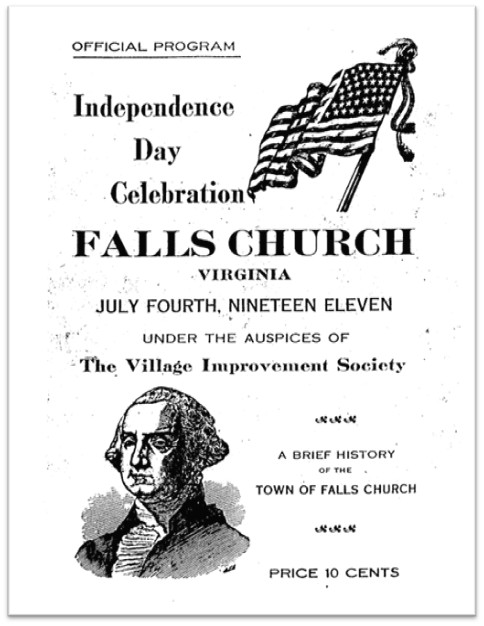
This rich history provided the basis for the Village Society to sponsor Independence Day Remembrances beginning with the founding of the Village Improvement Society in 1885, now called the Village Preservation and Improvement Society (VPIS). Artifacts show that the Society held ball games, ice cream socials, and a variety of other means of celebrating independence throughout the decades.
The current Independence Day Remembrance has been held on July 4th at 12 noon in a format first developed in 1984. Lou Olom and Susie Bachtel created the program, which highlights the sequence of events that led to the independence of America and the establishment of a living thriving democracy, with all its flaws, including public readings of our foundational documents. The program reveals the leadership of the founding fathers, especially Virginians, and the Falls Church connection to national events.
In the past, the event was held at City Hall and more recently at the Falls Church Episcopal’s historic chapel, the building that is part of this history. Over the years, the program has been led by Lou Olom, then Ross Netherton, Keith Thurston, David Snyder, Michael Connelly, and Mike Volpe, among others. We have also had visiting historians and others, each enlightening us with differing aspects that allow everyone to realize how committed and brave the founders of the country really were.
Each year, I walk out of the event feeling more hopeful and patriotic than I felt the day before.
Join us this July 4 for the Independence Day Remembrance
VPIS continues this tradition this year in the very building where the Declaration of Independence was read for the first time – the historic Falls Church Episcopal Church. This free hour-long event is open to the public and offers a unique experience to share in the public reading of these historic documents as a community.
The Independence Day Remembrance starts at 12 noon per the poster below.