New Portraits Unveiled in City Council Chambers Honor Carol DeLong and Frederick Foote, Jr.
Photo: New portraits unveiled at the City Council meeting on September 8, 2025.
Summary
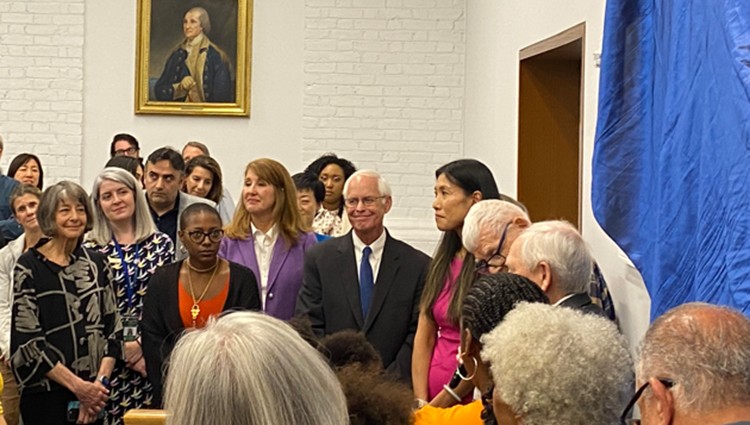
Artists Deborah Conn and Asia Anderson won commissions from the City of Falls Church to paint portraits of Carol DeLong and Frederick Foote, Jr., that now hang in City Council Chambers. The commissions were made in November 2024, and the finished works were unveiled at the City Council meeting on September 8, 2025.
The Pulse profiles Ms. DeLong, the first woman mayor of Falls Church, and Mr. Foote, the first African American Council member. We also reached out to the artists who provided additional perspectives on their work.
The artists received $6,000 each for their watercolor portraits, each 25 inches by 30 inches. The funds came from the $90,000 budgeted for the City’s 75th anniversary celebration.
Carol Witte DeLong (1930-2023)
Carol DeLong was a pioneering civic activist who dedicated more than 60 years to serving the City of Falls Church. She moved to Falls Church in 1960 with her husband, Chester DeLong. While raising three daughters, she quickly became involved in community affairs, holding such roles as Madison School PTA president and Planning Commissioner.
She was elected to the City Council in 1974 and served four terms. In 1980, she became the first woman to serve as mayor. She held that office until 1988 and remained a Council member until 1990. Ms. DeLong also had an impact regionally; she was instrumental in brokering compromise among the various jurisdictions in the Metropolitan Washington Council of Governments regarding transportation funding formulas.
Ms. DeLong advocated for women and affordable housing. She pushed for the Falls Church Housing Corporation to purchase 81 apartments at Winter Hill to preserve them as housing for lower-income elderly and people with disabilities. She fought for the establishment of Aurora House, a residential counseling center on S Maple Avenue for adolescent girls.
In 1999, Ms. DeLong was awarded the Mattie Gundry Award for “furthering the standing of women in the community” from the Falls Church Commission on Women. In 2021, she was one of the women honored at the inaugural Falls Church Women’s History Walk.
Her advocacy extended beyond government. She was a past president of the Citizens for a Better City and long-time member of the League of Women Voters of Falls Church and the Village Preservation and Improvement Society. Ms. DeLong passed away in 2023, at the age of 93. Former Council Member and current Planning Commissioner Phil Duncan is her son-in-law.
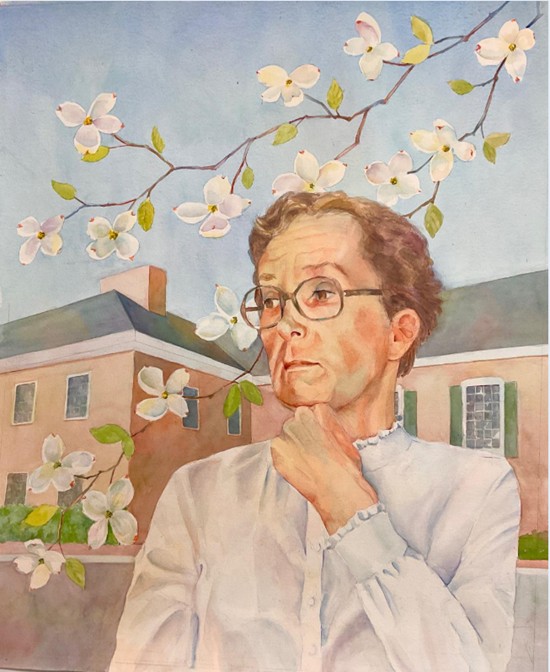
Artist Deborah Conn strove to portray the strength of Carol DeLong
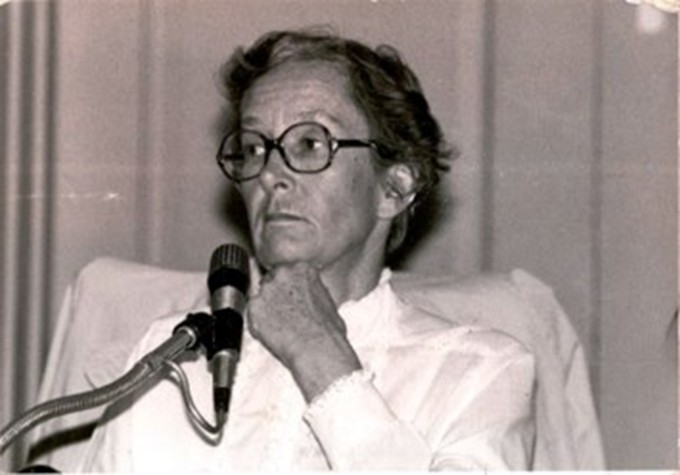
Deborah Conn worked from photographs, some professionally taken and others provided by staff. The DeLong family suggested that Ms. Conn base her painting on the photograph shown above and that she portray Carol’s connection to City Hall and her love of trees. Accordingly, City Hall and dogwood branches frame Ms. DeLong in the final portrait.
Ms. Conn said she had difficulty capturing Ms. De Long’s blouse from the photograph, so she bought a similar top and posed wearing it to capture this article of clothing in her painting. While she did not know Ms. DeLong, she said the photograph gave her the impression of a woman of strong character. It is this strength that she tried to convey in her painting.
Frederick Forrest Foote, Jr (1846 – 1889)
Frederick Foote, Jr, an African American cobbler and general store owner, was elected Town constable in 1875 when the village of Falls Church became a town. In 1880, he was elected the first African American Town Councilman. Foote’s electoral success was largely due to the fact that everyone knew him since his store was the largest in the area but also because of the large male African American population in Falls Church that was able to vote. The 1870 Falls Church census showed the town to be over 40% Black.
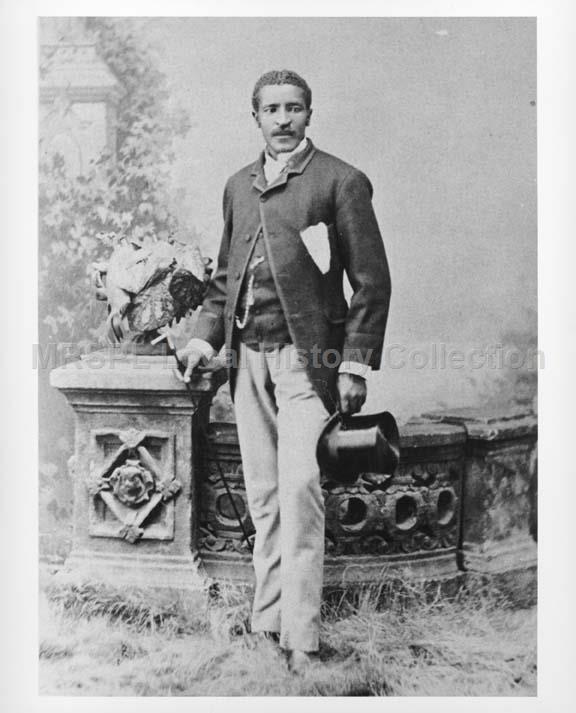
Unfortunately, Mr. Foote’s tenure as a Town Councilman was filled with contention and bitterness. He found himself in a hostile environment of constant marginalization. This was an era of retribution by Southerners because of the Confederacy’s loss of the Civil War and their sense of displacement by African Americans during the period of Reconstruction that followed.
In 1887, the majority of the Town Council voted to gerrymander out of the town the section where most of the African American population lived. One third of Falls Church was retroceded back to Fairfax County, which effectively meant that African Americans had no say in town matters.
Mr. Foote passed away suddenly in 1889 at the age of 43 while still a Falls Church Town Councilman. He left behind a wife, two children, and both his parents. His father was a slave, freed by the Emancipation Proclamation, who became a landowner of more than 28 acres at the east end of Falls Church, now Seven Corners.
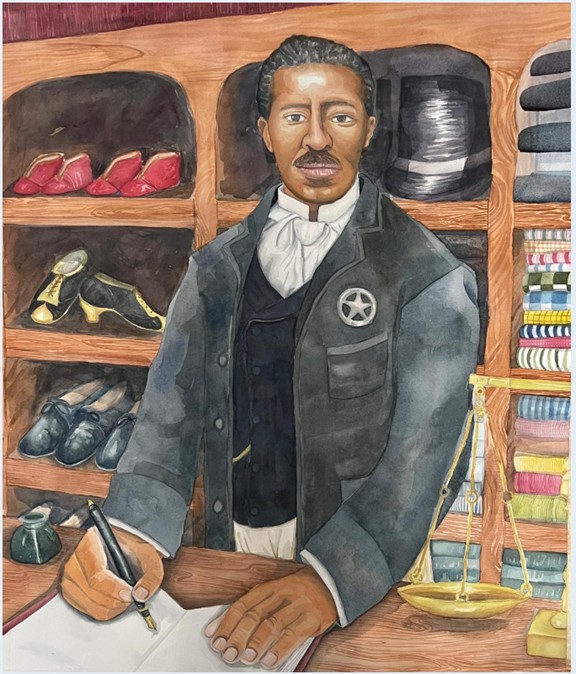
Artist Asia Anderson sought to convey the many facets of Frederick Foote
Asia Anderson said that she spent considerable effort searching for information about Frederick Foote, Jr. Ed Henderson’s post on the Falls Church Pulse, Falls Church’s Black History: A Welcoming Community That Has Not Always Been So Welcoming | Falls Church Pulse, became a source she relied upon to learn more about her subject. She wanted to understand who he was to the community. The general store was vital to communities during that time, and Black and White customers shopped there. As Town Constable, Mr. Foote also was responsible for some law enforcement.
The City staff provided Ms. Anderson with one black-and-white photo, shown above, which was too grainy for her work. She was only able to find one other photo of Mr. Foote and tried to determine his skin tone by researching how darker skin tones appeared in black-and-white images.
In composing the portrait, Ms. Anderson wanted to convey who Mr. Foote was as a person, keeping to elements that were true to him. She placed him in a general store setting of that era with shoes for men, women, and children on the shelves in a nod to his skills as a cobbler and the wider community he served.
In her painting, Mr. Foote is wearing the jacket seen in the photo and a Town Constable’s badge and is writing in his store’s ledger. His posture is that of an important man. Behind him is his top hat from the photo. To his left are the scales that might have been in his store and that also serve as a symbol of justice.
Ms. Anderson said of her work, “[This project] was a lot of fun!”
References
- City Council meeting, September 8, 2025. This official video will not display properly on a small screen as it includes the agenda. The unveiling of the portraits begins at timestamp 22:10 and ends at timestamp 45:15.
- City Council Meeting, September 8, 2025. YouTube video.
- Unveiling of New City Council Chambers Portraits, September 8, 2025.
- Council Chambers Public Art Project Update_v2, November 12, 2024. Staff report.
- Carol DeLong Obituary – Falls Church, VA, December 10, 2023.