Exploring How Townhome Land is Valued in Real Estate Assessments
By Peng Highnam and Robert Speir
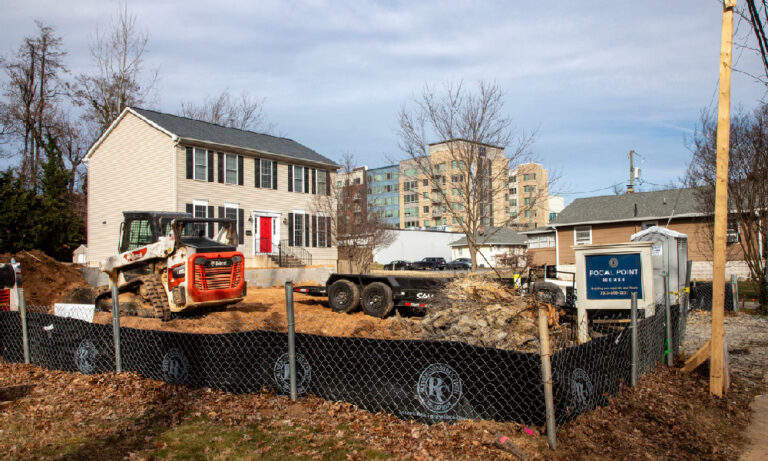
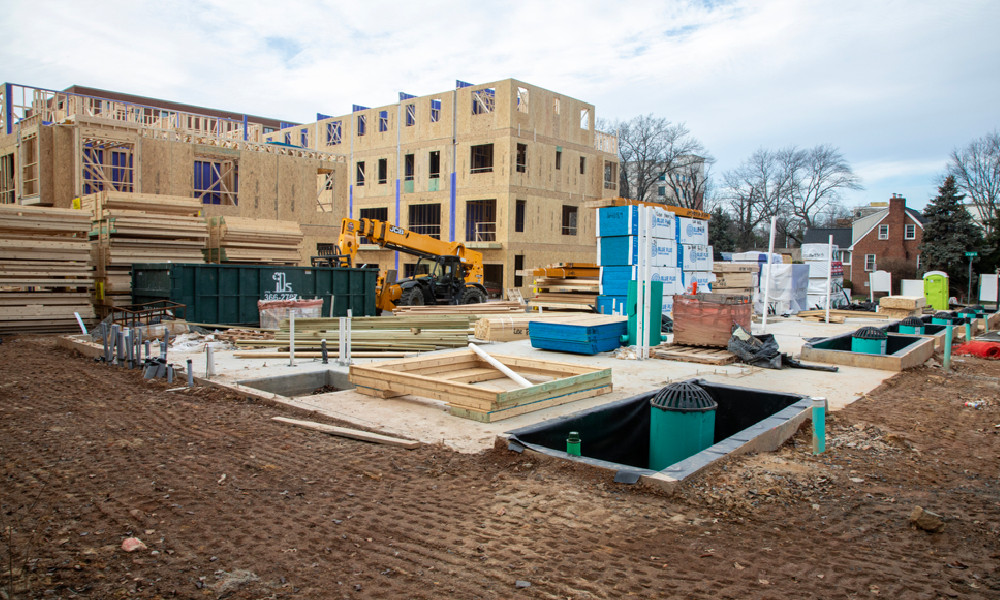
Photo: Lee Park townhomes development
Summary
The assessments of townhomes are similar to detached single-family homes (SFH) in that they are the sum of the land value and the value for “improvements,” each calculated independently. Land values make up a third to half of the townhome assessments. However, unlike detached SFH, townhome land assessments are not tied solely to the size of their lots. Our data analysis shows that the common land assigned to homeowners’ associations (HOA) implicitly have value that is subsumed in the taxes individual homeowners pay on their properties.
The actual methodology used by the City Assessor is not public and has not been shared with us. Our analysis of the City’s historic assessment data shows that the total assessed land values of townhome complexes are highly correlated with the land areas of the entire townhome complexes. However, even though individual townhome owners’ lots are significantly different in size, most commonly, entire complexes’ assessments are divided equally among residents, with small differences that are related to whether a townhome is an interior or end unit.
That methodology may be changing. Land values of the new townhome lots on Park Avenue show that the deeded purchase price of the original land formed the 2025 basis for the complexes’ land values. That amount was then apportioned among the units relative to the individual townhome owners’ deeded lot size.
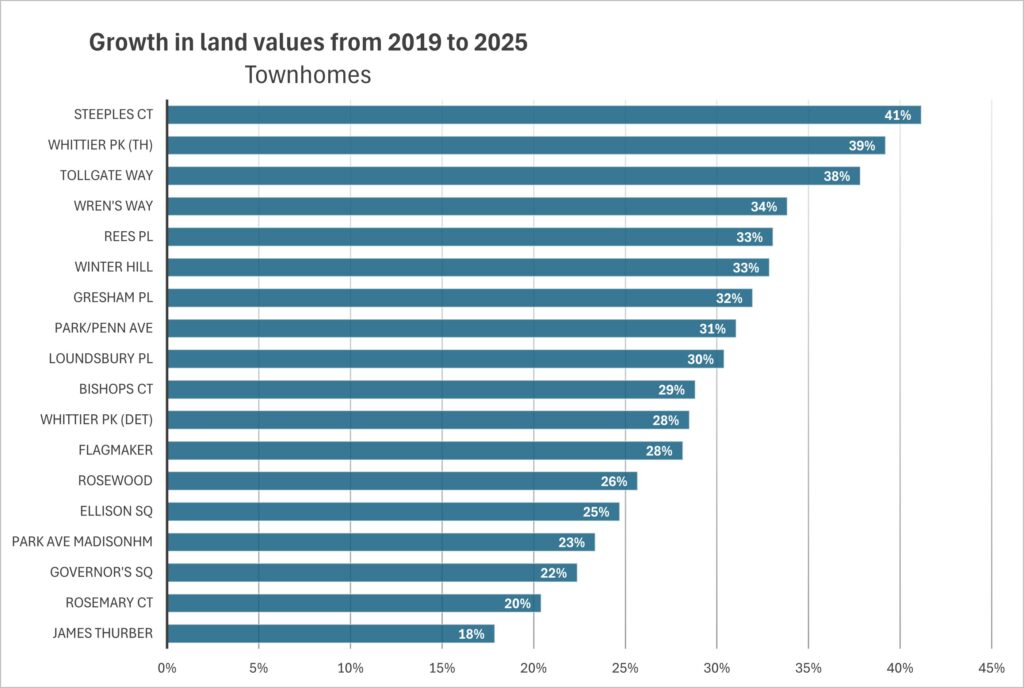
Whereas the City’s detached SFH land values increased fairly uniformly at 44-46% from 2019 to 2025, townhome land values showed a wide variation of change from complex to complex. Their increases varied from 18% to 41%.
Real estate assessments and “fair market value”
Real estate taxes are the main source of revenue for the City. For single-family homeowners especially, these taxes have been increasing at a rate that far exceeds inflation and income growth, contributing to the housing affordability crisis. (See Pulse post Single-Family Homeowners Bear the Cost of the City’s Growth, December 3, 2025.)
By law, these taxes are a percentage (1.185% in 2025) of the “fair market value” (FMV) of residents’ homes and land, as estimated by the Falls Church City Assessor’s Office in its annual “mass assessment.” That term distinguishes the process from the individual appraisals required by mortgage lenders and other financial market participants.
In the Pulse post Exploring How the Land of Detached Single-Family Home is Valued in Real Estate Assessments, March 14, 2026, we examined the land value components for detached single-family properties. Here, we address the land assessment values for townhomes, also considered single-family homes.
Data sources and methodology
The City’s assessment methodology is a black box. The staff at the Assessor’s office have provided limited answers, but the actual methodology is unknown to us. By analyzing the City’s assessment data, including those obtained in past years, drawing from our experience with assessment appeals and their public records, and consulting Falls Church land records from the files held by Arlington County, we were able to shed some light on the City’s townhome land valuation.
Some City assessment data for 2025 and prior years can be accessed through the City assessment portal. The lot sizes of individual townhomes are no longer available online, but we were able to obtain them from previous year’s datasets.
We excluded Cherrywood on Hillwood Drive and S. Cherry Street because over half of the residences are in Fairfax County.
Townhome complexes include homeowners association (HOA) land
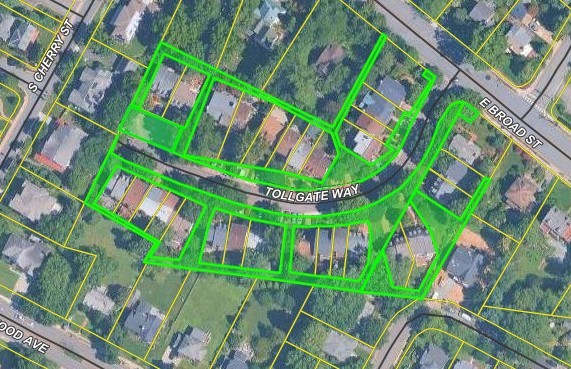
A townhome complex usually includes land that is not owned or assigned to any particular lot owner. Historically, Falls Church’s public records showed these land areas, attributing them to Homeowners’ Associations (HOAs), sometimes called “common property” in legal documents.
Using Tollgate Townhouses as an example, the HOA land (outlined in green) typically wraps around individual lots and creates unrestricted access areas to residents. The remaining land is divided into lots owned by individual townhome owners. The Tollgate lots total about 92,000 sq ft, and range in size from 1,671 sq ft to 6,704 sq ft. The HOA land totals 43,295 sf, or about 32% of the total area.
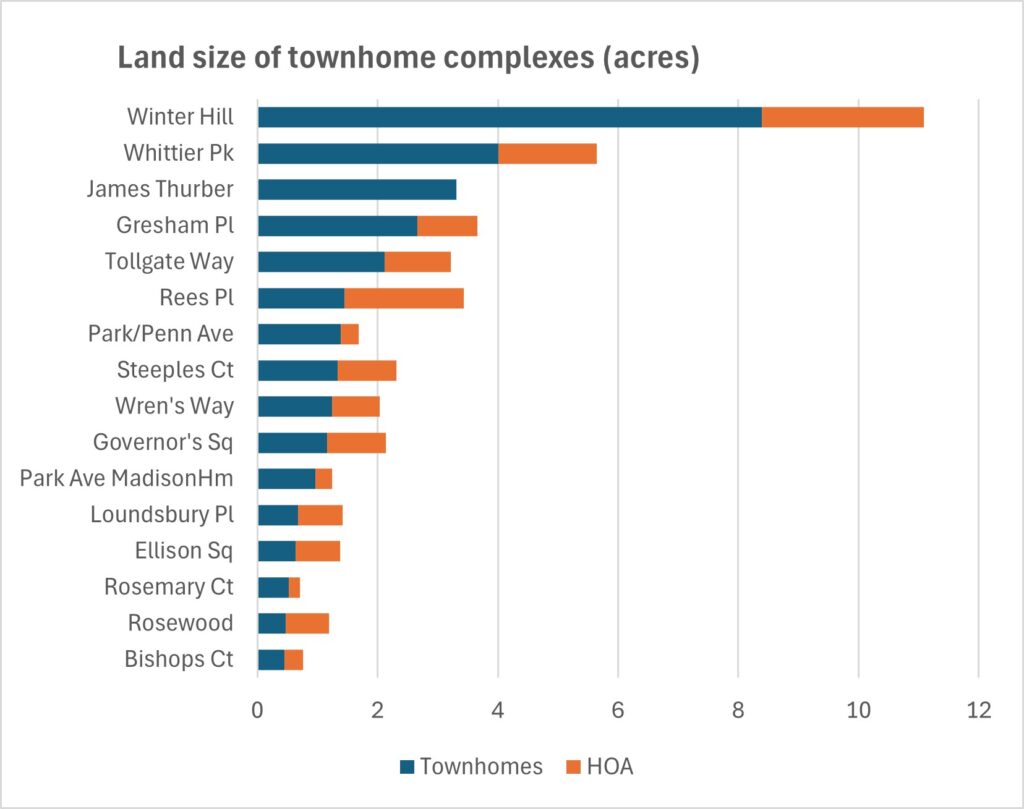
The figure below shows the overall sizes of the townhome complexes in Falls Church City and their two land area components. In total, the Winter Hill complex (aka: the Cherry Hill Neighborhood) is almost twice as large as its nearest competitor, Whittier Park (officially known in Falls Church records as the James Wren neighborhoods). HOA land sizes vary considerably from 0% for James Thurber Court to almost 60% of the townhome complex for Rees Place.
HOAs do not pay real estate taxes. Homeowners do.
Homeowners’ assessments alone generate all the real estate taxes due for their complexes. HOAs do not pay taxes. Our analysis indicates that the City determines the total land value of each complex, townhomes and HOA land, and then apportions that amount among the townhome units.
A simplistic approach to apportioning townhome land values
In an earlier post, we showed that detached single-family homes (SFH) land assessments are determined by a unit value function, expressed in dollars per square foot of lot size, that declines as the size of the lot increases. Our first surprise in conducting this analysis for townhomes was that the tax assessments for individual properties within townhome complexes bear little relationship to the size of the individual lots themselves. The most common situation is that interior units within a townhome complex have the same, or nearly the same, assessed land values, regardless of their size. End units are assessed nearly the same also, but at a slightly higher value than the interior units (e.g., up to about 8% higher).
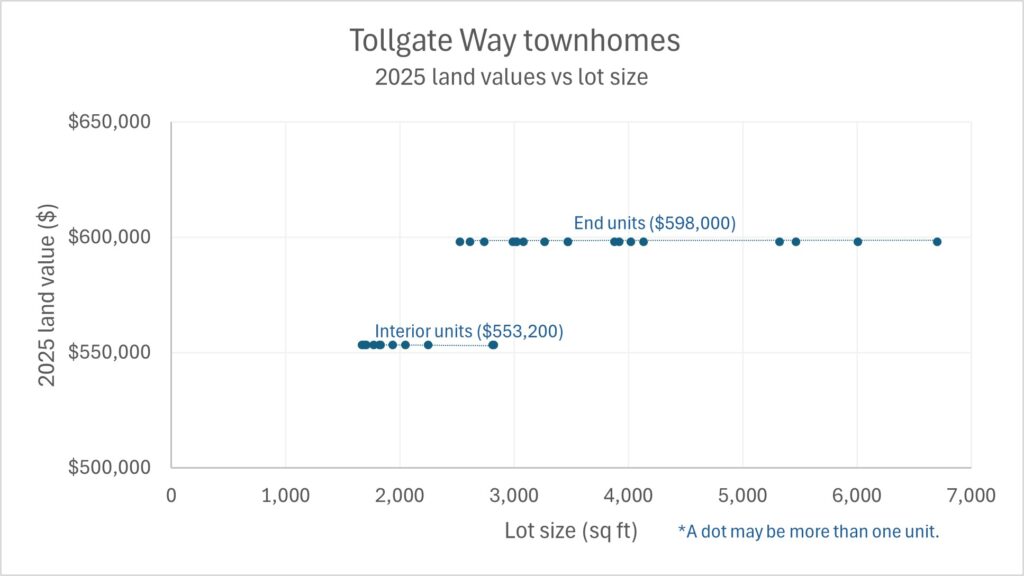
The lower Tollgate $553,200 valuation line applies mostly to smaller, interior townhouse lots, but it is constant over a range of 1,671 sf to 2,824 sf. End units, whose lots are valued at $558,000 each, range from 2,528 sf to 6,704 sf. The two size ranges overlap because two of the lower-priced interior units have more land than a few of the end units that have higher assessed values.
This pattern is present in most of the townhouse complexes we examined, as seen in the graph below. Each dot in the graph represents one or more townhome units based on its lot size and assessed land value. They can be connected by horizontal lines for different complexes, a few of which have been drawn.
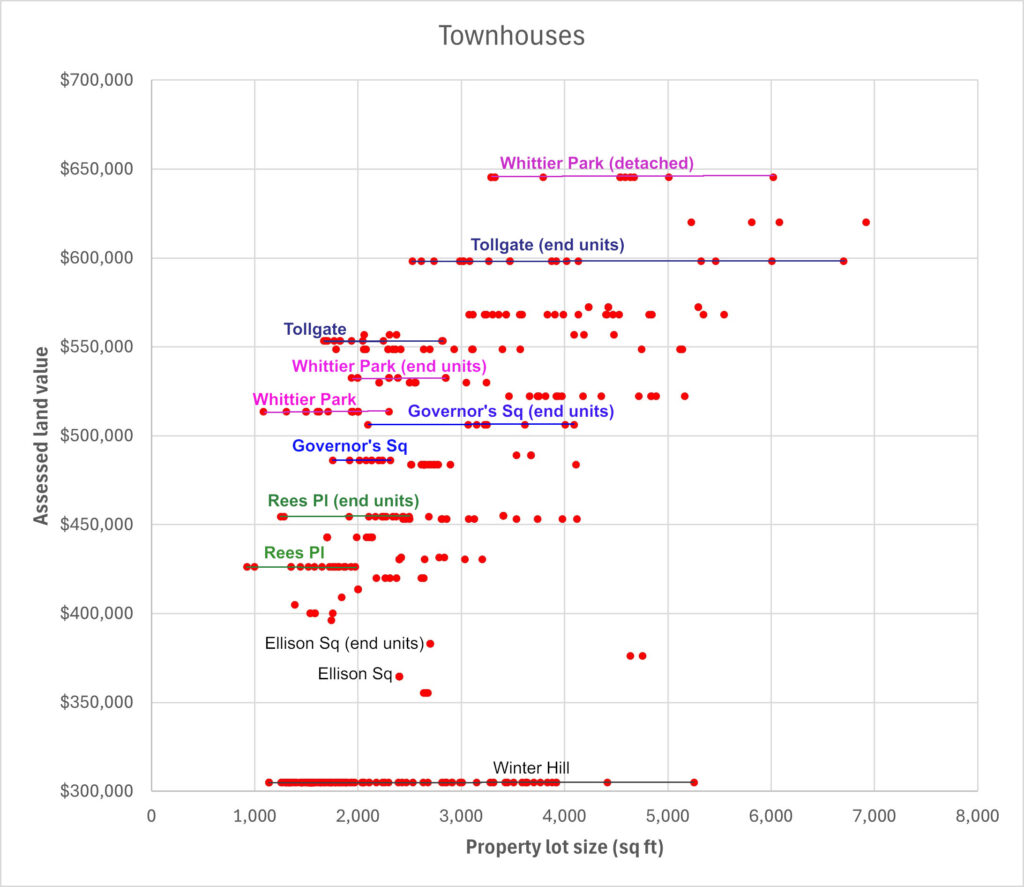
The figure shows two important differences between detached SFH land valuations and those of townhomes:
- Assessed land values for lots of the same size vary by over 100%—about $300,000 for Winter Hill to $650,000 for the townhome-like complex at Whittier Park. Detached SFH lots are valued the same way throughout the City.
- Laterally, within each complex, there is no relation between assessed value and lot size in any of Falls Church’s 16 townhome complexes. All the SFH lots follow a single relationship that yields a declining per-square-foot valuation as lot size increases.
This suggests that the allocation of land to individual units within townhome complexes is somewhat arbitrary and may be inconsistent among the complexes themselves. That could result from the fact that construction of the 16 complexes we evaluated took place over a period of 45-50 years. Since little real documentation of the assessment process exists, it is very likely that, as institutional memory is lost due to frequent staff turnovers, different methodology rules have been applied when new townhome complexes appear.
Determining the total assessed land values of townhome complexes
Since individual townhome lot assessed values seem to be independent of the lots’ sizes, we theorized that the total assessed land value of each complex must have been calculated first, then apportioned to its units.
This sequence was followed in assessing the 2025 land values of the new Oak Park and Lee Park townhomes on Park Avenue. Land records indicate that Madison Homes, the townhomes developer, paid $3 million for the Oak Park lots and $8.25 million for the Lee Park lots. These outlays were then attributed to individual townhome owners in proportion to their individual lot sizes as their 2025 land assessments. (That departs from the existing townhomes in the City, where the apportionment only slightly differed among units based on their status as an interior or end unit.)
In the above cases, Madison Homes appears to have paid $192/sq ft for Oak Park and $276/sq ft for Lee Park. The result of assuming the listed purchase price is the fair market value is that the land values of Oak Park average $250,000 per unit while those of Lee Park average $412,500 per unit. These are two very similar townhome complexes located one block apart. Due in part to these considerations, we elected to exclude Oak and Lee Park developments from this analysis and focus on the complexes with stabilized assessments.
We tried several data fit models involving land areas of townhome complexes and land values, all of which fit the data with high degrees of confidence, and ultimately decided on the simplest, as shown in the following figure. There, we saw a simple regression formula:
Total Assessed Land Value = $124 per square foot of complex area
This formula explains about 98% of the variation in land assessment value among the 16 complexes included in this analysis. That is, we can safely link assessments for complexes in their entireties to the size of the complexes overall without worrying about relative proportions of townhome lot sizes and HOA land. This essentially validates our original assumption about the City’s methodology.
This formula explains about 98% of the variation in land assessment value among the 16 complexes included in this analysis. That is, we can safely link assessments for complexes in their entireties to the size of the complexes overall without worrying about relative proportions of townhome lot sizes and HOA land. This essentially validates our original assumption about the City’s methodology.
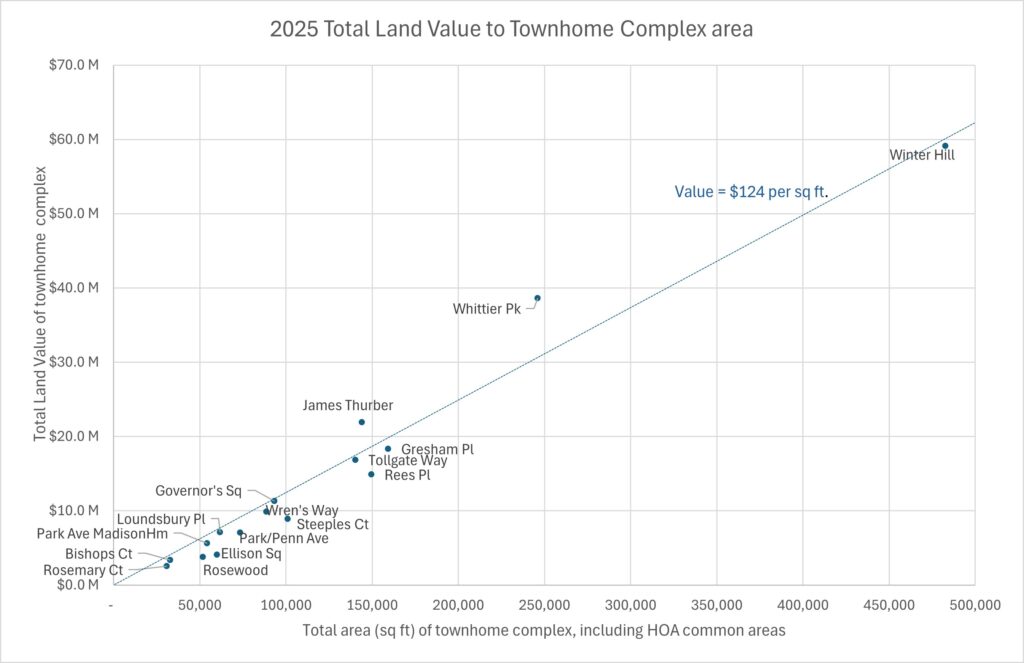
Ironically, while we were attempting to determine why the Whittier complex seemed to be an outlier in the chart, we found additional substantiation of our assessment valuation model. It yields an estimate of about $30.6 million for the total value of Whittier’s land whereas the City database gives a figure that is $8 million higher. We found reliable information indicating that the developer that purchased the land for the Whittier complex from Falls Church City in 1994 accepted several proffer obligations that likely were included in the land value. When these costs are appropriately escalated, they account for most of the $8 million. This was an independent validation of the simple $124/sf model and its application.
Are Falls Church’s townhome land assessments stable?
Unfortunately, the answer seems to be that they are not. For detached SFH, land assessments can change significantly from year to year—or remain unchanged—but they mostly all move together by the same rate. Between 2019 and 2025, most SFH land grew 44-46%. That is not the case for townhome complexes.
The figure below shows the change in assessed land values of each townhome complex in the City from 2019 to 2025. These land values had varying growths of between 18% to 41%. Sales-based neighborhood factors do apply to the townhome units themselves, but the City Assessor’s office has said that neighborhood (i.e., location) is not a factor in land values. Yet the appreciation rate is clearly different for each complex.
Concluding Remarks
In this analysis, we show the unexpected results that townhomes’ land assessments within well-defined complexes are usually not proportional to lot size. Rather, they are essentially identical. In these cases, the only difference is related to whether a unit is an end unit with a slightly higher valuation or located in the complex’s interior. Most complexes have cases where an end unit would have a smaller lot than some interior units but would still have a higher assessment. This process benefits some residents and acts to the detriment of others.
We spent a good bit of time trying to derive a model for determining how the City values townhome land and ended up concluding that we cannot reach below the level of the complexes’ total land holdings. Allocations of those assessments to individual units is too arbitrary to model reliably.
Our analysis pertains to data that we have to date. The City has a new Assessor, Darius Gould, who may introduce new changes to the assessment methodology.