Falls Church City Receives the Gordon Road Triangle Report, Considers Next Steps to Redevelop the 15 acres
Summary
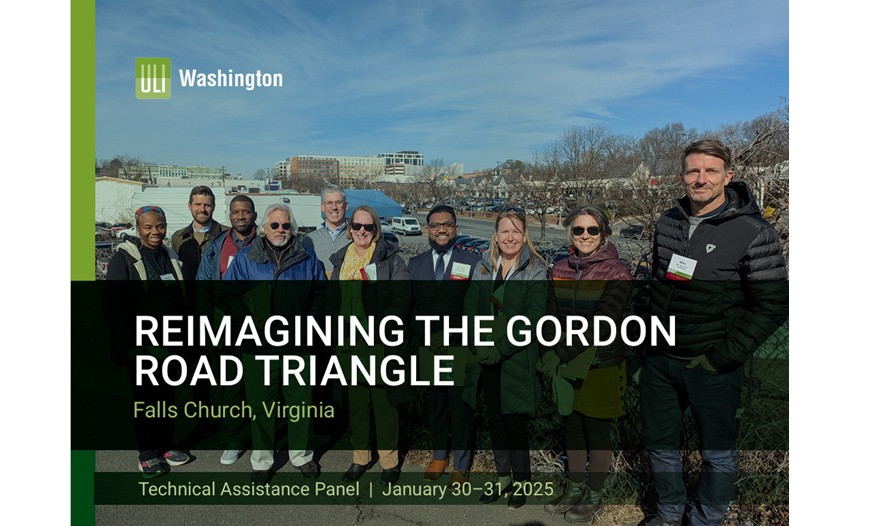
Last January, the City hosted the Urban Land Institute Technical Assistance Panel (ULI-TAP) and tasked its members to provide a technical analysis of the land-use and planning issues associated with the Gordon Road Triangle (GRT). According to the Planning Department, the City’s contribution to this effort was $15,000. The Metropolitan Washington Council of Governments (COG) and ULI Washington through their partnership for these technical assistance programs subsidized the rest of the cost by $7,500 each for a total study cost of $30,000. [For background on ULI-TAP’s initial findings, see the Pulse article City Explores Redeveloping the 15-Acre Gordon Road Triangle, Including Its Property Yard, February 18, 2025.]
Twelve panelists performed the assessment, with additional input and participation from 52 “stakeholders” representing municipal bodies (Fairfax County), developers, local businesses, and selected civic organizations.
The 33-page final ULI-TAP report titled “Reimagining the Gordon Road Triangle” was published five months later on June 30, 2025. While the goals and key recommendations it describes are consistent with the panel’s conclusions from January, the final report includes several supplemental details that this post summarizes.
Background
The distinct goals and recommendations identified by the ULI-TAP panel in January were:
Goals
- Identify strategies for reinvestment in the Gordon Road Triangle (GRT)
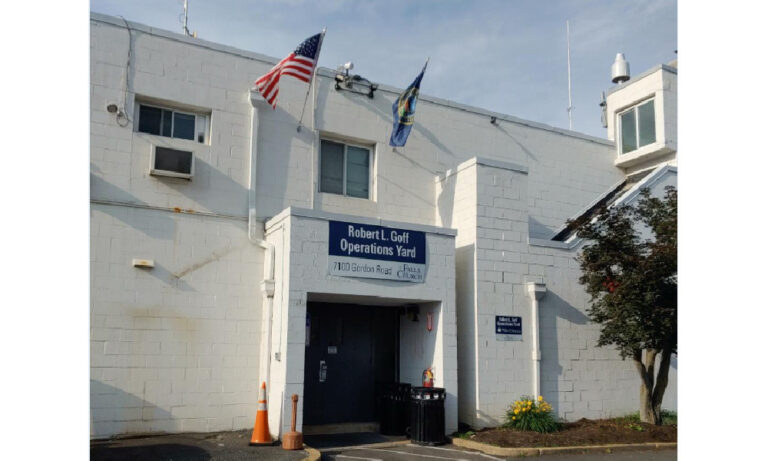
- Explore the feasibility of a public-private financing structure for the City’s Operations, or Property Yard
- Enhance multimodal connections offered by the W&OD Trail and West Falls Church Metrorail Station
Recommendations
- Appoint a Gordon Road Triangle Implementation Manager at the City of Falls Church to champion the project
- Formalize an agreement between the City and Fairfax County to advance reinvestment in the GRT
- Convene a City Working Group to advance development of a new Public Services Center
- Convene a working group of property owners
There are a number of changes evident in the final report compared to the panel’s January 31 slide presentation.
The ULI-TAP final Gordon Road Triangle report
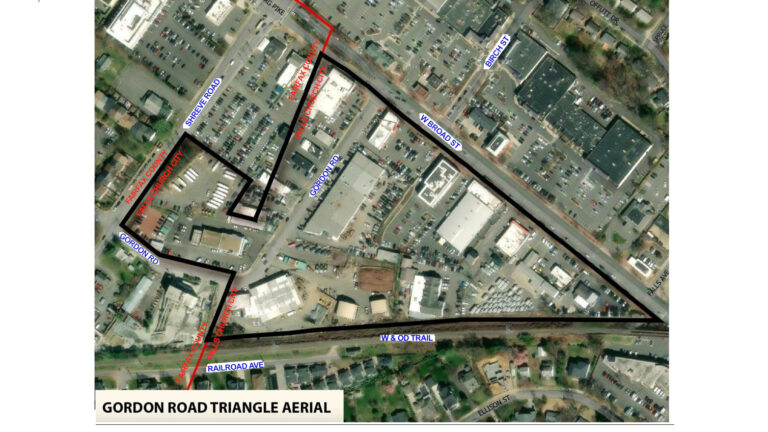
The Urban Land Institute Technical Assistance Panel (ULI-TAP) final report “Reimagining the Gordon Road Triangle” describes a 20-acre study area rather than the 15 acres in the City, thus acknowledging the adjacent land areas within Fairfax County.
The report also clarifies that the Beyer family owns 4.58 acres through six different LLCs. [For more information on the land and initial development proposals for the Fairfax portion of the Triangle, see the Pulse post Fairfax Reviews Gordon Road Triangle Plans, April 28, 2025.]
Finally, the report modifies and expands goal #4: Develop a process, identify capital, and reimagine the current site for a successful long-term repositioning. The City sponsors asked the panelists to leverage institutional and socially motivated capital to maximize positive impacts for the surrounding residents through redevelopment and/or renovation.
Questions posed by the City
In the final report, the sponsors are identified as the City of Falls Church and its Community Planning and Economic Development Services (CPEDS) Department. The report provides a full list of detailed questions provided by the sponsors to be addressed by the panel. Only five major questions were presented in January.
The questions addressed in the report cover the following five key topics.
- Public-Private Partnership. What private uses might be most suitable for a public-private partnership with the City in addition to the Operations Yard? What is a model for public-private partnership that the City could consider and how could that be coordinated with any potential redevelopment of surrounding privately-owned land?
- Land Use. What existing and new uses are compatible with proximity to an Operations Yard? How can existing businesses fit in with the future development? How could small-scale manufacturing uses such as breweries, distilleries, and arts and craft markets contribute to the area? Can adaptive reuse be considered for the existing buildings?
- Transportation and Connectivity. How can we increase pedestrian, bike, and transit connectivity among the Gordon Road Triangle, Downtown Falls Church, the West Falls Economic Development, Virginia Tech campus redevelopment, the City’s Middle and High School Campus, and Fairfax County’s upcoming mixed-use developments around the West Falls Church Metro Station?
- Equity. How can the development of workforce and affordable housing and the expansion of the City’s shelter for persons experiencing homelessness be incorporated into any potential development in Gordon Road Triangle?
- Regional Coordination. What are the biggest opportunities for advancing a regional best practice of land use planning leveraged by partnering with and learning from other jurisdictions?
Lessons from stakeholders
Appendix A of the final report identifies the 52 participating stakeholder representatives. The public and the press were not invited to actively participate in the January discussion. The final report indicates that the panelists listened to stakeholders’ concerns, spent time discussing the best ways forward, and considered these issues when forming their recommendations. These details, many omitted from the January slide presentation, include:
- The need for more affordable and workforce housing in the area, with the suggestion that the Gordon Road Triangle could be ideal for these purposes. “Everyone is used to mixed-use housing now.”
- The preservation of existing businesses that add value to the area. One stakeholder posed the hypothetical question: “Do you really want to run some of the businesses out, and all of a sudden you are driving to Chantilly to get your car repaired?”
- The importance of keeping a meaningful amount of industrial use in the GRT, because doing so is in line with how the area is already zoned. Some stakeholders expressed concern that this area includes “some of the City’s last land … zoned for light industrial and [we] do not want it all to be rezoned, as it would never be recaptured once lost.”
- The benefit of more green space and increasing the tree canopy, especially along the W&OD Trail. Addressing stormwater management issues was also something stakeholders hoped to see considered in the updated GRT plans.
- The imperative of retaining the homeless shelter with needed expansion and modernization.
- The need to address well-known bike-pedestrian connectivity issues within and adjacent to the GRT. The panel acknowledged that while the W&OD pedestrian and bike bridge is useful, stakeholders felt that bike and pedestrians had to go out of their way to access it, and an additional ground level crossing is desired for local use. Additionally, stakeholders mentioned that there are too many curb cuts on Route 7, which conflict with bikes and pedestrians.
- The desire to consolidate parking so the visual experience of the area is not just continuous strings of parking lots. Stakeholders also acknowledged that the “automobile dominated public realm necessitates a reconsideration of how driving to and parking within the Gordon Road Triangle should feel.”
- The request that redevelopment of the GRT not include a grocery store, given the “plethora of nearby grocery options.”
- The concern that the City is near its debt limit and any additional debt should be limited “along the lines of $30 million maximum debt capacity… for this project.”
- Consideration of additional amenities that might be ideal for this space, such as a pool or aquatic center, a second library, a tech business incubator, a bike shop to serve people using the W&OD Trail, maker spaces, gathering spaces, a dog park, and public art.
The panel concluded that “there is great enthusiasm from stakeholders and City leadership to invest in the Gordon Road Triangle in a way that creates more housing and improves multimodal transportation while reimagining the existing Public Works facilities.”
Site Constraints
The panelists identified a number of site constraints of the GRT (see diagram below), such as poor bike and pedestrian infrastructure and existing fencing and streams acting as barriers to accessing area amenities. Gordon Road was identified as having subpar pedestrian connectivity, narrow sidewalks, and encroachment by parked cars. “Gordon Road is also a cut-through street with high speed and limited site[sic] lines. The Panel found that it was difficult to cross Broad Street safely and conveniently and that driveways and curb cuts create conflicts for people walking and biking.”
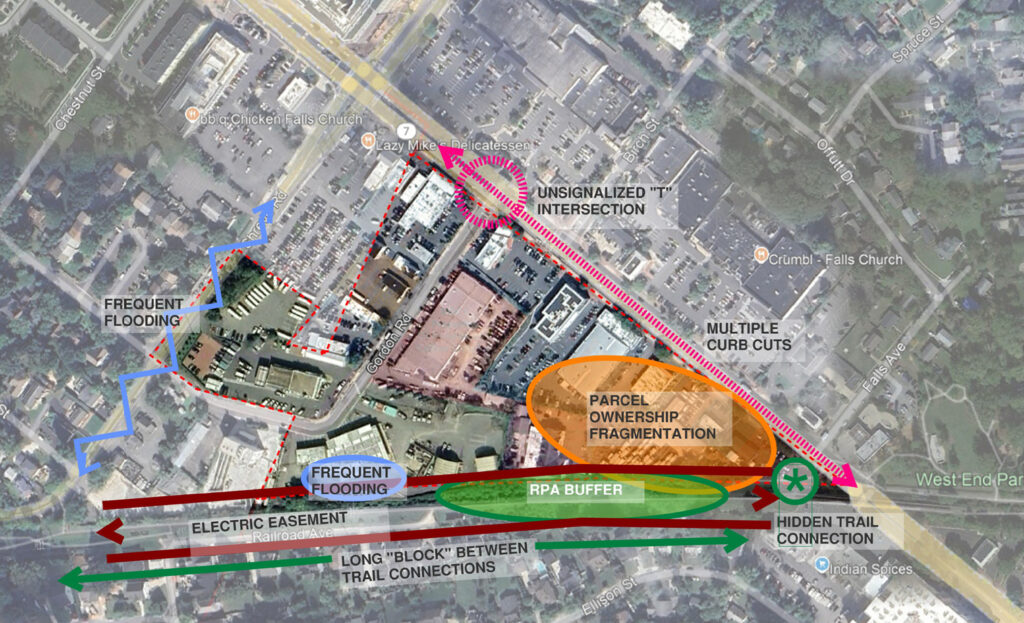
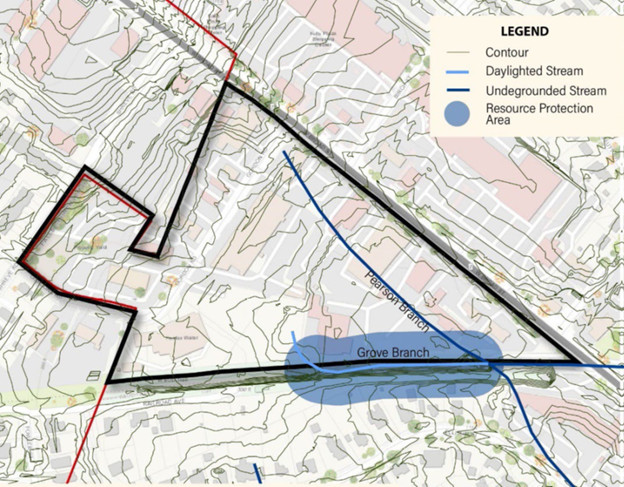
While the Panel acknowledged in the January slide presentation that they identified areas of frequent flooding, these areas and related streams as well as Resource Protection Areas within the GRT were only depicted on site maps in the final report. For example, the report notes that the southern edge of the City’s Property Yard is one of the locations identified as experiencing frequent flooding. An open engineered channel also runs west-east adjacent to the W&OD Trail at the southern edge of the GRT (not fully shown in the maps) and would likely require modification to resolve drainage issues.
Recommendations
The panel devised a phased development framework for investment in the GRT that was initially presented in January and was retained in the final report. Additional explanations and rationales are detailed in the report.
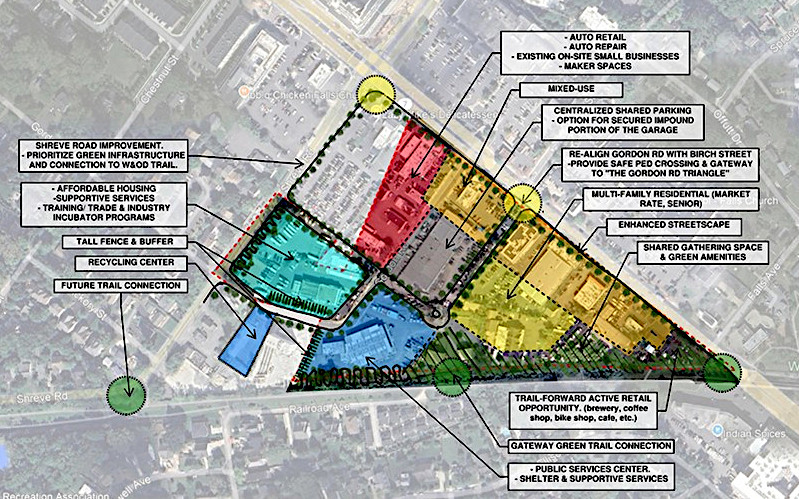
Reinvestment in the GRT should focus first on retaining critical City services, the panel concluded and recommended redevelopment and improvement of these spaces immediately to address critical needs. Achieving this goal would allow for maximum flexibility in the rest of the GRT as well as further investment, according to the report. Addressing the City’s Public Works needs also would make it clear that the Triangle maintains a light industrial character but still has a “people first” message that acknowledges that the livelihood of many depends on the services performed there.
The panel recommends that the urgent nature of the City’s needs should prioritize the City’s Operations Yard expansion into a new “Public Services Center” and that “the rest of the development will follow.”
The panel’s recommendations in the final report are consistent with the January presentation and are summarized as follows:
Updating the “Public Services Center”*
- Add Centralized Parking
- Create an Apprenticeship Program for Public Works-Related Disciplines
- Establish a permanent Supportive Housing program by expanding the homeless center
- The City and stakeholders move away from the previous study on how to use the site and perform a full program analysis complete with realistic project financial estimates.*
[* Implementing these recommendations would essentially negate the $85,000 study and master planning concepts and related report prepared by Fox Architects, LLC in 2024, and reported in the Pulse post in February and in Property Yard Design Concepts Report Released, May 9, 2024.]
A Framework for the Gordon Road Triangle
- Realign Gordon Road
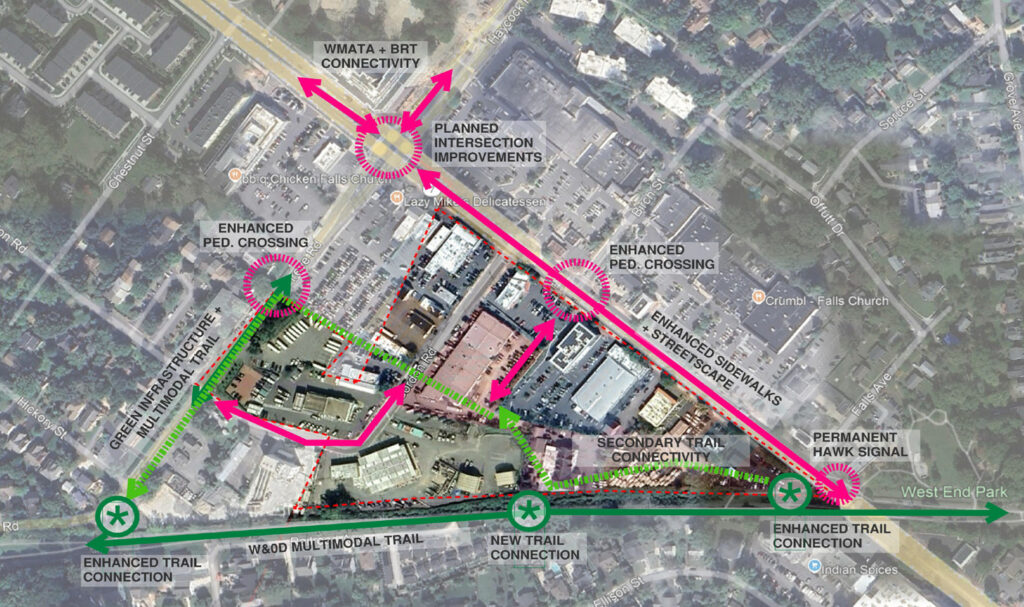
- Enhance Pedestrian and Bicycle Connections to the W&OD Trail
- Reimagine Shreve Road
- Improve Traffic and Pedestrian Safety Surrounding Broad Street
- Build Affordable Housing
- Create More Green Space
Governance Recommendations
- Appoint a Champion
- Formalize agreement with Fairfax County
- Convene City Working Group
- Convene working group of property owners
Conclusion and implementation
“The Panel feels that the City of Falls Church has tremendous potential to invest in the Gordon Road Triangle in such a way that protects and maintains existing operations and businesses. The City can transform the City-owned properties into a world-class Public Services Center, which will provide for the long-term needs of its residents and also set the tone and give investors confidence that positive change will occur in the site.”
“The Panel expressed confidence that the Gordon Road Triangle can continue its use as both a light industrial site and allow for more housing options while still retaining and attracting retail. The Panel has faith in the strong City leadership which has approached this project with thoughtful consideration and an eye to the future of Falls Church.”
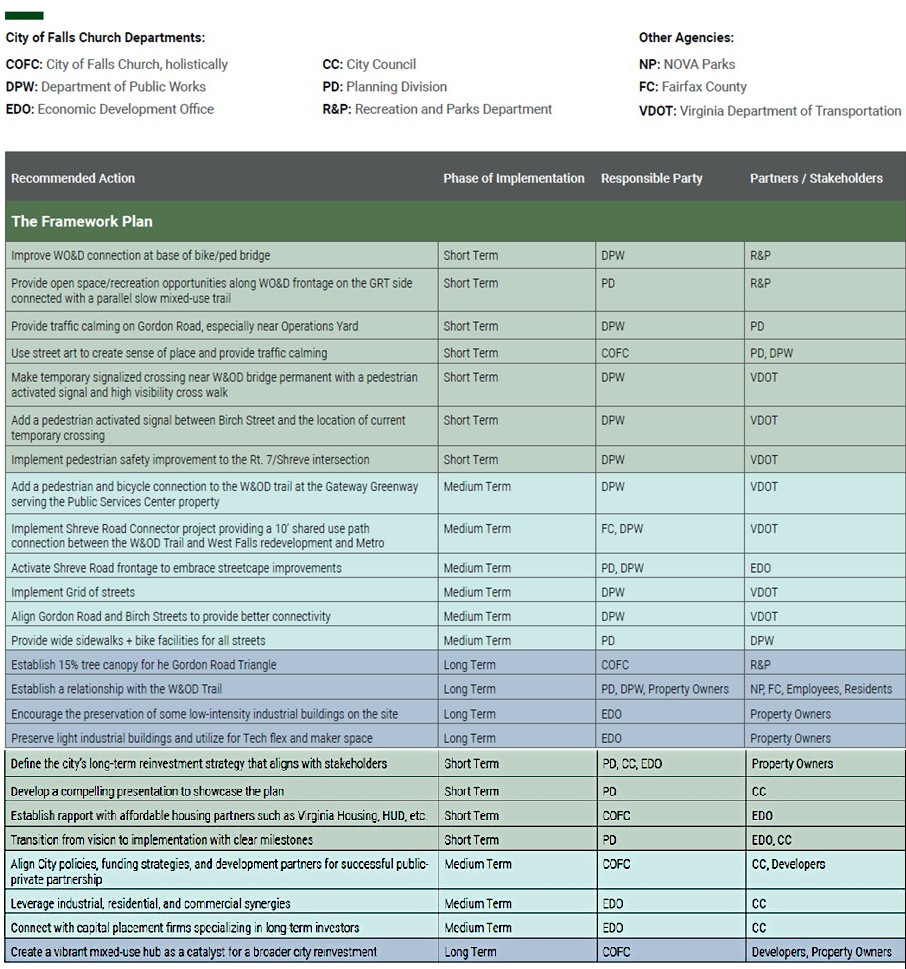
The panel recommends three phases of implementation for the Framework Plan for the GRT.
Step 1- Finalize the Reinvestment Vision
- Define the City’s long-term reinvestment strategy that aligns with stakeholders
- Develop a compelling presentation to showcase the plan
- Conduct parking needs assessment study to help evaluate demand for a shared parking facility
Step 2 – Engage Private and Public Partners
- Connect with capital placement firms specializing in long-term investors to reduce risk, increase cash flows, and increase private participation
- Establish rapport with public partners (i.e. Fairfax County, the Commonwealth of Virginia, and Federal partners) to create impact for the greater area
Step 3 – Grow The Gordon Road Triangle into a Model District
- Create a vibrant mixed-use hub as a catalyst for a broader City reinvestment
- Leverage industrial, residential, and commercial synergies
When Executing the Plan:
- Transition from vision to implementation with clear milestones
- Align City policies, funding strategies, and development partners to create a successful public-private partnership
The panel concluded that “there was a strong consensus that in order to create synergy between City and land owners, the City of Falls Church should take initial steps to re-vision their two parcels and be the catalyst for the larger Gordon Road Triangle redevelopment.”
Implementation matrix
The implementation matrix is reproduced below. Interestingly, the matrix does not list a point at which the Public Services Center would be constructed.
Next steps and City Council discussion
The ULI Final Report is on the agenda for City Council discussion at its September 15, 2025, work session.
References
- Gordon Road Triangle ULI-TAP Final Report, 2025.
- Gordon Road Triangle TAP Presentation Slides, January 31, 2025.