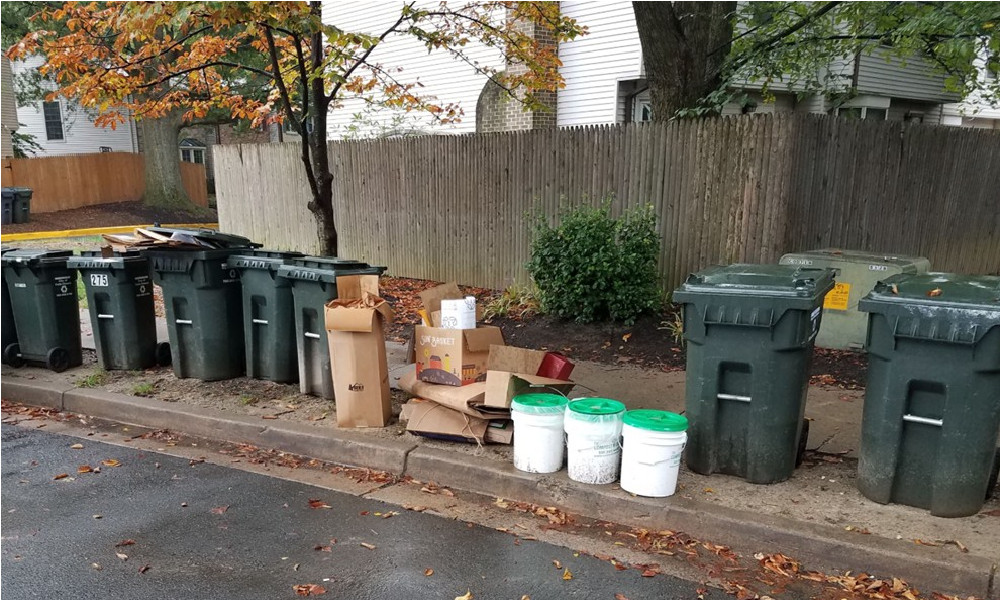
Trading Inequities: Proposed Trash Fees Disproportionately Burden Owners of Lower Valued Properties
Summary
The City staff on the Solid Waste Task Force will draft their recommendations to the City Council, which are scheduled to be presented at the Council’s August 4, 2025, work session. The July 21, 2025, final task force meeting agreed on the following:
- The itemized contract, staffing, and overhead costs to be covered by fees totaling $1.2 million with a third organics bin.
- For the fee-based system to be revenue neutral to the City’s budget, the FY2026 real estate tax rate (now $1.20/$100 of assessed value) will be reduced for all residential and commercial real estate so that the projected tax collection will be reduced by the same amount as the cost imposed on fee-payers. For the $1.2 million in new trash fees, the tax rate will be reduced by 1.8 cents.
- A choice of either a flat fee or one of two variable fee structures based on the general waste bin size. No change of bin sizes will be possible in the current year.
Implementing trash fees would impose a disproportionately larger burden on owners of lesser valued properties who use City services than on owners of higher valued properties. If fees were expressed as tax payments, then lower valued properties would pay a significantly higher tax rate than higher valued properties.
All residences, including condos, in Falls Church are eligible for the City’s trash services – curbside collection of designated types of bins. Denser multifamily buildings and the Park Avenue townhomes under construction have been designed so that they do not accommodate such a service. Winter Hill Condominiums and the Falls Chase multifamily building are able to use City services.
The City’s solid waste municipal code states that residents who use the service pay a disposal charge.
Background
In 2024, staff were asked to present options to respond to condominium owners who say that their taxes are paying for a service they do not receive from the City, i.e., curbside solid waste collection. One option was to pay for this service through a fee imposed on users only.
During budget discussions earlier this year, a majority of Council members asked staff for a plan to implement a fee-based trash collection service for the 3,107 properties that receive curbside collection. Furthermore, this plan is to be implemented in FY2026, starting July 1, 2025, and included in the November real estate tax bill. These discussions are summarized in the Pulse post, Update: City Manager Proposes 3-Month Study of Fee-Based Trash Service, May 2, 2025.
City Manager Wyatt Shields proposed convening a Solid Waste Task Force to recommend a fee structure and possible policy changes. Their report will be presented at the August 4, 2025, City Council meeting, when a decision is expected in time for the fee’s inclusion in the first FY2026 real estate bill.
The task force had three prior meetings, reported in the Pulse post Solid Waste Task Force Works on a Fee-Based Trash Collection Service. The fourth and final public meeting was held on July 21, 2025, and is covered in this post.
More public feedback received
Following efforts by the City to publicize the work of the task force, and articles on this site and in the Falls Church Independent, the task force received 16 emails and two in-person comments on this topic. Most of the emails are now available on the City’s webpage.
The feedback covered a wide spectrum of opinions and concerns – some clearly for fees, some against, many asking for clarification and pointing out personal situations. They demonstrate how many citizens deal with solid waste, how they use the City or alternative services, and how fees could be advantageous or disadvantageous.
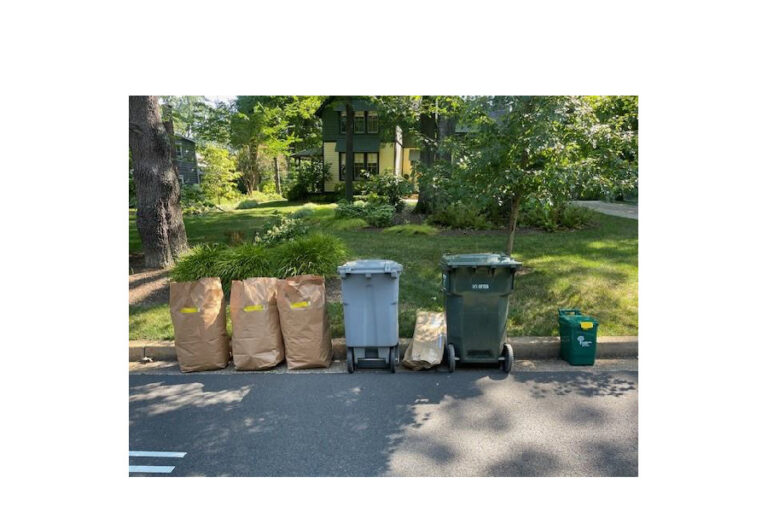
Falls Chase condo owners share bins today and wanted to know if they would still be charged as though they had individual bins. Some people don’t have bins but put out a bag with a sticker. There are people who use yard bags, those who wonder why we have stickers that are not enforced or are inconvenient, and others who avoid stickers altogether by using their own yard waste cans.
Some residents have also pointed out that the recent substantial increase in the federal tax limits for state and local tax deductions (SALT tax 2025) means that more people will be able to itemize deductions. Paying for trash through taxes would allow the cost to be an itemized deduction whereas fees cannot be deducted.
Costs to be covered by trash fees

The costs to be covered by a fee-based system total $1.2 million and are itemized in the table. This cost summary assumes that a composting service will be provided with a third organics bin. If the third bin is not adopted, the costs would be reduced by $51,000, assuming the City’s current food waste composting program continues.
Users of the current City composting program pay an additional fee, set by the City to incentivize participation, with the City subsidizing the remaining cost of the program. This program began in 2017 with 300 households and now serves 580 households. At this level of participation, the City’s subsidy is $90,000. The task force has included this subsidy in the cost table.
A variable fee structure offers lower fees, but bins can’t be downsized just yet.
The task force considered a flat fee structure and two variable fee structures, as described in the previous Pulse post. A variable fee allows residents to downsize to a smaller general waste bin for a lower fee. However, because of the rush to implement this year, that fee would be based on the bin size that residents use today. The fee would be included in the November real estate tax bill.
Deputy City Manager and Task Force Chair Andy Young said, “We don’t really have time, with the tax bills, to give everybody a choice to change. That would have to happen next year.”
Trash fees impact lower valued properties more than higher valued ones.
Both the task force and the City Council were concerned that moving to a fee-based system would place a heavier burden on residents in lower valued properties. If a fee-based system is implemented in FY2026, the result would have to be budget neutral. There should be no additional revenues to the City from the trash fees. If $1.2 million are to be collected through fees to cover the cost of the solid waste service, then $1.2 million less in real estate tax revenues would be collected. This would be accomplished by a reduction in the City-wide real estate tax rate of 1.8 cents.
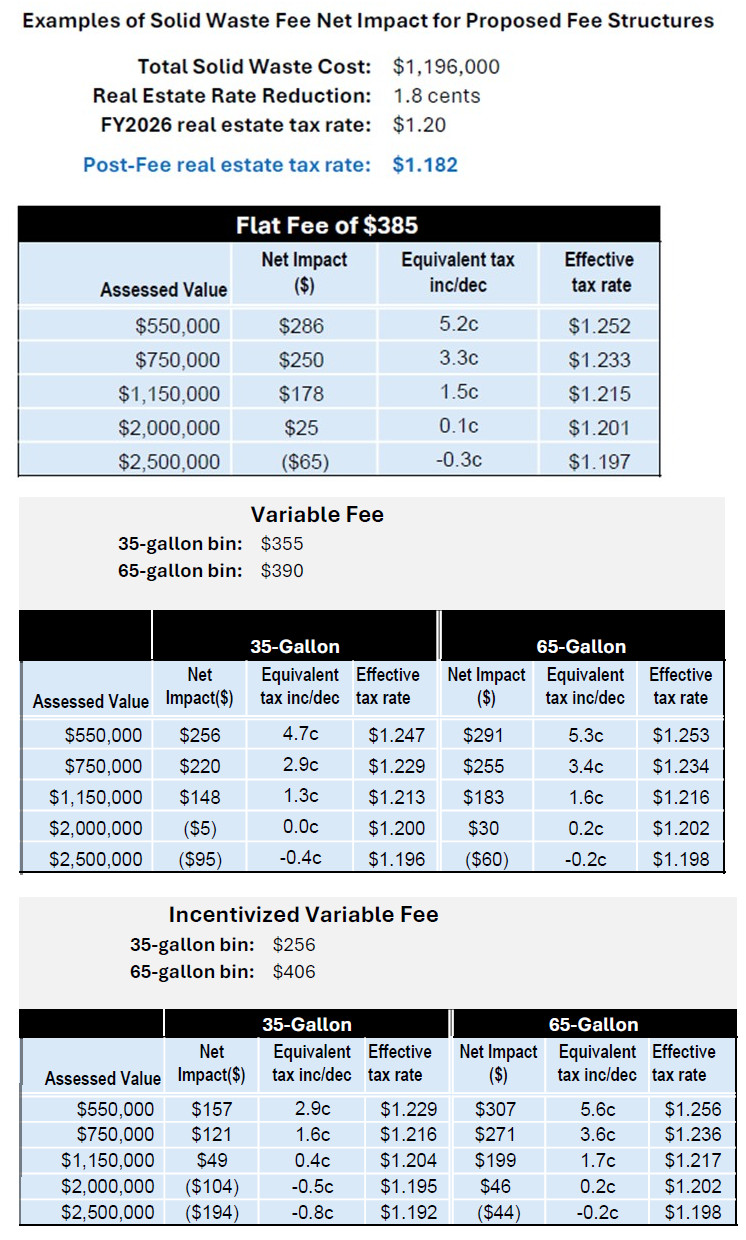
The task force has focused on the net impact of a fee-based system to understand how different homeowners in the City will be affected. The net impact is the increase or decrease in total payments to the City, as fees and taxes, when compared to the current practice of paying for trash services from general revenues and the FY2026 tax rate of $1.20/$100 of real estate assessed value. This analysis applies only to FY2026. The task force analyzed net impact assuming $1.2 million in cost, i.e. 1.8 cents in tax rate reduction to a rate of $1.182/$100 of real estate assessed value. The following discussions are based on this assumption.
The FY2026 impact for properties that do not receive City trash services today is the full tax rate reduction, 1.8 cents in this case. In absolute terms, the resulting tax savings would be $99 for a $550,000 property and $450 for a $2.5 million property from reducing the real estate tax rate from $1.20 to $1.182. For Founders Row, valued at $176.5 million, for example, the tax savings would be $31,764.
Homeowners that use the City’s trash service also receive the benefit of the tax rate reduction, but they would pay a new solid waste fee. The net impact is dependent on the fee structure that the City Council ultimately implements and the individual property value.
Under a flat fee system where each fee-paying property would be charged $385. A $550,000 property would receive a tax reduction of $99 but be charged $385 for trash. As a result, that homeowner would pay $286 more to the City than if a fee system had not been implemented. $286 is the net impact on that property.
If the $286 had been collected as taxes rather than fees, that would be equivalent to increasing the tax rate by 5.2 cents on this property. It would be as though that property’s tax rate increased to $1.252. By contrast, for a $2.5 million property, the $450 tax savings would more than compensate for the trash fees. The net impact would be equivalent to an effective tax rate of only $1.197.
The tables below show the net impacts as equivalent tax increases/decreases and the effective tax rates for properties of different values under each of the proposed fee structures. If the fees were expressed as taxes, the implication would be that lower-value properties pay higher tax rates than high-value properties.
How are the trash fee impacts distributed?
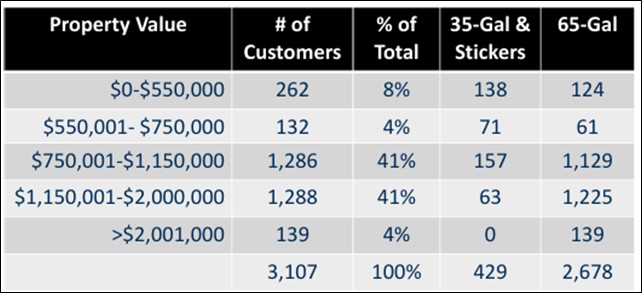
The table shows the distribution of property values for the 3,107 residences that currently receive City trash services. 139 properties assessed at more than $2 million would see little change in cost, or even slight savings, under a fee-based system. The rest will see an increase in costs with 262 properties valued at $550,000 or less, shouldering a disproportionately higher burden.
Are condos not eligible for trash service?
The discussion to implement a fee-based trash service began with some condo owners who pointed out that they were not eligible for the City’s trash service even though the service is paid out of the City’s general fund rather than fees to users and having to pay for private trash service through their homeowners association (HOA) fees.
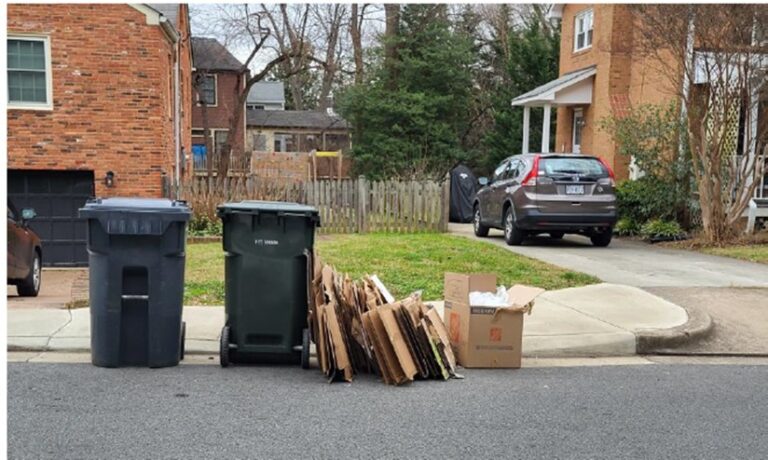
The City’s Solid Waste municipal code does not exclude any residence from using the City’s trash service. However, the code specifies that residences must use certain carts/cans and place them on the curbside on a schedule determined by the City Manager. This service is available to all, and any residence can opt out if it has an alternative collection service.
The service offered by the City is one that, until the development of mixed-use buildings, satisfied the needs of almost all residences. The Winter Hill condominiums and the Falls Chase multifamily building use City services to this day. But the denser multifamily buildings constructed in the last 20 years found the service unsuitable for their needs and contracted their own solid waste services.
Whether to utilize the City solid waste service is typically a design choice developers make. Most recently, Madison Homes elected to design townhomes on Park Avenue that will not use the City’s service because the garages are too small for the City bins, and no space has been provided on the site for the storage of City solid waste bins. Madison Homes informed the City that the townhome owners will contract their own solid waste services.
The City could expand its service by specifying an additional plan for multifamily units, and those units could decide whether they would like to accept that service. Staff has said this would be complicated and result in additional costs. They concluded that it would not be possible to implement such a service for FY2026.
The municipal code specifies a solid waste service charge
At the April 21, 2025, City Council work session, Council Member Erin Flynn pointed out that the City’s municipal code refers to residents paying a solid waste charge. This would support the implementation of a fee-based system as the original intent of the code, Section 34-3 (b), which reads as follows:
Disposal charge. Residents receiving city solid waste service shall pay a solid waste disposal charge, to be set by resolution of the city council. The billing schedule, due date for payment, and method of payment shall be determined by the city manager or the city manager's designee. Failure to pay this charge shall be enforced through any civil remedy available by law to the city and described in section 34-9.
Exemptions for low-income seniors
Staff will need to work out how to accomplish this legally, but are optimistic as other jurisdictions have managed to fulfill similar code provisions.
What’s next?
Staff have received feedback from the three City residents on the task force and comments from the public. They will now draw up their recommendations for the City Council, scheduled for the August 4, 2025, work session. The City Council is scheduled to decide whether to implement a fee-based system, and, if so, the fee structure in a first reading at its regular meeting on August 11. A final, second reading on this ordinance is set for adoption by the Council on September 8.
Reference
- Solid Waste Task Force – Presentation 4 (rev A), July 21, 2025.
- Solid Waste Task Force Meeting 4 Video (YouTube), July 21, 2025.
- Solid Waste Task Force – Meeting 4 Public Comments, July 21, 2025.
- Municipal Code on Solid Waste, Ch. 34. City of Falls Church.