Green Infrastructure Can Prevent Flooding by Soaking Up Rain Where It Falls
By Jeff Peterson
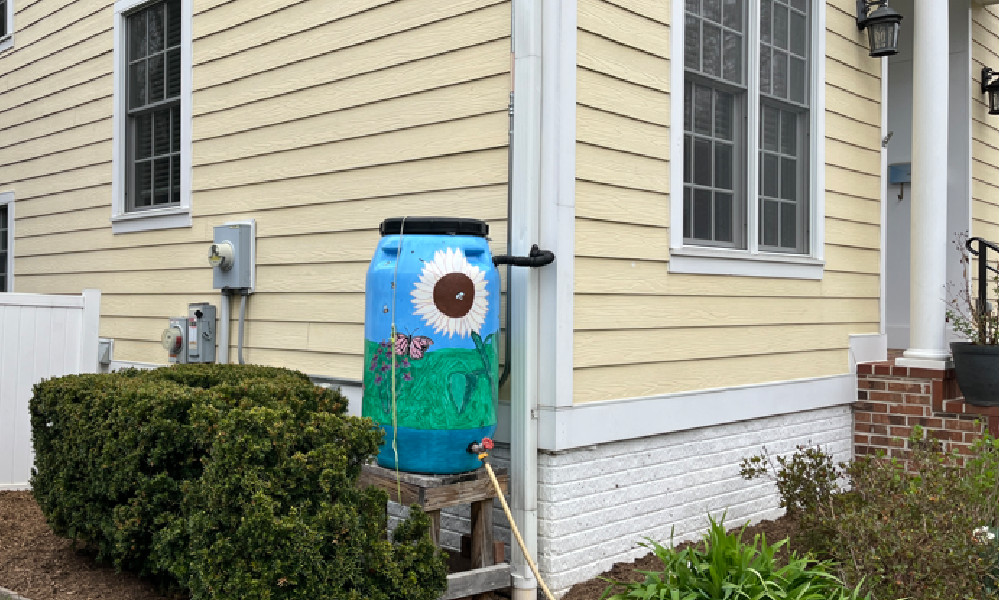
Photo: A rain barrel connected to a downspout of a house in Falls Church.
Summary
The City of Falls Church has a flooding problem, and it is likely to get worse as development adds impervious surfaces and a warming climate drives more intense, flood inducing downpours.
To date, most of the City’s investment in managing stormwater has been in repairing and expanding the storm sewer system to better flush water, along with substantial pollution, to local streams and then to the Chesapeake Bay. While a reliable storm sewer system is needed, another approach is to invest in stormwater management practices throughout the City that help more rainfall soak into the ground where it falls. These practices, termed “green infrastructure” educe flooding, reduce the amount of rainwater that storm sewers need to handle, decrease pollution and high flow impacts on local streams, and provide the water that plants and trees need.
The City has taken some important steps toward supporting green infrastructure, but much more can and should be done to expand green infrastructure practices. Fortunately, the City now has a golden opportunity to significantly increase its application of these infrastructure practices. The Commonwealth of Virginia just awarded the City a grant of almost $500,000 to develop a new plan for managing stormwater and preventing flooding. As this stormwater planning process begins later this year, the City should consider both green infrastructure and storm sewer upgrades as part of the strategy to address its growing stormwater problem.
Understanding the flooding and water pollution problem in Falls Church
Here is key information that is important to know about flooding in Falls Church:
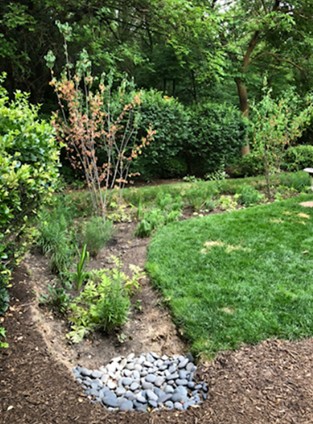
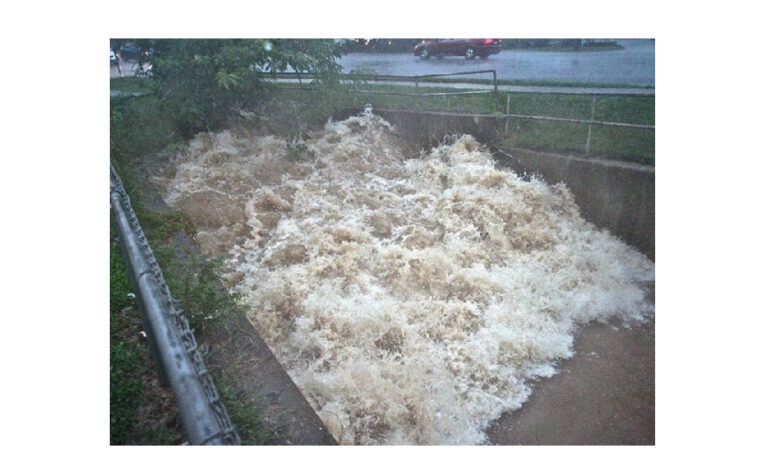
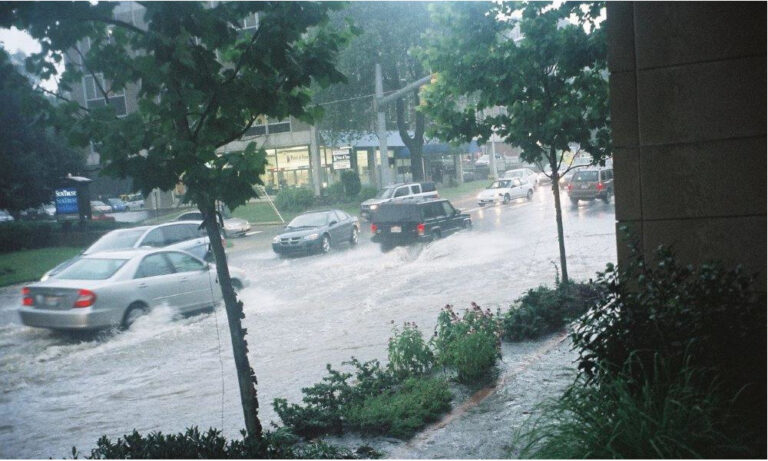
- City flood risk is local: The City is fortunate to be at the upper end of its watershed. It does not have to deal with floods caused by stormwater coming down a river. Nevertheless, intense storms drop enough water on roads, buildings, and other impervious surfaces that the existing sewer system can back up, generating flooding in low lying areas and sometimes flooding homes or other infrastructure.
- Flooding damages homes and causes pollution: Flood damage to homes and other buildings is a costly problem for homeowners and the City, but flooding also carries pollutants, such as sediment and nitrogen, to local streams. The high flow discharges of stormwater from storm sewers cause local stream flow velocity to increase, scouring and deepening stream channels and carrying even more sediment downstream to neighboring communities.
- Flood risks are likely to increase: The risk of flooding will increase in the decades ahead for two reasons. As development continues throughout the City, impervious surface areas expand, and the flow of rainwater to the storm sewer system increases. City maps indicate that impervious surface increased from 29.9 percent in 2015 to 31.3 percent in 2025. The Center for Watershed Protection identifies watersheds with greater than 25 percent impervious cover to be “non-supporting.” In addition, as the planet warms, annual rainfall is expected to increase as is the percentage of rainfall that occurs as part of a downpour of more than one inch.
- Past focus on storm sewer system: The major flooding that occurred in 2019 caused the City to expand investment in repairs and expansion of the storm sewer system funded, in part, by a storm water fee collected based on the amount of impervious surface on each property. Sewer system projects have been focused on addressing major problem areas. Some of these projects have included green infrastructure elements.
- Limited green infrastructure investments: The City has supported modest efforts to promote green infrastructure projects and practices on a decentralized, community-wide basis. The City supports the RainSmart program managed by the Village Preservation and Improvement Society (VPIS) that offers grants for rain barrels and rain gardens. The City just increased the cap on grants for rain gardens from $1,500 to $3,000. In addition, the City provides credits on stormwater fees for a range of green infrastructure actions by residents, but these credits are complex and so are little used.
How much impervious surface is
too much?
“Most researchers acknowledge that streams with more than 25% IC [impervious cover] in their watersheds cannot support their designated uses or attain water quality standards and are severely degraded from a physical and biological standpoint.”
Center for Watershed Protection; p. 21
Benefits of green infrastructure
The Environmental Protection Agency website describes the environmental, social, and economic benefits of green infrastructure in more detail.
Why invest in green infrastructure?
Falls Church needs a stormwater management program that both maintains a reliable storm sewer system and makes a long-term investment in many small, decentralized green infrastructure practices across the City. These green infrastructure practices and policies are well-proven and in place in many neighboring communities.
Building a strong green infrastructure program will:
- Reduce stormwater flows into the storm sewers, reducing backups and costly flood damage to homes and other infrastructure;
- Reduce high flow, high velocity discharges that damage local streams (e.g., washout plants and wildlife and deepen streambeds within incised stream banks) and ensure the City is a good neighbor to downstream communities;
- Reduce water pollution loads to streams, both in the City and downstream, as well as help the City meet the conditions of its Clean Water Act stormwater permit;
- Promote rainwater soaking into the ground where it falls, thus supporting healthy trees and plants that soak up water and provide other environmental benefits City-wide (e.g., wildlife habitat, carbon sequestration in vegetation and soils, aesthetic benefits);
- Offer social benefits to the community, including reducing the urban heat island effect, increasing property values, and improving mental and physical health by offering recreational space; and
- Provide a cost-effective complement to storm sewer projects that commonly cost over a million dollars each.
What can Falls Church do to expand green infrastructure for flood reduction?
The City of Falls Church has made a modest start in expanding green infrastructure, including building green infrastructure elements into storm sewer projects (e.g., Tripps Run project and Lincoln Avenue project), offering stormwater fee credits to property owners who install stormwater management practices, and supporting the RainSmart program. The City is also proposing to implement green infrastructure practices at Roberts Park in FY2028 at a cost of $550,000.
Meeting the flood reduction and stormwater management challenges of the coming decades, however, will require a significant expansion of support for green infrastructure programs and projects.
Here are some examples of steps the City should consider.
1. Reform the Stormwater Fee Credit System.
The current program of offering reductions in stormwater water impervious surface fees in return for implementation of stormwater management practices is complex, provides minimal credits, is little used, and thus is effectively broken.
Reforms to the program, including allowing credits for specific measures rather than just a total score based on multiple measures, would make the credit program more effective. Arlington County adopted a stormwater fee credit program in 2024 that could serve as a model for Falls Church.
The City should commit to reviewing and revising the Stormwater Fee Credit Program to reduce administrative burden on applicants, simplify credit approval, and increase the credits available for implementation of management practices.
2.Fully fund the Neighborhood Tree Program.
For many years, the City supported planting of trees in the City right-of-way along streets through the Neighborhood Tree Program (NTP) working with VPIS to implement the program. Trees have outstanding value in managing stormwater in that they absorb between 10 and 150 gallons of water per day. Over the course of a year, one large tree can reduce stormwater runoff by over 1,000 gallons, with some estimates reaching as high as 4,000 gallons per year. This recent study found that the City had a net loss of ten acres of tree cover from 2014 to 2021.
For the past several years, the City has not provided the modest funding needed to support the NTP. The Draft FY2027 City budget proposes to provide “administrative support” for the program but no funds for the purchase of street trees. The City Council should support the proposed funding for the program and provide additional money for street tree purchases.
3.Join the Northern Virginia Soil and Water Conservation District.
The Commonwealth of Virginia operates a network of Soil and Water Conservation Districts that offer services to communities and property owners, including grants to property owners for stormwater management practices of up to $7,000. With grants of this amount, the City could work with both homeowners and owners of large parking lots (e.g., commercial properties and churches) to support implementation of large-scale rain gardens and related green infrastructure practices. Homeowners could also afford to implement larger projects than are possible with a grant from the RainSmart program.
Although the Soil and Water Conservation Districts are free to join, Falls Church is not currently a member of the Northern Virginia Soil and Water Conservation District (NVSWCD). Joining the NVSWCD is an easy way for the City to offer property owners access to significant support for green infrastructure practices through the state.
4. Strengthen local land development ordinances and enforcement.
The City has adopted ordinances to guide land development, including requirements for lot size, lot coverage and setbacks, tree protection, and construction site runoff control. For example, the City recently adopted updated tree canopy requirements for non-residential sites, but neighboring jurisdictions have stronger requirements, and City staff are evaluating options to strengthen requirements.
As climate changes drive more intense precipitation, impervious surface area grows, and tree canopy decreases, the City needs be sure that land development ordinances are updated to match the new flood and pollution risks. The City should expedite work to identify and adopt other improvements to land development ordinances (e.g., better protection of mature trees on development sites).
In addition, a rededicated effort to enforce these requirements would make a significant contribution to reducing stormwater runoff both during and after construction. Post construction non-compliance with land development ordinances can significantly undermine stormwater management benefits.
5. Expand use of green roofs on commercial buildings.
Existing commercial buildings across the City make up a significant portion of total impervious surface and a significant contribution to high flows in the storm sewer system. Installation of a “green roof” is a green infrastructure practice that can reduce stormwater flows by using plants to soak up rainwater. Green roofs have other benefits including conserving energy, filtering pollutants that would run off a conventional roof, and improving air quality.
The City should treat large, commercial roof spaces as effective extensions of the storm sewer system and consider projects to install green roofs in conjunction with projects to maintain and upgrade the underground storm sewers. As a first step in this process, the City should evaluate existing commercial buildings for potential installation of a green roof, consider incentives for installing green roofs, and identify building owners that are receptive to working with the City to manage stormwater.
6. Adopt street design guidelines promoting alternatives to curbs and gutters.
The street and road network is the single largest impervious surface in the City and the conventional curb and gutter design channels stormwater and pollutants to storm drains, storm sewers, and local streams.
Green infrastructure practices can both convey stormwater and address some of the problems associated with curbs and gutters. These alternatives include grassed swales, vegetated bioswales, bioretention systems or rain gardens, tree boxes and permeable pavement. All of these “soft” practices provide a range of benefits, including stormwater discharge reduction, pollutant removal, and enhanced curb appeal.
The City should initiate a review of existing street design standards and consider amendments that provide for gradual implementation of alternatives to curb and gutter designs as the City funds road rebuilding projects in the years ahead.
7. Use land acquisition to reduce flooding.
The City has purchased property at risk of flooding with the goal of keeping the property in a natural state, and the newly adopted “Community Building Blocks” chapter of the City Comprehensive Plan indicates that the City will continue this practice. Although purchase of property at risk of flooding can be useful in cases of extreme risk, it is very expensive compared to other measures.
When allocating limited funding for land acquisition, the City should consider both places at risk of flooding and other places throughout the City watershed with the potential to implement green infrastructure practices (e.g., a rain garden, wetlands) that will let rainwater soak into the ground where it falls.
8. Shift nutrient management credit funding to local green infrastructure.
The City’s stormwater discharge permit provides that the City reduce both sediment and nitrogen discharges from the storm sewer system to local streams. The City has concluded that it is unable to reduce nitrogen loads sufficiently with management practices within the City, so it has purchased “credits” for nitrogen reduction actions from sources outside the City at a cost of $2.2 million over four years.
The City should set a goal of developing green infrastructure practices within the City to reduce, and ultimately eliminate, the need for off-site purchase of nitrogen credits. This approach would focus Falls Church tax revenues on projects that both reduce nitrogen pollution and provide benefits of green infrastructure within the City.
9. Expand the mission of the City Public Utilities Commission.
The City Public Utilities Commission is charged with the somewhat narrow mission of advising the City on “the management and operation of the City stormwater and sanitary sewer systems,” including capital improvements programs and rate structures. The Commission is, unfortunately, not charged with promoting a more general reduction in flooding or reducing the water pollution associated with stormwater.
The City should expand the mandate of the Public Utilities Commission to include a reduction in the property damage and water pollution associated with stormwater flooding, including supporting development of a range of green infrastructure practices and projects across the City.
10. Commit to long-term stream restoration.
The poor condition of many streams in the City is the legacy of years of poor stormwater management resulting in high-flow, high-velocity discharges from the storm sewer system to these waters. Between 2015 and 2018, the City implemented several stream restoration projects. Although these projects can be expensive, state and federal grants are available for this work.
The City should recognize the value of healthy streams and its role in degrading them and commit to developing stream restoration projects over the long-term on a priority basis. The Public Utilities Commission and Environmental Sustainability Council should both support the City in this effort.
VPIS letter seeking reform of the Stormwater Fee Credit System
This letter from the Village Preservation and Improvement Society provides more information about what is wrong with the current stormwater fee credit system and how it could be improved.
Shift from street curbs and gutters to swales
This Environmental Protection Agency website provides more information on the design of alternatives to street curbs and gutters.
How can Falls Church transition to an expanded green infrastructure?
Today, the City has a golden opportunity to make the transition to a stormwater program that both assures a reliable storm sewer system and makes a long-term investment in green infrastructure projects and practices throughout the community.
In January of this year, the Commonwealth of Virginia awarded the City a grant of nearly $500,000 for a project to develop a stormwater resilience plan (i.e., $394,000 grant and $98,000 City match). The grant application describes the project:
“The City views the development of a [Department of Conservation and Recreation (DCR)]-approved Citywide Resilience Plan as a critical opportunity to modernize, strengthen, and unify the City’s technical and operational approach to flood mitigation….The Resilience Plan itself will serve as a long-term training and reference tool, consolidating guidance, standards, design considerations, and planning frameworks into a single, practical playbook for City staff.”
The City also states its commitment to involve a range of stakeholders and the public in developing the stormwater resilience plan.
In conjunction with flood resiliency planning, the City will also conduct “stormwater master planning” that will focus on water pollution aspects of the stormwater problem and include updating the Watershed Plan. The cost of this work is $150,000. The City expects to combine the resiliency planning and water quality planning into “one comprehensive plan” that will provide “a better framework for setting priorities, planning investments, improving operational efficiency, and advancing long-term stormwater goals.”
This major investment in stormwater planning will set the City’s direction and policies in this critical area for years to come. Now is the time to develop investments, incentives, and ordinances to make green infrastructure a significant element of the City strategy for reducing flooding and the property damage and water pollution that it causes.
What you can do to reduce flooding and stormwater pollution
Plant a tree or shrub
Get a rain barrel or two
Install a rain garden or conservation landscape
Plant native plants (they have deeper roots than non-natives and soak up way more water)
Plant more plants and less lawn
Reduce hardscape
Reduce or eliminate fertilizer
Leave the leaves
Redirect downspouts away from paved areas and roads
More information is available on this website.