Council Approves $15.6M Sewer Agreement
Update:
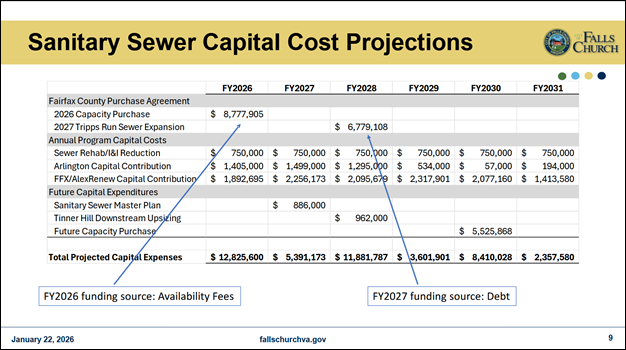
The City Council unanimously approved a proposed sanitary sewer capacity agreement with Fairfax County during its January 27, 2026, regular meeting. At a projected total cost of $15.6 million, the agreement includes a fixed $8.8 million wastewater treatment and conveyance capacity purchase this year of an additional 0.5 million gallons per day (MGD) and an estimated $6.8 million capital contribution in Fiscal Year 2028 to expand the City’s peak flow capacity.
Falls Church plans to cover the sewer capacity purchase with availability fees already paid by developers, said Deputy City Manager Andy Young. Meantime, the capital contribution to expand the Tripps Run sewer in Fairfax County south of the City will be debt financed and “paid for by growth in the subscriber base,” he added, thus affecting all taxpayers.
Sewage flows reflect population growth
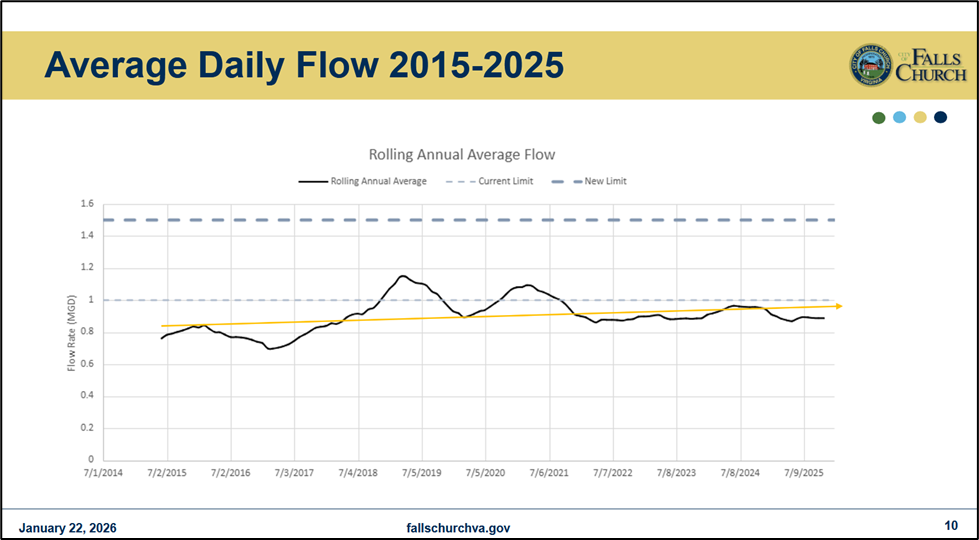
The graph below charts the rolling average annual wastewater flow for the City for the last decade. Mr. Young said these flows have risen 28% during this period due to new development, an increase that tracks the growth in the City’s population. The need for this sewer capacity purchase “opened the door for Fairfax to make some additional demands on us from a peak flow standpoint,” he explained.
Nonetheless, the staff, Mayor Letty Hardi, and some members of City Council continued to justify the use of debt to pay for the Tripps Run expansion as a legacy issue caused by inflow and infiltration, or I&I, of stormwater into the sewer system, particularly during extreme weather events. They maintained that I&I is a community-wide problem that all taxpayers should bear.
The staff is trying to identify areas of the City that contribute most to I&I and expects to address this issue as part of a sewer master plan that will be included in the proposed FY2027 Capital Improvements Program (CIP). Mr. Young acknowledged, however, that the hundreds of miles of City pipes and the sanitary sewer system’s resulting complexity make the sources of I&I challenging to pinpoint. The City has been relining pipes and manhole covers throughout the system and will consider ways to reduce private property I&I as part of the master plan.
Fairfax County’s Board of Supervisors is expected to approve the agreement sometime in April 2026.
References
- City Council Meeting, January 27, 2026. This official video will not display properly on a small screen as it includes the agenda. The discussion of the sewer agreement with Fairfax begins at timestamp 1:53:00 and ends at timestamp 2:22:27.
- City Council Meeting, January 27, 2026. YouTube video.
- Sanitary Sewer Agreement Staff Report, January 26, 2026.
- 2026 Sanitary Sewer Capacity Purchase—City of Falls Church, Staff Presentation, January 26, 2026.
Sewer Agreement Jettisons Basin for Bigger Pipe
January 18, 2026
Summary
- City staff proposed that the City Council approve a sanitary sewer agreement at a projected total cost of $15.6 million. The agreement includes a fixed $8.8 million wastewater treatment and conveyance capacity purchase this year and an estimated $6.8 million capital contribution to expand the City’s peak flow capacity, likely payable in 2028.
- The capital contribution replaces Fairfax’s previous demand that the City build a $10.8 million flow equalization basin to address peak flows during extreme weather events. The City had planned to construct the basin under Cavalier Trail Park.
- Instead, the City’s hourly peak flow limit will be increased from 5.38 million gallons per day (MGD) in 2026 to 7.0 MGD in 2027, and the City will be permitted to exceed this limit a total of three rather than two times in a 12-month period.
- Further, the City will contribute half the cost of enlarging a pipe to mitigate flooding at Barrett Road in Fairfax County, which is also the critical point at which peak flows from Falls Church enter the Fairfax County sewer system. The City would then own 50% of the conveyance capacity in this section of the Fairfax system.
- Members of City Council saw the agreement as a significant improvement over earlier versions of the sewer pact but questioned how the City will pay for it so that developers, and not taxpayers, shoulder the cost of growth. Staff and some Council members contend that inflow and infiltration (I&I) are chiefly legacy issues caused by illegal tie-ins to the sewer system from single-family homes, thus justifying debt financing covered by taxpayers.
- The Council will vote whether to approve the agreement with Fairfax at its January 26, 2026 meeting. The Fairfax Board of Supervisors is scheduled to review, approve, and authorize the pact by April 2026.
- Staff also said that the Quinn senior living and mixed-use development project, which was approved with a plan to construct a force main that would pump the building’s sewage to Arlington County’s treatment facility, may now be revised to tie into the Fairfax sewer system using gravity. This decision on the Quinn project will be made by mid-February.
A year-plus negotiation
Nearly a year since their last communication on the subject, City staff presented a revised sanitary sewer agreement with Fairfax County to the City Council at its January 12, 2026 meeting. [For background on earlier draft agreements, see past Pulse posts on sewer infrastructure, including Sewer Saga—A Deal with Fairfax and $45+ Million in Costs Over 6 Years, March 22, 2025.]
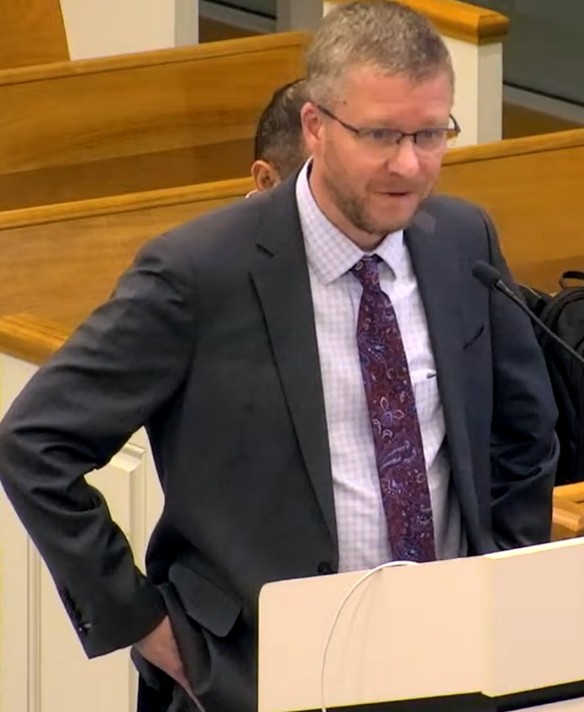
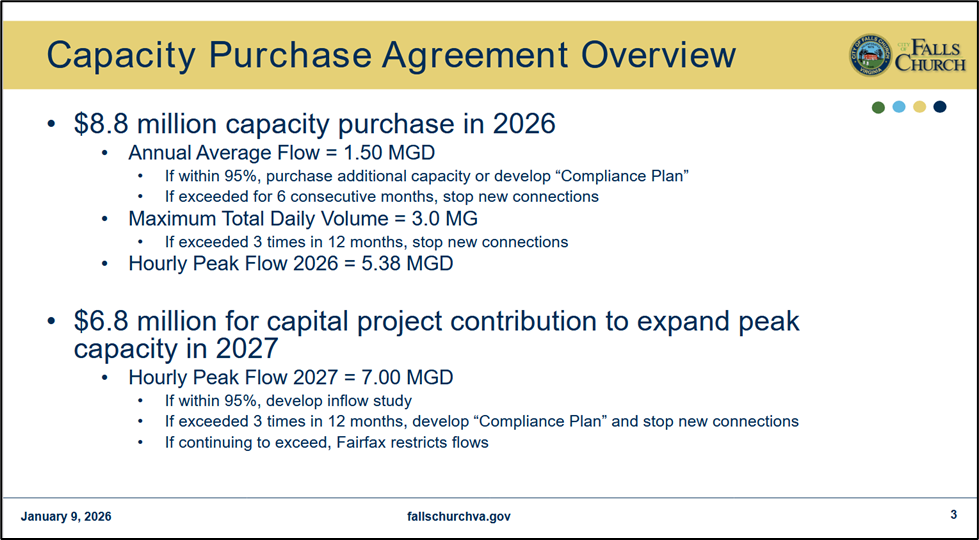
In what Deputy City Manager Andy Young described as “two separate but connected transactions,” the agreement continues to call for an $8.8 million capacity purchase this spring that would add 0.5 million gallons per day (MGD) to the present annual average flow of 1.0 MGD. Failure to stay within the new 1.50 MGD average flow would trigger an additional capacity purchase, a compliance plan, or a halt to new connections.
The second transaction in the revised deal drops the requirement that the City build and maintain an estimated $10.8 million flow equalization basin, replacing it with a projected $6.8 million capital contribution to Fairfax County for a sewer main relocation and upsizing project in Tripps Run that would mitigate flooding outside the City at Barrett Road. The City had planned to construct the basin under the tennis courts at Cavalier Trail Park.
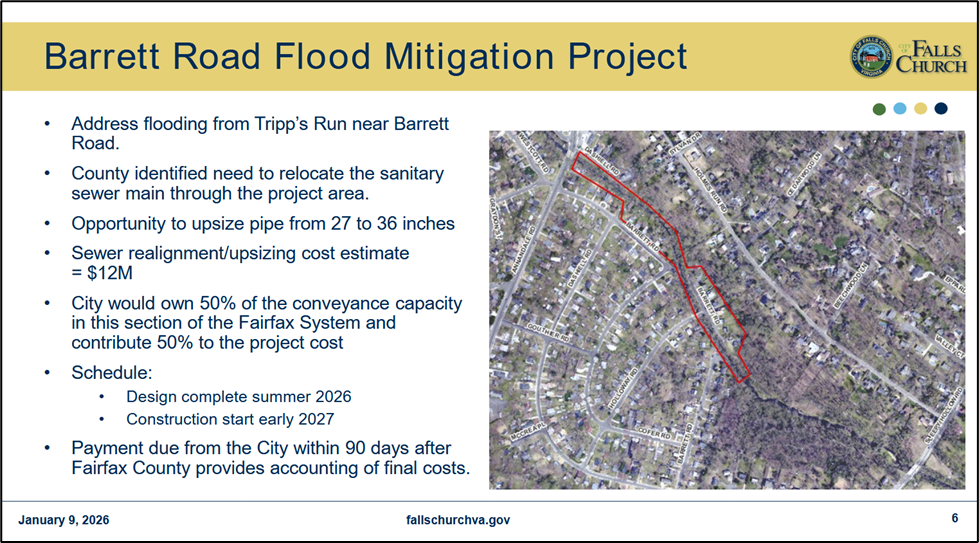
“This upsizing project would remove a key constraint in the Fairfax County system and allow [the County] to sell the City additional peak flow capacity,” Mr. Young said. Its location just south of Arlington Boulevard along Annandale Road at Barrett Road “happens to be the main choke point that limits the amount of flow [Fairfax] has been able to offer the City,” he added.
This contribution would allow the City’s allowable hourly peak flow to increase from 5.38 MGD in 2026 to 7.00 MGD in 2027. In addition to paying for half of the $12 million cost of the relocated and upsized pipe from 27 inches to 36 inches, the City would own 50% of its capacity.
The details of the Falls Church-Fairfax sewer agreement are summarized below in two slides from the staff presentation to City Council. Mr. Young noted that on Friday, January 9, he received a call from Fairfax indicating that the design phase of the Barrett Road project has slipped from spring to late 2026, which pushes the construction and completion of the effort and so the City’s portion of the payment for it from 2027 to 2028.
Limited risk and no operational liabilities
Mr. Young maintained that the new agreement carries “no unique risks” to the City. While the costs of the Tripps Run project at Barrett Road could increase, he said that Fairfax and Falls Church both consider it “pretty straightforward.”
“By pivoting from the flow equalization basin to the Tripps Run project contribution, we’re currently estimating to save the City $4 million in capital costs compared to what we’ve presented [to Council] previously,” Mr. Young stated.
Further, “this approach does not carry the long-term operational liabilities for the City that a flow equalization basin would [have],” he said, noting the added costs of staffing, maintenance, routine cleaning, odor control, and the risk of equipment failure.
Paying for capacity and peak flow leeway
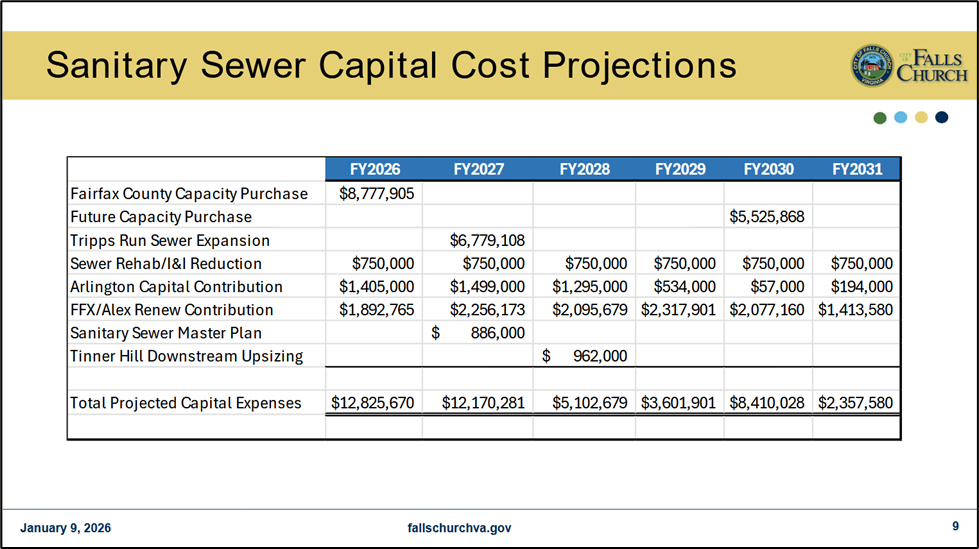
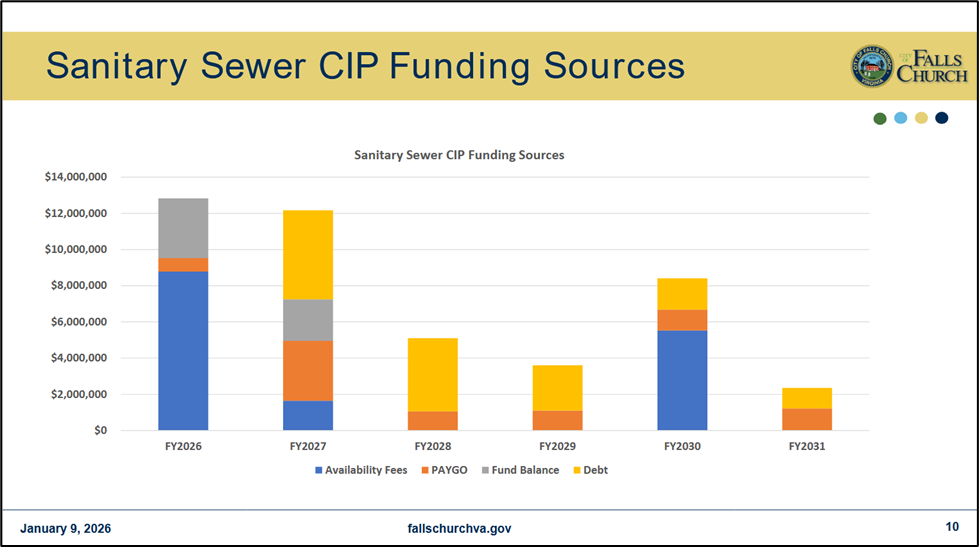
Mr. Young provided the following costs for the two transactions detailed in the agreement (see slide below). He said that the City almost has enough in availability fees collected from developers to pay the $8.8 million cost to purchase additional sewage capacity, adding that “a small amount” from the Sanitary Sewer Fund may be needed to cover the balance.
The $6.8 million Tripps Run sewer expansion will be paid through a combination of availability fees, fund balance and debt. “Debt would be paid for by the growth in users due to development in the City – or expansion of new customers,” Mr. Young said.
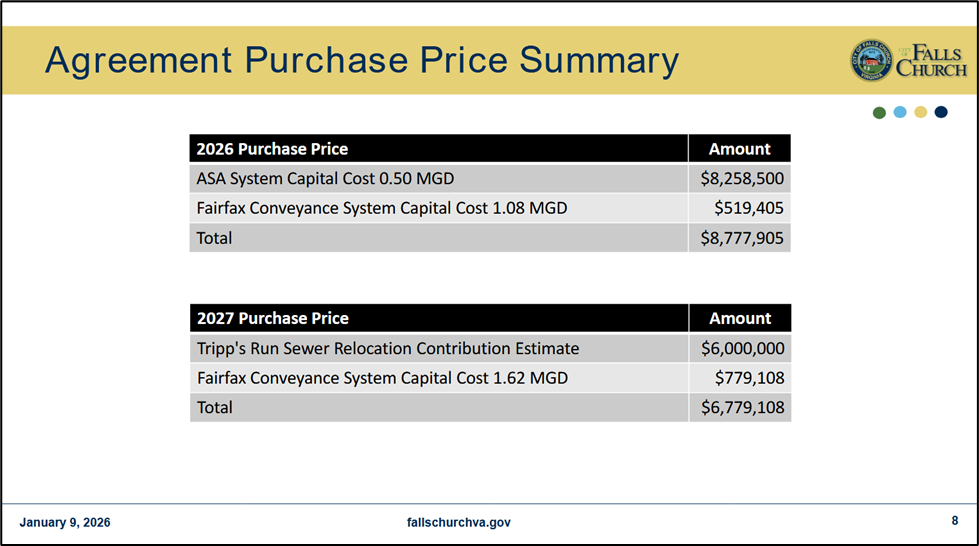
Looking ahead, Mr. Young said a possible future capacity purchase in FY2030 would be covered by availability fees paid by new development. He noted that in estimating the costs in the table below, City staff “had to do a lot of projections on how the new buildings are going to perform.” He expects that staff “will learn some things over the next couple of years” to refine these projections.
Mr. Young also noted that the City will continue to reline pipes and manhole covers at a projected investment of $750,000 each year and will pay Arlington and Fairfax the City’s share of wastewater treatment plant costs annually as indicated below, though he noted that the actual costs are typically lower. The City will also invest $886,000 to create a Sanitary Sewer Master Plan in FY2027 and just under $1 million to upsize a downstream sewer main in the Tinner Hill sub-shed in FY2028.
Reassessing where the Quinn project sewage will be directed
Mr. Young surprised City Council when he said that as a result of the new agreement with Fairfax, the Quinn senior living and mixed-use development might now be able to send its sewage flow by gravity to the Fairfax system rather than build a force main and pump it to Arlington County’s sewer system. [For more information, see Pulse posts City Council Approves the 10-Story Quinn Homestretch Project, Not Waiting For Information On Sewer Outcome, March 11, 2024, and Approved! Quinn Project Moves Loading Dock to S Washington Street, 46% Parking Reduction Waiver Requested, March 20, 2025.]
When the Quinn site plan was approved last year, City Manager Wyatt Shields in a March 19, 2025 memorandum directed the owner/developer to provide a pump station and force main to convey flows to Arlington County, as agreed in a voluntary concession. That concession stated that these sanitary sewer improvements would be paid for and
installed by the owner, that the costs will be deducted from the sewer availability fees otherwise owed by the owner to the City, and that the owner would cover any cost in excess of the sewer availability fees, estimated at about $1.9 million.
Mr. Young said that abandoning the plan to pump the Quinn project sewage to Arlington would allow the City to collect availability fees from the owner/developer in the amount of about $1.7 million that could be used for future capacity purchases. He anticipates that a credit would be issued to the owner/developer for what they have spent thus far on plans for the force main. He added that a final decision on where the Quinn sewage will go will be made in mid-February.
Council commends the work thus far
In sum, Mr. Young said the agreement before Council meets the needs of both the City and Fairfax County. The deal supports ongoing and future growth in the City and comes at a reduced cost to the Sanitary Sewer Fund compared to what the staff had expected the City would need to spend. In addition, the agreement prevents the operational risks of the City building and operating a flow equalization basin.
Council members applauded the progress the new agreement represents in money saved and costs associated with the basin avoided. They also valued the reduction in risk to the City of failing to comply with limits set by Fairfax County by increasing the hourly peak flow and the number of times it might be exceeded in a year. “The architecture of this agreement is far better than we saw before,” said Council Member David Snyder.
Council Member Arthur Agin asked about the assumptions underlying availability fees for an FY2030 capacity purchase from Fairfax. Mr. Young replied, “If the development pipeline doesn’t materialize to support the need for the purchase, the City would not make it.”
Council Member Erin Flynn said she appreciates not having to take on the Cavalier Trail Park disruption and remediation and the build and long-term operation and maintenance of the flow equalization basin. In response to her inquiry, Mr. Young affirmed that the Tripps Run pipe relocation and upsizing is a one-time payment with no ongoing costs.
Questions about the Quinn project’s sewer flow
Ms. Flynn asked whether the staff is comfortable that there is now sufficient sewer capacity through the Fairfax system, even if the Quinn project and other possible City Center developments are added to it. Mr. Young said that staff is confident that the capacity will meet the City’s needs and added that regarding the Quinn project, the team is evaluating “downstream infrastructure so that we don’t create other problems.”
Mayor Letty Hardi requested that the staff “factor flexibility into the Quinn discussions beyond ‘we really like gravity.’” She asked whether staying with building the force main and pumping sewage from this project to Arlington would give the City more leeway for future development.
Council Member Flynn questioned whether the Quinn developers should receive a credit against their sewer availability fees, because they took on that risk when they came to Council seeking approval for their project. City Manager Shields asserted that there is an agreement that they would be compensated for the dollars spent on the force main above their availability fees. Ms. Flynn said she wants to understand those expenditures and desires transparency into the numbers before a decision is made regarding a credit.
Paying for increased capacity and a bigger pipe
Mr. Snyder focused on how the transactions in the agreement with Fairfax will be financed and requested greater clarity regarding the funding sources in the chart below. “Who pays, how is it paid, and over what time period?” He asked about the specific fund balance contribution and the total debt financing needed between now and FY2029. Mr. Young said he would respond with exact figures by January 26, the date of the meeting at which staff has asked for Council’s approval of the agreement.
Concerned about cost overruns for the Tripps Run capital contribution, Council Member Flynn asked if the City’s contribution to this project might be capped.
Assessing the impact of inflow and infiltration
The Council discussed the impact of inflow and infiltration on the need for more sewer capacity and to mitigate peak flows in terms of who should pay for elements of the agreement with Fairfax.
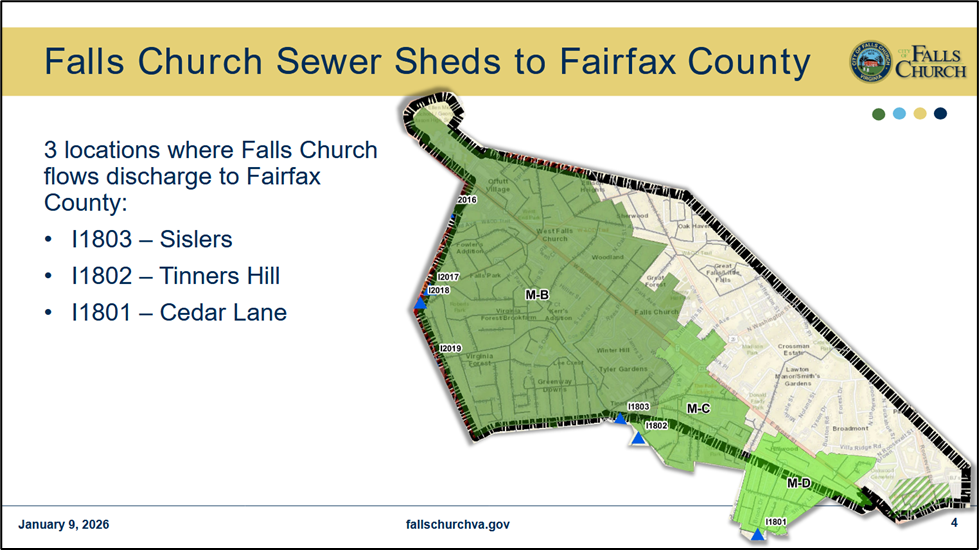
The chart below shows the three locations where Falls Church flows enter the Fairfax County sewer system. Sislers is the sub-shed that has seen most of the recent development and would be the part of the system to which the Quinn project’s sewage would be discharged if the decision is made to direct it to Fairfax rather than Arlington.
Mr. Young said that much of the City’s I&I problem comes from the Cedar Lane sub-shed, which is primarily a residential area that includes parts of Fairfax as well as Falls Church.
Council Member Marybeth Connelly asked if there is a way for the City “to bifurcate I&I” between new mixed-use buildings and older homes. Mr. Young said he thinks the Sanitary Sewer Master Plan can help answer that question, but added that it is complicated by the weather as well as newer, more efficient appliances in recently constructed buildings.
Ms. Connelly also inquired about the role of the Public Utilities Commission (PUC) in working with homeowners to identify sewer laterals that contribute most to I&I. City Manager Shields emphasized the importance of the PUC in addressing what he said is one of the key environmental issues “within our control. We are committed to making real progress in Cedar Lane.”
Council Member Snyder challenged the assumptions about I&I and the conclusion that it is a legacy issue that taxpayers must pay to resolve. He suggested that when the demand for sewer capacity is raised, a small amount of I&I can trigger an overage. “It is not correct to blame that overage on I&I.”
“Certainly there’s more demand, and that’s quantifiable,” Mr. Shields responded. “But the I&I is [also] quantifiable, and it is a serious public policy issue, and that’s why we’ve been talking with Fairfax County about it for two years.” He asserted that “a rainy year has a more significant impact on flows than 20 years of mixed-use development,” adding that if the City tackles this issue, it would be a leader among jurisdictions in doing so.
Mr. Snyder replied, “My view is that I&I is used more for political purposes since it’s never been quantified. The reality is we need more [sewer] capacity because we’ve built more stuff here and more people live here.”
Mayor Hardi brought the discussion to a conclusion by telling Mr. Shields, “We would appreciate the data” on I&I.
References
- City Council Work Session, January 12, 2026. This official video will not display properly on a small screen as it includes the agenda. The discussion of the sewer agreement with Fairfax begins at timestamp 2:07:27 and ends at timestamp 3:13:15.
- City Council Work Session, January 12, 2026. YouTube video.
- Sanitary Sewer Agreement Staff Report, January 12, 2026.
- Falls Church Sanitary Sewer Agreement FINAL, January 7, 2026.
- City of Falls Church and Fairfax County Disposal Areas.
- 2026 Sanitary Sewer Capacity Purchase—City of Falls Church, January 9, 2026.