City Manager: Virginia Village Multistory Building Key to Expanding Affordable Housing
Summary
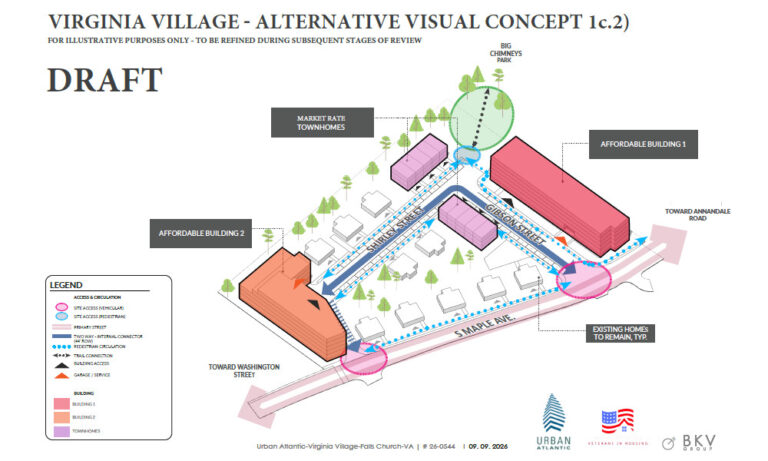
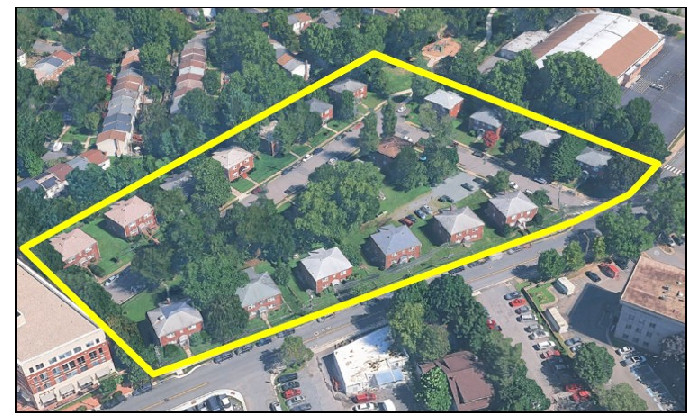
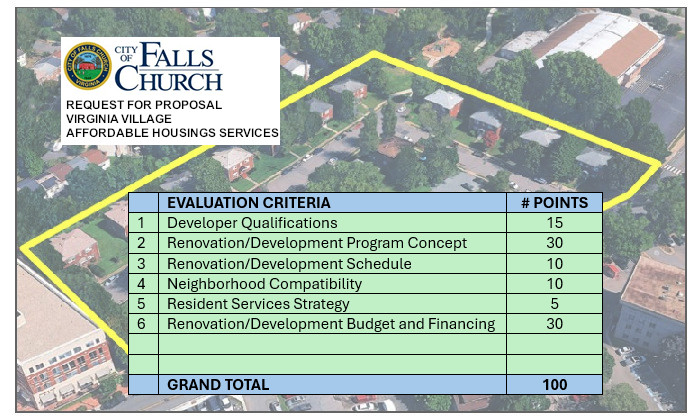
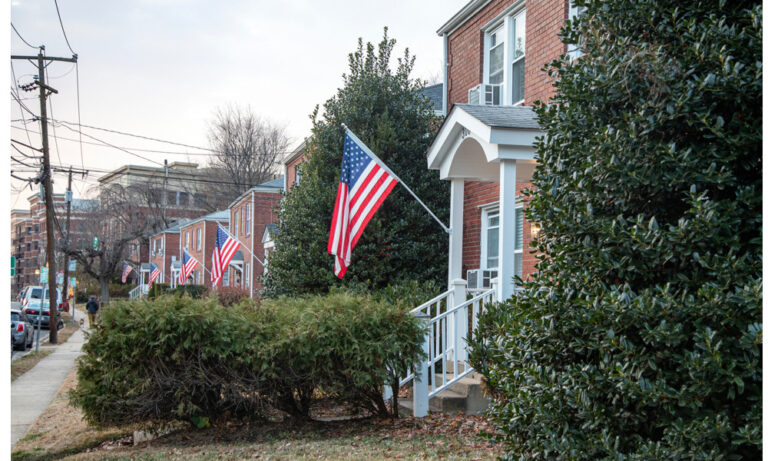
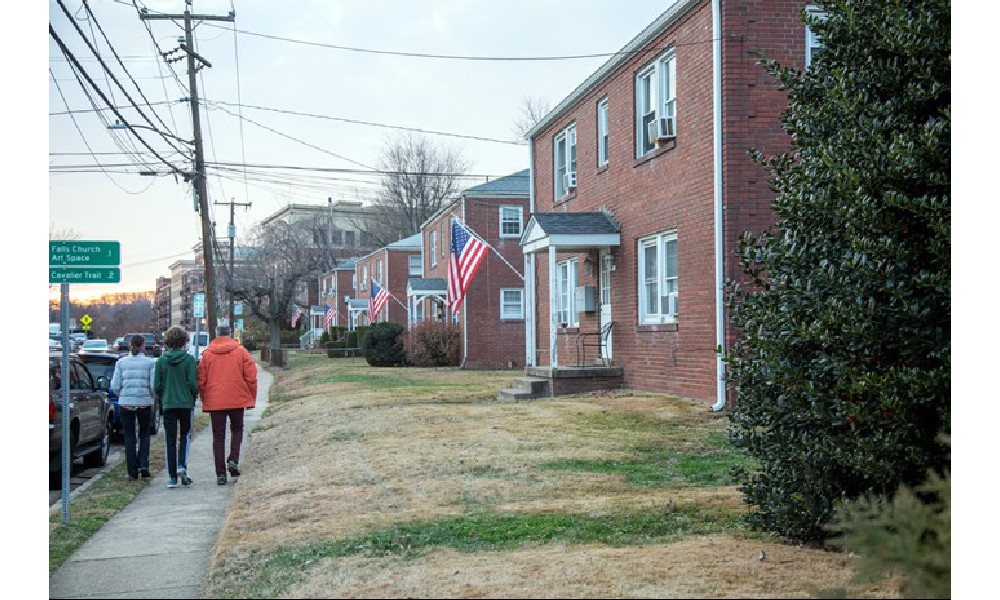
- At the City Council’s January 27, 2026, meeting, City Manager Wyatt Shields said he believes the only way to increase affordable housing at Virginia Village is to construct a multistory building that would replace some or all of the 20 existing 1940s quadplexes.
- A January 22 memorandum from Mr. Shields to the City Council and comments by Mayor Letty Hardi during the meeting further implied that the City will not meet its 2040 affordable dwelling goal of 564 units if it does not build such a structure at the site bound by S Maple Avenue and Gibson and Shirley Streets.
- Separately, Mr. Shields sought to execute a memorandum of agreement (MOA) with the Economic Development Authority, which holds the titles to the nine Virginia Village properties now in the City’s possession. The draft agreement would retain the EDA’s current $475,000 investment in the Virginia Village redevelopment.
- The lack of a signed MOA with the EDA caused the City Council to postpone further discussion of this redevelopment effort from February 9 until March.
Moving forward with the Virginia Village redevelopment roadmap
City Manager Wyatt Shields briefed City Council at its January 27, 2026, meeting on progress made since last fall in vetting staff’s recommended process for redeveloping Virginia Village with the goal of expanding affordable housing. [For background, see the Pulse post Council Mulls Proposed Process to Redevelop Virginia Village, December 10, 2025.]
In a January 22 memorandum to Council, Mr. Shields said the staff has further analyzed the City’s affordable housing inventory and conducted outreach to stakeholders, including tenants, owners, and neighbors of Virginia Village properties, as well as to potential developers.
The impact of the City’s affordable housing goals
In their housing analysis, Mr. Shields said the staff looked at the affordable housing inventory, future growth projections, and the City’s ability to reach its adopted affordability goals, which include that by 2040, 6% rather than the current 3% of all housing stock in Falls Church would be affordable. [See Pulse post Council Approves Affordable Living Policy With 9 Priority Goals, August 19, 2025.]
Staff’s analysis indicates that the City had 206 affordable dwelling units (ADUs) at the end of 2024 and added another 130 ADUs in 2025 for a total of 336 units. However, affordable housing commitments in six of the 14 residential complexes included in the analysis are set to expire before 2040. If none of these commitments at Pearson Square (15 ADUs), The Fields (96), the Read Building (9), NorthGate (7), West Broad Residences (18), and 455 Tinner Hill (14) are renewed, the City will lose a total of 159 ADUs.
Using housing projections from the Stephen S. Fuller Institute at George Mason University, applying the 6% goal to the 2040 population forecast, and assuming all 159 at-risk affordable units are lost, Mr. Shields concludes that the gap in affordable units could be as high as 388 units.
| AFFORDABLE LIVING POLICY AFFORDABILITY GOALS | |||
| Housing Baseline Years | Total Housing Units | ADU Goal | |
| 3% | 6% | ||
| 2022 | 6,500 | 195 | 390 |
| 2024 | 7,469 | 224 | 448 |
| 2025 | 7,814 | 234 | 469 |
| 2040 | 9,400 | 282 | 564 |
Renters, owners, stakeholders, and developers
Mr. Shields told the Council that the staff has spent the last two months contacting renters and owners of properties in the Virginia Village site to inform them of the City’s plans. In addition, the staff has begun conversations with stakeholders, including the City’s Planning and Housing Commissions, neighbors adjacent to the Virginia Village site, the Winter Hill Condominium Board of Directors, and the Tinner Hill Heritage Foundation.
The staff has also met with four nonprofit developers to gather feedback on the proposed process roadmap presented to Council by Planning Director Matt Mattauszek last November. In these conversations, the staff focused on the City’s plan to issue a request for proposals from nonprofit partners that can develop new affordable housing on at least part of the Virginia Village site. Mr. Shields said staff sought to balance the desire for plans “that are buildable” with concerns that such elements as density, number of units, building heights, and mix of uses might be “prebaked before we engage with the community.”
Mr. Shields said the staff met with development teams from True Ground Housing Partners (formerly Arlington Partnership for Affordable Housing), Fairfax County Housing Authority, NHP Foundation, and Community Housing Partners.
These developers provided the following feedback:
- While they appreciated the overall schedule being organized around the annual March Low Income Housing Tax Credit (LIHTC) funding application due date, these organizations consider the proposed roadmap’s March 2027 LIHTC application target “aggressive.”
- A request for proposals should be as clear and detailed as possible regarding the City’s goals; “‘Don’t make us guess’ was a frequent theme,” Mr. Shields’ memorandum stated.
- Ideally, more land would be assembled before an RFP is issued.
- Prior to an application for LIHTC or other federal and state funding, the developers would need clarity from the City on:
- Site control—an executed purchase and sale contract for the property.
- Zoning entitlements—building envelope, height, setbacks, number of units, mix of uses, other zoning requirements, and proffers, or Voluntary Concessions.
- Local funding commitment—local contributions in recent nearby affordable housing projects range from $80,000 and $120,000 per unit in such forms as a non-recourse loan, land contribution, and tax treatment.
Council discussion
Both Mayor Letty Hardi and Council Member Erin Flynn asked whether the local funding commitment of $80,000 to $120,000 included the land contribution. Despite the suggestion in his memo that the local funding commitment could include Virginia Village land, Mr. Shields said, “I don’t have clarity on that.”
Ms. Hardi suggested that the Council think creatively about other ways to provide this subsidy, such as limiting the amount of parking the developer would be required to provide. She recently offered her personal and thus unofficial testimony in Richmond in favor of a bill proposed by Senator Saddam Azlan Salim that would eliminate parking requirements statewide, even though the City Council’s adopted legislative program calls for working collaboratively with the Senator to refine his bill so that it maintains local authority over such decisions and mitigates the impacts on built-out neighborhoods. [See the Pulse post Social Safety Net, Metro Funding Top 2026 Legislative Program, January 5, 2026.]
The City Manager acknowledged that the funding commitment will be “a big challenge that will require us to think through options and tradeoffs.”
Regardless of the March 2027 LIHTC deadline, Ms. Flynn urged that sufficient time be given for community engagement in revising the Small Area Plan and the Comprehensive Plan for this part of the City. Council Member Marybeth Connelly recommended that the staff also reach out to the Cherry Hill Townhouse Homeowners Association, and Vice Mayor Laura Downs stressed the need to involve the Winter Hill/Cherry Hill community in planning discussions “on the front end.”
Relocating Virginia Village residents
Both Ms. Flynn and Council Member David Snyder expressed concern about relocating people now living in Virginia Village’s affordable housing. Council Member Flynn asked how the City would go about assembling the units needed to relocate individuals and families during any redevelopment. Mr. Snyder noted that finding new homes for people and moving them back after redevelopment have quality-of-life as well as economic costs. He, too, asked whether the staff has determined an approach for doing this.
Mr. Shields responded that this is not the staff’s job. The staff’s role, he said, “is to have a process where there can be a policy-driven vision for the future of this site. The City Council is going to have to decide what we are trying to accomplish…with respect to affordable housing and, ultimately, what other mixes of uses…we want to accomplish on this site.” He maintained that the process the staff has outlined in its roadmap should provide a way for the Council to make those policy decisions.
Renovate or tear down?
Mr. Snyder also said he wants “to make sure [from] the beginning that we’re looking at all options, including renovating the existing units and expanding those units. My fear is that the assumption is already being made…that we’re going to tear them down and replace [the quadplexes] with some big building.”
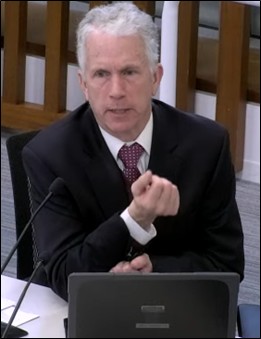
In reply, Mr. Shields said, “To be totally transparent, I do envision that there would be a multistory building…as the only way to expand affordable housing [at Virginia Village]. But does that need to cover the full site? I think there [are] a lot of opportunities for different things to be happening on the site, including market-rate housing.” He added, “That’s what the public process can help us grapple with.” The City Manager continued, “These are my thoughts; the Council will make the decision.”
Mayor Hardi pointed to the Affordable Living Policy the Council adopted last year and suggested that Virginia Village represents a key piece of what the Council hopes to accomplish across the entire City in terms of affordable targets. “If we really are going to hit our commitment [that] 6% of all housing in the City [will be] affordable by 2040, we need 564 units,” she said.
Expiring ADUs
Ms. Hardi also asked the City Manager for the City’s “game plan” regarding the expiring 159 ADUs. “A tragedy I think we are dealing with is that in the past, units expired faster than we could build them,” she said. The Mayor suggested setting aside Council time for a separate strategic discussion about how to preserve these units, rather than combining such negotiations with the Virginia Village conversation.
A draft agreement between the City and the EDA
The following week the Economic Development Authority (EDA) met with City Manager Shields and City Attorney Sally Gillette to review the proposed memorandum of agreement (MOA) between the EDA and the City governing the Virginia Village properties. Because she serves as the attorney for the City and the EDA, Ms. Gillette sought and received consent to represent both organizations in negotiating this agreement.
During the February 3, 2026, EDA meeting, the City Manager reviewed the draft MOA, which calls for the Authority to retain the title to the nine quadplexes currently owned by the City and any of the remaining 11 Virginia Village quadplexes the EDA may acquire. The arrangement specifies that the EDA will not sell or encumber the properties without the permission of the City Council. Further, the MOA assumes the EDA will keep its original $475,000 investment in Virginia Village and permits the Authority to earn an annual return on that investment equal to the Consumer Price Index for the Washington/Arlington/Alexandria area plus 1%.
The City staff will oversee the day-to-day management of the properties with an outside property manager, including setting rents, Mr. Shields said, and the City Council will be “the policy decider” with respect to the current and future uses of the Virginia Village properties.
“The City is about to invest significant time and money to consider planning for the future of this site,” Mr. Shields said. “It’s important to have an agreement up front so…we all understand what the rules of the road are and that, ultimately, the decision on the disposition of the properties lies solely with the City Council.”
Is a City-EDA partnership possible?
In response to EDA Chair Ross Litkenhous’ statement that an equity investment could generate an 18% return, Mr. Shields acknowledged that the MOA proposes “a conservative ROI” to the EDA. However, he said the arrangement reflects what he hopes will be “the spirit” of the EDA’s partnership with the City on affordable housing.
This ROI was proposed “on the theory that we want as much money to be working to help this project be successful and not leaking out for other things,” Mr. Shields said. Because affordable housing developments often include a requirement for a local contribution, “the City is going to be looking under every cushion of our sofa to find money to provide [that] contribution to make the project feasible.”
Mr. Litkenhous said that a return of CPI plus 1% would constitute “a good neighbor policy,” but that the EDA may find it has other competing opportunities, such as “a pending land banking deal that becomes urgent” and could be used to advance the City’s interests when needed. Further, the EDA Chair said while CPI plus 1% might be acceptable for a Virginia Village project that is 100% affordable housing, if market-rate and commercial elements become part of the redevelopment, the EDA would want to see its $475,000 generate a higher return.
EDA Member Alan Brangman suggested that the Virginia Village land might not need to be contributed in the form of a sale but rather as a ground lease with a return provided over a period of years and ownership remaining with the EDA and the City. “The ground lease could be part of whatever deal gets done,” he said.
Mr. Brangman said another approach would be to leave discussion of the EDA money out of the MOA “until there is some determination as to what this project is going to look like”—all affordable, a portion affordable, or primarily market rate.
Mr. Litkenhous recommended that the present MOA speaks only to a project that is 100% affordable, and any market-rate development at Virginia Village would require separate agreements negotiated between the City and the EDA for “how our money is treated.”
Mr. Shields said he would continue to work on the MOA draft to accommodate this range of scenarios. In response to EDA Member Matt Quinn’s request for greater involvement by the Authority in the Virginia Village redevelopment, the City Manager said he expects to have an EDA member on the selection committee that will choose the City’s Virginia Village development partner.
References
- City Council Meeting, January 27, 2026. This official video will not display properly on a small screen as it includes the agenda. The discussion of the Virginia Village redevelopment begins at timestamp 1:18:00 and ends at timestamp 1:46:00.
- City Council Meeting, January 27, 2026. YouTube video.
- Manager’s Report on VA Village, January 26, 2026.
- Economic Development Authority Meeting, February 3, 2026. This official video will not display properly on a small screen as it includes the agenda. The discussion of the Virginia Village MOA begins at timestamp 26:35 and ends at timestamp 1:10:22.
- Memorandum of Agreement Between the City of Falls Church and the Falls Church Economic Development Authority for the Management of Virginia Village Properties, February 3, 2026.