City Plans to Select Virginia Village Developer by August
Summary
The City Council initiated a process on March 9, 2026, to amend the small area plans (SAPs) that include Virginia Village in preparation for the affordable neighborhood’s redevelopment.
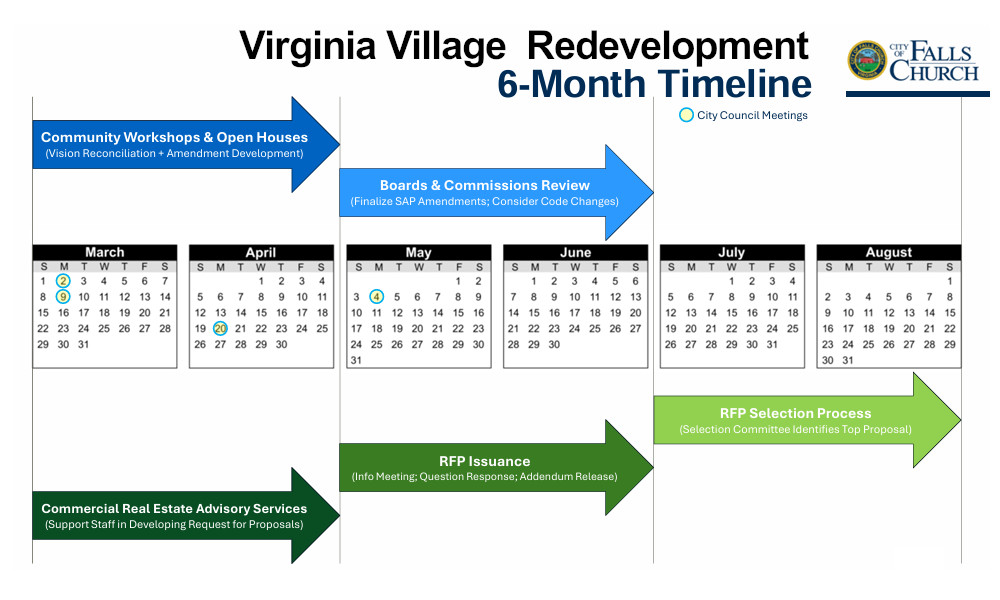
The SAP amendment process involves community visioning workshops and review sessions as well as board and commission meetings that will take place between late March and the end of June 2026. The initial visioning workshops are scheduled for Saturday, March 21, from 10:00 a.m. to 12:00 noon, at Oak Street Elementary School, 601 S Oak Street. and Tuesday, March 24, from 7:00 to 9:00 p.m., at the Columbia Baptist Church, 103 W Columbia Street.
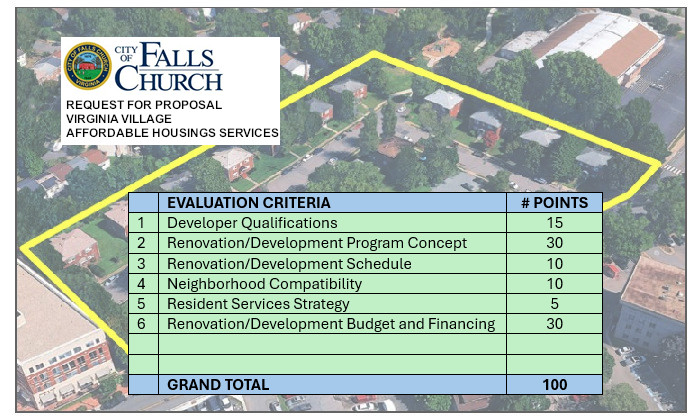
Simultaneously, the City’s planning staff is preparing a request for proposals for the redevelopment of the Virginia Village properties the City now owns through its Economic Development Authority. The staff says that what is put out for bid will be informed by changes to the SAPs and that the RFP can be amended, if necessary, after it is issued in May. The City expects to choose a developer by the end of August to meet the March 2027 application deadline for federal Low Income Housing Tax Credit funding.
The speed with which the Planning Department plans to issue the RFP has caused concern among some community members and leaders about whether the City is genuinely interested in community feedback. In addition, issuing an RFP could have the unwelcome impact of significantly raising land prices, making it more difficult for the City to acquire additional Virginia Village properties to provide more affordable housing.
Parallel tracks
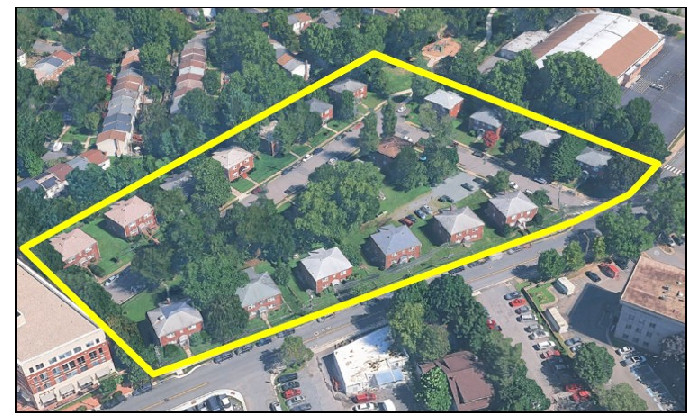
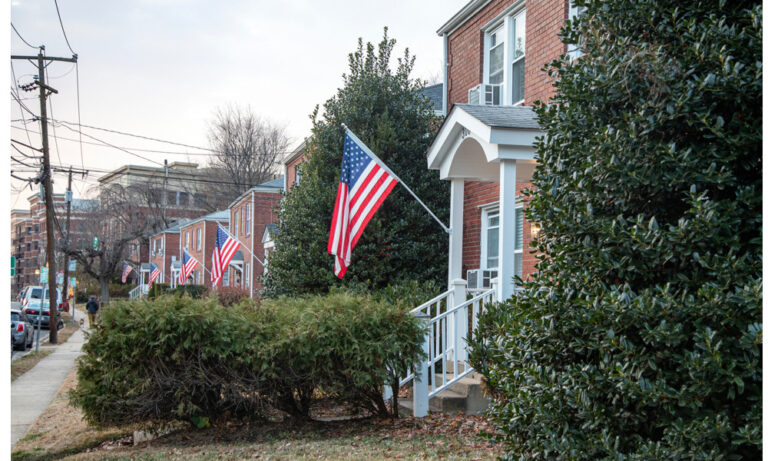
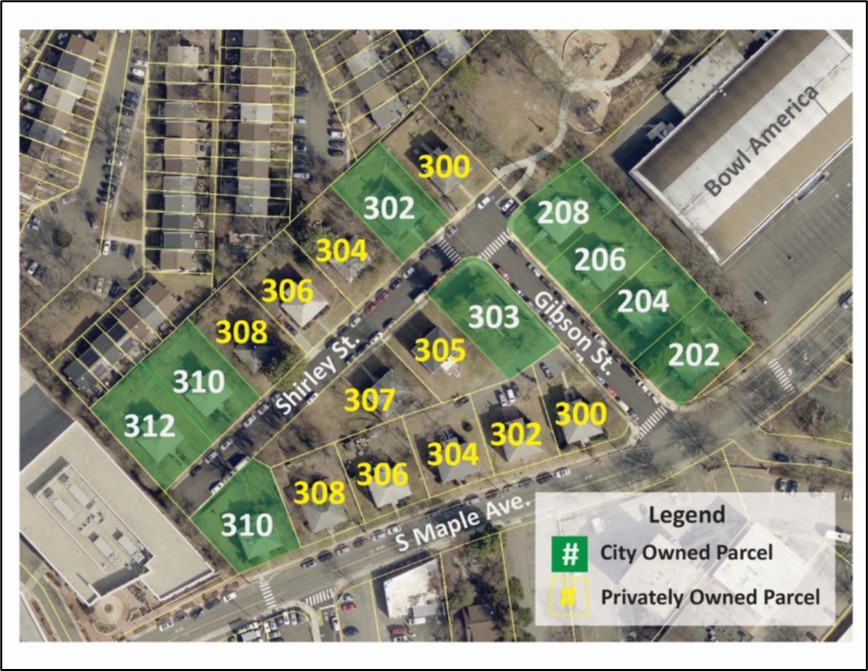
During its first two meetings in March, the City Council considered and passed a resolution to initiate community discussions about what comes next for Virginia Village, the 1940s collection of 20 quadplexes bound by S Maple Avenue and Gibson and Shirley Streets that currently provides affordable housing to 80 individuals and families.
In their presentation to Council, the City’s planning staff emphasized that public feedback on any redevelopment of the site will focus on possible amendments to the two small area plans (SAPs) that govern this part of the City but will not address the request for proposals (RFP) for what might be built there. The RFP, which is being fast-tracked for an award by late August, will only include the properties the City owns when it is issued in the May/June time frame, according to Planning Director Matt Mattauszek.
The parallel tracks for “dusting off and confirming” the vision for Virginia Village to be included in the RFP while also preparing and issuing that document and selecting a developer before summer’s end have caused concern that the outcome is predetermined.
In fact, City Manager Wyatt Shields said last month that he believes a multistory building is the only way for Falls Church to meet its 2040 affordable housing goals, and Mayor Letty Hardi and other members of City Council support the process outlined by the planning staff, which the staff itself characterizes as “aggressive.” [For background, see the Pulse post City Manager: Virginia Village Multistory Building Key to Expanding Affordable Housing, February 13, 2026.]
Part of two small area plans
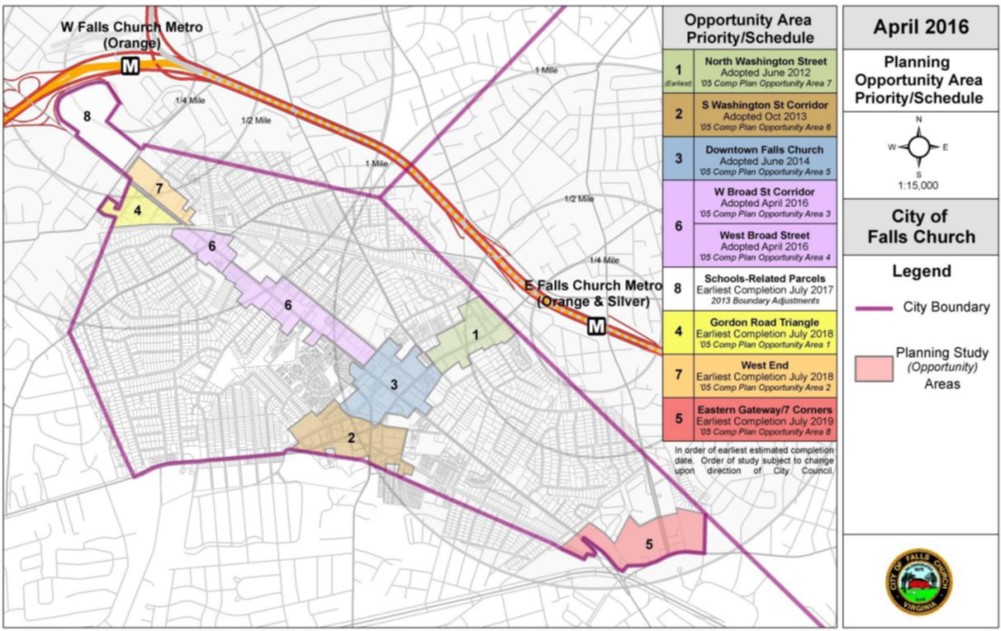
In his presentation to City Council on March 2, 2026, and again on March 9, Senior Planner Jack Trainor explained that small area plans (SAPs) “represent community-defined visions for redevelopment within Planning Opportunity Areas,” or POAs. SAPs are intended to make recommendations that reflect Comprehensive Plan guidance and include zoning and future land use, mobility and access, character and design, and utilities and environment, he said.
Source: Staff report, “Virginia Village Initiating Resolution:
Small Area Plan Amendments,” March 9, 2026
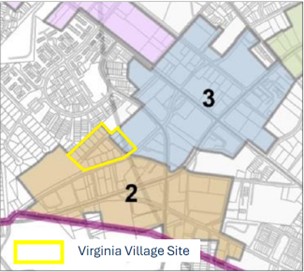
Virginia Village spans two of the City’s eight SAPs and consists of approximately 4.5 acres – 3.5 acres, or 83% of the neighborhood, falls within the South Washington SAP (POA #2), adopted in October 2013, and 1 acre, or 17% of the site, is part of the Downtown SAP (POA #3), adopted in June 2014.
Source: Staff report and presentation, “Virginia Village Initiating Resolution: Small Area Plan Amendments,”
March 9, 2026
Mr. Trainor said the staff seeks to reconcile present SAP guidance with recent Comprehensive Plan updates and City policies related to affordable housing. Those updates include the 2040 affordable housing goals set in the Affordable Living Policy adopted by City Council in August 2025, as well as new and expanded affordable housing creation using the Virginia Village Property Acquisition Strike Fund, a revolving fund established in 2022 to acquire properties in Virginia Village when they become available with the stated goal of ensuring that affordability is preserved.
Updated SAP guidance for Virginia Village would cover future land uses (such as residential, park space, a community center), buffering and screening with consideration for neighboring uses, and building design (height, density, step-backs). Mr. Trainor said the revised guidance would inform the RFP for the redevelopment of this neighborhood and be included in the City’s Comprehensive Plan chapter on land use.
Mr. Trainor emphasized that revisiting the specific SAP recommendations for Virginia Village will not involve a wholesale rewrite, but rather a focused review of previously developed recommendations related to this specific site.
A phased approach calling for multiple uses, including affordable housing
Source: Staff report and presentation, “Virginia Village Initiating Resolution: Small Area Plan Amendments,” March 9, 2026
Thus far, the City has acquired a contiguous 30,000 sq ft on the East side of the property, and nearly 29,000 contiguous sq ft on the West side of the site shown above, “both of which have the potential to accommodate a range of housing typologies at various levels of densities,” according to the March 9 staff report to City Council. The City hopes to acquire additional properties through its Economic Development Authority (EDA), which holds the title to the nine quadplexes now within the City’s control.
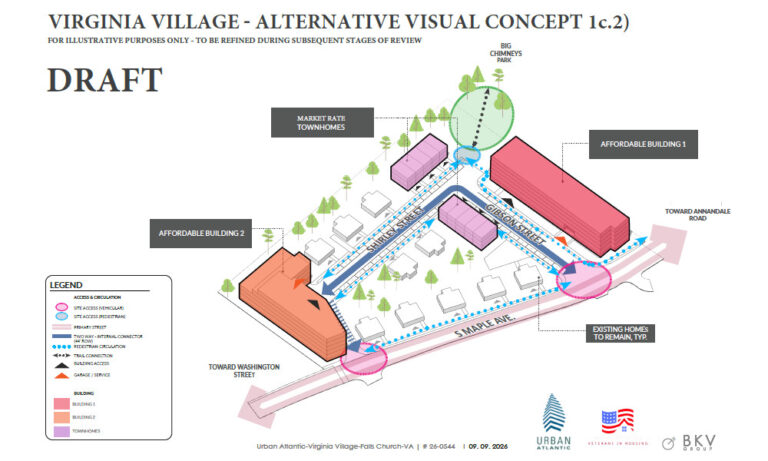
“Instead of considering a single use for the entirety of Virginia Village, a mixed-use phased redevelopment strategy could achieve multiple positive outcomes without diminishing the affordable housing already on site,” the staff report continues.Among those outcomes are “meaningful affordable housing development” as well as “community amenities or market-rate townhomes to help subsidize some of the costs of redevelopment.” Other possible uses include the expansion of Big Chimney’s Park and a community center.
Engaging the public
The City’s planning and housing staffs met with the residents of Virginia Village in February to describe the possible redevelopment and answer their questions. The housing staff are finalizing a relocation policy for these residents, should redevelopment proceed. Staff have also convened meetings with other stakeholders, including the Tinner Hill Heritage Foundation and Winter Hill Condominium Association, which represent sites and communities adjoining Virginia Village.
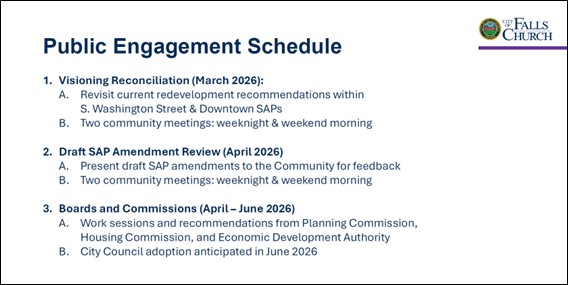
Going forward, staff proposes a three-step public engagement process between March and June 2026 to update the South Washington Street and Downtown Small Area Plans.
Source: Staff report and presentation, “Virginia Village Initiating Resolution: Small Area Plan Amendments,” March 9, 2026
The first phase, community visioning workshops scheduled in March, will invite residents to confirm those aspects of previous Small Area Plan guidance that remain relevant for the Virginia Village site, including land uses and neighboring uses, such as buffering, Mr. Trainor said. These workshops will be held Saturday, March 21, from 10:00 a.m. to 12:00 noon, Oak Street Elementary School, at 601 S Oak Street, and Tuesday, March 24, from 7:00 to 9:00 p.m., at the Columbia Baptist Church, 103 W Columbia Street.
In the second phase this spring, staff will present and seek additional feedback on proposed amendments to the SAPs based on input received in March during community review meetings on April 11 and 14. The Planning Commission and the City Council will hold work sessions on the feedback received by that point on April 15 and April 20, respectively.
The third and final phase will involve feedback from City boards and commissions in May and June as the staff prepares plan amendments, Mr. Mattauszek said. Final City Council consideration and adoption of any SAP amendments are scheduled for late June.
Finding a partner
Meanwhile, before the public engagement phases are complete, the planning staff will issue an RFP to identify a partner for an affordable housing redevelopment of the City-owned properties in Virginia Village, said Mr. Mattauszek. To accomplish this, the staff will partner with a commercial real estate advisory services firm to finalize the RFP and manage the procurement and selection process.
The staff has also asked the City Council to appoint a selection committee that would include representatives of the EDA, other boards and commissions, and staff. The selection committee will begin work in July and will be charged with identifying the top proposal by the end of August.
Reactions to the staff’s roadmap
In response to concerns from Tim Stevens of the Planning Commission and Erin Flynn of City Council at the March 2 Council work session about the Virginia Village schedule, Mr. Mattauszek characterized the short timetable as “the elephant in the room” but maintained it is “doable.”
The Planning Director noted that only 5% of the RFP will involve community feedback while “95% is boilerplate.” If adjustments need to be made based on public engagement, Mr. Mattauszek said, the staff “can issue an addendum to the RFP.” Referencing this comment at the March 9 Council meeting, Mayor Hardi said, “That made me feel better that [feedback] is driving the [RFP], and not the other way around.”
However, Council Member David Snyder expressed concern that the community may be restricted in what it is able to say during the public engagement process. “What if the community says we don’t want an RFP?” he asked. “I want to be sure that there is maximum freedom for the community…that they have the right to make comments that may be very favorable, may suggest modifications, or may suggest going in a different direction, and that all of that would be considered seriously moving forward.”
In response, Mr. Trainor indicated the scope of the public engagement would be to consider amendments to the small area plans only and not the RFP. Ms. Hardi jumped into the exchange between Mr. Trainor and Mr. Snyder to insist that these plans, developed more than 13 years ago, need to be “refreshed in light of the new acquisitions we’ve made at Virginia Village…[and] the Affordable Living Policy” adopted last year.
“We don’t actually have a proposal before the community,” she said. “We don’t even have a project yet. Developers may respond to [the RFP] and propose projects, but that’s down the road. That’s several months down the road.” Mayor Hardi added that any relocation or displacement of Virginia Village residents is “several years away.”
During their meetings in March, Council members asked for copies of the City’s revised relocation policy and the costs to move current Virginia Village residents as well as a finance plan for redeveloping the site.
In addition, Council Member Arthur Again, Ms. Flynn, and EDA Member Alan Brangman expressed their preference that guidance for Virginia Village be consolidated under the South Washington Small Area Plan. While applauding the creation of a roadmap, EDA Vice Chair Jim Coyle recommended being clear about the definition of the type of housing this will be, whether “workforce housing, housing for those with disabilities, housing for people with limited incomes.”
Council Member Justine Underhill voiced concern about who will participate in the public engagement portion of this process. “A lot of research shows that people who show up at meetings…are really a very small, self-selected group, also disproportionately higher income homeowners,” she asserted. “It is important to include those who are nearby in the discussions, but I also want to make sure that we include the broader community—people who aren’t homeowners, people who might even want to live in this sort of place, otherwise we end up with a very narrow view of community feedback.”
Finalizing an agreement with the EDA
The City’s plans for Virginia Village require finalizing a memorandum of agreement (MOA) with the EDA as the owner of the properties to be redeveloped. The agreement calls for City staff to function as the EDA’s agent in managing the nine properties and the rents generated from them, with these proceeds only permitted to be used for maintenance, acquisition of other Virginia Village properties, and planning for future development. In addition, the EDA is entitled to an annual return on its investment of $475,000 to acquire the 302 Shirley quadplex.
At its March 17 work session, the City Council agreed to return the draft MOA to the EDA for additional discussion in early April before Council considers and approves it during the Council’s April 13 meeting. The remaining issue is whether a sale of the Shirley Street property for anything other than affordable housing would result in the City paying the EDA “market value,” the term preferred by the City, or “fair market value.”
EDA Chair Ross Litkenhous has said he will not sign the MOA if it does not include the fair market value language. Market value is the actual current price a property would command in the open market and typically would be less than the theoretical fair market price often used for tax and legal purposes. When the planning staff first suggested the idea of issuing an RFP for the redevelopment of Virginia Village last November, some EDA members expressed concern that doing so would spike land prices, making the creation of more affordable housing on the site untenable.
References
- City Council Work Session, March 2, 2026. This official video will not display properly on a small screen as it includes the agenda. The discussion of the Virginia Village redevelopment begins at timestamp 0:2:35 and ends at timestamp 1:08:10.
- City Council Work Session, March 2, 2026. YouTube video.
- City Council Regular Meeting, March 9, 2026. This official video will not display properly on a small screen as it includes the agenda. The discussion of the Virginia Village redevelopment begins at timestamp 0:55:00 and ends at timestamp 1:19:40.
- City Council Regular Meeting, March 9, 2026. YouTube video.
- Staff report on Resolution to Initiate Amendments to the South Washington Street Small Area Plan and Downtown Small Area Plan Related to Recommendations for Redevelopment of Virginia Village and to Amend the City of Falls Church Comprehensive Plan to Update Chapter 4, “Land Use and Economic Development” to Incorporate Both Small Area Plans, March 9, 2026.
- South Washington Street Corridor, Planning Opportunity Area 2, October 28, 2013.
- Downtown Falls Church, Planning Opportunity Area 3, June 23, 2014.
- Virginia Village Roadmap, November 17, 2025.
- Staff presentation, Virginia Village Initiating Resolution: Small Area Plan Amendments, March 9, 2026.
- Memorandum of Agreement between the City of Falls Church and the City’s Economic Development Authority, March 16, 2026.