Sale of The Fields Risks Loss of 96 Affordable Units by Year-End 2029
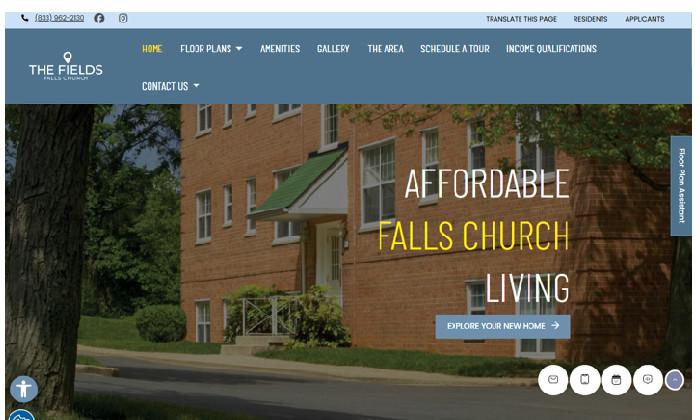
Above, a screenshot of The Fields website
Summary
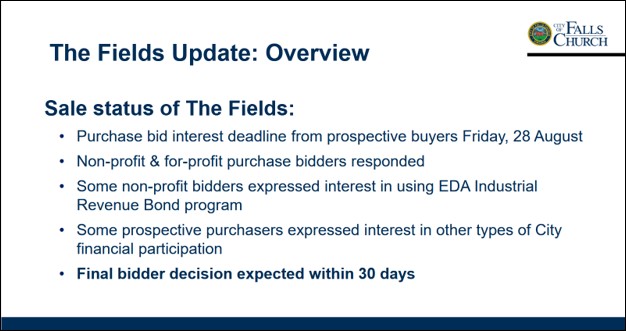
- The Fields, currently the largest affordable housing complex in Falls Church with 96 apartments, is up for sale. Bids were due by August 28, 2026, with a buyer expected to be selected in 30 days.
- With low-income housing tax credits (LIHTC) expiring at the end of December 2026 and the increasing value of the land here, the property could be redeveloped at market rates after 2029, thus risking the loss of more than a quarter of the City’s existing affordable housing stock.
- The Economic Development Authority (EDA) indicated its willingness to issue Industrial Revenue Bonds (IRBs) to support nonprofit buyers of The Fields that commit to maintaining affordable housing at the site.
The property and its owners
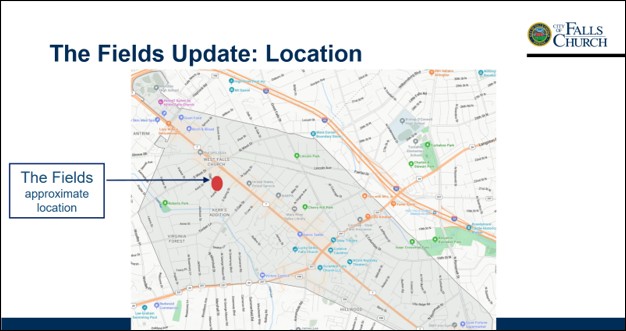
Located on Ellison Street behind Taco Bell at Broad and West Streets, The Fields apartment complex is on the market. The partnership that owns the property sought bids by August 28, 2026, and told the City they plan to decide on a buyer in 30 days, according to Deputy City Manager, External Operations Andy Young.
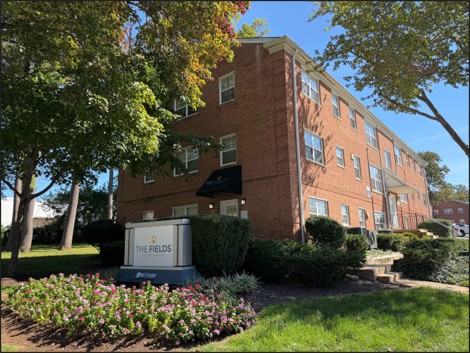
The nine, 3-story, garden-style buildings consist of 96 committed affordable one-, two-, and three-bedroom units and offer communal laundry facilities and outdoor spaces. Constructed in 1958, they sit on 4.38 acres and were last significantly renovated in 1996.
The Fields provides homes to households earning at or below 60% of the Area Median Income (AMI) and was made affordable through the partnership’s use of 30-year, low-income housing tax credits (LIHTC) that are set to expire at the end of December 2026. Under Virginia Housing’s extended use agreement, however, the units must remain affordable for a full three years after the housing credits expire, so through 2029.
The ownership group includes Wesley Housing, the designated nonprofit partner; Kettler, the general partner and property management firm; and SunAmerica (AIG), the limited partner and primary investor. According to a study titled The Fields Preservation Plan and prepared for the City by consultants National Housing Trust in October 2020, “SunAmerica is the controlling party and can decide whether to hold or sell the property, and when.”
According to City records, The Fields was assessed at $14.1 million in 2025 and at nearly $16.9 million in 2026. The property’s market value can be expected to be higher than its assessed value. The preservation plan report concludes that given the value of the land, “the City can assume that the property’s future will entail one of the following options: 1) the sale of the property at a market-rate price that does not assume long-term affordability; or 2) allowing the affordability covenant to expire, increasing rental prices, upgrading the units as they become vacant and renting at market rate; or 3) redevelopment of the site to a more profitable use.”
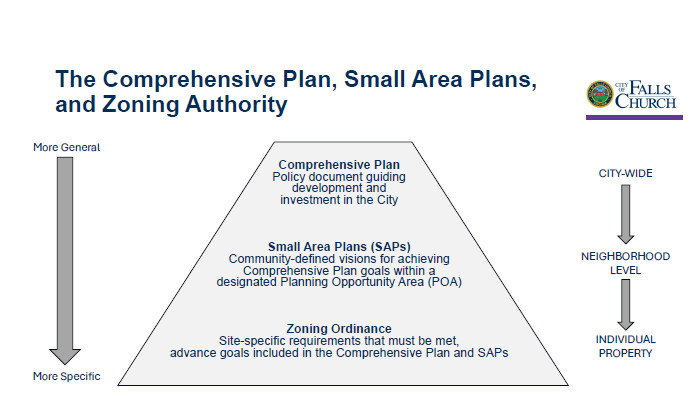
The Fields is currently zoned Residential Multifamily (R-M), which allows by-right the uses in R1-B districts, multifamily dwelling units up to 3 stories, and boarding and rooming houses. This zoning presently does not permit the construction of townhomes by right.
A key chunk of the City’s affordable housing stock
The Fields constitutes more than a quarter of the City’s current affordable housing stock of 336 units. [For background, see the Pulse post Council Approves Affordable Living Policy With 9 Priority Goals, August 19, 2025, and the City’s adopted Affordable Living Policy.]
The loss of The Fields affordable units “would be devastating” to the City’s affordable housing inventory and initiatives, Mr. Young told Economic Development Authority (EDA) members during their September 1, 2026, meeting.
Mr. Young met with the EDA to brief Authority members on the status of the sale of The Fields and to ask whether the Authority would support the issuance of Industrial Revenue Bonds (IRBs), which would provide potential nonprofit buyers access to debt financing at a much lower interest rate than would be available to for-profit purchasers of the apartment complex.
In describing the IRB process, Mr. Young said, “There is no risk to the City or the EDA in issuing these bonds, and the EDA would collect a little transaction revenue by supporting them.” The annual EDA administrative fee would be one tenth of one percent of the outstanding principal balance of the loan, as noted in the slide below.
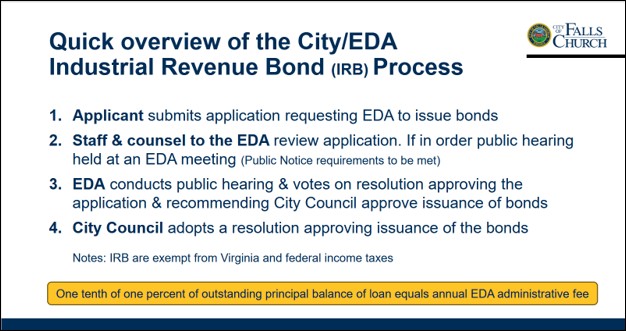
EDA Chair Ross Litkenhous affirmed Mr. Young’s comments. “Having access to debt…at a much cheaper price allows [nonprofit developers] to compete in for-profit, market-rate transactions.” IRBs don’t completely “level the playing field,” he added, “but they help advance municipal objectives,” such as affordable housing.
The EDA voted unanimously to indicate its “willingness to entertain issuing IRBs to support” purchasers of The Fields who want to maintain affordable housing at the complex. Mr. Young thanked EDA members for the flexibility their vote gives the City in addressing the needs of potential nonprofit bidders.
Recommendations to the City from the 2020 preservation plan
Six years ago, The Fields Preservation Plan stated that there is “no silver bullet that will ensure the long-term preservation of the property at this time….If the property is sold to new owners in 2029, or the intervening years, it can be assumed that any new owner will also aspire to maximize profits once any affordability restrictions expire, similarly recognizing the value of the land.”
However, the report continued, “There are steps that the City can and should take to better position themselves to negotiate with the owner(s) when that time comes.” Those steps included clarifying the available redevelopment options and potentially revising the zoning ordinance and Future Land Use Map, proactively approaching the owners to offer increased density in exchange for maintaining affordability, and exploring incentives the City might offer to ensure long-term affordability.
In accepting the report, City Director of Communications and Public Information Officer Mary Catherine Chase said City officials noted that many of its recommendations “emphasized redevelopment as a primary tool to extend affordability for The Fields, citing various land use and zoning actions that could be considered to facilitate increased density on this site as a way to preserve affordability.”
However, “absent a larger study to further assess the appropriateness of this approach, the City instead focused its efforts on ensuring various financial tools were created or remained available as alternative solutions to extending, preserving, and expanding affordability,” she said. Those tools include nonprofit tax abatement, the affordable housing fund, and IRBs through a nonprofit bond authority, such as the EDA, all of which can be considered once a developer makes a formal preservation request.
Asked whether eminent domain, where the City would take the property for affordable housing and compensate the owner for it, Ms. Chase said, “the Virginia State Code has legal limits on the use of this tool, which is strictly limited to permitted public-purpose uses. While technically available, it is often considered a last resort once other solutions or alternatives have been attempted but ultimately ruled out.” In addition, “the Code includes limits on affordable housing projects funded with LIHTC or those not owned by a housing redevelopment authority.”
Regarding the City’s progress since 2020 in continuing affordability at The Fields, Ms. Chase cited the City’s Affordable Living Policy, which “more proactively addresses rental housing needs as well as preservation goals and strategies.” In the case of The Fields, this policy “identifies working with developers to extend affordability.”
References
- Economic Development Authority Meeting, September 1, 2026.
- The Fields Preservation Plan, October 2020.
- City’s adopted Affordable Living Policy, August 12, 2025.