Virginia Village Developer Selection Delayed Until September 14; Citizens Criticize Lack of Proposal Diagrams
Summary
- Community Planning Director Matt Mattauszek presented City Council with a revised schedule for the Virginia Village redevelopment that pushes selection of a preferred developer from September 8 to September 14, 2026.
- Mr. Mattauszek also suggested that a third first reading of zoning changes for the 4.5-acre site is likely, based on responses to the request for proposals (RFP) for the project.
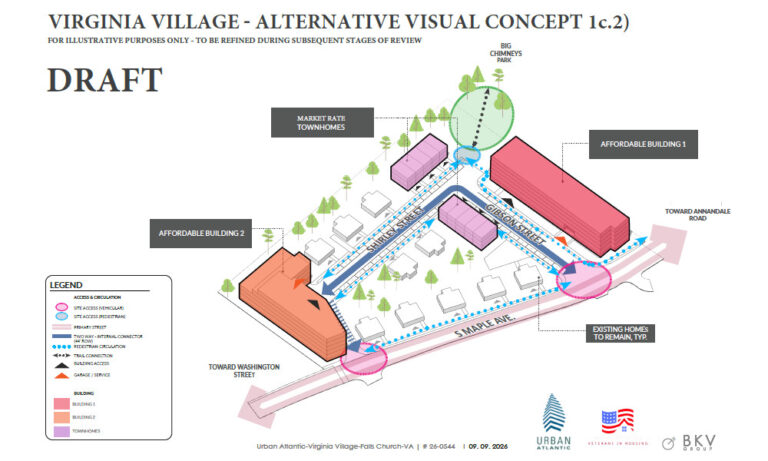
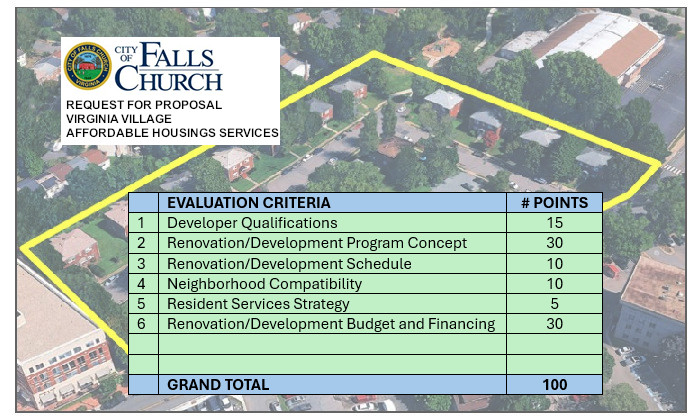
- Citizens and three Council members noted the inadequacy of the executive summaries provided by the three developers responding to the RFP, and particularly the absence of any drawings or diagrams though the RFP required them. From comments made from the dais, it became clear that the Council’s closed session with the City Attorney following the August 31 action meeting addressed this point.
Revised schedule
Community Planning Director Matt Mattauszek briefed the City Council at its August 31, 2026, action meeting on a new schedule for the Virginia Village redevelopment project. [For background, see the Pulse post Three Bidders Vie for Virginia Village Redevelopment, August 18, 2026, and the post that precedes it at the same link, City Receives Virginia Village Proposals, Launches Evaluation Committee, August 12, 2026.]
The revised schedule, shown in the chart below, includes the following key near-term dates and actions. Opportunities for public input are highlighted in yellow.
- September 14: In a closed session with City Council, the seven-member Virginia Village Proposals Evaluation Committee (VVPEC) will provide its recommendation of the preferred developer in response to the City’s request for proposals (RFP) to redevelop the properties it owns on the site. The planning staff’s expectation is that the Council will choose the winning developer team that evening.
- September 22:
- The top-ranked proposal will be made public by this date.
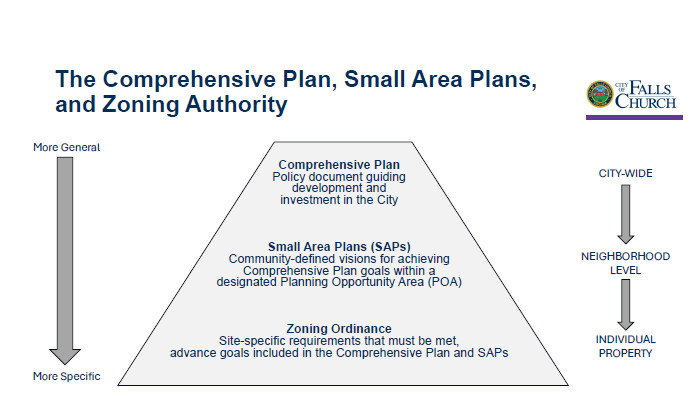
- City Council and the Planning Commission are slated to meet during a joint work session about the Virginia Village Overlay District and discuss whether a third first reading of the proposed zoning ordinance is required. City Council voted an initial first reading establishing the Overlay District on June 22, 2026, and then a new first reading on a revision of the ordinance on July 27.
- Council will also review a proposed draft interim agreement between the City and the developer that will establish exclusivity for the selected team and detail near-term, agreed-to milestones to be achieved.
- September 28:
- City Council will hear public comment on the developer’s proposal, any new zoning changes, and the interim agreement.
- Council is expected to finalize the interim agreement and vote on first reading any new zoning changes.
- October 7: The Planning Commission will conduct a public hearing on the proposed zoning changes and form its recommendations about the ordinance to City Council.
- October 26: City Council will conduct a public hearing on the proposed zoning for Virginia Village and vote whether to approve the final Virginia Village Overlay District.
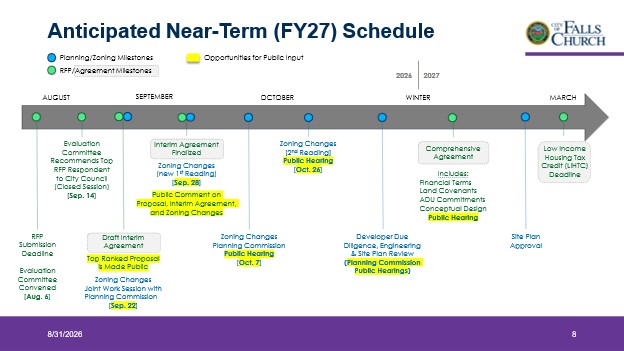
Mr. Mattauszek said that with the zoning changes accomplished, the City and the developer would proceed to draft a site plan and a comprehensive agreement that would include financial terms, land covenants, affordable housing commitments, and a conceptual design and be binding and enforceable on both parties. These milestones would need to be accomplished in time for the March 2027 deadline for the developer to apply for federal Low Income Housing Tax Credit (LIHTC) funding.
The Community Planning Director said LIHTC and other financial sources for the project would be finalized in FY2028, along with the preparation and review of construction drawings and the issuance of building permits. Construction at Virginia Village would begin no earlier than FY2029 and likely be completed in FY2031, he added.
Inadequate narratives and the absence of visuals
During the public comment portion of the City Council’s August 31 meeting, several citizens spoke to the minimal narratives provided by the three responses to the RFP and the absence of any drawings or diagrams of what the bidders proposed. One citizen’s comments capture this concern as well as the value of public input.
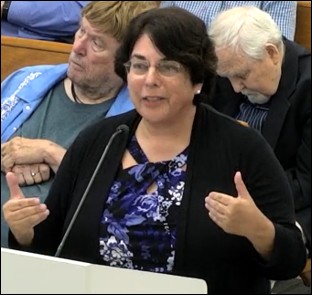
In her remarks to Council, resident Kathy Kleiman cited the positive results that public comments yielded at Founder’s Row on W Broad Street and Park Avenue.
Founder’s Row “was a fortress in its early design—something we saw clearly from the diagrams” she said. “After discussions and working together, it changed, and every time I walk through it, I see the fingerprints of my neighbors, my husband, and myself on its openness, its more reasonable size, and its activation and integration into neighborhood. The developers came up to us at the end and said very sincerely that the project was much better for all the contributions of the neighbors.”
“So, too, with this project,” Ms. Kleiman continued. “We want affordable housing, but we want housing that fits into our neighborhoods and parks, with the best ideas of our neighbors —the ones who know where the children cross, where the shadows will be, what changes make sense, and what is reasonable to ensure that the structure is not being superimposed on a neighborhood but brought into it well.”
“That work needs real information and real diagrams. …This information and these diagrams were promised, and I was here when those promises were made,” she said.
Following Mr. Mattauszek’s presentation, Council Member David Snyder said he saw “no opportunity for citizens to interact with us before we decide about the top developer. …All the public has right now are three so-called summaries, which, frankly, I’ve read…and most of them contain very little useful information and no visuals, no diagrams. I honestly feel that the comments made by a number of our citizens relating to this part of the process carry merit.”
Council Member Erin Flynn echoed these concerns as well as Council and staff’s ability “to maintain public trust” if commitments staff made about the RFP process were not followed through and that process became “a shield” to limit transparency.
Although Mr. Mattauszek said that Virginia procurement rules governing the RFP process would only allow the release of the preferred developer’s proposal once Council decides on the top-ranked respondent, Ms. Flynn suggested those rules would not supersede Freedom of Information Act (FOIA) stipulations if the public were to file for non-proprietary information about the proposals that were not selected.
The Council met with City Attorney Sally Gillette in closed session at the end of the public meeting. Council Member Arthur Agin said he would have more to say then about the failure of any of the RFP respondents to provide diagrams illustrating their proposals. Once Council determines who the preferred developer will be, Mr. Agin said to Mr. Mattauszek of the winning proposal, “I’d encourage you to get it out there quick.”
Zoning remains unresolved
Mr. Mattauszek said during his presentation that the recommendation from the VVPEC to City Council on September 14 “will yield some additional tweaks to the zoning changes, so we want to make sure we build [in] enough time for another first reading…and get those changes in front of you in a work session on September 22.”
However, he amended this statement later in the meeting following questions from Council Members Agin and Flynn.
Noting that the Council has already had two first readings on the proposed zoning ordinance, Mr. Agin asked, “Is there a specific reason you believe we are going to need another first reading?” Mr. Mattauszek responded that “the RFP process may trigger additional substantive changes,” adding that the possibility of a third first reading “is a precaution and may not be necessary.” He agreed with Mr. Agin that scheduling time for another first reading is “a placeholder.”
Ms. Flynn pressed Mr. Mattauszek on why the most recent first reading of the zoning ordinance had not been posted on the City’s Virginia Village website or been provided to and discussed by the Planning Commission. He expressed the staff’s desire to consolidate changes made to the ordinance on July 27 with any new changes before the Planning Commission’s review.
Council Member Flynn questioned the adequacy of the September 22 joint Council-Planning Commission work session where “we will talk about new zoning changes for the first time when the public can’t comment and then only six days later [on September 28] potentially have a new first reading and say this is the public’s input opportunity on something we would take action on that night.”
Ms. Flynn concluded that “the schedule between now and the end of September actually needs to do more than it’s doing in terms of educating the public about where the zoning is.” She asked that the current proposed zoning ordinance from July 27 be put on the Virginia Village website “by the end of the week” and that it be placed on the Planning Commission’s September 16, 2026, meeting agenda for that body’s review and comment. The latest version of the ordinance is now available on the website as a summary and in full text. The upcoming Planning Commission agenda for September 16 has yet to be posted.
Mr. Agin expressed his disappointment that the Planning Commission has not already met to discuss the zoning changes approved by the Council on first reading at the end of July.
A broad interim agreement
Mr. Mattauszek described the interim agreement as “a framework for how the City and the developer will work together.” He outlined during his presentation what such an agreement would not include, reserving details regarding design to the comprehensive agreement that will take time to develop and govern the project for several years along with the final zoning ordinance for Virginia Village.
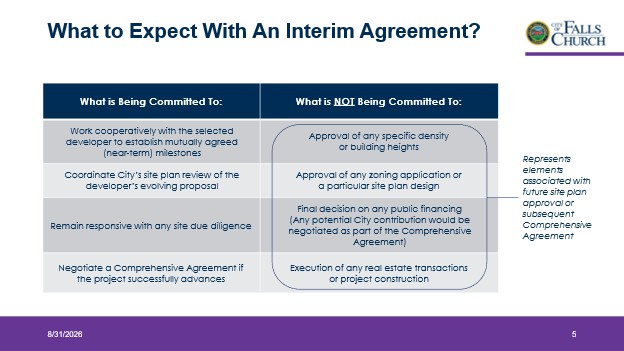
In response to a question from Vice Mayor Laura Downs about whether the interim agreement might set guidance for the project’s design, Mr. Mattauszek said, “The beauty and advantage of zoning changes coming in parallel [with the RFP process and the selection of the developer] is that they will speak to a lot of those details.” He continued noting, “The comprehensive agreement can only be approved once we have a site plan that does have to follow the zoning changes.” Ms. Downs concluded, “Then there is still a great deal of opportunity for public input.”
Engagements versus weddings
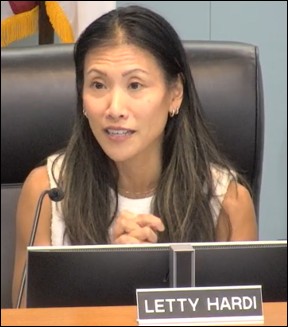
Mayor Letty Hardi concluded the public discussion of Virginia Village by attributing what she described as “the angst” Council and the community see with the approach governing this project to the City’s familiarity and comfort with “a linear process” and the desire traditionally “to have control over every decision.”
However, “we very deliberately decided last fall that we were going to do this parallel process,” she said. “We said we’re going to do zoning changes and have a public procurement process, and sometimes the procurement process is not going to be as transparent as people like because that is Virginia procurement law. We decided that this parallel process was necessary because we wanted to shoot for this March LIHTC deadline, because affordable housing is a crisis for the community.”
Ms. Hardi said she believes that “the more by-right, form-based code process” where guardrails are determined up front and proposals are required to meet them is “a new way of doing things” and more effective in this instance.
Noting that “six of us haven’t seen the proposals, so it’s really hard to know how this will all unfold,” she insisted that “we have very much heard from the community about massing, height, setbacks, neighborhood transitions, and those are reflected in the [current] first reading of the zoning changes. Should we need to revisit that again, we’ll have ample opportunity to talk about those guardrails.”
The Mayor likened the interim agreement to an engagement and the comprehensive agreement to a wedding. “I get that there’s a lot of anxiety to make sure that you’ve picked the right person, but it’s not final at the interim agreement stage.”
Retiring City Manager Wyatt Shields added, “The intentionality behind [this process] is so the public can weigh in on what this building looks like and how it functions on the site in a public way. If those details are buttoned up in the interim agreement, then the public hasn’t had a chance to weigh in on them yet, and the Council will benefit from the public engagement on those details before making those final decisions.”
New City Manager Seth Hendler-Voss’ first day on the job will be September 14 when Council meets in closed session with the evaluation committee to hear its recommendations. [See Pulse post, Seth Hendler-Voss Named Falls Church City Manager, September 3, 2026.]
References
- City Council Action Meeting, August 31, 2026. This official video will not display properly on a small screen as it includes the agenda. Public comments begin approximately 50 minutes into the meeting, followed by the Virginia Village schedule update and discussion, which concludes at about timestamp 2:03:00.
- City Council Action Meeting, August 31, 2026. YouTube video.
- Virginia Village Schedule Status Update, August 31, 2026.