Successful Efforts to Increase Car Tax Compliance Boost City’s FY2026 Revenue
By Edith Snyder
Summary
- Over the past year, targeted outreach and new verification tools have led to the identification, assessment, and billing of more vehicles garaged in Falls Church, growing the car tax portion of the personal property tax base and generating much needed revenue for the City.
- The contribution of personal property taxes, which include vehicles for most individuals as well as business tangible personal property, increased $950,000 in the FY2027 budget, helping pay for the current year’s $5 million budget increase over the prior fiscal year.
- Commissioner of the Revenue Tom Clinton has employed a variety of strategies—from postcard mailings and license plate recognition technology as well as collaboration with other City departments—to achieve these gains and foster continued improvement in compliance and collections.
Compliance = Revenue
Between 2025 and 2026, Falls Church added 856 vehicles to its rolls for a total of 12,594 assessed and billed in FY2026, a 7.29% growth in registered vehicles. The City collected $521,281 in additional net tax revenue in the fiscal year ended June 30, 2026—largely from vehicles brought into compliance with its licensing, or decal, program.
In an interview earlier this month with the Falls Church Pulse, Commissioner of the Revenue Tom Clinton and his office’s Chief Deputy Daniel Clinton discussed the new initiatives that helped achieve these results and their commitment to ensuring that all cars, trucks, and motorcycles normally garaged within the City of Falls Church are registered, clearly display the permanent green City decal, and pay their personal property taxes. [For background on the role of the Commissioner of the Revenue’s Office, see the Pulse post, Meet the City’s Sheriff, Commission of Revenue, and Treasurer – All Seeking Reelection and Unopposed, October 3, 2025.]
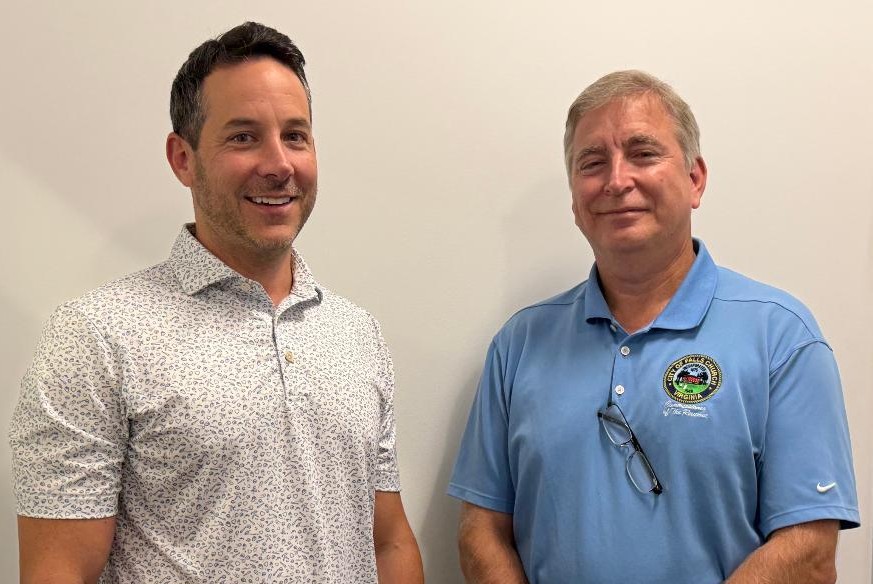
“We are passionate about this work,” Tom Clinton said, because the additional revenue collected “means another teacher or police officer for the City.” Added Daniel Clinton: The office’s goal is “to help the City pay its bills without resorting to new taxes.”
First-year results
The Commissioner of the Revenue (COR)’s added focus on compliance with what is often called “the car tax” in Virginia began with the financial pressures brought to bear on Falls Church and the country as a whole by the incoming federal government administration in January 2025. Anticipating tough budget years ahead, the City Manager, City Council, and the Commissioner sought to find additional revenue without creating new taxes or raising current tax rates. Mr. Clinton and his office set out to maximize revenue already owed to the City, particularly in the area of the car tax portion of personal property taxes.
The results of their efforts from FY2025 to FY2026, summarized in the table below, illustrate their initial, year-over-year success. Commissioner Clinton expects this progress to continue, enabling him to project an increase in property tax revenues by $950,000 in FY2027 through continued enforcement and better communication with new residents. [See the Pulse post, Revenues From a 6.9% Assessment Increase Fund the FY2027 Budget, April 1, 2026.]
| MOTOR VEHICLES | FY2025 | FY2026 | CHANGE |
|---|---|---|---|
| Vehicle Count | 11,738 | 12,594 | +856 |
| Assessed Value | $158,557,672 | $169,417,687 | +$10.86M |
| Net Tax Collected | $5,589,890 | $6,111,171 | +$521,281 (9.33%) |
| Average Tax/Vehicle | $476.22 | $485.24 | +9.02 (1.89%) |
Source: Office of the Commissioner of the Revenue
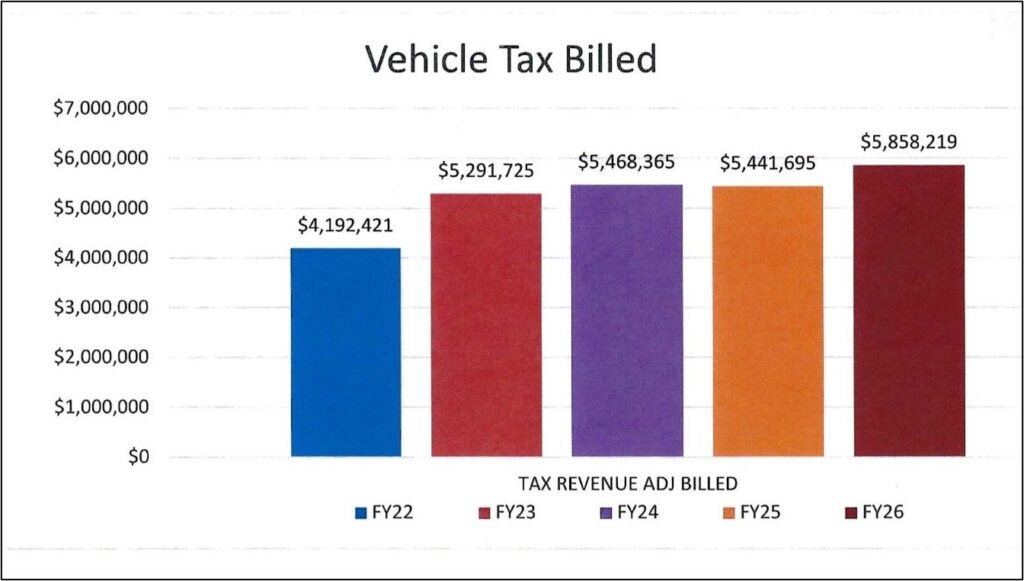
The following chart shows the vehicle tax the City billed from FY2022 through FY2026. The current vehicle personal property tax rate in Falls Church is $4.80 per $100 (4.8%) of a vehicle’s assessed value. Bills are only sent once a year and are typically due October 5. The decal is an annual license fee at a current rate of $33 per year. Cars valued at $3,000 or less only pay the license fee. In most cases, the COR Office uses the National Automobile Dealers Association (NADA) Used Car Guide to assess vehicle value. Owners are taxed for the portion of the year that their vehicle is located in the City.
Harder to ensure that cars of residents in apartments are registered
The City’s growth over the past two decades—coupled with the form residential growth has taken—have made it harder for the COR Office to ensure every vehicle in Falls Church is on their rolls. With some 21 multifamily buildings within the City’s 2.2 square miles, “it is more of a challenge to get to the additional cars we have now,” Commissioner Clinton said.
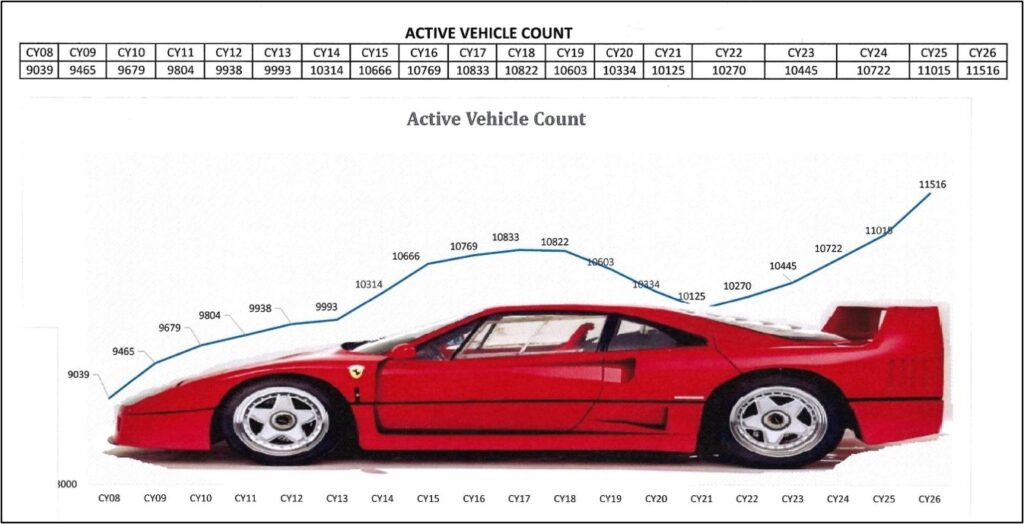
The number of vehicles registered in Falls Church reflects the City’s population growth from the US Census Bureau’s estimate of 11,409 in 2008 to between 15,250 and 15,270 in 2026. According to Chief Deputy Clinton, the active vehicle count for Calendar Year 2026 is 11,516, compared to 9,039 in CY2008.
“Our single-family neighborhoods are stable,” Commissioner Clinton said. However, “the City is more transient with more apartments than ever. We see more non-compliance [displaying decals and paying property taxes] in our multifamily buildings.”
Ideally, residents let the City know when they move in and out of Falls Church, and they register their vehicles while they live here. “Our goal is for everyone to self-report,” Daniel Clinton said, but added Tom Clinton, “we can’t rely on the honor system.”
Where is a vehicle garaged?
The task of determining whether an unreported vehicle is garaged in Falls Church City is often one of investigation, discovery, and triangulation using sources ranging from Virginia Department of Motor Vehicles (DMV) records to lists of tenants in multifamily buildings.
The DMV is a core source of information for the COR Office, though far from a perfect one. Each month, Commissioner Clinton’s staff receives and examines Virginia vehicle registration records from the DMV for Falls Church City and Fairfax County. However, these records have no email addresses or phone numbers, and people frequently move without notifying the DMV of their change of address. As a result, other information sources are needed.
Postcard mailings
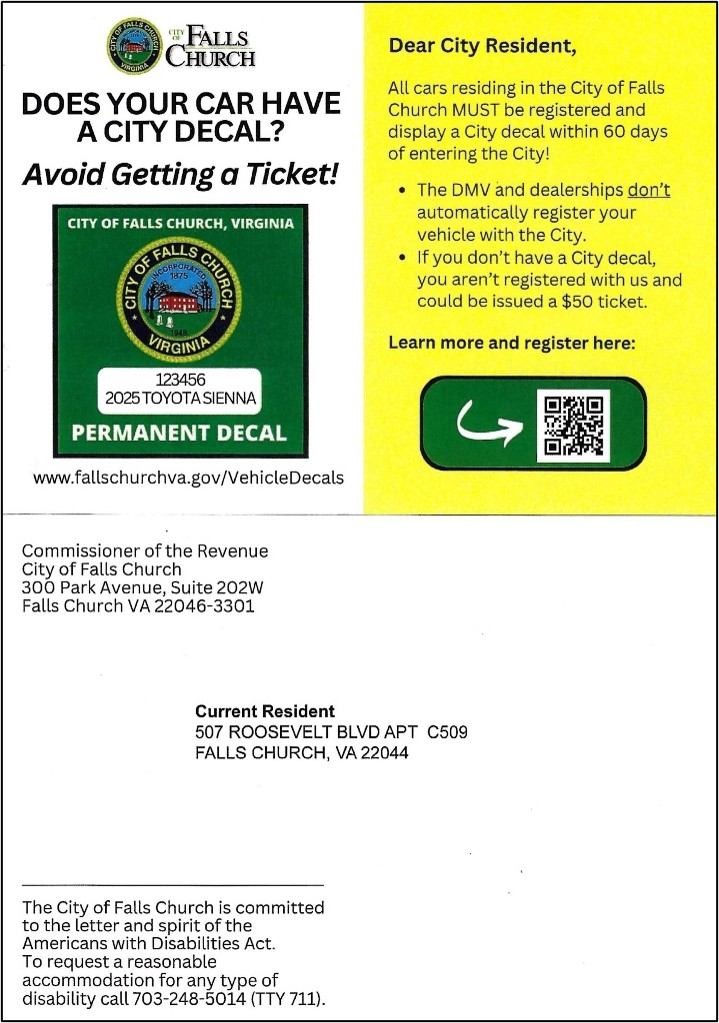
Among the newer strategies the COR has employed in the last year is to search all known addresses in multifamily buildings where residents have not registered cars and send them a postcard describing the requirement to do so. Commissioner Clinton recognizes that new residents—and particularly those who do not plan to remain in the City—may not know they need to register their cars and pay the car tax.
The offense leading to the $50 ticket for not registering a vehicle is the failure to display the City decal. “Other jurisdictions have gotten rid of the decal,” Mr. Clinton said. “Falls Church City went to a permanent decal so that we would have a visual that you registered your car and paid the car tax at least once.”
The COR Office’s educational mailing proved particularly effective with a significant return on investment. For the cost of about $2,000, some 400 new cars were registered and paid approximately $200,000 in car taxes after the first mailing in May 2025. The office repeated this mailing in May 2026 and plans to send the postcard annually.
Apartment outreach
Another effective strategy has been to work with leasing companies and property managers of the City’s apartment buildings. “They are selling Falls Church and want it to be a two-way street,” Mr. Clinton said. His office has created an email for the tenants of these buildings that explains the decal and the City amenities the car tax partially funds, such as the schools and public safety. “They are doing their residents a favor” by communicating this information, along with the benefits of living here, such as promoting the annual Fall Festival next month, he added.
With varying degrees of access to these and other multifamily buildings, Mr. Clinton said he relies on collaboration with these companies, managers, and building owners to educate tenants about their car tax liability. He has also worked to include access for his office to these residences as a requirement, or proffer, for their construction and, as a result, now has entry to eight of the City’s newer buildings.
“We need the apartment owners and condominium boards to let us in,” Mr. Clinton stressed. Virginia code does require apartment building owners and operators to provide lists of their tenants to the state’s Commissioners of the Revenue annually if the local COR requests it.
Public notices
Commissioner Clinton said that periodic reminders in the Falls Church News-Press and the City’s Focus on Falls Church newsletter help keep vehicle registration top of mind. His office also includes a comprehensive, two-sided flyer about vehicle registration, the decal, and the car tax with the annual mailed vehicle verification form and again with the personal property tax bill sent from the Treasurer’s office.
Clinton’s flyer includes “the four things you should always do when you move:” Contact the Virginia DMV, register your vehicle in your new jurisdiction, contact your old jurisdiction and provide proof you have registered your vehicle elsewhere, and contact the USPS and enter your change of address to receive all your mail (including final bills for car taxes owed). The Commissioner notes that “in order to stop taxing you, we need proof” that you no longer have a car in Falls Church.
License plate reader and access to state police data
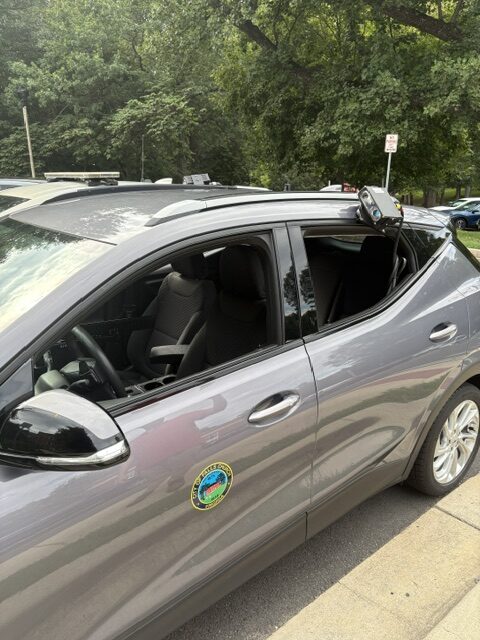
The City recently evaluated and is now employing license plate recognition technology to capture tag information on cars parked on City roads and in multifamily building garages that are not in the City’s registered vehicle database.
The license plate reader is mounted on the side of a City vehicle that patrols the streets and garages. Mr. Clinton emphasized that its use “is limited to discovering vehicles that are not registered with the City. We in the Commissioner’s Office can’t and won’t be enforcing state safety inspection stickers, expired license plates, or handicapped and fire lane parking violations,” he said.
Mr. Clinton expects the Leonardo ELSAG® license plate reader camera and software will boost his office’s efforts going forward. Ideally, he would add a part-time person to his staff to use the reader during strategic times of the day and night, bringing the information gathered back to the COR Office for research and possible vehicle registration. Such an approach would mirror what is done in Fairfax City and “would more than pay for itself,” he said.
In addition to the license plate recognition technology, Mr. Clinton’s office has recently acquired access to out-of-state motor vehicle records that will help flag owners who have relocated to Falls Church but have not re-registered their vehicles with the City.
Additional strategies to encourage compliance
The COR Office continues to look for ways to improve compliance and currently benefits from the following strategies.
- Online registration: The Commissioner’s Office is working to make it easier for residents to register their vehicles and pay their car taxes. To that end, Chief Deputy Clinton noted they recently revised the online registration form to improve user experience with it.
- Residential permit and zoned parking: Some 26 of the City’s 90+ streets allow residential permit parking. Applications for such permits and for specially zoned parking in the Winter Hill and the Grove and Park Avenue neighborhoods require residents to show that their vehicles are registered with the City to obtain permits or zone stickers. This requirement has helped with decal compliance, Commissioner Clinton said.
- Tax Evader Program: This City program encourages residents who notice a car routinely parked at a Falls Church address without displaying a City decal to anonymously report the vehicle to enforcing departments for review. This program has produced a few instances of unregistered vehicles.
- Permanent decals on City vehicles: To set an example for the public, Commissioner Clinton is working with the City’s Department of Public Works and its Police Department to place permanent decals on all City vehicles. As vehicles go to the City’s Property Yard for maintenance, the decals are being added to them. According to Mr. Clinton, Police Chief Shahram Fard said he is willing to fix the decals to all but his force’s unmarked cars.
Relying on the Police to enforce the car registration law
Commissioner Clinton noted the importance of collaboration with several City departments in his office’s work, including the Treasurer, Communications, Public Works, and the Police. He and his staff meet quarterly with the City’s two Deputy City Managers to review the progress made in vehicle registrations.
The COR Office is particularly dependent on assistance from the Police Department. “We can issue warnings,” Mr. Clinton said, “but the Police are responsible for enforcement,” which is crucial to success. The Police Department’s public safety aides are the staff assigned to ensure the vehicle registration law is followed; however, this is just one of several duties they must fulfill. The Police Department has struggled to hire and retain public safety aides, Mr. Clinton noted.
Regarding his own staff, Commissioner Clinton said that bigger jurisdictions have divisions devoted to ensuring that all vehicles garaged within their limits are registered and pay taxes, while vehicle registrations and personal property taxes constitute about a third of the work of his nine-member team. To address this issue, he plans to rely further on technology and hopes to see the development of a single, comprehensive list of City addresses to aid his office’s work as well as that of other City departments. He is grateful that nearly half of his staff live in the City and/or have relatives in Falls Church and know its streets well.
Future challenges
Looking ahead, Commissioner Clinton anticipates that newer apartment communities will see a higher move-in/move-out frequency, which will make sustained education about and compliance with the car tax harder to maintain. He also expects that the elimination of decal requirements by neighboring localities will increasingly lead residents to assume that registration is no longer required in the City.
“We’ll never get to 100% compliance,” Mr. Clinton said, noting the challenge of estimating what percentage of cars are currently registered when the City doesn’t know the universe of vehicles regularly parked here. Nonetheless, “we have seen significant progress with an over $500,000 increase in personal property assessments of cars and business equipment from last year to this year, and we are working hard to get more vehicles registered every day.”