Revenues From a 6.9% Assessment Increase Fund the FY2027 Budget
Summary
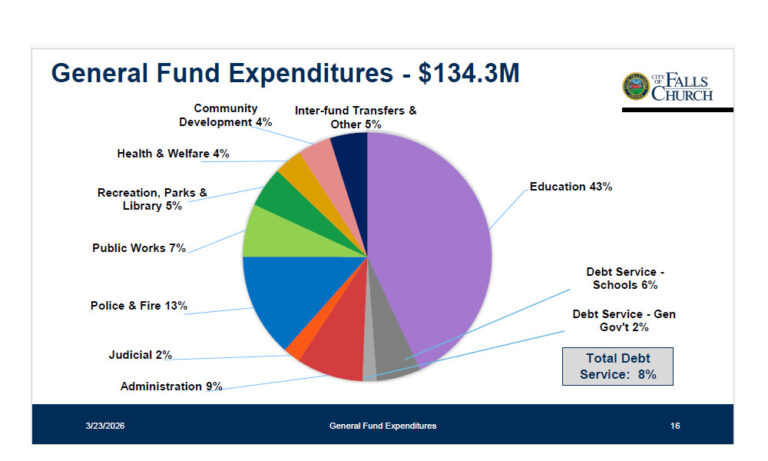
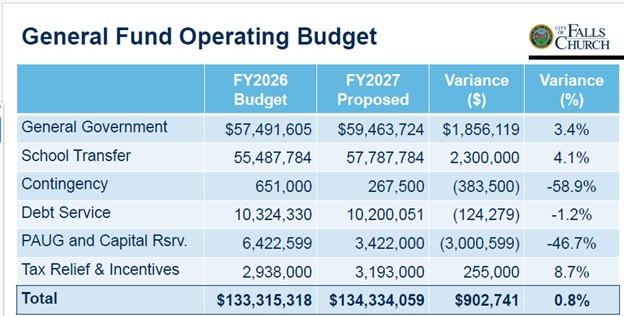
The $134.3 million FY2027 budget may be a 0.8% reduction on the previous year, but a 6.6% tax revenues increase is required to fund it. In FY2026, the budget included unusually large capital expenditures for transportation, public safety and sewer projects that were funded from capital reserves, funds set aside over years to cover these expenses. This year, the reduction in capital expenditure was offset by a 3.4% increase in the general government operating budget and a 4.1% increase in the transfer to the operating budget for the City’s schools. Operating budget increases are funded from tax revenues.
The tax revenues increase required to support this budget comes primarily from a 6.9% increase in real estate assessments, higher than the 6% estimated in December 2025. Detached single-family homeowners’ assessments went up the most, averaging 8.2%; townhomes 5.4%; condos 3.1%; apartments 4.9%, and commercial 2.3%.
Hoffman & Associates, the West Falls developer, decided not to proceed with Phase II removing $800,000 from the expected revenues. Phase II was supposed to be a $10 million lease. As a result, the two West Falls land parcels next to the middle and high schools and along Haycock Road that comprised this second phase of development have been returned to the City.
Sanitary sewer rates will increase 5%, and stormwater fees will increase 7%. Personal property tax rates are unchanged.
Solid waste fees will increase 4% to $246 for the 35-gallon bin and $348 for the 65-gallon bin.
Background
The City Manager and the School Board Chair presented their FY2027 budget proposals at the City Council’s March 23, 2026, meeting. This presentation set the stage for discussions in the coming weeks that will determine the real estate tax rate and other fees. The first reading of the budget for approval is scheduled for April 27, and final approval is set for May 11.
City staff held a town hall on March 26 and will hold a second budget town hall April 30 at 7:00 pm. Another opportunity for public comment on the budget is scheduled fort the City Council work session on April 27.
The 361-page budget includes the Capital Improvements Program (CIP) for FY2027 to FY2031. An earlier Pulse post covers the CIP, $162M FY2027-2032 CIP Invests in Sewer and Stormwater Capacity Expansion, Delays Property Yard Replacement, March 13, 2026.
This post focuses on the revenues to pay for this budget. The City’s planned FY2027 expenditures are covered in this post, FY2027 Proposed Budget Expenditures Maintain Operations at Current Levels, April 7, 2026.
4.1% increase for schools, 3.4% increase for the City
The total FY2027 budget of $134.3 million includes capital expenditures. This is a 0.8% reduction from last year, but that FY2026 budget included larger than usual capital spending on sewer, transportation, public safety projects. (Refer to last year’s Pulse post.)This year, the reduction in CIP spending resulted in $3 million less funds being drawn from capital reserves and Pay-As-You-Go (PAUG) cash reserves. This reduction was offset by the 3.4% increase in the general government operating budget and the 4.1% increase in the transfer of funds to the schools so that the budget ends up almost the same as last year.
Where are the revenues coming from?
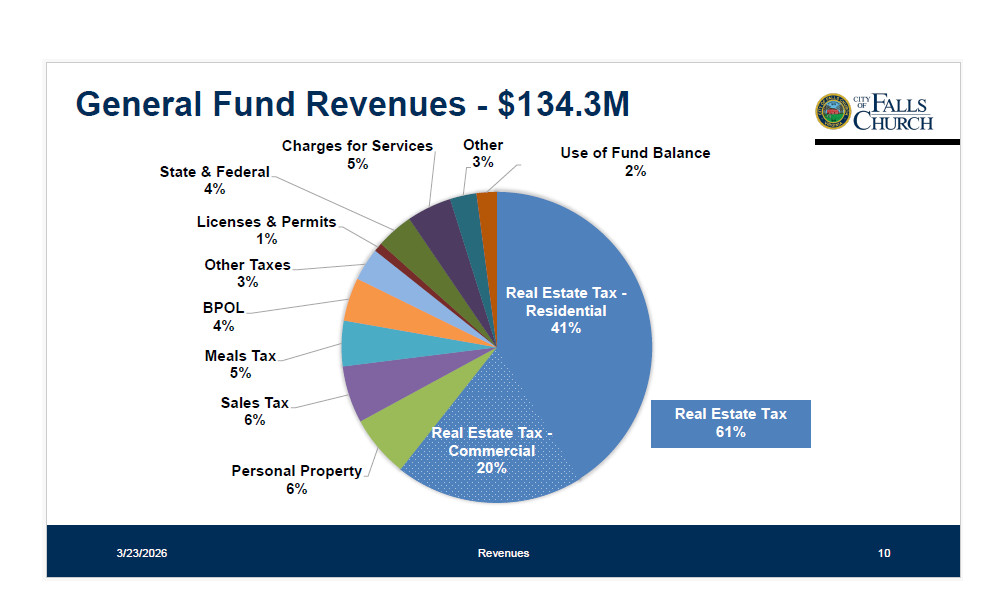
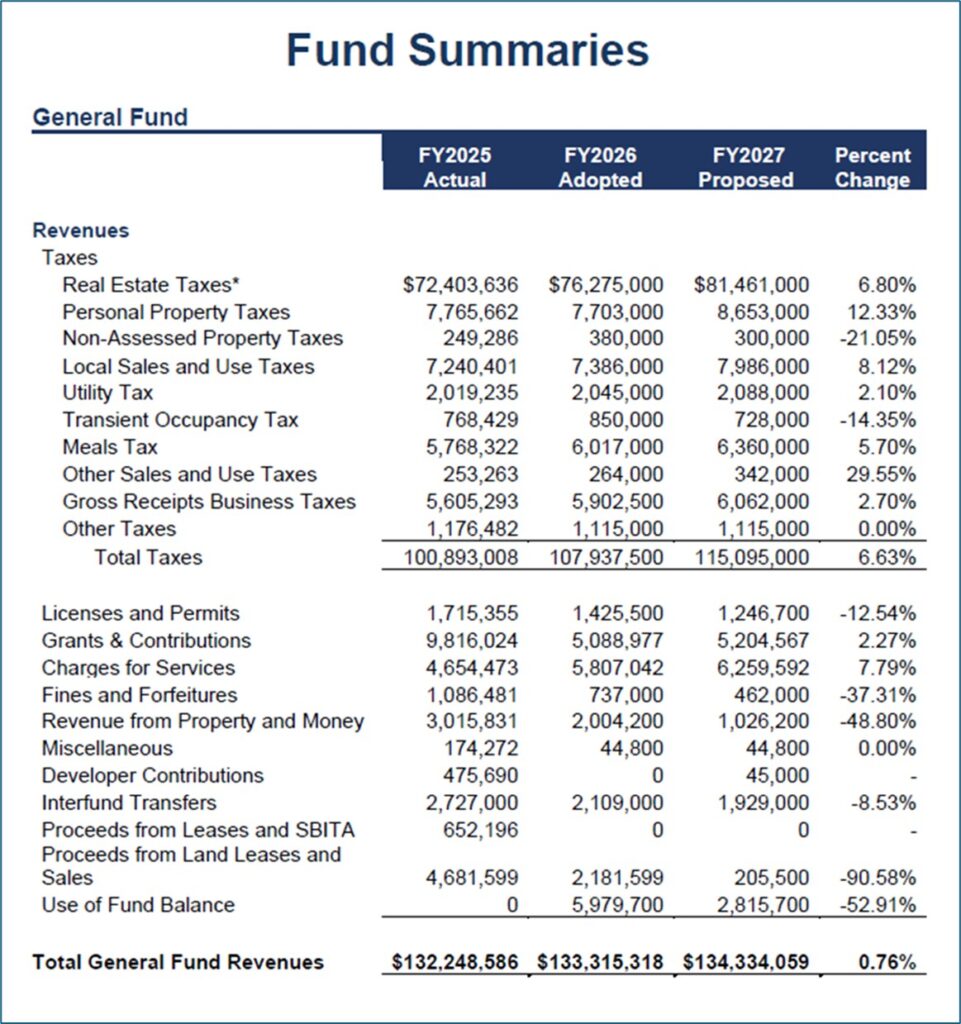
Although this year’s budget is almost the same as last year’s, the FY2026 budget drew $6.4 million from the City’s capital reserves and PAUG to pay for CIP expenditures. The City follows a policy of using reserves and certain non-tax revenues to fund one-time expenditures such as those in the CIP, whereas operating expenses should be funded by taxes. In FY2027, the $5 million increase in general government and school operating budgets has to be funded from new tax revenues. Tax revenues increased 6.6% to fund this budget.
The FY2027 budget relies on a 6.8% or $5 million increase in real estate taxes revenues coming from increased assessment values and properties being taxed at the current rate of $1.185 per $100 of assessed value. This is higher than the 6% estimate in December’s preliminary forecasts. The Pulse post, Single-Family Homeowners Bear the Cost of the City’s Growth, December 3, 2025, explains how market forces have driven up the value of single-family homes (SFH) so that they account for about 57% of the City’s real estate tax revenues. Once again, SFH homeowners, and detached SFH in particular, are expected to pay the largest share, 57%, of this increase.
City Commissioner of Revenue Tom Clinton has been able to increase property tax revenues by almost $1 million through enforcement and better communication with new residents. The budget projects improvements in sales tax and meals tax, but a decrease in hotels tax, based on regional forecasts.
There are sizable reductions in non-tax revenues compared to last year. Interest revenue decreased $1 million from the previous year with less money in the bank now that significant capital reserves have been drawn down. Also, the final West Falls lease payment of $2 million ended last year, and the developer, Hoffman & Associates, has elected not to proceed with Phase II of West Falls for $10 million. As a result, the contribution from West Falls has dropped to $205,500.
Utility, trash and stormwater fees increase
To pay for sanitary sewer upgrades and future stormwater system work, these fees are going up. Sanitary sewer rates will increase 5%, and stormwater fees will increase 7%. Even with these increases, the City expects to issue $10 million in debt for sewer projects in FY2028 that will be paid back by fees for sewer services.
Trash fees will increase by 4% for those homeowners who receive curbside solid waste service from the City. The 35-gallon container fees are proposed to increase from $236 to $246 and the 65-gallon from $336 to $348.
No tax rate change still means higher taxes
If the real estate tax rate remains unchanged, real estate taxes increase by the rise in assessments. The total assessed value of all properties in the City increased by 6.9%. Without changing the tax rate, the City’s real estate tax revenues will also increase by 6.9%. The summary below is taken from the detailed FY2027 budget and shows the change in assessment values for the various types of real estate.
| Residential | Commercial | Apartments | Total Properties | |
| Market Growth | 6.2% | 2.3% | 4.9% | 5.3% |
| New Construction | 1% | 4.2% | 1.4% | 1.6% |
| Total Growth | 7.2% | 6.5% | 6.3% | 6.9% |
The residential category includes detached SFH, townhomes, and condominiums. Total assessments for residential real estate grew 7.2%. 6.2% came from increases on existing property and 1% from new construction. Therefore, on average, these homeowners can expect a 6.2% increase in real estate taxes if the tax rate is unchanged. Commercial property owners average a 2.3% increase, and apartment building owners a 4.9% increase.
Yet, many SFH homeowners received an unpleasant surprise when they opened their 2026 assessment notices recently to discover increases of more than 10%, nowhere near the advertised average of 6.2%. City Council members have heard from many City residents who complained about their assessment increases. At the March 23 meeting, Council members asked staff to provide further information on the distribution of assessment increases for future budget discussions.
The Pulse obtained the City’s assessment database to investigate further. Our analysis showed a large difference in the assessments across neighborhoods and types of housing, hence the tax impacts. This will be covered in a future post. Overall, for residential properties, the 2025 to 2026 average assessment increases were:
- Detached single-family homes: 8.2%
- Townhomes: 5.4%
- Condominiums: 3.1%
Should commercial properties pay more taxes via a C&I tax?
The commercial property tax increases are not even keeping up with inflation because their average assessment increase is below the rate of inflation. In January 2026, the regional Consumer Price Index was 2.7%, higher than the 2.3% average increase in taxes for commercial properties. At the March 26 budget town hall, City resident Andrew Olesen raised the issue of imposing a C&I tax on commercial properties to raise funds for transportation projects. Such a tax would also raise their contribution to the City tax revenues to be more in line with that of other property owners.
The budget schedule
An up-to-date schedule may be found on the City’s budget webpage. The public is invited to attend the public meetings and submit questions by sending emails to City Council and staff at CityClerk@fallschurchva.gov or Budget@fallschurchva.gov.
The following meetings have been announced:
- Monday April 6, 2026, 7:30 pm Budget Work Session, Dogwood Room
- Monday, April 13, 2026, 7:30 pm, First Reading of Budget, Tax, and Fee Ordinances
- Monday April 20, 2026, 7:30 pm, Budget Work Session, Dogwood Room
- Monday, April 27, 2026, 7:30 pm: Budget Public Hearing, Council Chambers
- Thursday, April 30, 2026, 7:30 pm: Budget Town Hall #2, Council Chambers & Online
- Monday May 4, 2026, 7:30 pm: Budget Work Session
- Monday May 11, 2026, 7:30 pm: Budget Public Hearing and Final Consideration
- July 1, 2026: Fiscal Year 2027 Budget goes into effect
References
- FY2027 Proposed Budget City webpage.
- City Council meeting, March 23, 2026. This official video will not display properly on a small screen as it contains the agenda.
- City Council meeting, March 23, 2026. YouTube video.
- FY 2027 School Board Budget Presentation for CC 3.23.26.
- City Manager’s FY2027 Budget Presentation, March 23, 2026.
- Budget Town Hall #1 – March 26, 2026. Video.
- FY2027 Proposed Budget Document. 361 pages.