Falls Church City Pays $2M for Nutrient Credits. What Are They?
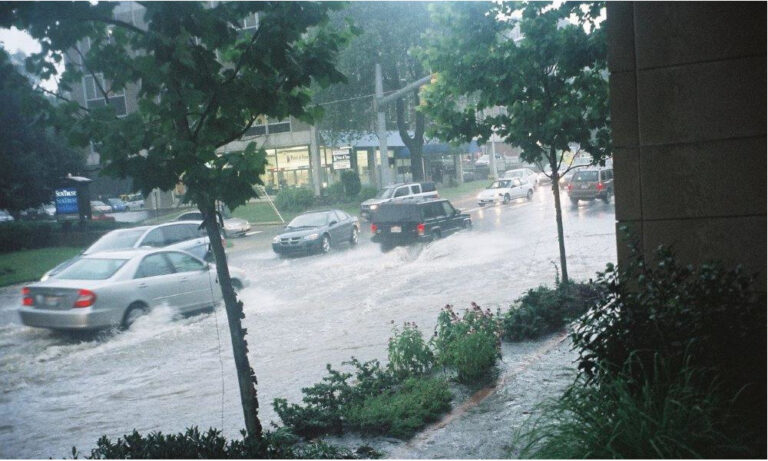
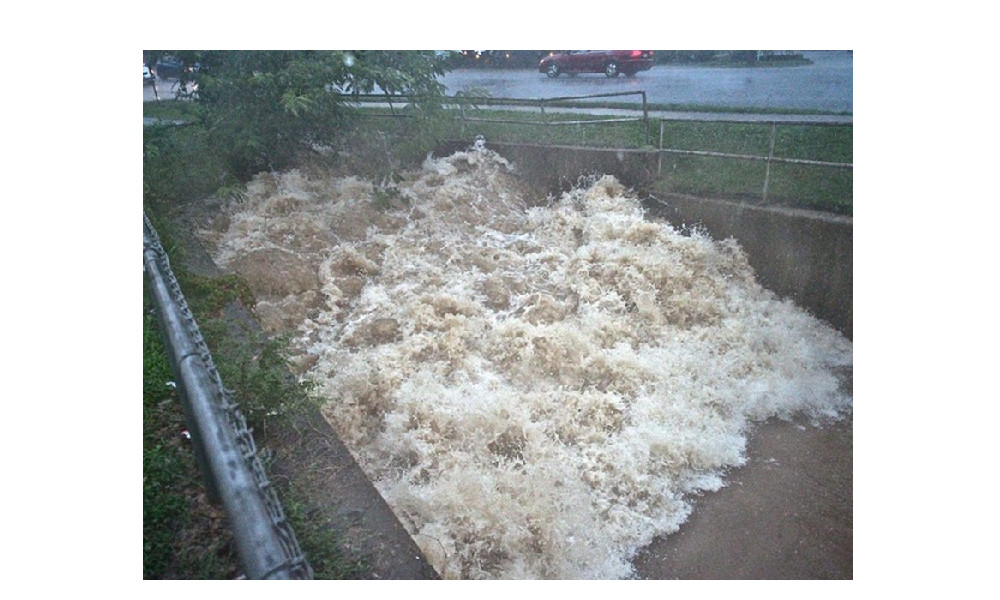
Photo by Dan Lehman. Tripps Run aqueduct by S Washington St during a major storm.
Summary
Nutrient credits are a tool for improving water quality that resulted from the federal Clean Water Act of 1972 and implementation of this foundational law by the states. Each state issues permits in accordance with this law.
Under the City’s Virginia Municipal Separate Storm Sewer System Permit (i.e., the MS4 General Stormwater Permit), Falls Church was required to develop a Phase III Chesapeake Bay Total Maximum Daily Load (TMDL) Action Plan to reduce nitrogen and phosphorus—the two pollutants of concern (POC) within the Chesapeake Bay Watershed—to meet clean water requirements. This reduction can be achieved in a number of ways, including development on prior developed lands; best management practices (BMPs) installed during development and redevelopment; BMP enhancement, conversion, and restoration; and the ability to buy credits, referred to as nonpoint source nutrient purchases.
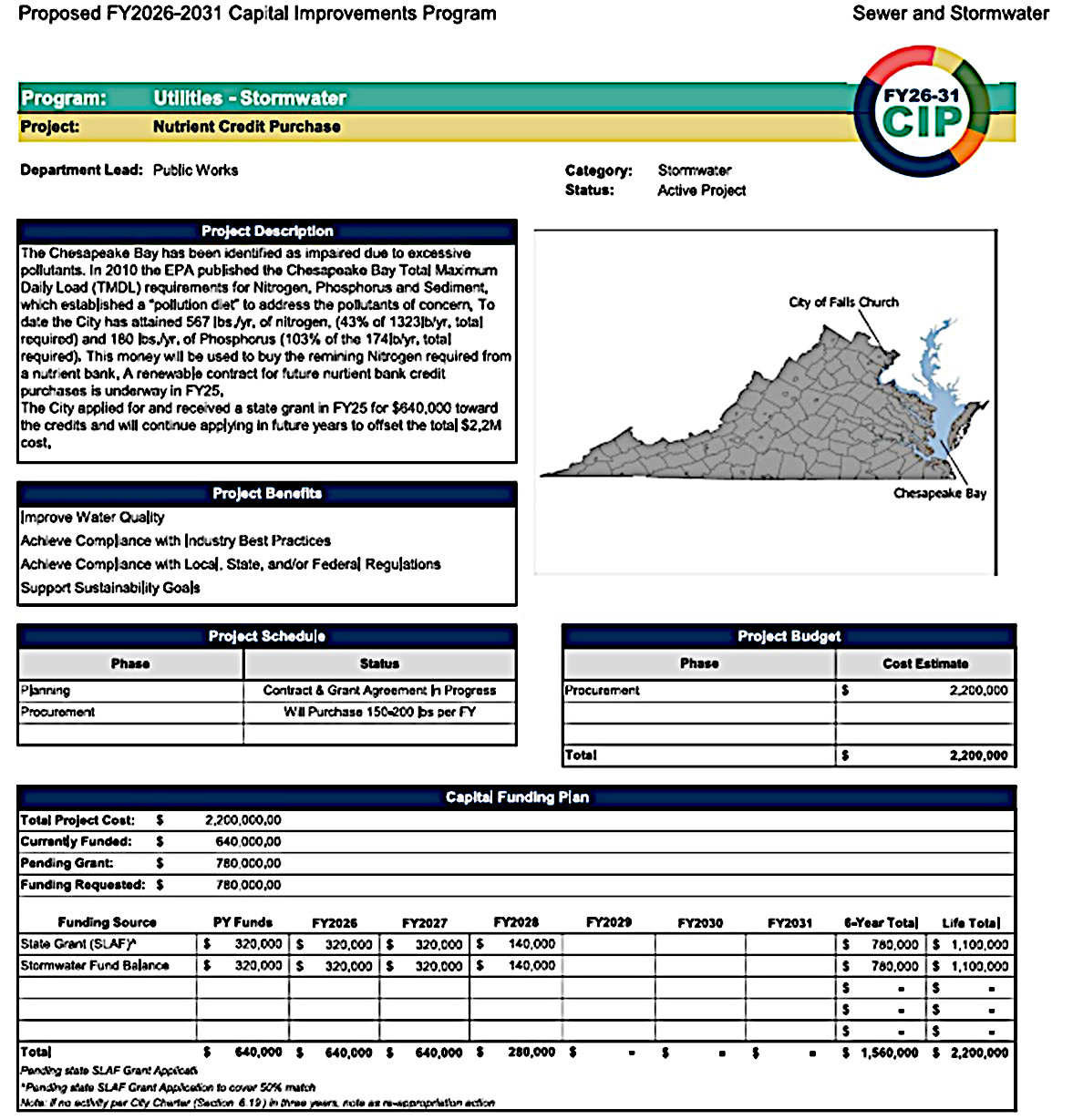
Because Falls Church is built out with little available area to implement onsite BMPs, nutrient credit purchases within the Chesapeake Bay watershed, and more specifically within the Potomac watershed, are one method to reduce POCs. This post provides an overview of the nutrient purchase process identified in the City’s Capital Improvements Program (CIP) for a total expenditure of $2.2 million over a four-year period and explains why nutrient credits are being implemented to reduce pollutant loading in the ever-developing City.
Background
Virginia’s Department of Environmental Quality (DEQ) regulates stormwater runoff by issuing permits to municipalities that are federally mandated under the National Pollutant Discharge Elimination System (NPDES) permit program within the Clean Water Act. The City was initially covered under the Virginia Municipal Separate Storm Sewer System Permit, or MS4 General Stormwater Permit, in 2003. Since then, the City has successfully implemented numerous best management practices (BMPs), and other stormwater management strategies and related actions to meet the conditions in each successive permit.
On November 1, 2023, the City obtained continued coverage under the most recent MS4 General Permit (Permit Number VAR040065). Through the MS4 General Permit, the City has agreed to comply with its conditions and authorizations regarding discharges from the City’s storm sewer system to protect water quality and to satisfy the appropriate water quality requirements of the State Water Control Law and its attendant regulations.
The general stormwater permit MS4
The MS4 General Permit covers stormwater in the entire City and is divided into four parts:
- Part I – Discharge Authorization and Special Conditions;
- Part II – Total Maximum Daily Load (TMDL) Special Conditions;
- Part III – Department of Environmental Quality (DEQ) Best Management Practices (BMP) Warehouse Reporting; and
- Part IV – Conditions Applicable to All State and Virginia Pollutant Discharge Elimination System (VPDES) Permits
Part II of the MS4 General Permit contains special conditions that define how the City is required to address applicable TMDLs of pollutants. Descriptions of the City’s requirement and compliance actions for TMDLs were developed and are documented in Section 5 of the City’s Municipal Separate Storm Sewer (MS4) Program Plan (May 2024). The City is required to reduce TMDLs for nitrogen, phosphorous, and sediments. These reductions are achieved through both City and private development projects.
MS4 targets
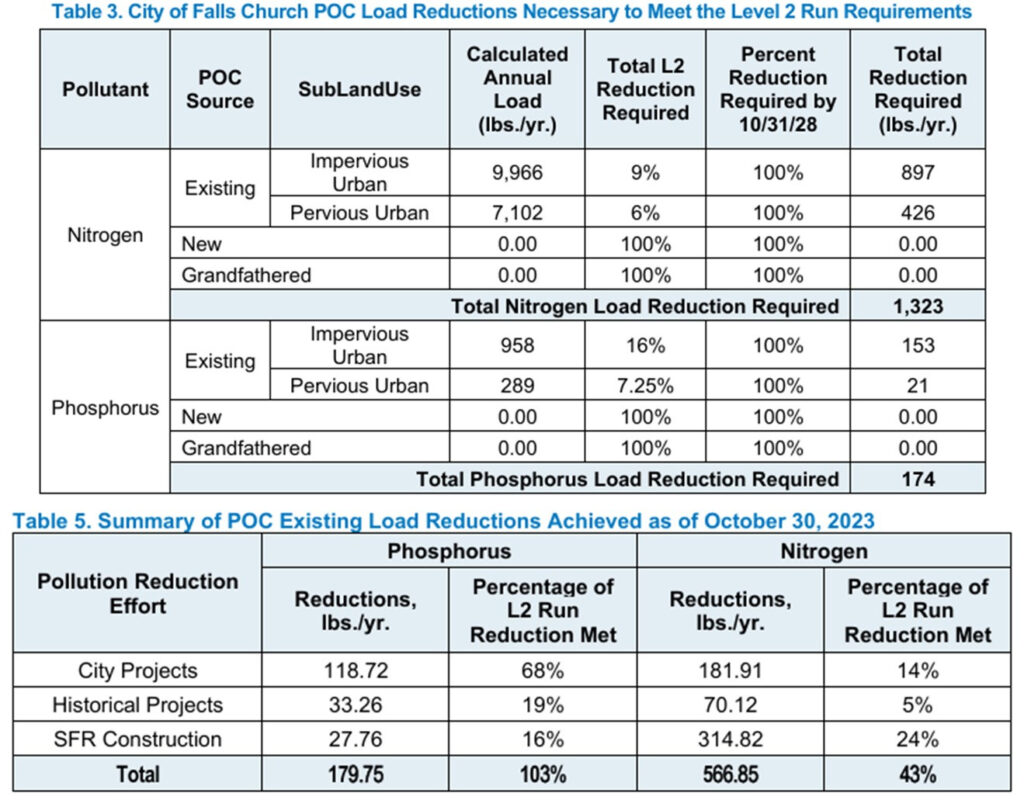
By 2028, the City is required to reduce specific amounts of nitrogen and phosphorous in its runoff as shown in the table below, Level 2 or L2 Run requirements. To date, the City had achieved the required phosphorous deductions (i.e., by 174 lbs/yr) but has only attained 43% of the required 1,323 lbs/yr nitrogen deduction (i.e., by 567 lbs/yr). Therefore, a nutrient credit purchase for nitrogen must be completed from an authorized Virginia DEQ NPS Nutrient Credit Registry (i.e., nutrient bank) to make up the 756 lbs/yr difference.
Nutrient purchases FY2025 through FY2028
According to the Virginia DEQ: The VPDES Watershed General Permit allows point source dischargers in the Chesapeake Bay watershed to generate nutrient credits by discharging nutrient loads below the waste load allocations included in the general permit. These nutrient credits can be acquired by facilities that have exceeded their waste load allocations to comply with the terms of the general permit.
For example, a project to restore the habitat around a stream to filter pollutants in stormwater runoff to the stream and create a self-sustaining ecosystem would generate nutrient credits that can be sold.
The City’s current plan is to purchase these credits from Ecosystem Services LLC, an authorized nutrient bank, for a contract amount of up to $640,000 annually. The justification for this purchase is described in the City’s Phase III Chesapeake Bay Total Maximum Daily Load (TMDL) Action Plan for Nitrogen and Phosphorus (September 10, 2024), ]which states “…the City is built out with little available area to implement onsite POC reduction strategies. As such, the City will prioritize the purchase of nonpoint source nutrient credits from nutrient banks approved by DEQ in accordance with § 62.1-44.19:21 and § 62.1-44.19:21.1 of the Code of Virginia and the MS4 General Permit.”
One-half of the funds will originate from the City’s Stormwater Fund, while the other half will be obtained from grants via the Virginia Stormwater Local Assistance Fund (SLAF). The initial $640,000 worth of credits were purchased in FY2025, while two additional years (FY2026 and FY2027) will cost $640,000 each, and the final purchase year (FY2028) will cost $280,000, for a total of $2.2 million over four years. The City’s share of this expenditure is $1.1 million, assuming the state continues to provide the grants, and will be paid with funds from stormwater fees.
Nutrient Reductions on Private Developments
Private developments or redevelopments are required to comply with the City’s water design quality criteria based on the City’s MS4 Permit TMDL requirements. If nutrient purchases are required to maintain the current loadings, then these purchases are the responsibility of the owner/developer.
The City cannot require private owners to do more than the minimum mandated by MS4 so the government cannot count on redevelopment for additional help to meet the City’s MS4 requirements. However, requiring more green space and a greater reduction in the quantity of stormwater runoff may indirectly help the City meet its DEQ targets. Fairfax County has required a 40% reduction in stormwater runoff rate from its West Falls developments compared to the City’s 10% requirement for its mixed-use projects and no reduction for all others.
Most of the private developments, including single-family home reconstruction, have been unable to satisfy all their MS4 requirements onsite. Most had to purchase additional nutrient credits from nutrient banks. The Quinn senior living and mixed-use development project is an exception among mixed-use projects. It has ample greenspace and no artificial turf, so it exceeds the POC reduction requirements.

Compliance reporting
Each year the City prepares an annual report required under the MS4 Permit, which includes stormwater compliance for construction control measures for erosion and sediment control, and post-construction stormwater management covering the reporting period from July 1 through June 30.
Management of Chesapeake Bay TMDLs have their own status report covering the same reporting period of July 1 through June 30. In its FY2025 status report, staff noted that “The City anticipates additional POC reductions resulting from redevelopment on prior developed lands and BMPs installed to meet development and redevelopment requirements. The City also anticipates the purchase of approximately 200 lbs. of nitrogen and 74 lbs. of phosphorus from an approved nonpoint source nutrient bank during the next reporting period.”
Beyond 2028
The City’s MS4 Permit expires October 31, 2028. A new permit will likely require further reductions in pollutants.
References
- Nutrient Trading, Virginia Department of Environmental Quality. Webpage.
- Falls Church City’s webpage for the latest MS4 reports.
- Staff Report, August 4, 2025. Authorization of contract with Ecosystem LLC for the purchase of nutrient credits.
- Phase III Chesapeake Bay Total Maximum Daily Load (TMDL) Action Plan for Nitrogen and Phosphorus (September 10, 2024)