Virginia Village Overlay District Details
Summary
- The City Council voted 5-2 on September 28, 2026, to approve a third first reading of the Virginia Village Overlay District. The Council increased building height limits, reduced setbacks, and set minimum parking requirements as detailed in the staff report. The Council opted for flexibility for the developer selected through the request-for-proposals (RFP) process, walking back zoning parameters agreed to in the second first reading of the ordinance on July 27, 2026, and over citizen objections.
- The prior details of the new Virginia Village Overlay District are contained in the staff report as revised according to the legislative update on these zoning changes presented to, revised, and approved by the City Council in a new first reading of the zoning ordinance on July 27, 2026. A summary of the changes Council made and voted on first reading and the actual text of the proposed zoning amendments were posted on the City’s Virginia Village website on September 4, 2026.
- These parameters may continue to change as the proposed ordinance is reviewed by the Planning Commission, the City Council, and the public and adjusted depending on an interim agreement the City is negotiating with Urban Atlantic, the top-ranked developer responding to the City’s Virginia Village Affordable Housing Opportunity Request for Proposals (RFP). The overlay district’s requirements will be updated by the Pulse as alternatives are proposed and/or approved. Last updated: October 5, 2026; changes approved on the latest reading on September 28 are in boldface italics.
A new zoning overlay
June 22, 2026
As part of a series of actions taken on June 22, 2026, the City Council gave initial authorization to critical zoning changes for the existing Virginia Village affordable housing site. [Please see the Pulse post, Council Moves Virginia Village Redevelopment Forward, Issues RFP, June 24, 2026.]
July 27, 2026
The zoning text amendments were revised and came before the City Council for a new first reading on July 27, 2026. A key addition is an abbreviated special exception (SE) rather than a by-right process that would govern redevelopment of Virginia Village properties beginning on July 1, 2027. Staff urged that any accepted proposals in response to the Virginia Village Affordable Housing Opportunity Request for Proposals (RFP) for the redevelopment of the site currently with prospective developers would proceed by right. [See the Pulse post, Virginia Village Zoning, RFP Evaluation, Tenant Relocation Readied for Council Votes, July 22, 2026.]
The new district “presents alternative redevelopment options for properties in the Virginia Village neighborhood when a substantial affordable housing contribution is included,” according to the summary accompanying the second first reading of the proposed ordinance on July 27 and posted by the City on September 4, 2026.
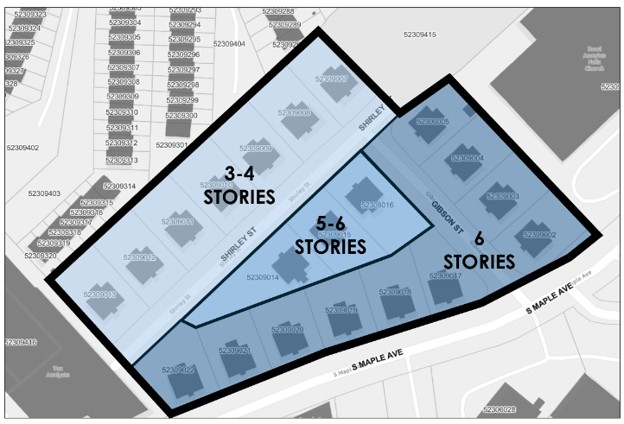
During its July 27, 2026, action meeting, the City Council addressed citizen concerns about a staff proposal to increase the allowable height of any Virginia Village redevelopment to 4 stories or 50 feet along its boundary with the adjacent Winter Hill neighborhood. Council ultimately rejected this proposal, restoring the 40-foot limit pending a review of responses to the RFP. [See the Pulse post, City Receives Virginia Village Proposals, Launches Evaluation Committee, August 12, 2026.]
September 28, 2026
The City Council voted 5-2 to approve the third first reading of amendments to Virginia Village zoning at its September 28, 2026, action meeting. Those amendments would:
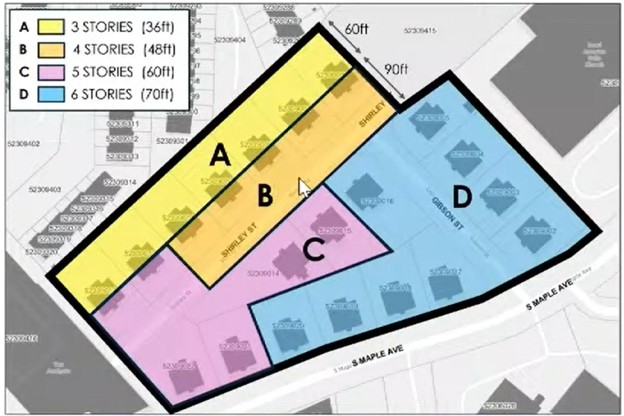
- Divide the site into four zones—A, B, C, and D—and set height limits in stories and feet in each of them as shown in the diagram below. The staff report accompanying the most recent zoning text amendments noted that maximum building heights in feet have been lowered across all zones “to balance an alignment with their corresponding maximum story limit for each zone while ensuring viability of multiple development options.”
- Establish off-site parking of one space per townhouse dwelling and 0.6 of a space per multifamily dwelling unit.
- Dispense with the existing regulation prohibiting vehicular entrances and egresses to commercial or business off-street parking or loading areas within 100 feet from any residential district for Virginia Village and require, instead, that parking and service areas “may not be oriented toward Winter Hill or the public park and must be completely enclosed.”
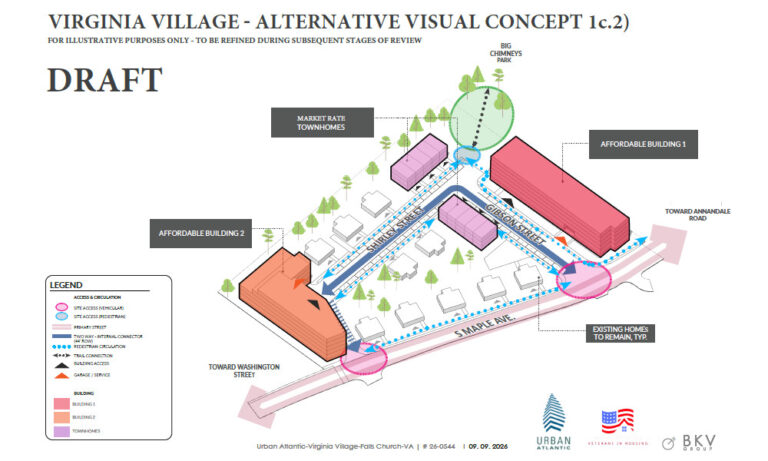
- Reduce the minimum building setback from the Big Chimneys Park property line from 35 feet to 20 feet “to maximize the buildable area for affordable housing along Gibson Street while staying within Council’s desired building height maximum of 6 stories.”
- Change the special exception process and criteria to 1) remove previous recommendations for height bonuses and relief from minimum building setbacks, 2) maintain the potential reduction of up to 10% of required minimum affordable housing units, and 3) add sustainable design requirements.
The proposed ordinance has been sent to the Planning Commission for its review during October. The Council is scheduled to vote on a second reading of the Virginia Village zoning on November 9, 2026. [See the Pulse post Council Backpedals on Proposed Virginia Village Zoning, October 5, 2026.]
Overview
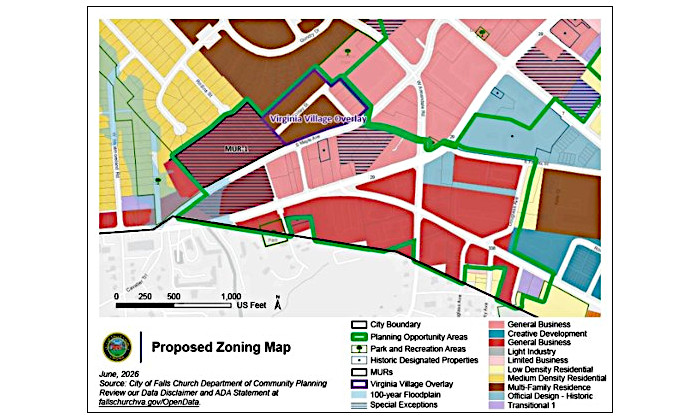
The Virginia Village Overlay District would replace the Mixed-Use Overlay District, or MUR-1 overlay currently in place, which the planning staff report maintains “is better suited for larger mixed-use redevelopments than what is anticipated for Virginia Village.”
According to the initial staff report, “The proposed amendments establish new regulations that would govern properties included in the zoning overlay district for Virginia Village and are intended to regulate potential future redevelopment within the Virginia Village neighborhood in a manner that reflects the vision and community values set forth in the Comprehensive Plan and Small Area Plan for this area.”
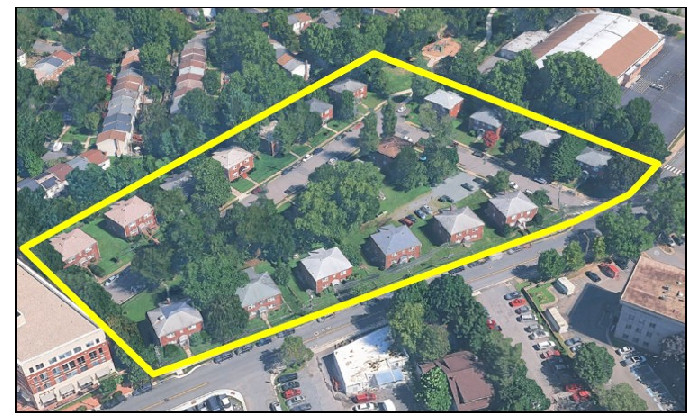
Thus, the proposed zoning ordinance for Virginia Village would apply not only to the City-owned properties, but also to the properties that remain in private hands, should they choose to access it.
Initially, the overlay district sought to encourage either an affordable housing or an open space contribution from potential developers by imposing one of two requirements:
1) Developers can access the overlay by providing a minimum number of committed affordable units, as measured across the combined project area, which would be affordable to households earning 60% of the Area Median Income (AMI) for the life of the project. A townhouse development application would need to provide the same number of affordable dwelling units prior to demolition or rehabilitation—a one-for-one replacement. A multifamily development application would have to make 50 percent of the total number of housing units affordable.
2) Alternatively, developers can provide a minimum public open space area equal to 60 percent of the combined development area that would be maintained for the life of the project as an alternative to the specified affordable housing contribution. (Special Exception only per the July 27 first reading.)
However, these requirements were amended by the City Council on July 27. Staff proposed and Council agreed that the affordable housing requirement apply to all by-right development applications, with an option for Council to permit open space in lieu of affordable housing after consideration of the needs of the City, market and economic conditions, special characteristics of the parcel being considered, and recommendations for the area as provided in the City’s adopted small area plans.
Council further clarified that there is no minimum open space requirement for by-right development and that the special exception for open space will be available immediately upon adoption of the ordinance, but that all other special exceptions will not be available until July 1, 2027.
Specifically, the new overlay district, as described by Senior Planner Jack Trainor and amended by Council on June 22, again on July 27, and for a third time on September 28, calls for:
Special Exception Process
- Staff introduced a special exception requirement for all district applications that would take effect beginning on July 1, 2027. District applications submitted prior to June 30, 2027, would be considered by-right. This schedule accommodates a by-right site plan review of a Council-approved RFP proposal and anticipates that any additional redevelopment projects would not be submitted until the special exception process takes effect.
- The City Council will act on special exception development applications within 60 days of receiving a complete submission. The Council will consider whether the proposed development satisfies the district’s permitted uses, standards of development, and affordable housing and open space requirements. The development must be consistent with the City’s adopted Streetscape Design Standards and Comprehensive Plan policies and incorporate reasonable landscaping, screening, and other design features to mitigate the impacts on surrounding properties from vehicular traffic, parking, and site lighting.
- Council removed previous recommendations from July 27 that the special exception may allow for height bonuses and relief from minimum building setbacks. A reduction of up to 10% required minimum affordable housing units remains. Sustainable design criteria have been added as SE application considerations.
Building Scale and Density Transitions
- Step-down approach:
- 10-foot building step-back requirement for any portion of a building after 3 stories or 36 feet in height, whichever is less when abutting or across an internal district street from an R-M district parcel or abutting a public park.
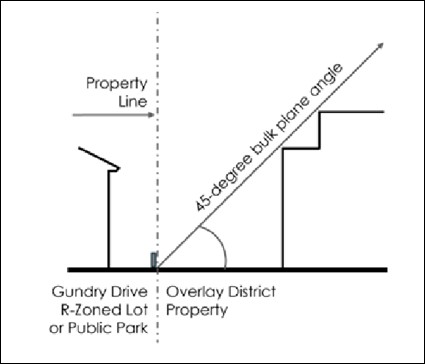
- Increasing building setback-to-height-ratio requirement respective to Gundry Drive properties and Big Chimneys Park (“bulk plane”) of 45 degrees measured from the point where the common property line meets the average grade elevation between the Gundry Drive and Virginia Village properties.
- The bulk plan angle shall be determined by site and grading conditions as of November 9, 2026.
- Building heights:
- Divide the site into four zones—A, B, C, and D—and set height limits in stories and feet in each of them as shown in the diagram below. The staff report accompanying the most recent zoning text amendments noted that maximum building heights in feet have been lowered across all zones “to balance an alignment with their corresponding maximum story limit for each zone while ensuring viability of multiple development options.” [For example, the 6 stories maximum building height was 75 feet, as of the July 27 first reading.]
- The staff recommended and Council walked back its prior approval maximizing the height of buildings located within 150 feet of any property line of a property that fronts on Gundry Drive or a public park at 4 stories or 40 feet in height, whichever is less. [Staff proposed to substitute 50 feet in lieu of the 40-foot height limit on July 27, leading to citizen opposition and Council’s restoration of 4 stories or 40 feet in the proposed ordinance approved on the second first reading. On September 28, Council approved 3 stories or 36 feet within 60 feet of the Winter Hill edge and 4 stories or 48 feet within 150 feet of the boundary between the Winter Hill and Virginia Village neighborhoods].
The prior maximum Virginia Village building heights maps as of July 27, 2026, is shown below.
- Buffers and setbacks:
- At least 15-foot setback from the abutting line of a commercially-zoned property.
- At least 15-foot setback from the Shirley Street face of curb.
- At least 18-foot setback from S Maple Avenue face of curb.
- At least 18-foot setback from Gibson Street face of curb.
- At least 20-foot setback from the abutting property line of any property within the district that is zoned R-M.
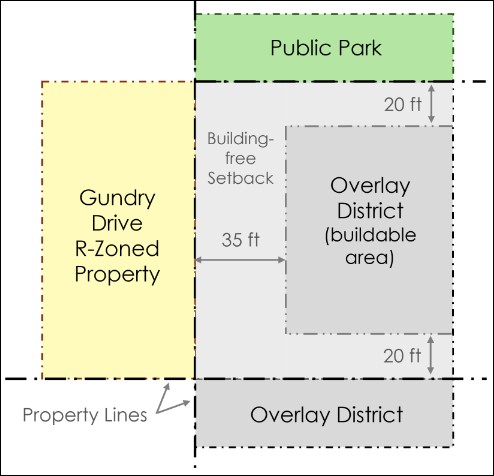
- At least 20-foot setback from public park to maximize the buildable area for affordable housing along Gibson Street while staying within Council’s desired building height maximum of 6 stories. [Previously at least 35-foot setback as of the July 27 second first reading of the ordinance.]
- At least 35-foot setback from the abutting property line of any Gundry Drive address (external to the overlay).
- By-right developments in the district, shall provide a minimum tree canopy on the development site, such that when measured 20 years after the first certificate of occupancy is issued, the tree canopy shall cover at least 10% of the development site.
- Screening requirements between internal-external overlay uses including:
- For public park and Gundry Drive frontages: 15-foot-deep landscaped planting strip with a minimum of 25 large shrubs, 4 canopy trees, and 4 evergreen trees per 100 linear feet and masonry wall or solid wood fence with a minimum height of 6 feet.
- For R-M district frontages (including interior Virginia Village properties: 10-foot-wide landscaping planting strip with a minimum of 25 small shrubs and 4 canopy trees per 100 linear feet.
- For commercial district frontages: 10-foot-wide landscape planting strip with a minimum of 25 small shrubs and 4 canopy trees per 100 linear feet and a screening element at least 6 feet in height of either a masonry wall, combined 3-foot-high earthen berm with the required landscaping located atop the berm, or a solid wooden fence.
- Architectural style:
- The new overlay district may include general guidance about neighborhood compatibility but stop short of codifying architectural standards. Clarification: Council agreed that no architectural mandatory requirements will be imposed on by-right development, but neighborhood compatibility will still be requested. [As of the July 27 first reading of the ordinance.]
Housing and Affordability
- Unit mix:
- Permits a variety of housing types (multifamily, townhouse) and loosens density restrictions.
- Affordability:
- Establishes a minimum one-for-one replacement of any existing housing units for committed affordable units, or a minimum of 50% of total new housing units as committed affordable units, whichever is greater, included within a redevelopment at 60% AMI and below for the life of the project.
- Note: This requirement was structured to apply to all properties within the overlay district; however City-owned properties subject to the request for proposals (RFP) released on June 24, 2026, will have a substantially higher expectation for their affordable housing contribution under two of the RFP’s three scenarios (b and c).
Open Space and Connectivity
- Access to development incentives found in the new overlay district will also include a minimum 60 percent public open space contribution as an alternative means for qualification that is contiguous and publicly accessible and includes one canopy tree per 500 square feet.
- Big Chimneys Park:
- Vegetative buffers and public open space requirements can serve as complementary and connecting links to Big Chimneys and surrounding trails.
- Pedestrian Links:
- New construction will be subject to City streetscape design standards, improving pedestrian and bicycling facilities.
- Vegetative buffers and public open space requirements can also connect pedestrians to Big Chimneys and surrounding trails.
- Most of these improvements are established as expectations in the RFP, given that the City-owned properties represent the northern and southern edges of Virginia Village.
- Parking:
- Parking for townhouses specified at one space per dwelling and 0.6 of a space per multifamily unit, with emphasis on reaching shared parking agreements with nearby garages with available spaces. [Previously, all redevelopment was subject to off-street parking requirements consistent with use ratios defined in Sec. 48-1004.]
- Existing regulation prohibiting vehicular entrances/egresses to commercial or business off-street parking or loading areas within 100 feet from any residential district will not apply to development within the Virginia Village Overlay District. Instead, the ordinance would require that off-street parking and loading area entrances may not be oriented toward Winter Hill or the public park and must be completely enclosed.
- Above-ground parking structures/garages must be at least 30 feet from S Maple Avenue.
- Placemaking:
- Redevelopment and new public open space can incorporate “sense of place” wayfinding and signage.
Complementary Uses
- The overlay permits childcare, supportive services, and other residential-supporting uses, and neighborhood serving retail as accessory uses to principal residential uses.
References
- City Council Action Meeting, September 28, 2026. This official video will not display properly on a small screen as it includes the agenda. Council discussion of Virginia Village zoning begins at timestamp 1:19:00 and ends at timestamp 3:37:00.
- City Council Action Meeting, September 28, 2026. YouTube video.
- Virginia Village Zoning Text Amendments Staff Report, September 28, 2026.
- City Council Joint Work Session with Planning Commission, September 22, 2026. YouTube video.
- Virginia Village Amendments Work Session Presentation, September 22, 2026.
- Virginia Village Affordable Housing District Zoning Parameters Granted First Reading on Monday, July 27, 2026, by the Falls Church City Council, posted September 4, 2026.
- Virginia Village Affordable Housing District Zoning Text Amendments [Full Text], posted September 4, 2026.
- City Council Action Meeting, July 27, 2026. This official video will not display properly on a small screen as it includes the agenda.
- City Council Action Meeting, July 27, 2026. YouTube video.
- Virginia Village Zoning Text Amendments Staff Report, July 27, 2026.
- Legislative Update & Summary Minutes Actions of the City Council for July 27, 2026.
- City Council Work Session, July 20, 2026. This official video will not display properly on a small screen as it includes the agenda. The discussion of the tenant relocation policy followed by Virginia Village items begins at about timestamp 2:30:00 and ends with the meeting at about timestamp 4:40:00.
- City Council Work Session, July 20, 2026. YouTube video.
- Virginia Village Zoning Text Amendments Staff Report, July 20, 2026.
- Virginia Village Presentation July 20 CC Work Session.
- City Council Action Meeting, June 22, 2026. This official video will not display properly on a small screen as it includes the agenda.
- City Council Action Meeting, June 22, 2026. YouTube video.
- Virginia Village Map Amendment Staff Report, June 22, 2026.
- Virginia Village Zoning Text Amendments Staff Report, June 22, 2026. This is the staff report on the Virginia Village Overlay District. The document contains the analysis of existing and proposed zoning changes, with images, and includes responses to public comments.