Falls Church City to Adopt Vision Zero Strategy to Eliminate Traffic Fatalities
Summary
At the City Council work session on October 20, 2025, Department of Public Works (DPW) Director Amanda Brain presented the Vision Zero strategy that will guide DPW’s approach to roadworks projects in the City. She asked the City Council to pass a resolution supporting the goals and implementation of the Vision Zero strategy.
What is Vision Zero?
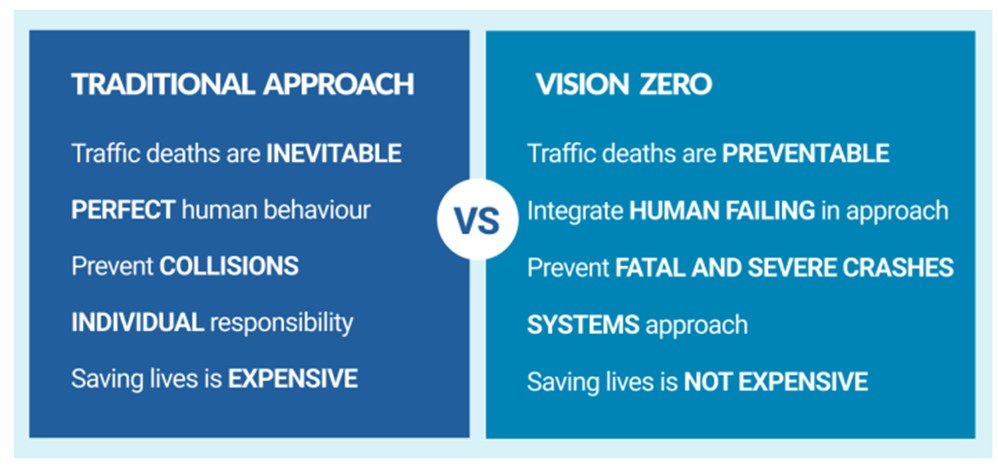
Vision Zero is an integrated approach to achieving zero fatalities on the roadways. The movement was started in Sweden in 1990s and has been formally adopted by many cities in the metropolitan region, including the District of Columbia, Arlington, and Alexandria. Although there has not been a fatality in 2025 in Falls Church yet and crashes are down, there was a fatality in the City in 2024.
Public Works is proposing that the City formally adopt Vision Zero, although the transportation staff have already begun using this approach to guide their work.
A systems approach to traffic safety based on data
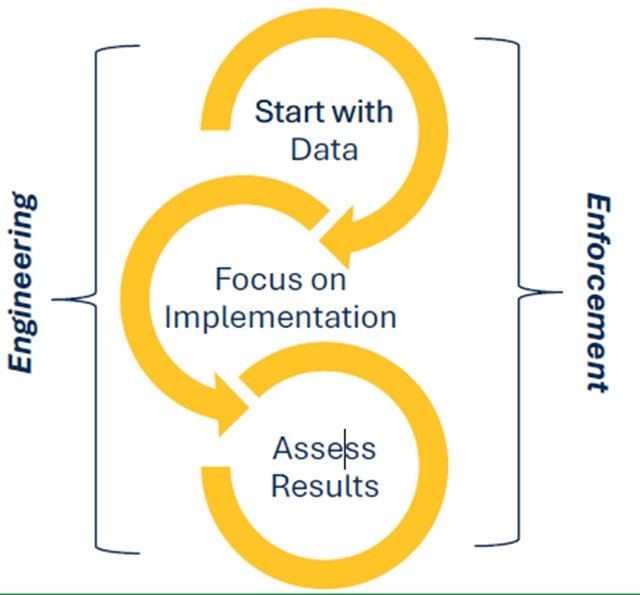
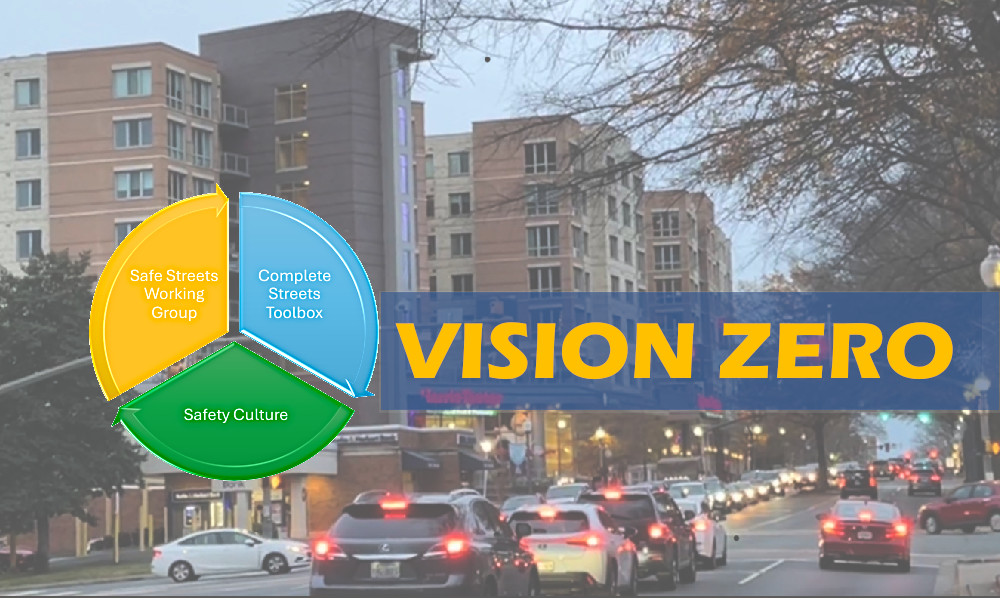
The Vision Zero strategy requires a holistic approach to traffic safety. A cross-functional working group involving the Public Works, Police, and Planning Departments now meets monthly to discuss road safety. This group analyzes traffic and accident data from the Virginia Department of Transportation (VDOT), Police Department Crash Reports, and the Falls Church Smart City Program as well as community feedback to identify problems and then works collaboratively to develop appropriate solutions.
Solutions may include increased enforcement, an education campaign, or improved engineering such as better signage or road markings. Capital Improvements Plan (CIP) projects will also be designed with Vision Zero principles in mind. Three projects being implemented this fall demonstrate these principles and are described in the Pulse post Three Roadworks Projects Planned in the Next 6 Months, October 27, 2025.
This strategy also includes a before/after assessment of the results to determine the success of the implemented solutions. Staff proposed a dashboard to track progress and publish maps of infrastructure installed, following the example of neighboring jurisdictions.
A “Complete Streets Toolbox”
DPW is developing a Complete Streets Toolbox to guide and evaluate designs that support the Vision Zero objectives. This toolbox will consist of:
- Complete Streets Checklist
- Use to assess CIP and developer projects, clarifying expectations and streamlining review.
- Timeline: late 2025.
- Guidelines
- Establish guidelines on various topics related to transportation infrastructure while allowing for context-sensitive design and creativity; not intended to be prescriptive.
- Include such topics as lane widths and vertical traffic calming.
- Build on the example documents from other local jurisdictions.
- Timeline: 2025-20263.
- A Public Facilities Manual
- Standardize design and engineering policies for road infrastructure for staff.
- Include development of this manual in the FY2027 budget proposal.
- Timeline: 2026.
Council discussion
Council Member David Snyder said that traffic safety is the “number one issue” that residents bring to the Council. Running red lights and stop signs and illegal right-turns are Citywide issues, not limited to any one trouble spot. He appreciates Vision Zero’s systemic Citywide look, saying, “I very much support the notion that this needs to be multimodal. This is not just about cars. This is about sidewalks,… about bike lanes, about pedestrians, about supporting business, but also encouraging people to come into the City and creating in them a culture of safety.” Mr. Snyder suggested looking at ways to do public communication about this initiative early in its implementation.
Council Member Justine Underhill asked for more information on the Complete Streets Toolbox that DPW is proposing as part of the Vision Zero strategy. Ms. Brain explained that this toolbox would establish standards for the streets, sidewalks, curbs, and greenery, among a range of factors. She also agreed to share the toolbox with City Council when a draft is completed.
Council members liked the idea of a dashboard of transportation projects. Council Member Erin Flynn said publishing a dashboard to track projects – past, current, and future – would be very useful to the community by providing transparency and visibility for the Council, boards, commissions, and the community, letting them see what is in the pipeline and which projects are prioritized.
Vice Mayor Debora Schantz-Hiscott noted that many people don’t understand the issues regarding rights-of-way between the streets and their property lines. Can they plant bushes in the rights-of-way and who has to maintain that land? Inappropriate plantings and maintenance of shrubbery in rights-of-way can obstruct vision on the roadways. She identified this as an area where education might be needed.
The Council asked staff for financial information that would identify the level of investment needed for various projects, so they have a better idea how to prioritize budgeting and spending. Mayor Letty Hardi said that Council has difficulty knowing if sufficient money has been budgeted to maintain and improve the City’s roadworks.
References
- Vision Zero – Staff report, October 20, 2025.
- Vision Zero – Slides, October 20, 2025.
- City Council Work Session, October 20, 2025. YouTube video.
- City Council Work Session, October 20, 2025. This official video will not display properly on a small screen as it includes the agenda.