City’s FY2025 Budget Year-End Report Reveals Slowing Economic Activity
Summary
The City’s Fiscal Year 2025 (FY2025) ended on June 30, 2025. On October 6, 2025, staff presented a year-end assessment of how well the FY2025 budget projections of revenues and expenditures turned out. FY2025 actual revenues were 1.7% over the $118 million projected and actual expenditures were 0.5% below budget, resulting in a surplus of $1.46 million available for distribution. This post dives into the details and how the City intends to use the surplus.
Online sales declined 6.5% from last year, suggesting a possible slowdown in consumer spending. The opening of Whole Foods in February helped increase taxes from grocery purchases by 6%.
Meals taxes grew only 2.9%, despite the addition of six new restaurants. Staff believe that restaurants have opened more slowly than expected. The final quarter of FY2025 saw an uptick in meals taxes.
City Council put an additional $45,000 toward emergency financial assistance for residents who are facing financial hardship. Staff reported that they are seeing more requests for financial assistance.
Fun fact: Fines from speed cameras brought in $536,000 more than projected.
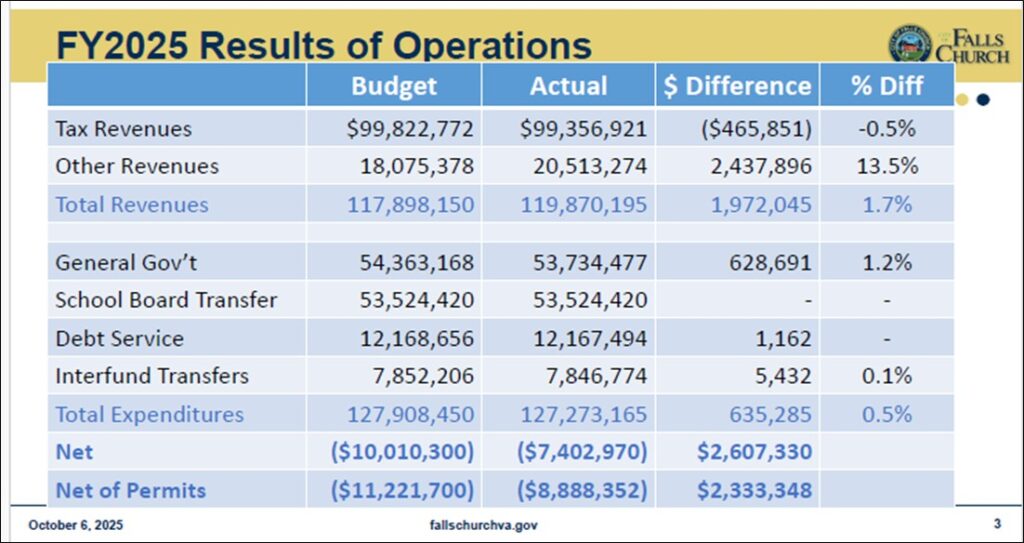
Local tax revenues were $466,000 (0.5%) below budget
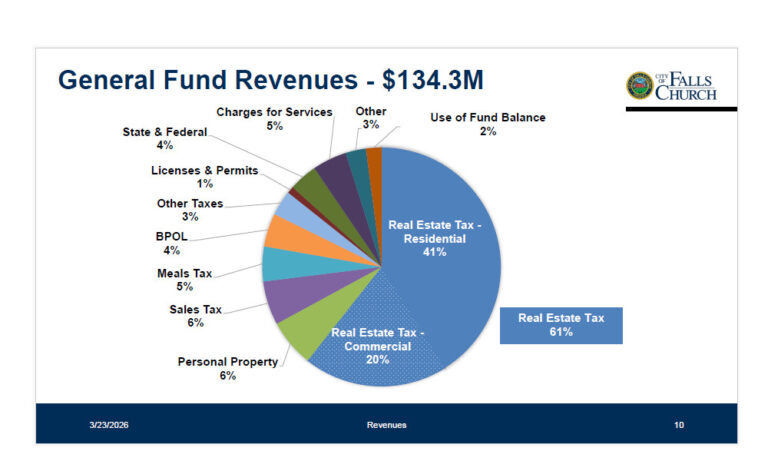
Actual local tax revenues were 0.5% below the FY2025 budget, due primarily to lower sales taxes, meals taxes, and business taxes. The shortfalls were offset by slightly higher real estate taxes from new construction and higher personal property taxes from new car registrations in the City. Local tax revenues are comprised of:
- Real estate taxes (69% of total taxes)
- 0.5% above budget, $346K.
- Personal property taxes (8% of total taxes)
- 5.1% above budget, $376K.
- Sales taxes (7% of total taxes)
- 2.3% below budget, -$173K
- Meals taxes (6% of total taxes)
- 10.4% below budget, -$672K.
- Business taxes (6% of total taxes)
- 6.4% below budget, -$381K.
- Other local taxes (4% of total taxes)
- 0.9% above budget, $38K.
The School Revenue Sharing Agreement requires that any local tax surplus at year-end be shared with the School Board. Because the local taxes at year-end were $465,871 below budget, Falls Church City Schools will not receive any surplus funds this year.
$1.6 million more from interest on investments and speed cameras
“Other Revenues” were higher by $2.4 million at year-end. This category refers to non-tax revenues that include investment income, fees for service, fines and forfeitures and permits. The City’s cash reserves earned $1.1 million more than budgeted. The new speed cameras also proved to be unexpectedly bountiful, bringing in an extra $536,000, almost doubling the budget projection. Receipts from Community Center classes were also higher than planned. The FY2025 budget planned for the worst-case scenario where there would be no classes during the HVAC renovation, but Recreation and Parks were able to hold many activities offsite.
This excess revenue is not part of the revenue sharing agreement with the City schools.
Lower than budgeted General Government spending last year
Actual City government expenditures were $635,000 below the FY2025 budget, adding to the surplus. Some of the budgeted items that were planned but not incurred by year-end are carried forward into FY2026, as shown below in the proposed allocation of surplus funds table.
Sales tax receipts fell short of optimistic forecast due to lower consumer spending
Of the 6% Virginia sales tax paid on most purchases either online by residents or in stores in the City, the City receives 1%. (4.3% goes to the State, and 0.7% is a special district tax.) For grocery sales, 1% tax is paid to the City.
After two years of strong sales tax growth, the FY2025 budget projected 7.1% increase in sales tax receipts for FY2025. After all, sales growth was 8.6% for FY2024. However, actual sales taxes increased only 4.6%, below the 10-year average growth of 6.2%.
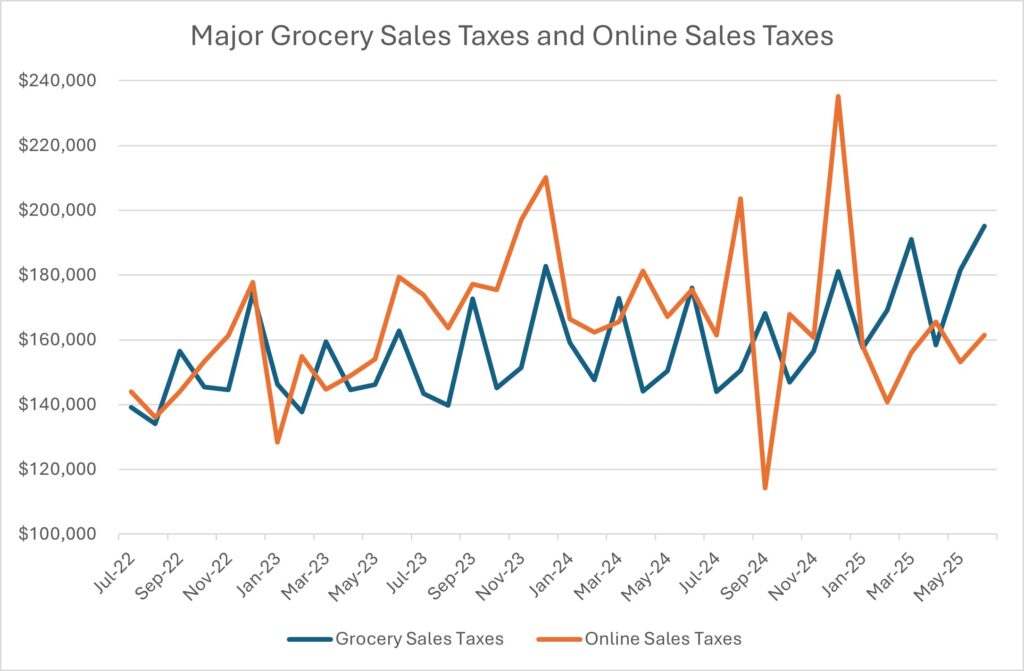
The graph above shows sales tax data for the last three fiscal years for two major sources of sales taxes – grocery stores and online purchases. As expected, the new Whole Foods that opened in February this year increased sales tax receipts in 2025. Interim Director of Finance Melissa Ryman reported that taxes from grocery sales were up 6%. However, online sales tax receipts declined by 6.5% from FY2024. Online sales taxes include major purchases to furnish the new apartment developments, so it is difficult to say how much consumer spending has fallen.
The FY2026 budget relies on a sales tax growth of only 2%.
How are City restaurants doing?
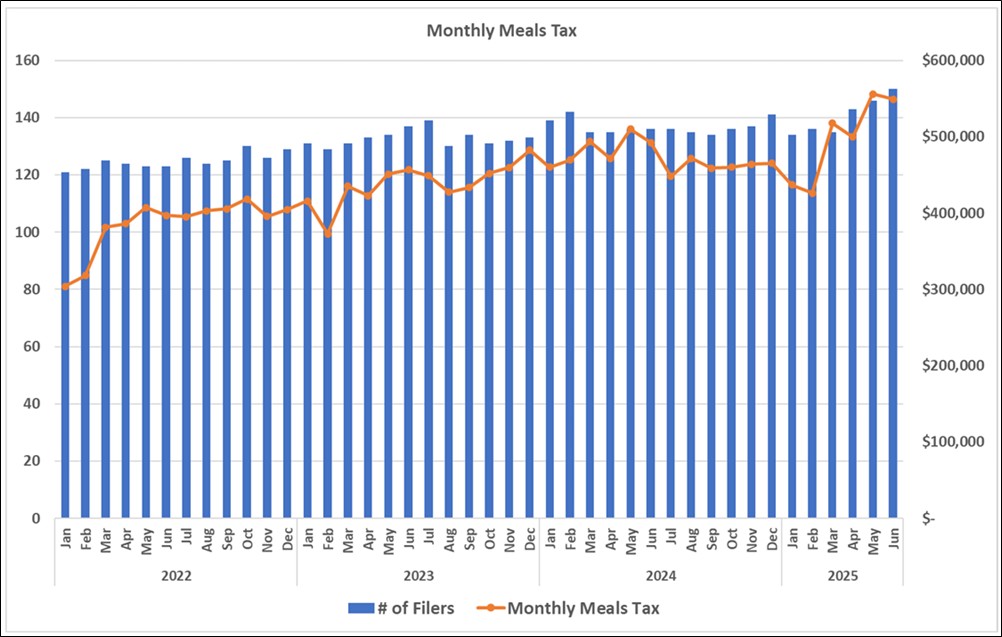
The growth in meals taxes was a disappointing 2.9% in FY2025, despite an additional six restaurants in the City, according to the staff report. For FY2024, the meals taxes grew 12.2% leading to an aggressive 14.9% projection for FY2025 as the City anticipated the launch of new restaurants. The new restaurants opened a little later than expected, and existing restaurants barely managed to maintain their revenues. It wasn’t until the last few months of FY2025 that the meals tax receipts began to increase, probably due to the new restaurants.
Staff is cautiously optimistic that the 4.3% FY2026 budgeted growth for meals taxes will be achieved. The 10-year average meals tax growth is 8%.
FY2025 ends with a $2.3 million surplus
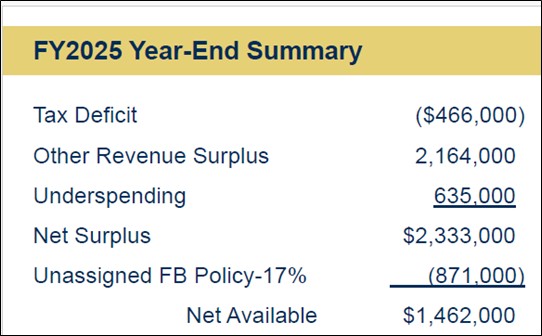
Together with underspending by the general government, the net surplus for FY2025 was $2.3 million, or 1.8% of the FY2025 budget. Actual revenues were $2 million (1.7%) above budgeted revenues. This is closer than the $6 million (5%) revenue surplus in FY2024. A large revenue surplus means that the City collected more real estate taxes than needed and the real estate tax rate could have been lower.
The City has a policy to maintain an unassigned fund balance that is at least 17% of budgeted expenditures. This would require $871,000 to be added to the unassigned fund balance for FY2026, leaving a $1.462 million surplus available for distribution.
Why are revenue surpluses linked to over taxation of real estate? Click here.
The one source of tax revenues that the City can predict with great accuracy is the real estate taxes. This is because the real estate assessments, and appeals, are known before the annual budget is approved in May each year. The real estate tax rate is set to produce the desired level of taxes that will support the approved budget expenditures, supplemented by other local tax and non-tax revenues forecasted in the budget.
Underestimating the non-real estate tax revenues when setting the annual budget, typically by adopting conservative projections, reduces their contribution to budgeted revenues so that the real estate tax collection needs to be higher to compensate. A year-end revenue surplus indicates that the non-real estate tax revenues were underestimated and too much real estate taxes were collected, i.e. the real estate tax rate could have been lowered.
Growing financial hardship in our community
City Council members asked staff if they were seeing signs of the need for financial assistance in the community. At an October 3 meeting, Treasurer Jody Acosta told the Council’s Budget and Finance Committee that her office had prepared at least 40 payment plans for property taxes due to financial hardship this year. In the previous year, they only made about 15 payment plans. Ms. Ryman also reported that the real estate tax relief program had exceeded the FY2025 budget by over $250,000.
Staff had proposed an additional $20,000 be set aside for emergency financial assistance, supplementing the $25,000 allocated in the FY2026 budget. At the October 27, 2025, City Council meeting, Council Member Erin Flynn proposed that even more money be set aside to help residents or to donate to area food banks. She asked if $50,000 for the USA 250th anniversary celebration was excessive, compared to the amount set aside for financial assistance.
Council Member David Snyder, who is a member of the Falls Church 250 Committee, explained that the events currently being discussed are not so much celebrations but activities that would encourage “discussion for the future about what things like the Declaration of Independence and the Constitution mean to people today and what’s occurring today, so that they can learn from that in the future.” He believes that creating opportunities for such discussions is particularly critical in the present climate.
Jim Coyle, chair of the Falls Church 250 Committee, explained that the group is in discussions with the library to show videos exploring democracy from many viewpoints. They are also working with community and veterans groups to develop other activities. The committee is in the early stages of its planning and does not know how much money its activities will cost. Mr. Coyle said they would be comfortable with a lower budget with the understanding that the committee would be able to approach the City Council to request additional funds, if needed, when their plans become clearer.
Allocation of the budget surplus to non-recurring expenses
The available budget surplus, net of permit fees, is $1.462 million. It is the City’s policy to use budget surpluses on non-recurring expenses, so-called “one-time spending”. City Council voted unanimously to approve the use of funds shown below, with the change to increase “Additional emergency financial assistance” by $25,000 and reduce “USA 250th Anniversary” by $25,000.
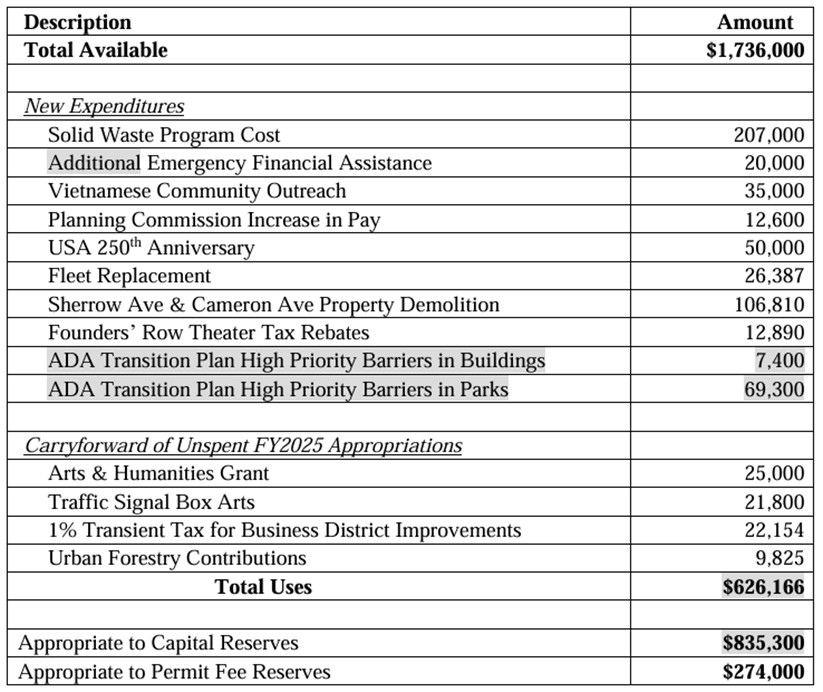
The solid waste program costs are related to the new solid waste fees:
- $144,000 for the new organics bin. This money will be recovered through trash fees over five years.
- $15,000 for communications – yard signs, mailings, flyers, etc.
- $38,000 subsidy for the current food waste program.
- $10,000 to pay for those who qualify to be exempted from trash fees.
The Planning Commissioners will receive $250 a month and the Chair will receive $300. [Read Pulse post Council Boosts Planning Commission Salaries; First Increase Since 1990, July 17, 2025.]
The Sherrow and Cameron Avenue property demolition refers to property the City purchased that is in a flood plain. The high demolition price is due to the presence of asbestos. This property will be turned into greenspace.
The City is obligated to give $12,890 in meals and tickets taxes collected from Paragon Theaters to Founders Row in accordance with the economic incentive agreement between the City and Founders Row. An explanation of this agreement may be found in this staff report [August 8, 2022]. (This is technically not a budget surplus item.)
The City will use $76,700 to make City buildings and parks ADA compliant. The list of items may be found here and here. These items include providing paths to shelters and picnic tables that are wheelchair accessible from the street or parking lot.
$835,300 will be deposited in the Capital Improvements Program fund for future projects.
References
- City Council Meeting, October 27, 2025. YouTube video.
- FY2026 Budget Amendment, October 27, 2025. Staff report on the allocation of the FY2025 YE budget surplus.
- FY2025 YE Report, October 6, 2025.
- FY2025 YE Report PPTX, October 6, 2025.
- City Council Work Session, October 6, 2025. YouTube video.
- City Council Budget and Finance Committee Meeting, October 3, 2025. This video will not display properly on a small screen as it contains the agenda.