Increasing the City’s Tree Canopy
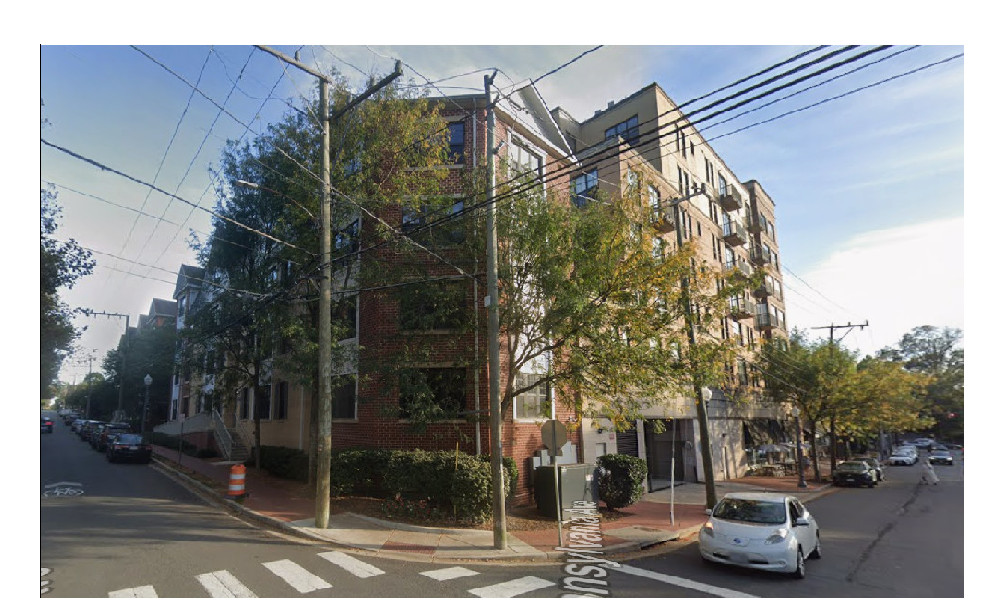
Photo of the street trees on Park Avenue and Pennsylvania Avenue, planted around the Spectrum building that was completed in 2008. After 17 years, the trees are unable to reach their maximum canopy because they are too close to the building and do not receive adequate light.
Summary
- The City’s Urban Forestry Commission (UFC) has been concerned for several years about the loss of tree canopy within the City, as development proceeds at a rapid pace on commercial lots and trees on residential lots are torn down to make way for larger houses. Between 2014 and 2021, Falls Church City experienced a net loss of 10 acres of tree cover, according to new data released by the Chesapeake Tree Canopy Network in July 2025. Canopy coverage is estimated to have gone from 46% to 41%.
- Based on recommendations by the UFC, as a first step on October 6, 2025, City Arborist Charles Prince and Planning Director Matt Mattauszek presented a resolution at a City Council Work Session recommending that the City fill the gap in our City Code for non-residential lots by requiring a minimum 10% tree canopy coverage within non-residential zoning districts as new developments occur, consistent with Virginia State regulations.
- Staff’s objective for non-residential lots is to exclude street trees and canopy bonuses now permitted within residential districts under the City Code in order to require the full 10% canopy onsite for commercial lots. UFC Chair Amy Crumpton has indicated that “excluding the street trees from the 10% requirement could make a difference in getting more trees into the commercial hot zones.”
- The proposal was endorsed in an initiating resolution by Council on October 27, 2025, prior to further consideration and advice from the Planning Commission, the Environmental Sustainability Council (ESC), and the UFC, in advance of an anticipated Council first reading on November 24, 2025, a Planning Commission public hearing on December 17, 2025, and final action by City Council on January 26, 2026.
- Additional efforts to enhance these admittedly minimal requirements, perhaps through steps similar to measures taken in other jurisdictions and by encouraging increased legislative minimums at the State level, might then be pursued as well.
- Discussion of measures to maintain and increase trees on residential properties is anticipated in 2026.
Background
City Manager Wyatt Shields introduced the discussion at the October 6, 2025, Council Work Session by noting that the City has been losing tree canopy over the last 10-20 years due to greater density on commercial and residential lots. There are several different third-party analyses of tree canopy within the City, currently under review by City staff. Staff will further update City Council on its review at the November 17 work session.
- Software provided by the U.S. Forest Service based on aerial surveys showed that the City’s canopy coverage in 2014 was 46% (https://www.fallschurchva.gov/190/Urban-Forestry).
- Current tree canopy coverage within the City is estimated at 41% by the Chesapeake Tree Canopy Network, reflecting a net loss of 10 acres of tree canopy from 2014 to 2021.
- This is well below the Metropolitan Washington Council of Governments’ goal of 50%for the region, set in 2024.
Recent City documents have emphasized the importance of tree canopy within the City:
- The City’s Comprehensive Plan incorporated a new Chapter 5 on “Environment for Everyone: Environmental Sustainability, Resilience, and Natural Resources” on February 10, 2020, citing the following goal: “Protect and enhance the network of trees, green spaces and naturalized land on public and private property throughout the City, and the plants and wildlife it supports.”
- Efforts to increase the City’s tree canopy coverage were included in the City Council’s strategic priorities for 2024 and 2025 in Environmental Sustainability Strategy #2: “Expand green infrastructure, tree canopy, and open space citywide.”
Trees provide numerous benefits
Chapter 5 of the Comprehensive Plan outlines the benefits of our network of trees and greenspaces on public and private property as a critical part of the City’s economic and civic well-being (p. 19):
“It provides many environmental benefits, including carbon capture, oxygen emission, filtration and capture of air pollution, reduced energy use through shading and shelter, stormwater flow management and filtration, improved soil condition, diverse wildlife habitat, beauty, and increased human health. The urban forest also contributes to real estate values and to the appeal and walkability of City business districts.”
At the October 6 Council Work Session, City staff underscored these benefits, drawing on a summary graphic prepared by the Nature Conservancy:
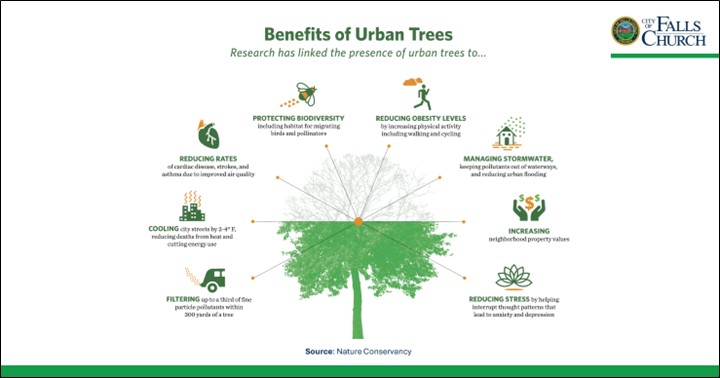
According to the Chesapeake Tree Canopy Network, there are also specific financial benefits derived from the current Falls Church tree canopy:
- 31,000 pounds of air pollution are removed annually, saving us $88,000 each year.
- 9.6 million gallons of stormwater runoff are reduced per year, saving us $86,000 annually.
- 665 tons of carbon are sequestered each year, saving us $318,000 annually.
(Calculations are based on 2021 tree cover data using landscape.itreetools.org.)
Several factors lie behind the City’s recent loss of tree canopy
City staff attribute the loss of tree canopy during the past decade to several factors:
- Eight special exception development projects along the major corridors during this period,
- Six minor commercial development projects on much smaller lots,
- Some 300 regrading projects for single-family home expansions, subdivisions, and redevelopments,
- Actions by utility companies to trim/remove trees to guard against power outages or for routine maintenance, and
- City Capital Improvements Projects impacting areas adjacent to roadways or in the street median.
State law restricts tree canopy minimums to 10% for non-residential properties
Virginia State regulations (§ 15.2-961.3) permit localities to require a minimum of 10% tree canopy on business, commercial, or industrial properties, or for residential sites with more than 20 units per acre. A minimum 20% tree canopy requirement applies to properties with single-family homes. Tree canopy is defined as “all areas of coverage by plant material exceeding five feet in height, and the extent of planted tree canopy at 10- or 20-years’ maturity.”
Credit can be given “in consideration of the preservation of existing tree cover or for preservation of trees of outstanding age, size, or physical characteristics.” Localities also may provide for exceptions where the State minimums would result in “unnecessary or unreasonable hardship to the developer,” and may establish a tree canopy bank or fund “whereby a portion of a development’s tree canopy requirement may be met from off-site planting or replacement of trees.” Because Virginia is a Dillon Rule state (localities cannot go beyond State minimums), Falls Church must adhere to these regulations.
The current City code has never required tree canopy coverage on commercial lots
- The City Code does not currently include any minimum standards for tree cover on commercial lots, with the exception of required plantings for interior and perimeters of parking lots and for landscaping buffers between zoning districts (Sec. 48-1181, 48-1182, and 48-1183 of the City’s municipal code).
- The code also lacks specific requirements for tree canopy for mixed-use developments, which generally don’t have external parking lots and have often focused on green space rather than tree canopy in negotiations on an ad hoc basis as part of Special Exception procedures.
- New homes on residential lots, however, are required to have 20% tree canopy coverage at maturity (within 10 years of planting) under the City Code. For these lots, a bonus of 25% of the tree canopy is granted for native trees, the preservation of existing trees, new plantings for rain gardens or other biodiversity programs, or trees qualifying for energy conservation to shade the southern side of homes. A 25% bonus means that a tree with a canopy of 200 sq ft after 20 years is calculated as contributing 250 sq ft to the required canopy coverage. An additional 10% bonus is provided for species diversity. (See Sec. 48-1180 of the City’s municipal code.) These provisions tend to reduce the absolute coverage requirement on residential lots.
- The new T-zone requirements adopted in 2023 require at least 10% canopy coverage, but City policy has permitted street trees to be counted as part of that minimum in by-right projects developed to date, resulting in few trees onsite.
Filling the “gap” in code canopy requirements
The staff proposal would draw on State authority to fill the current “gap” in City Code canopy requirements. It would focus on City commercial revitalization areas, primarily along Broad and Washington Streets and the East and West ends of the City. These areas account for 23% of the City’s land coverage, and the residential areas approximately 77%. The proposal has strong support from the City Arborist and the new Planning Director.

The new proposal would require 10% canopy coverage at tree maturity for all new developments on commercial lots but would not affect existing commercial or mixed-use developments. Although City staff initially proposed that existing Code provisions for tree bonuses also be excluded from the 10% minimum, that proposal wasn’t included in the final initiating resolution. Staff also agree that higher minimums would be desirable, noting that other surrounding jurisdictions have managed to achieve up to 25% canopy on commercial lots. Staff have pledged to explore further how other jurisdictions have managed to increase tree canopy despite the State restrictions.
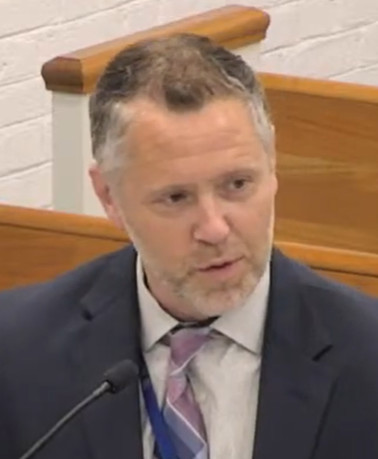
The new City Planning Director, Matt Mattauszek, affirmed that a 10% canopy requirement is virtually nothing, and it should not be contentious. However, the City should start with this requirement for now. He said that the Small Area Plans for the East and West ends of the City seek 15% canopy coverage, which could provide additional leverage in negotiations with developers.
For the City as a whole, programs such as the Neighborhood Tree Program coordinated by the City with the Village Preservation and Improvement Society (VPIS) have also encouraged voluntary plantings in the right of way on residential lots, although current City staff shortages have suspended the program for the time being. In 2025, VPIS has also offered free tree saplings to residents to plant elsewhere on their lots, as well as for plantings on City land. Going forward, City staff hope the City can support changes to State law to permit higher canopy requirements.
For the moment, the focus is on a requirement for tree canopy on commercial lots themselves, excluding street trees planted in the City’s right of way. In the meantime, Charles Prince, the City Arborist, has emphasized that tree canopy on recent development lots should increase over time as new plantings mature.
Recent Development Projects in Falls Church
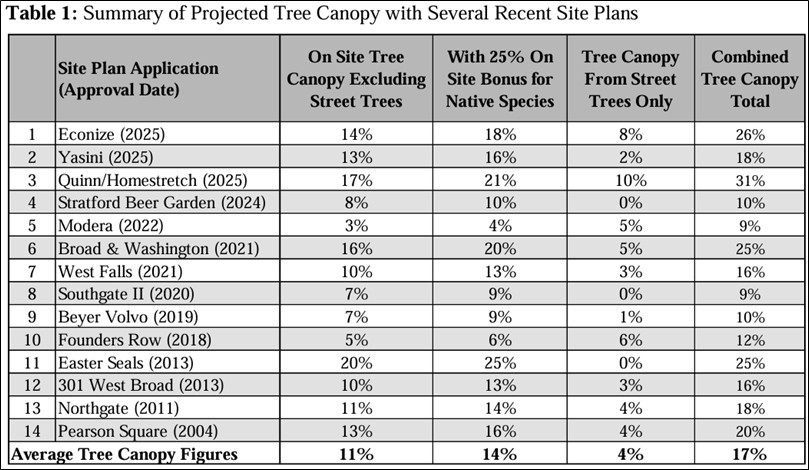
City staff have reviewed projected tree canopy coverage based on site plans for recent projects on commercial properties within the City. Tree canopy projections are based on the 20-year tree canopy coverage worksheet from the Chesapeake Bay Preservation Ordinance based on proposed species.
For smaller projects, several have exceeded 10% projected coverage on-site (Easter Seals, Econize, Yasini), but others have fallen short (Stratford Beer Garden, Southgate II, Beyer Volvo) when street trees are excluded. Similarly for large mixed-use projects, 301 West Broad and West Falls come in at just 10% projected coverage on-site, while Pearson Square, Northgate, Broad and Washington, and Quinn/Homestretch exceed that standard based only on on-site trees. However, Founders Row I and II (Modera) fall significantly short with just 5- and 3%coverage on-site. The average projected on-site tree canopy for all projects is just 11%.
When a 25% bonus for native species is included, the average credited tree canopy for these projects is artificially boosted to 14% (through no additional trees), with four projects still below the 10% objective. Street trees also increase the total canopy count, with 6-10% street canopy numbers for Founders Row I, Econize, and Quinn/Homestretch. Several projects only achieve a 10% canopy goal by including the native species bonus and street trees, while Modera (Founders Row II) and Southgate II still don’t make it.
City Council discussions yield unanimous approval
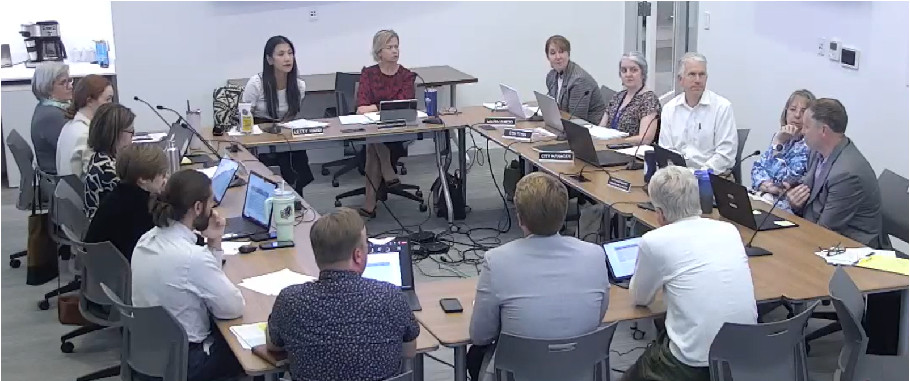
During the October 6 and October 27 City Council meetings, following staff presentations, Council members raised a number of specific questions, but ultimately strongly endorsed the new staff proposal. The following points were made at the October 6 session:
Mayor Letty Hardi noted that the City Code already requires 20% tree canopy coverage for individual residential homes within 10 years, the highest level permitted by state law.
Council Member Laura Downs asked whether City staff specifically check tree plantings as part of new home developments, and whether they come back to check compliance after 10 years. City Arborist Prince outlined the current checks prior to occupancy, noting they do not currently come back after 10 years, but said he would like to do so.
City Manager Shields noted that the current proposal is for an initiating resolution, to be followed by further analysis and additional information during the development of actual code language. He said that a tree canopy requirement could impact other goals Council has already established for mixed-use development projects and that the City will want to have a transparent process so that Council can understand how those objectives might interact.
When asked by Council Member Downs whether the native tree bonus would be excluded, the City Arborist noted that the current proposal would exclude street trees, but they would have to see how they would come out on the other bonuses (included for residential lots) after further analysis.
Council Member Justine Underhill asked if there would be any possibility of a waiver of the 10% canopy requirement if a developer was having a particular difficulty in achieving that target. Planning Director Matt Mattauszek responded that they would emphasize having information on the new requirement clearly known ahead of project development, and that they would intend to apply any waivers only for small projects experiencing particular hardships, not major developments.
In further response to Council Member Erin Flynn’s question about the interaction of landscape and tree canopy requirements, Mr. Mattauszek said that a reduction of even two parking spaces in a commercial parking lot might enable the achievement of tree canopy goals.
Ms. Flynn further asked for clarification that the new requirement does not apply to R-TH, R-M, and R-C residential lots, since they currently have a 50% impermeable coverage cap that leaves greater potential for tree canopy. She also encouraged follow-up enforcement/checks on actual tree canopy for the major development projects after 10-12 years to see if the pledged coverage is being met. Mr. Mattauszek responded that many of our data sources are time-specific, we don’t currently have the capacity to do aerial analyses on an annual basis, and tree canopy increases over time as trees mature.
Council Member Marybeth Connelly expressed concern that the green spaces indicated on site plan maps don’t seem to reflect tree canopy, citing the Modera Falls Church (Founders Row II) property. Staff confirmed that only actual tree plantings on the site plan are indicative of trees, and that smaller bushes, small trees, or ground cover do not meet the definition of canopy trees for the City’s tree coverage analysis.
Tim Roche, representing the Urban Forestry Commission, stated that the 10% requirement from the UFC’s perspective is very much a minimum, but urged Council to move ahead with the proposal as a starting point. He said the UFC hopes the City will further analyze what other jurisdictions are doing to achieve higher canopy levels, a suggestion that Council Member David Snyder and Ms. Downs also emphasized.
Mayor Hardi seemed surprised at the analysis that our canopy is declining, versus the assumption in March that it was holding steady. She asked if the City has a sense of where the reduction in tree canopy has been occurring, emphasizing that we’ve had three times as much residential land as commercial land redeveloped in the last 10 years. Mr. Shields noted that development projects that combined parcels often had perimeter trees such as mulberry or locust scrub trees that had grown up that the City hadn’t valued as of great public benefit; upon a review of pre-existing coverage and site plans, it became apparent that coverage had declined on commercial lots over the past 20 years. Mr. Mattauszek emphasized that in looking at the 300 regradings we have seen on residential lots over this period, they came to a stark realization that a number of them occurred on residential lots that originally might have had 60-80% tree canopy coverage, which was then reduced to 20%.
Mayor Hardi also asked if setting a 10% minimum canopy coverage might undermine our ability to achieve higher coverages in major development projects, by setting a reverse motivation for developers that might otherwise do more. Mr. Mattauszek responded that the more policy or Code references we have when beginning discussions with developers early in the process strengthens the City’s position. Having no minimum now is already a step backward, weakening our hand. In the grand scheme of things, 10% is nothing; depending on who you ask, it is laughable. We should be doing much more if we share the MWCOG goals of 50% coverage.
Most of the active discussion on this item was during the Council’s October 6 work session. At the October 27 Council meeting, Arborist Prince noted that staff plans to consider changes for the residential districts later. At that meeting, Ms. Downs asked if Mr. Prince had any ideas how other jurisdictions were achieving 25%for commercial tree canopy. He responded that most of those levels were attained through special exceptions; also, the other local governments didn’t waiver on their tree requirements. In response to a further question about regrading of single-family home lots for expansion or further development, Mr. Prince said that regrading and putting storm structures in the ground have had a major impact on tree canopy.
Vice Mayor Debora Schantz-Hiscott noted that the ESC has supported this proposal and would like to press for a change in the state legislation to permit higher canopy coverage requirements. She also asked where the City stands regarding coverage on its own land, as a means of setting an example for our businesses and residents.
The initiating resolution was adopted unanimously.
November 5 Planning Commission session raises additional isues
Mr. Prince emphasized in his presentation that the current 10% proposal sets the stage for more work next year on tree canopy. He noted that the Chesapeake Bay Ordinance provides incentives for planting native trees, while Falls Church only plants native trees as a general policy.
Commissioner Tim Stevens commented that it wouldn’t be ideal to seek much over 10% coverage in the most dense areas of the City. Planning Director Mattauszek responded that if tree canopy is something the City is known for, we should prioritize it on both commercial and residential properties. He suggested that the role of residential neighborhoods in the City is part of our “brand.” Looking to the next decade, it would be very difficult – and perhaps impossible – to get back further loss of tree canopy.
Mr. Prince contended that effective negotiations with developers can achieve up to 25% tree coverage, although there may be trade-offs in getting there. We are already at a 10% average for our recent projects, so that objective shouldn’t be controversial. He was confident that we could ask for 15-25% canopy coverage on commercial lots and still have viable projects.
Commissioner Phil Duncan asked if there might be a benefit in requiring bigger trees to be planted, in order to get to our goals faster. He also wanted to know what we might ask state legislators to support with regard to excessive tree clearance on residential lots. City Arborist Mr. Prince responded that larger trees would have to be watered for approximately four years, as compared to two years for smaller caliper trees.
Mr. Duncan also asked what is legal for cutting down trees on residential property, noting citizen concerns about recent clear-cutting on neighboring properties. He thought the issue of any appropriate restrictions on such action should be an item for discussion.
Planning Commission Chair Andrea Caumont asked if the City should do more on its official land as an example for other non-residential properties in setting a new core target. She noted that we also need to discuss whether the City needs additional criteria regarding tree canopy in our Special Exception documents, taking this into account in the context of our other priorities. “Trees make for more attractive spaces,” she said. Planning Director Mattauszek responded that, ideally, we need a common position in all our documents.
City staff again presented their recommendation: “Introduce a minimum 10% canopy coverage in the City Code for on-site trees within zoning districts that currently do not have minimums (without the inclusion of any bonuses or street trees).”
What about the T-Zones?
Council’s adopted initiating resolution was slightly different: “(TR25-30) RESOLUTION TO INITIATE AN AMENDMENT TO THE CODE OF THE CITY OF FALLS CHURCH CHAPTER 48, “ZONING,” TO REQUIRE THAT THE SITE PLAN FOR ANY SITE LOCATED IN A NON-RESIDENTIAL ZONING DISTRICT INCLUDE THE PLANTING OR REPLACEMENT OF TREES ON THE SITE TO THE EXTENT THAT, AT 20 YEARS, THE MINIMUM TREE CANOPY ON THE SITE WILL BE 10%.”
By moving to non-residential zoning districts instead of districts that do not have canopy minimums, the proposal would appear to include both T-Zones and official design districts in the 10% on-site canopy requirement, while retaining a focus on “minimum tree canopy on the site.”
Future scheduled meetings
- Environmental Sustainability Council Work Session November 20, 2025
- City Council 1st Reading November 24, 2025
- Planning Commission Public Hearing December 17, 2025
- City Council Final Consideration January 26, 2026
References
- Chesapeake Bay Land Use/Land Cover (LULC) Database 2024 Edition: U.S. Geological Survey data release, July 2025
- Falls Church City Council Strategic Priorities, Calendar Years 2024 and 2025
- (TR25-30)-3 MWCOG_Resolution_R14-2024, April 10, 2024
- City Council Work Session, October 6, 2025. This official video will not display properly on a small screen as it includes the agenda.
- City Council Work Session, October 6, 2025. YouTube video.
- City Council Meeting, October 27, 2025. This official video will not display properly on a small screen as it includes the agenda.
- City Council Meeting, October 27, 2025. YouTube video.
- Planning Commission, November 5, 2025. YouTube video.
- Falls Church Comprehensive Plan, Chapter 5: Environment for Everyone
- Code of Virginia 15.2-961.3
- Commercial Development Tree Canopy Assessment, Staff presentation, October 6, 2025, Council Work Session.
- Tree Canopy Code Changes Staff Report, October 27, 2025.
- (TR-25-30) Resolution to initiate an amendment to the Code of the City of Falls Church Chapter 48, “Zoning”, to require that the site plan for any site located in a non-residential zoning district include the planting or replacement of trees on the site to the extent that, at 20 years, the minimum tree canopy on the site will be 10%. Approved by Council on October 27, 2025.