Growth in the Little City and a Tax Base Still Dependent on Single-Family Homes
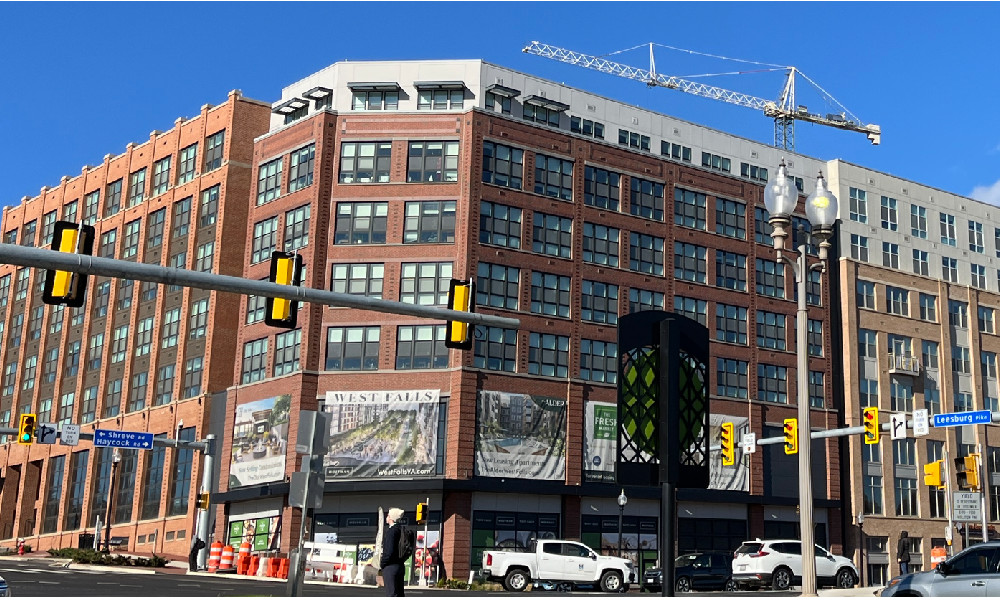
Photo of the West Falls development at the corner of Broad Street/Leesburg Pike and Haycock Road.
Summary
From 2013 to 2025, new developments added 1,987 housing units to the City. This growth has changed the profile of the community from a majority of households living in single-family homes, including townhomes, to a majority living in apartments and condos. City leaders aimed to diversify the tax base by adding more commercial taxpayers who brought businesses to the City and corporate taxpayers who owned apartment complexes. However, this growth did not counter the surge in values of single-family homes so that these homeowners continue to account for almost the same share of taxes, despite becoming a much smaller share of households in the City.
This post profiles the growth and its impact on the community and City schools. We draw upon data and documents from the City website, its budgets, financial reports, and assessment database to reach these conclusions.
A portrait of growth
If there is one thing residents and visitors to Falls Church agree on, it is that the City has changed dramatically over the last decade. Beyond that, the debate about whether the changes have been good or bad still rages. Growth has brought vibrancy to the City with new restaurants, grocery stores, and more residents. But it has also changed the profile of the households that make up the Falls Church community.
In 2002, the City had 564 condominiums. A decade later, the City more than doubled that number with 615 new condominiums. No new apartments were built before 2013, although the condominiums at Pearson Square and the Read Building have single corporate owners that rent out the units as apartments.
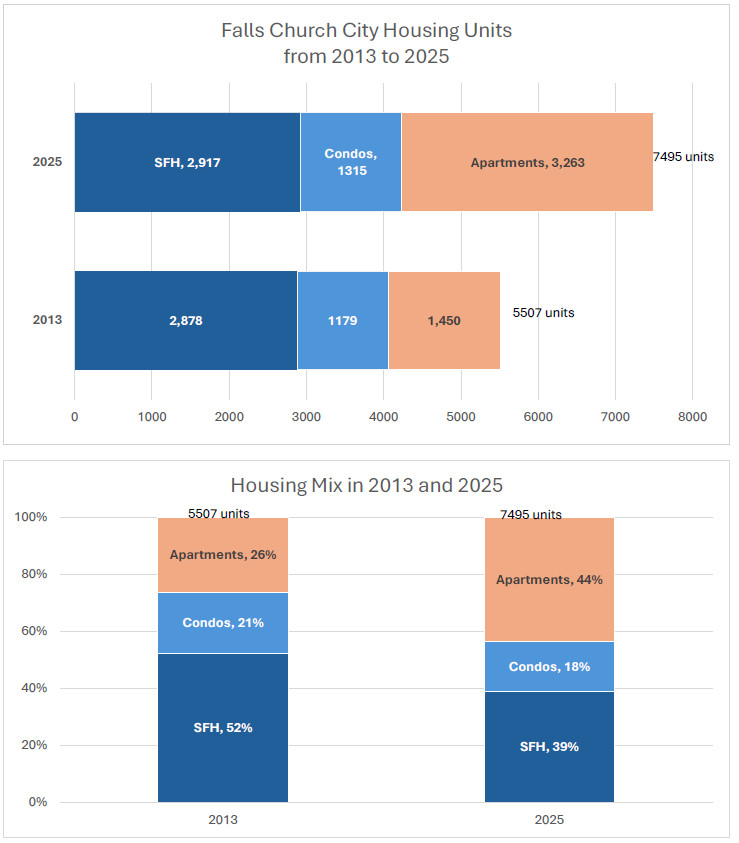
Since 2013, the City has added 1,987 housing units, a 36% increase driven primarily by 1,813 new apartments. The breakdown in growth of additional housing unit types follows:
- 39 detached single-family homes (SFH) (1% increase)
- 10 Railroad Cottage condominiums in 2018, 126 West Falls condominiums (11.5% increase)
- 1,813 apartments (125% increase) at:
- Northgate (2014, 104 units),
- 301 W Broad and Tinner Hill Apartments (2016, 509 units),
- Founders Row (2021, 466 units),
- Broad and Washington (2024, 334 units), and
- West Falls (2025, 400 units).
What is the difference between an apartment and a condominium? Click here.
Although both are typically residential units in multifamily buildings, condominiums can be individually owned while apartments are rental units under a single owner, usually a corporation that owns the entire complex. Condominium owners can obtain mortgages to build equity in their homes and stabilize their housing costs for decades. Renters must renew leases, typically one-to-three years long, at market rates.
The graphs below summarize the City’s housing stock in 2013 and in 2025. Single-family housing (SFH) consists of both detached houses and townhouses. In 2013, SFH was 52% of all housing units while apartments made up 26%. By 2025, only 39% of the housing units were SFH, and 44% were apartments.
Trash fees, a consequence of growth
In 2002, the City’s curbside solid waste collection served over 90% of homeowner households. By 2025, with the addition of 615 condominiums from five high-rise developments, the City’s trash collection only served 70% of homeowners. The change in housing mix made it less acceptable to finance the trash service from general taxes, resulting in separate solid waste fees being imposed on those served.
Population increased but households increased more
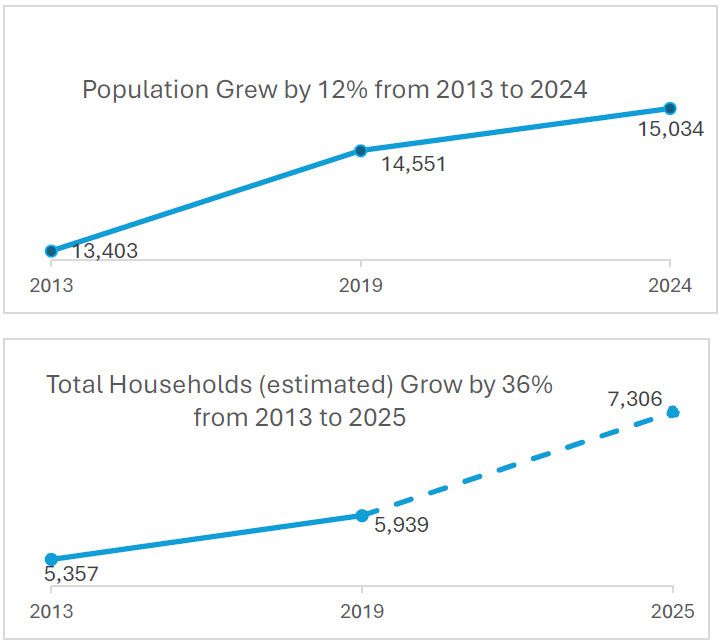
The new apartments brought in new residents, and the City’s population increased by 12% in 11 years, according to US Census data. But in terms of households, these residents are projected to increase the number of households in the City by 36%, once the West Falls apartments and condominiums are fully occupied. This does not include the new households now moving into Moderna Founders Row, a development of 280 apartments.
The number of vehicles and interactions with City government are closely related to the number of households so that the increase in the number of households is relevant when considering the traffic impact and the need for government services. This increase in households explains the heavier traffic in the City.
Diversification of the tax base
City leaders saw the new developments as a way to increase and diversify the tax base. Real estate taxes have accounted for about 70% of local taxes since 2013, and that tax base is described by the property assessment values. By adding mixed-use developments with commercial spaces that would also generate sales taxes, meals taxes, and business taxes, the City Council hoped to increase the apartments and commercial property shares of the tax base to reduce the tax burden on existing SFH and condominium homeowners. However, as the graph of assessment values below shows, this strategy has had limited success.
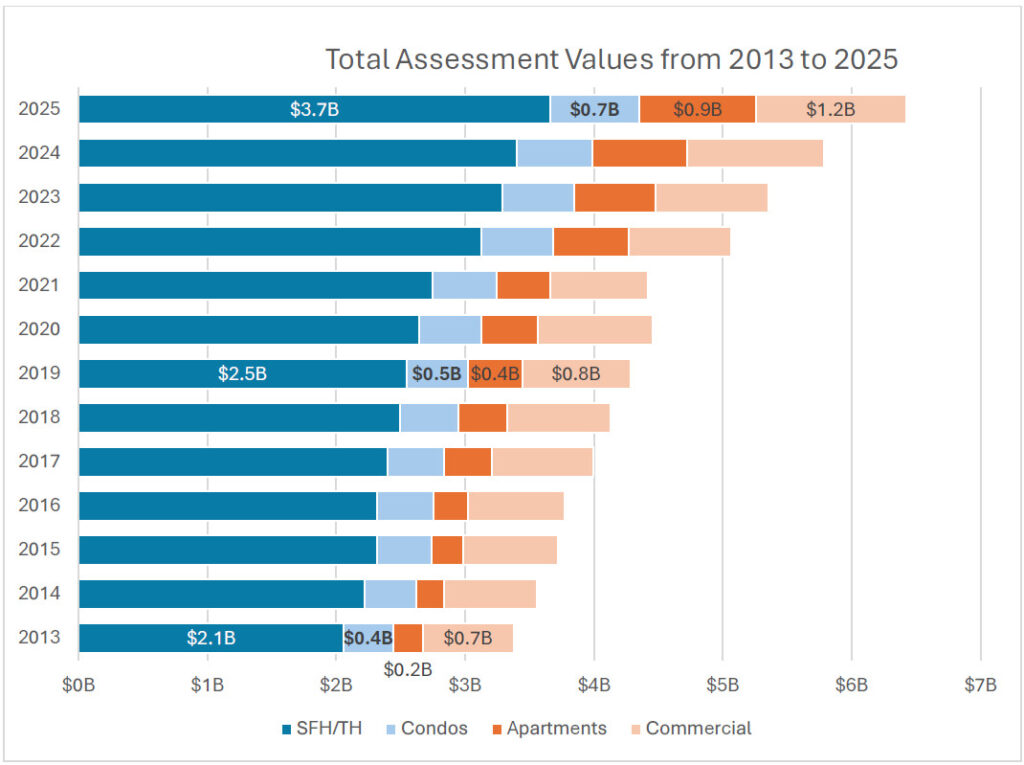
The new developments increased the tax base of apartments as expected, from $200 million in 2013 to $900 million in 2025. However, the surge in the housing market for single-family homes caused the valuation of SFH properties to rise much faster than other types of housing so that its share of the tax base was only slightly reduced.
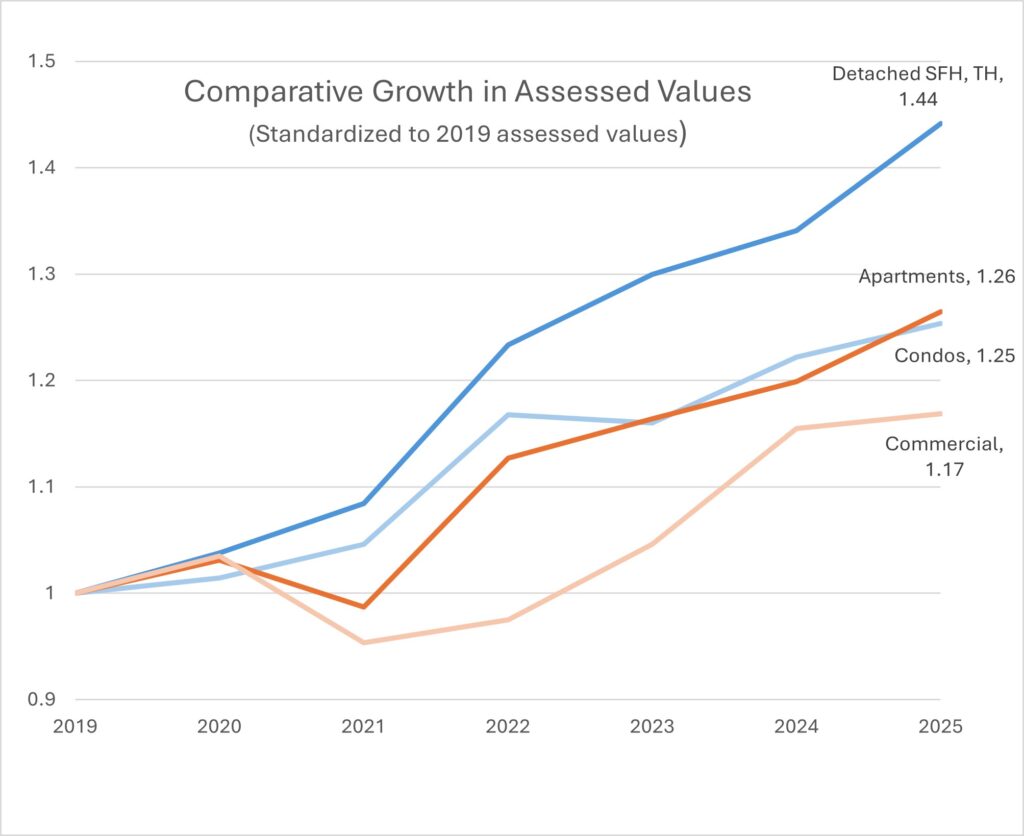
The graph below compares the growth in values of the different real estate types from 2019 to 2025. In six years, the average value of SFH grew by 44%, while apartment buildings and condominium values grew by 26% and 25%, respectively. Commercial buildings grew by only 17%. Because of this unequal growth, SFH accounted for around 60% of the real estate tax base each year until 2025. In 2025, the addition of the West Falls complex, and a greater increase in valuations of apartments and commercial buildings reduced the SFH share to 57%.
The impact of growth on the City schools
The one area where the City has clearly planned for growth is education. Falls Church has invested heavily in ensuring the schools have the physical capacity for a growing population. The predominantly one- and two-bedroom apartments do not bring many students, but nonetheless, more than a thousand such units add significant numbers.
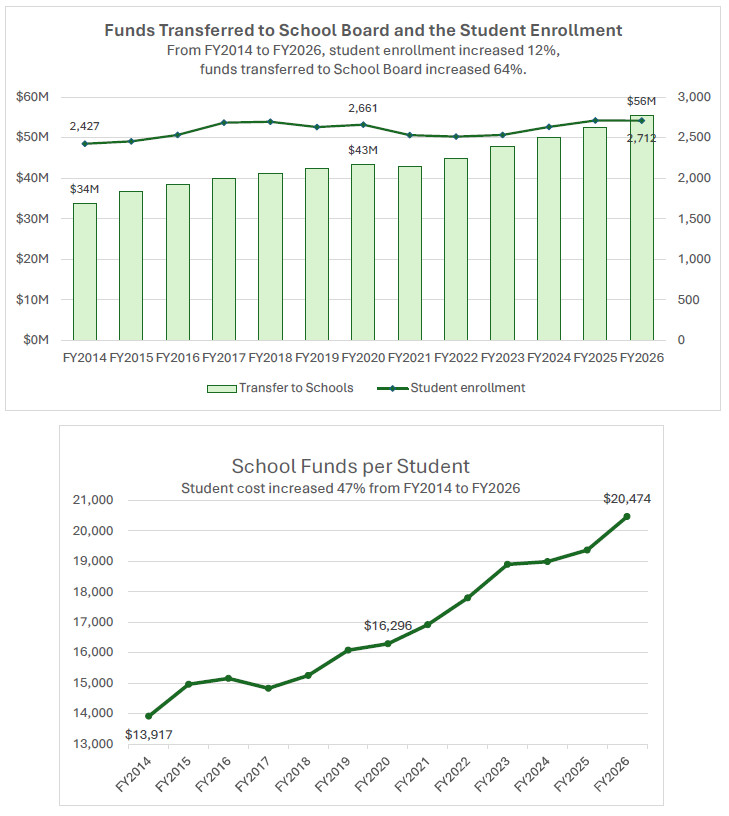
When the School Board convened to set the school budget earlier this year, the schools were preparing for an additional 100 or more students. To everyone’s surprise, school enrollment for FY2026 is the same as FY2025 despite the opening of the Broad and Washington apartments and the Alder at West Falls. From FY2014 to FY2026, the student population grew 12%, in line with the overall population.
The charts below show enrollment each year and the funds transferred to the School Board to support the school budget, i.e. the cost of the schools to taxpayers. These funds only cover operating expenses for the schools, but neither the capital expenses nor debt service for the school bonds.
The tax burden on single-family homeowners
The data show that the City’s efforts to diversify its tax base were confounded by economic forces in the housing market. Despite the introduction of so many huge multi-family high rise buildings that have urbanized the City, the share of single-family homes in the tax base has only slightly decreased. In our next post, we explore the cost of growth and the tax implications of this failure to significantly diversify the tax base for single-family homeowners.
References
- Students by Dwelling Place, Stephen Fuller Institute analysis of FCCPS Student enrollment, October 31, 2024. Presented at the City Council work session of December 2, 2024. This document enumerates the housing units in the City.
- Resident Population in Falls Church city, VA (VAFALL0POP) | FRED | St. Louis Fed
- Falls Church City Budget webpage.
- City of Falls Church, Virginia Real Property Search – actDataScout. Assessment data. A subset of this database can be obtained as a datafile from the City Assessor for a fee.