City Council Reelects Hardi Mayor in 4-3 Vote
Summary
- At its organizational meeting on January 5, 2026, the City Council voted 4-3 to reelect Letty Hardi to a second two-year term as mayor. Council Member Marybeth Connelly challenged Hardi for the position.
- In her remarks nominating Ms. Connelly for the role, Council Member Erin Flynn proposed that the City consider rotating what is intended to be a presiding and ceremonial position among all Council members interested in filling it. “I believe that rotating the mayor will help the public understand that our system of government is based on committee rule without a superior officer in our local government,” she said.
- Council Member Laura Downs was elected unanimously by her colleagues to the role of vice mayor.
Selecting the mayor
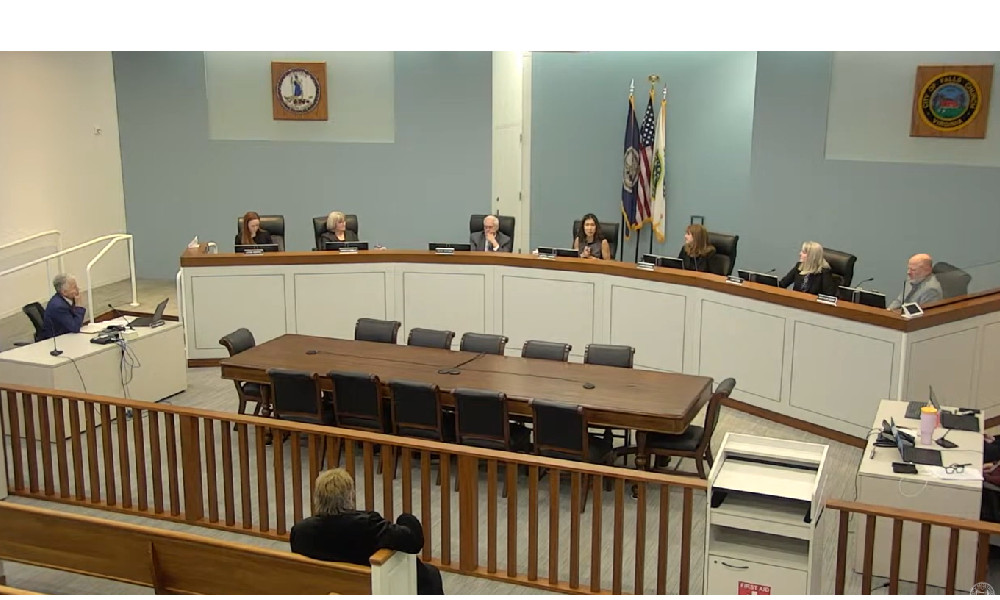
The City Council met January 5, 2026, to begin organizing itself for the next two years. Its first order of business was to elect the mayor. Council Member Justine Underhill nominated Council Member Letty Hardi for the role, while Council Member Erin Flynn named Council Member Marybeth Connelly.
In unscripted remarks, Ms. Underhill noted Ms. Hardi’s dedication and leadership locally and regionally as well as her meetings with constituents, businesses, and “people whose voices are often unheard.” Ms. Underhill said she hoped to build on the work of the last two years.
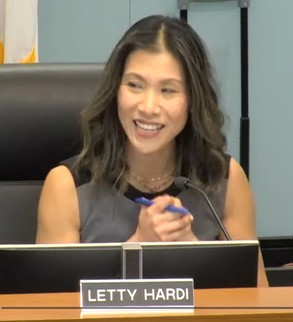
In a prepared statement, Ms. Flynn commented on Ms. Connelly’s 30-year City residence, her 20-year employment with the Falls Church City Public Schools, and the start of her fourth four-year term as a member of City Council. Ms. Connelly has served in multiple capacities, Ms. Flynn said, including vice mayor, and through a range of issues, such as the water-system-for-land swap, the building of the new high school, the COVID-19 pandemic, and the City’s recent growth.
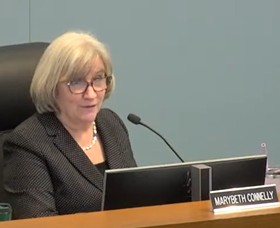
She described Ms. Connelly as “a generous colleague whose natural inclination is to look for consensus and to build bridges,” not only on Council, but in many areas of the community. Ms. Flynn specifically cited Ms. Connelly’s recent Better Together work with the schools, businesses, and nonprofits including churches to help address food insecurity in Falls Church.
Ms. Hardi won the position on a 4-3 vote, with support from herself, Ms. Underhill, Council Member Laura Downs, and newly elected Council Member Arthur Agin. Ms. Connelly also voted for herself, with support from Ms. Flynn and Council Member David Snyder.
Choosing the vice mayor
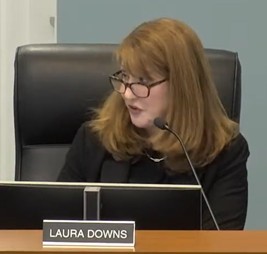
Ms. Connelly then nominated Ms. Downs for the position of vice mayor, highlighting her “deep knowledge of the City… Though she has only served one year on City Council, she had a full [four-year] term on School Board and was chair for two years” through the building and opening of the high school and the closing of the schools during the pandemic, Ms. Connelly said.
Receiving no other nominations, the Council voted 7-0 for Ms. Downs in this role.
Defining the mayoral role and alternative means of filling it
In addition to her specific reasons for nominating Ms. Connelly, Ms. Flynn expressed her belief that “we should follow a rotational system for the mayor’s position when multiple people are interested in serving in that capacity.”
Ms. Flynn noted that“Under the City’s charter, the seven members of Council have equal votes and equal roles. The nominal mayor has no greater say or authority than any other, and the role of mayor and the substance of the duties is limited to presiding over meetings and acting as the head of our City government for ‘ceremonial purposes’.”
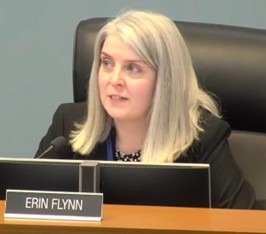
“Along the same lines,” she continued,“all of us are elected as members of Council and none of us is elected by the community to serve as mayor.” Accordingly, Ms. Flynn said,“I believe that rotating the mayor will help the public understand that our system of government is based on committee rule without a superior officer in our local government. A rotational system will also improve the collective spirit of our Council by giving multiple members of the community the opportunity to personify the City at ceremonial events as the nominal mayor,” she said.
The practice in neighboring jurisdictions
Falls Church is an outlier in its process for selecting the mayor and vice mayor based on whoever succeeds in attracting four or more votes from their colleagues on City Council. Other Northern Virginia localities either rotate the role or their citizens elect the mayor.
In Arlington, for example, the five members of the County Board are elected at large and serve staggered four-year terms. The chair of the Board rotates annually, presides over Board meetings, and serves as the official County head. The chair and vice chair are determined at the annual organizational meeting in January.
The mayor of the City of Alexandria, Virginia, is elected every three years on a separate ballot from the City Council in the November general election. The mayor serves at large with six Council members for three-year terms. Voters choose one mayoral candidate, with the winner becoming Alexandria’s ceremonial head, who presides over Council but without veto power. The top vote-getter for Council is often chosen as vice mayor.
And in the City of Fairfax, Virginia, the mayor is elected every two years on a non-partisan, at-large basis, alongside six Council members, with voters choosing candidates city-wide rather than by district. The mayor is the head of the Council, which oversees the City Manager in a council-manager system of government.
References
- City Council Organizational Meeting and Work Session, January 5, 2026. This official video will not display properly on a small screen as it includes the agenda.
- City Council Organizational Meeting and Work Session, January 5, 2026. YouTube video.