Community Feedback on Virginia Village Development Heats Up
Summary
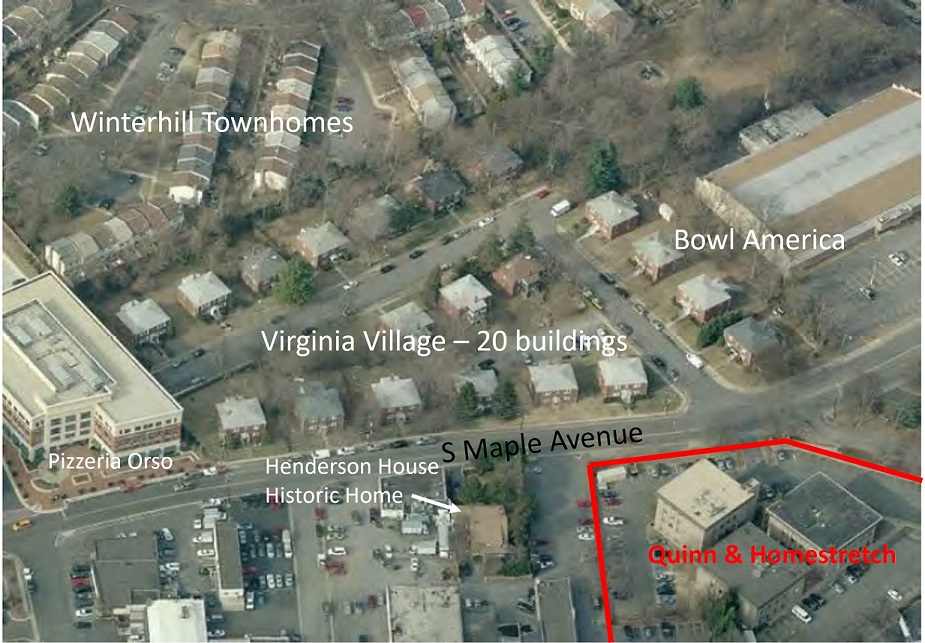
The City’s two-pronged approach to redevelopment of Virginia Village, the neighborhood of 20 quadplexes off of South Maple Avenue, is moving briskly ahead. Four community sessions were held in March and early April to gain feedback on possible redevelopment concepts and potential tweaks to the applicable Small Area Plans to reflect recent updates in City policies. Outreach to neighboring residents is also actively underway and will continue.
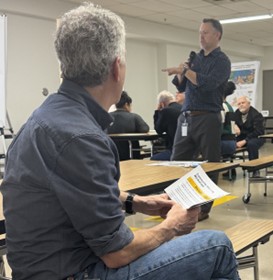
The April 14 community session elicited heated comments from several Virginia Village residents concerned about possible displacement and the lack of remodeling in City-acquired properties, as well as concerns from Winter Hill about maintaining adequate buffers between their homes and new construction.
A positive alternative was offered by former Mayor Nader Baroukh to expand current buildings rather than tearing them down in order to avoid displacement of residents.
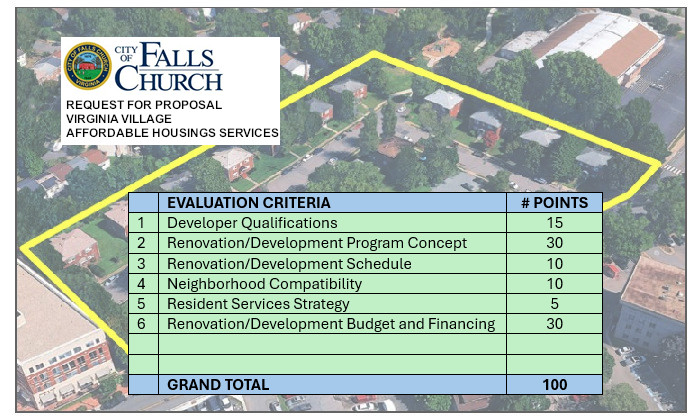
Next steps include work sessions with Boards and Commissions leading to a projected first reading on the vision and Small Area Plans by Council in June. On a separate track, the City is developing a request for proposals (RFP) for developers to be offered by the end of May, with subsequent amendments if necessary. A City appointed selection committee will then review submitted proposals and recommend a developer to be hired by the end of August, with the aim of applying for State low-income tax credits in March 2027 to support a specific proposal.
Background
City staff held two community sessions on March 21 and 24, 2026, to discuss possible redevelopment concepts for Virginia Village, the neighborhood of 20 quadplexes off of South Maple Avenue. Further discussions on potential changes to the South Washington Street and Downtown Falls Church Small Area Plans to facilitate such development were held in two community sessions on April 11 and 14. This article focuses on the current state of play and next steps. For further background, see the Pulse post City Plans to Select Virginia Village Developer by August, March 19, 2026.
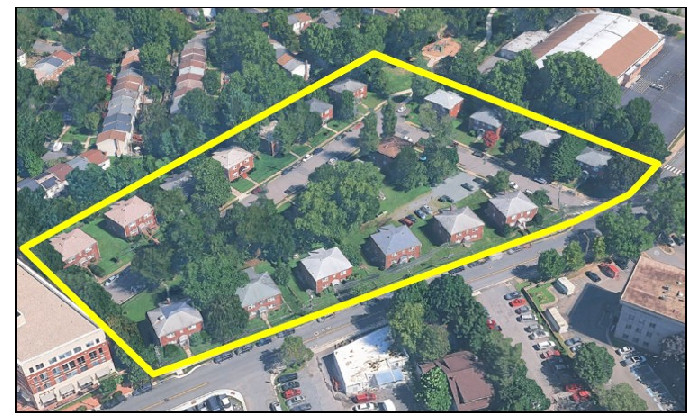
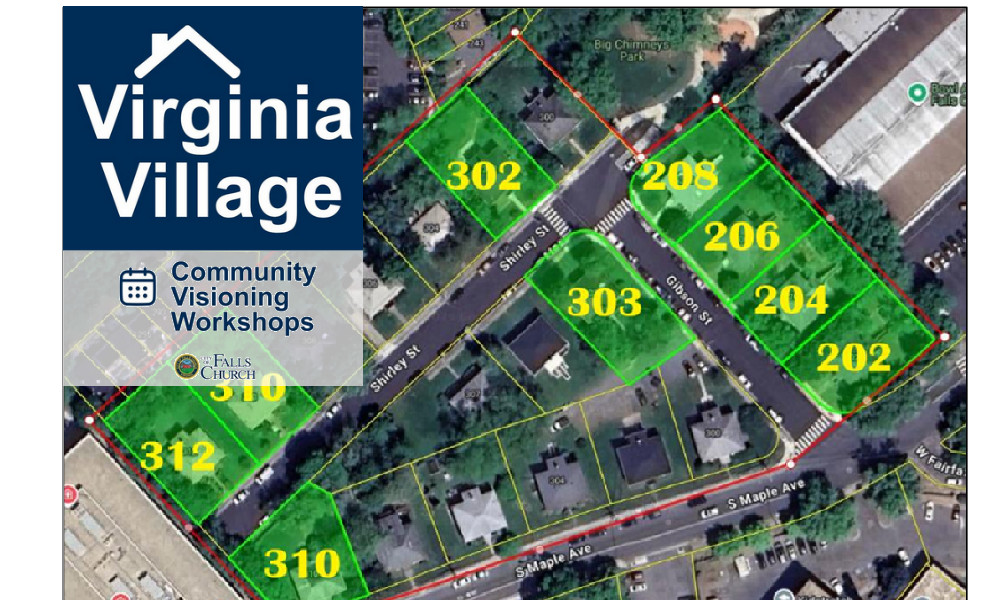
The City, through the Economic Development Authority (EDA), currently owns nine of the 20 quadplexes; discussions are underway to potentially acquire one more. Although staff have reached out to owners of the remaining 10 quadplexes, none have expressed interest in selling at this point or in the foreseeable future. City staff assured that there will be no use of eminent domain to further consolidate properties for development. However, City Planning Director Matt Mattauszek acknowledged that zoning might be one tool to encourage greater coalescence in the future.
Staff contend that moving aggressively now to lay out a community vision and solicit interest from developers provides the best chance of securing state low-income tax credits to facilitate future development. The key focus remains preserving and expanding long-term affordability of housing within the community.
No precise plan yet
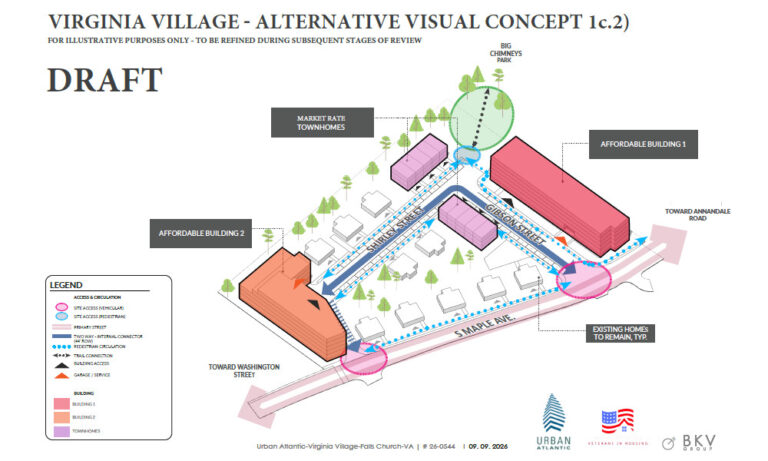
Mr. Mattauszek acknowledged that there is no firm “plan” in place at this point, and that the City needs expert advice in advancing this effort. It will be soliciting help from consultants, but informal outreach to potential developers suggests something might be possible with the properties the City now has in hand. Possible concepts discussed at the public visioning sessions include a potential 5-7 story mixed-income building constructed on the four adjoining sites, 202-208 Gibson Street, with a daycare and supportive services, a civic space, or Tinner Hill museum on the first floor. New construction, possibly townhouses, along the border with Winter Hill might be 3-4 stories tall as a step down to that community and to Big Chimneys Park.
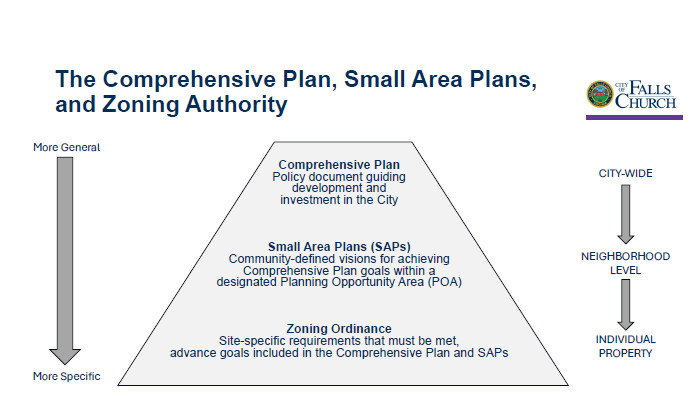
Staff expected that changes to the Small Area Plans would be at the margins to incorporate City goals in the new Affordable Living Plan and other recent changes in the Comprehensive Plan. The two revised Small Area Plans for South Washington Street and Downtown Falls Church could then be incorporated into the Comprehensive Plan. No specific changes were indicated.
Reactions from Virginia Village residents
The response from Virginia Village residents, and others, on Tuesday, April 14, was voiced strongly. These are approximate quotations to capture the essence of the comments:
“This is a mess”.
“We are the City’s “missing middle” housing that you are proposing to eliminate. We accept having no air conditioning and old appliances to be able to afford living here.”
“Village residents work at Kaiser and other City establishments and have been here for years, decades, making positive contributions to the community.”
“Why haven’t you remodeled as you acquired these buildings, rather than letting one stay vacant for years? Use the money you have to remodel rather than acquire more properties.”
“What is the rush? Shouldn’t this wait until you have consolidated more properties?”
“Just wait until my two grandchildren graduate from high school. Then I don’t care what you do.”
“The City has had other proposals that have gone nowhere; this is a waste of time; I don’t plan to come back again.”
Winter Hill residents at the meeting had particular concerns about the units that back up to Virginia Village that count on the green space in the Village property back yards, to assure that an adequate buffer is maintained. There was also general concern about having too dense construction near Winter Hill, the speed of moving ahead to a RFP, and the City’s ability to form a plan for the whole area when only nine of the 20 properties are currently owned by the City.
In response to a question about the number of affordable units that would be targeted by any development, staff indicated that they don’t currently have a target, but thought that up to 60% of the mixed-use building might be affordable or workforce living units.
Former Mayor Nader Baroukh offered an alternative approach to demolition of the current homes on City-owned properties: expanding the existing buildings to potentially double their size. Residents could remain in their current homes during construction and move into the new additions once completed, after which the original homes could be remodeled as appropriate.
This would be a simpler approach, would avoid displacement, and would maintain the neighborhood’s existing character — including providing natural buffering and appropriate scale relative to surrounding neighborhoods — while still adding a meaningful number of new affordable living units. In contrast, large-scale redevelopment risks displacement, loss of neighborhood character, and a shift away from the scale and compatibility that have long been part of the area’s planning framework.
Assurances for current residents
City staff indicated that the intent is to provide housing for all levels of AMI (area median income) as defined by the U.S. Department of Housing and Urban Development. Most current residents have incomes at 60% AMI or above, although some are well below this level. Income levels at 80% or 120% AMI could be included in an effort to draw in both affordable and workforce housing.
Although a policy for addressing displacements is still being developed, the City is trying to get spaces within the City or nearby, while emphasizing that they would have a first right of return within the new construction. The City is looking to assure that any residents who are temporarily relocated would receive City subsidies, if needed, to maintain their current cost levels both upon relocation and on their return. The budget impact of these subsidies would need to be approved by City Council. A firm objective would be to provide housing for all currently living in Virginia Village properties at their current AMI levels.
Additional concepts emerging from the visioning sessions include:
- Green buffering and screening, such as shade trees, and building setbacks between new redevelopment and the Winter Hill community;
- Blending new “medium density” development with the existing surroundings, especially Winter Hill townhomes and Pearson Square;
- Assuring adequate parking for new and returning residents;
- Including a diverse mix of housing types and bedroom counts reflective of the City’s current needs;
- Providing permanent affordability for new units;
- Incorporating pedestrian links, walking trails, and green links that connect Big Chimneys Park, Cavalier Run Trail, and commercial areas on South Maple Avenue; and
- Encouraging additional open space through pocket parks.
Mr. Mattauszek noted that the City has some money for potential acquisitions, but not adequate funds for renovation. The hope is to partner with the developer to gain additional funds for development.
Going forward
Following additional public meetings with the community, Mr. Mattauszek anticipates that the City may have enough sense of what the community wants to go forward with a request for a proposals (RFP) laying out the City’s objectives and requirements by late May, with the selection of a developer by late August. He emphasized that there would be no changes affecting Virginia Village residents for the next 18-24 months, and that it would be 2030-2031 before any new construction is in place.
Key milestones identified in the November 17, 2025 staff report include the following anticipated sequence of activities:
- Spring 2026: Public review of planning concepts and release of a competitive Request for Proposals (RFP) to identify a development partner.
- Summer 2026: Proposal evaluation, interim agreement development, and continued planning review.
- Fall 2026: Finalization of zoning or planning updates and developer due diligence.
- Winter 2026–2027: Formal development application and entitlement review aligned with housing finance deadlines.
- Spring 2027: Financing determinations, final agreements, and property conveyance actions.
- Fall 2027: Anticipated construction commencement, subject to financing approvals.
- Late 2030 (estimated): Completion of initial redevelopment phase and occupancy.
References
- The City’s website: https://www.fallschurchva.gov/2478/Virginia-Village.
- City Council Work Session, March 2, 2026. This official video will not display properly on a small screen as it includes the agenda. The discussion of the Virginia Village redevelopment begins at timestamp 0:2:35 and ends at timestamp 1:08:10.
- City Council Work Session, March 2, 2026. YouTube video.
- Staff report on Resolution to Initiate Amendments to the South Washington Street Small Area Plan and Downtown Small Area Plan Related to Recommendations for Redevelopment of Virginia Village and to Amend the City of Falls Church Comprehensive Plan to Update Chapter 4, “Land Use and Economic Development” to Incorporate Both Small Area Plans, March 9, 2026.
- Agenda for City Council Work Session, April 20, 2026.