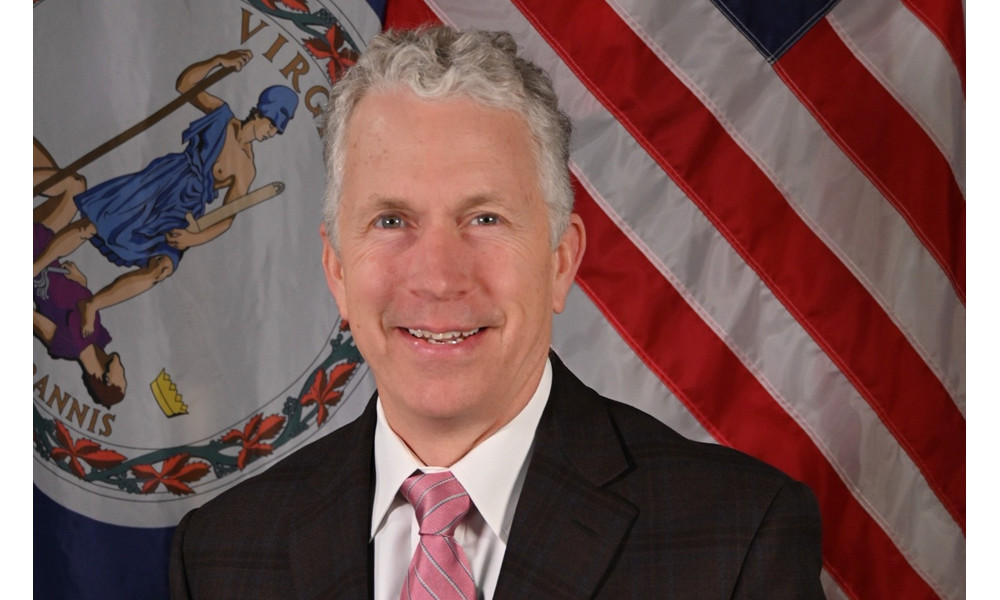
Shields Reflects on Accomplishments, Issues Facing Falls Church
Summary
- The day after presenting the General Government’s proposed budget for Fiscal Year 2027 on March 23, 2026, City Manager Wyatt Shields announced plans to retire after 23 years of service, initially as Assistant City Manager and from January 2007 in his current role. In a City press release, he called his time in Falls Church “the honor of my life” and expressed gratitude “for the trust that has been given to me by this community.”
- Mr. Shields said he will retire on September 4, 2026. He remains unsure of what the future holds but is certain that he will continue “to serve” in some capacity.
- In keeping with the City Charter, the City Council has begun the process of recruiting and appointing a new city manager. Following a meeting of Council members, Mayor Letty Hardi said the governing body will hire a professional firm to help conduct a nationwide search and has pledged to create opportunities for key staff, community members, and other stakeholders to identify the skills and characteristics they desire in the next City Manager.
- The Falls Church Pulse interviewed Mr. Shields about his time here and his outlook for the City going forward. This post is based on that March 30, 2026, interview.
From Scottsville to Falls Church
Born and raised in Virginia, Wyatt Shields came to Falls Church in August 2003 from Scottsville, Virginia, where he served as Town Administrator for five years. His experience prior to Scottsville included service as Legislative Assistant to Senator Charles S. Robb (D-VA) and work for Dominion Virginia Power in its Office of Government Relations.
Initially hired as Assistant City Manager, Mr. Shields was responsible for the annual development of the City’s Capital Improvements Program (CIP). He was also the staff lead for a citizen task force that created an open space acquisition plan, and he developed the City’s annual legislative program, tracking key issues for the City Council in Richmond and on Capitol Hill and garnering federal and state grants for City transportation and other improvements. Mr. Shields was named City Manager in January 2007, following the death of Daniel E. McKeever who led City Hall for six years.
Mr. Shields earned his BA degree in English from the University of Virginia in 1991 and an MA degree in public affairs from the University of Texas in Austin in 1998. He also completed UVA’s Senior Executive Institute leadership development program at the Weldon Cooper Center for Public Service in 2005.
As City Manager, Mr. Shields has served on Northern Virginia Chief Administrative Officers Group since August 2006 and currently chairs that body. In addition, he has been a member of the Metropolitan Washington Council of Governments (MWCOG) Chief Administrative Officers Committee since January 2006 and chaired the committee from 2022 to 2024. MWCOG honored him in 2015 with its Institute for Regional Excellence Visionary Leadership Award.
Greatest accomplishments as City Manager
For Mr. Shields, “the big three” problems he is proudest of having addressed as City Manager are attracting private investment to the City to diversify and grow its tax base, successfully selling the water system to Fairfax County while transitioning the system’s employees from Falls Church to Fairfax Water, and building and financing a new high school. These accomplishments “wove in and out of each other,” he noted. For example, “the high school couldn’t have happened without the boundary adjustments” that resulted from the water system sale.
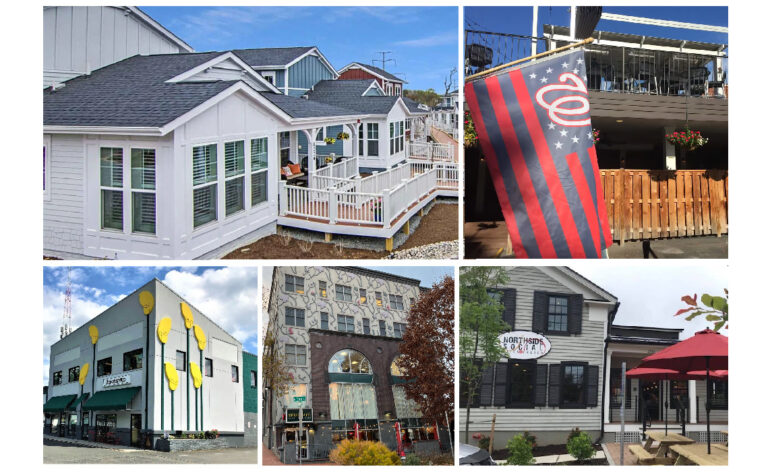
He is also pleased with the City’s role in encouraging Fairfax County to think through the possibilities represented at the University of Virginia/Virginia Tech and WMATA sites at West Falls Church. With Fairfax, “we’ve created a place where lots of people will be able to live and work,” Mr. Shields said. He described the developments at the City’s West End as “complementary.”
Overall, Mr. Shields is proud of the City’s and his ability “to recruit good people” in several key roles, whether as police chief, finance director, or directors of planning and public works. The staff has expanded with the City’s growth during his tenure from 206 General Government staff members in 2007 to 252 employees in 2026.
Navigating challenging periods
Challenging situations require “learning on the fly” and “addressing questions every step of the way,” Mr. Shields said of the more difficult periods the City has faced. One of the biggest challenges was the Great Recession that hit the City hard from 2010 through 2013. Staffing dipped as low as 179 at the height of the recession. “There’s no trouble like money trouble,” Mr. Shields said.
Looking to Fiscal Year 2027, Mr. Shields said he is “very worried about the City’s and the region’s revenue picture. In the past 10 years, our revenues have been higher than projected. That won’t happen in the future.” He cited infrastructure—such as the sewer and stormwater systems—as ongoing challenges with clear impacts in the proposed Capital Improvements Program (CIP) for the next fiscal year.
The cancellation by Hoffman & Associates of Phase II of the West Falls development presents a significant revenue hit, removing an $800,000 payment from the developer for FY2027 revenues and $10 million in anticipated lease payments over time. However, the return to the City of two parcels of land near the secondary school campus and at Haycock Road “gives us a chance to assess how we like the built environment there,” Mr. Shields said. For this reason, “maybe having a bit of a pause” will be helpful.
Asked how that land might be used, Mr. Shields said it will be for his successors to determine what to do with those parcels. Because he and his wife Patricia plan to stay in Falls Church, “I look forward to participating as a citizen.”
Rising assessments contribute to fiscal concerns
While he declined to comment on how assessments are determined— “That is a legal process in which the City Manager is not involved,” Mr. Shields acknowledged the pressures created by rapidly rising assessments, particularly of detached single-family homes. The budget increase for FY2027 is funded primarily by a 6.9% increase in real estate assessments. Detached single-family homeowners’ assessments rose most, averaging 8.2% more than in FY2026; townhomes 5.4%; condominiums 3.1%; apartments 4.9%, and commercial 2.3%. [See the Pulse post, Revenues from a 6.9% Assessment Increase Fund the FY2027 Budget, April 1, 2026.]
Mr. Shields is concerned about the overall tax burden for the community. The central question for everyone in government is whether that burden “is sustainable,” he said. “It is very much the City Manager and City Council’s concern that we carefully consider affordability, fairness, and the cost of government as a whole” in making decisions. The FY2027 budget reflects the constraints remaining sustainable requires by cutting seven vacant staff positions and rearranging space and furniture at City Hall to avoid leasing additional space elsewhere.
Importance of “a growth strategy”
In response to whether there is a maximum population that Falls Church can sustain, Mr. Shields referred to the City’s population projections. City residents numbered 11,039 in 2007; the US Census Bureau estimates that Falls Church’s current population ranges from 15,000 to 15,500. The City anticipates a population between 16,000 and 17,755 by 2030, for growth of 21%.
“Having a growth strategy is crucial” for any jurisdiction, said Mr. Shields, who has overseen the City’s substantial growth over the last two decades.For years, the City’s growth strategy has centered on the construction of several mixed-use developments. However, Falls Church currently has just one project in the pipeline: the Quinn senior living building. “There is nothing beyond that,” Mr. Shields noted.
This is one reason he found it hard to take renovation of the Property Yard off the FY2027-2031 CIP. In doing so, the City Manager said he collaborated with the people most affected by this delay, the employees of public works and safety.
Private before public investment at Gordon Road Triangle
Looking at the Property Yard in the broader context of the future 15-acre Gordon Road Triangle development, Mr. Shields indicated he prefers to see the private sector develop their plans for the site before the City commits further funding. “We can do our work along with the private sector. The City can be a thought leader and a convenor. Whether ours is the first money in” is another matter, he said.
He anticipates that the City might use virtual tax increment financing at the Gordon Road Triangle as it did at West Falls where a significant share of the revenue generated by development at that site is intended to fund the debt service for the $120 million Meridian High School. This public financing method captures future increases in property tax revenue within a designated district to fund current redevelopment and infrastructure projects, enabling local governments to subsidize such improvements as roads, utilities, and site preparation without increasing taxes. Mr. Shields predicts, “These will be interesting discussions for the next six years.”
A “personal touch” enabled by independence
Despite concerns about the sustainability of the tax burden on the community, Mr. Shields believes Falls Church should remain independent rather than returning to town status as part of Arlington or Fairfax County. He further stated that he considers the City’s future “bright.”
The key, he continued, is to accept “that we can’t do everything, that we have to be able to say ‘no.’ The great thing about being an independent city is that we can make those choices.” Smaller jurisdictions will always have higher costs because they lack larger jurisdictions’ economies of scale. “They can have programs that we can’t dream of having here,” he said.
But what Falls Church offers that bigger governments can’t is “a personal touch, a human connection around the services people care about,” from education to public safety. Mr. Shields predicts that “this connection will be even more valuable” in the years to come, particularly as artificial intelligence is used for some government functions. For example, he noted that Arlington County is experimenting with AI for its 311 non-emergency calls.
Returning to the issue of assessments, Mr. Shields added that the City Assessor’s Office consists of three people, and residents can contact them about their assessments anytime. Residents “can also appeal your assessments to a board of your neighbors.”
Further, Mr. Shields noted that Falls Church has reduced the tax rate gap that existed with its neighboring jurisdictions seven years ago. The 20- to 35-cent difference that existed in 2019 has dwindled to less than two cents today. For FY2027, the Pulse confirmed that Falls Church’s proposed tax rate is $1.185 for each $100 of assessed value compared to proposed tax rates of $1.1225 for Fairfax County, $1.053 for Arlington, and $1.080 for Fairfax City. Mr. Shields added that the last time he heard much debate about the City becoming a town within Arlington or Fairfax was during the Great Recession.
The role and selection of the next city manager
According to the City’s Charter, the city manager “shall be the executive officer of the city and shall be responsible to the council for the proper administration of the city government in furthering the council’s goals and objectives. He shall be appointed by the council for an indefinite term. He shall be chosen on the basis of his executive and administrative qualifications, with special reference to his actual experience in or knowledge of accepted practice in respect to the duties of his office.”
“So much of the job is about communications, about listening and trying to understand. This skill is important for any city manager,” Mr. Shields said. “Next, you have to communicate in language that people can understand. Then, you have to be able to stand up and explain [your policies and actions]. If you can’t, you have a problem [with those policies and actions].”
“Early in my career, I was more reactive,” he said. “Through wise counsel and experience, I’ve tried to become less reactive.” The principle Mr. Shields has adopted is that “we are a government—there is always another perspective.” He has found that “taking the right amount of time to do the right analysis is critical to then applying the necessary resources and accelerating and sustaining a new direction.”
Mr. Shields will not be involved in selecting the next city manager unless he is asked to do so by the City Council. “It is the City Council’s process and decision to select the next city manager,” he said.
Council will also decide who will serve as acting city manager if Mr. Shields’ successor is not in place by the time he retires on September 4, 2026. Possible candidates for this role include current Deputy City Managers Jennifer Carroll and Andy Young.
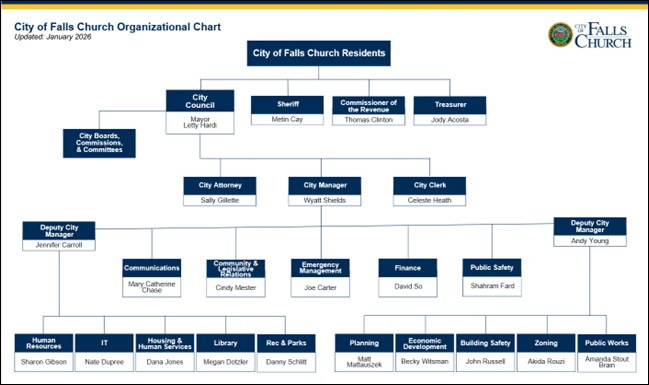
In accordance with Falls Church’s Charter, the City Council will lay out a schedule and process for the recruitment and appointment of Mr. Shields’ successor. Following Mr. Shields’ announcement and a brief meeting of Council members, Mayor Letty Hardi said, “We’ll be bringing in a professional firm to help with a broad, nationwide search and will have opportunities to hear from key staff, community members, and other stakeholders on the skills and characteristics we’d like in the next city manager.”
Next steps for Mr. Shields
With five months remaining in his tenure and a budget to conclude, Mr. Shields said he has yet to reach his valedictory moment. Nonetheless, he described himself as “curious and excited” about what the future might hold. He said it will be important for him “to serve,” but he remains unsure “what form that will take, what problems I might address.”
Teaching is a possibility. Mr. Shields has been a member of summer faculty at Virginia Tech’s College of Architecture and Urban Studies, teaching a graduate course on local government management in Virginia.
Meantime, he looks forward to having Monday nights off—the governing bodies of both Falls Church and Scottsville had their meetings on Monday evenings. “That’s 28 years of Monday nights!” that he will be glad to have free after Labor Day.
At the same time, Mr. Shields is “sad to be leaving what has been a wonderful period here—and one that has been longer than I thought it would be,” he said. “I feel gratitude for the opportunity to be able to serve in this community with so many great people.”