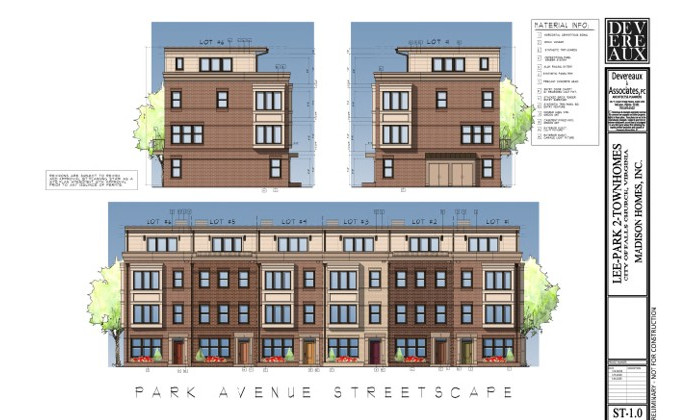
Lee Park II Townhomes Project Revised to Address Stormwater Concerns Raised by Neighbors
Summary
The Lee Park II site is known for flooding in heavy rains, thus acting as an inadvertent stormwater retention area. Neighboring Broadway condominium owners raised concerns that the proposed development would increase the risk of stormwater flooding their building by channeling runoff into drains too quickly.
In their second submission, Madison Homes proposed a large subterranean stormwater retention tank around the southern part of the site to reduce and slow the runoff. The developer calculated the tank would reduce the runoff by 13%, removing some landscaping to accommodate this solution to the stormwater issues. The project provides 10% tree canopy, the minimum required.
Commissioner Brent Krasner pointed to this project as an example of the limitations of loosening zoning codes to allow more by-right projects, resulting in developers meeting only the minimum requirements. He noted the powerlessness of the Planning Commission, especially under the fast-tracked, new State law on the site plan approval process.
Background
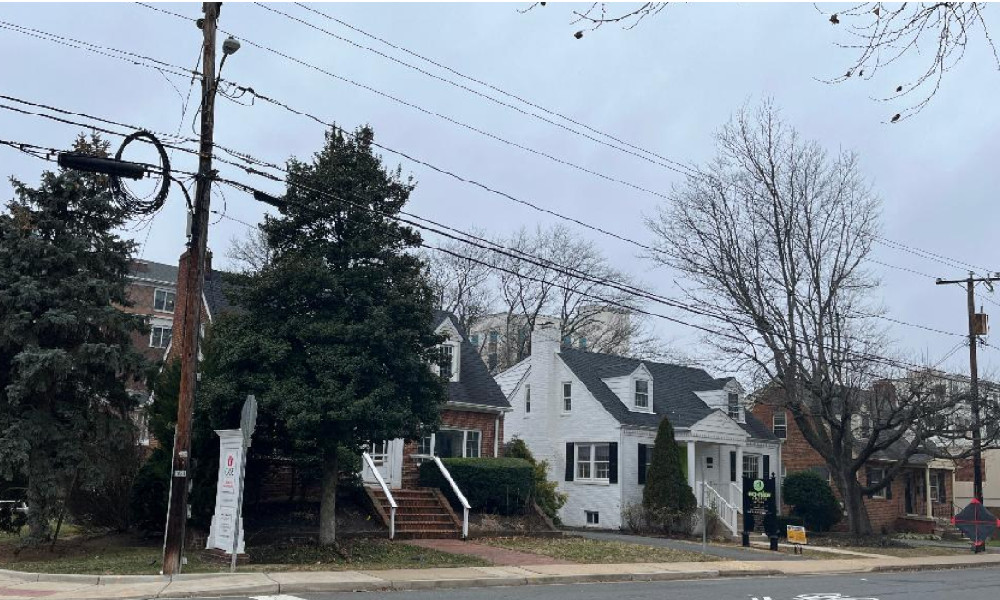
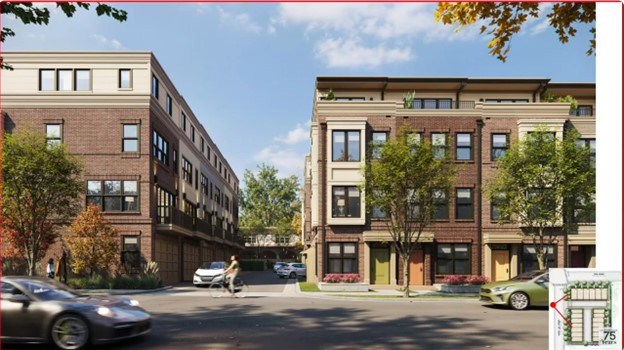
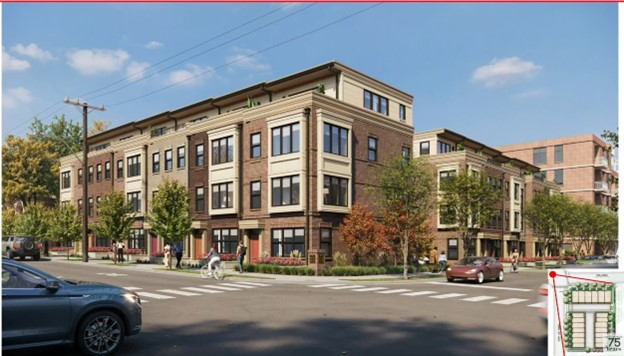
The Lee Park II townhomes project is the third Madison Homes luxury townhome development that takes advantage of the 2023 changes to loosen the zoning code for T-1 or transition lots (T-Zone), mostly along Park Avenue. After contentious debates, five of the seven City Council members voted to pass the zoning ordinance, saying it would enable “Missing Middle” housing with prices of about $800,000. However, the zoning changes have thus far yielded townhomes averaging $1.2 million and as high as $1.8+ million.
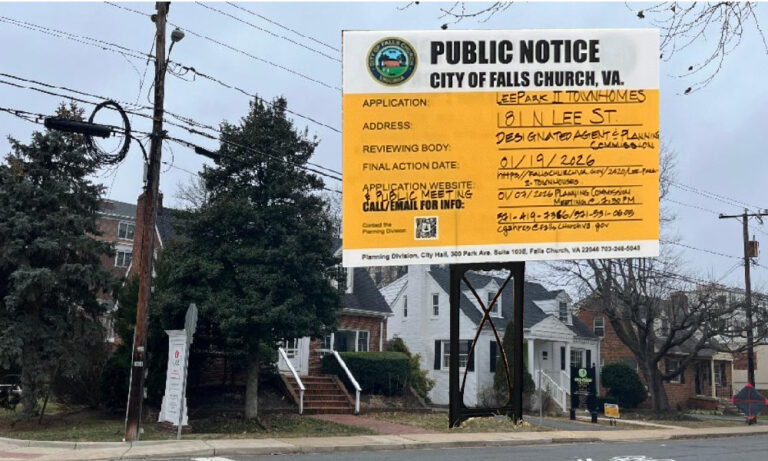
The first submission of Lee Park II presented at the Planning Commission meeting on January 7, 2026, was similar to Madison Homes’ first Lee Park townhomes. As a by-right project—meaning the developer requested no waivers, the City was required to respond within 40 days. The staff review raised issues primarily around the handling of stormwater runoff on these lots that are known to be prone to flooding. The Planning Commission also reviewed and provided recommendations on this submission.
The second submission was received on May 15, 2026. Under the new State-mandated site plan review process, the second review necessitated a response in 30 days, not enough time for the Planning Commission to review and provide recommendations to the City’s “designated agent,” the Planning Director. However, at the June 17 meeting to discuss the related lot subdivision plan, the commissioners received an update on the second site plan submission.
Stormwater flooding at the Lee Park II site
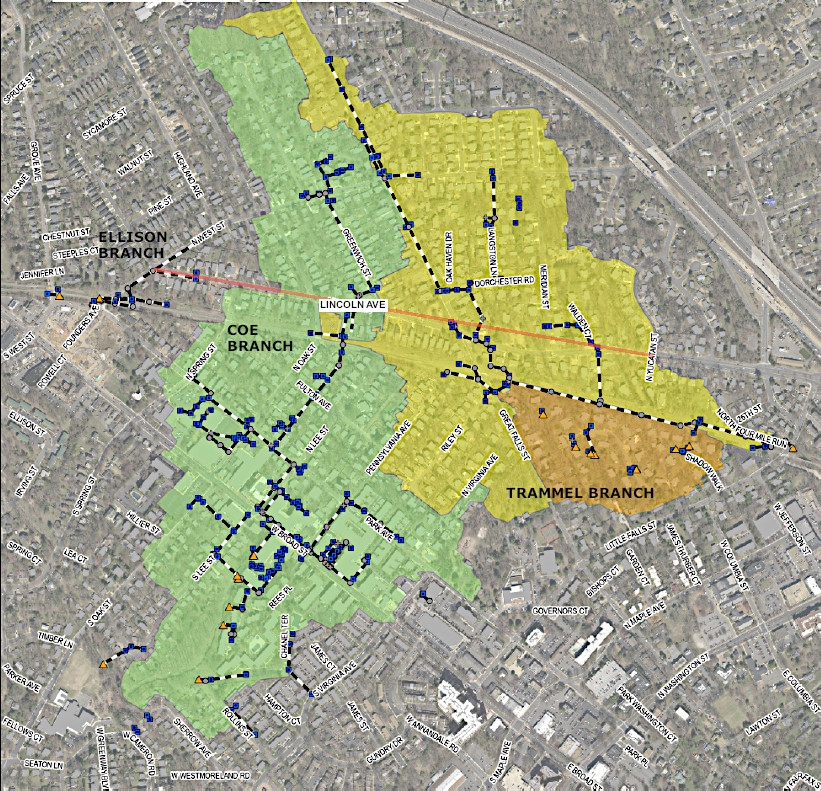
The City hired Kimley Horn to model the stormwater flooding and runoffs in the Coe Branch area of the City that extends from Greenwich Street in the north, through the Howard Herman Stream Valley Park to Sherrow Street in the south. All three Madison Homes townhomes developments lie in this watershed. The Lee Park II site is a known area for stormwater flooding after periods of heavy rain. The flood model shows that two-thirds of the site would flood in a 100-year storm. Today, stormwater flows over the adjacent Hilton garage into the rear of the three Lee Park II lots, collecting there before overflowing onto North Lee Street into drains below Broad Street to Howard Herman Park.
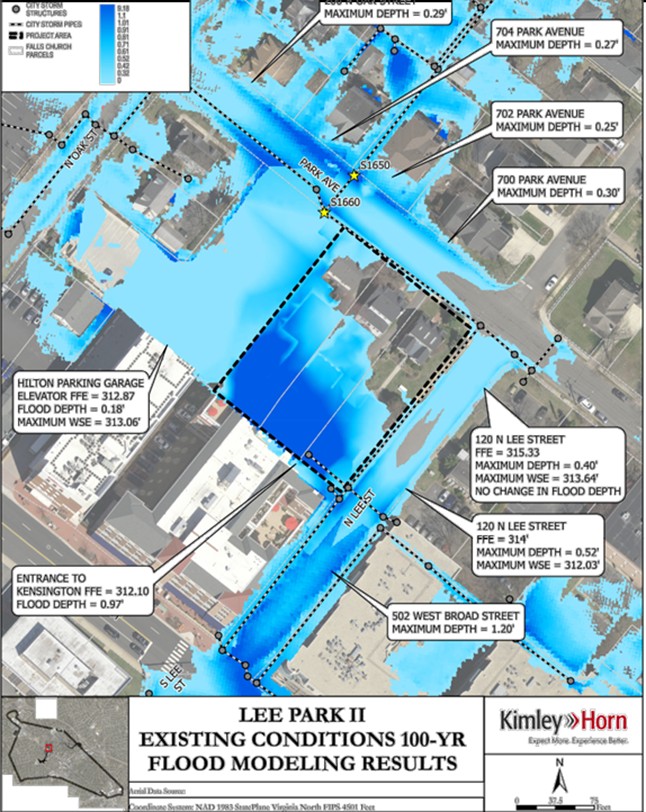
Broadway Condominium owners worry the project would overwhelm shared storm drains
In the first submission, Madison Homes proposed to channel the stormwater around the townhouses, onto the street and into the drains at the Broadway Condominiums (502 W Broad St.). (City code only requires that the developer demonstrate through mathematical models that flows do not exceed current runoffs.) These drains are already undersized for the drainage area they serve, especially as higher building density, larger homes, and the loss of mature trees reduce the ability of the land to absorb stormwater. Each of the three Madison Homes townhome sites had about 50% tree canopy with many mature trees, now reduced to about 10% on each site.
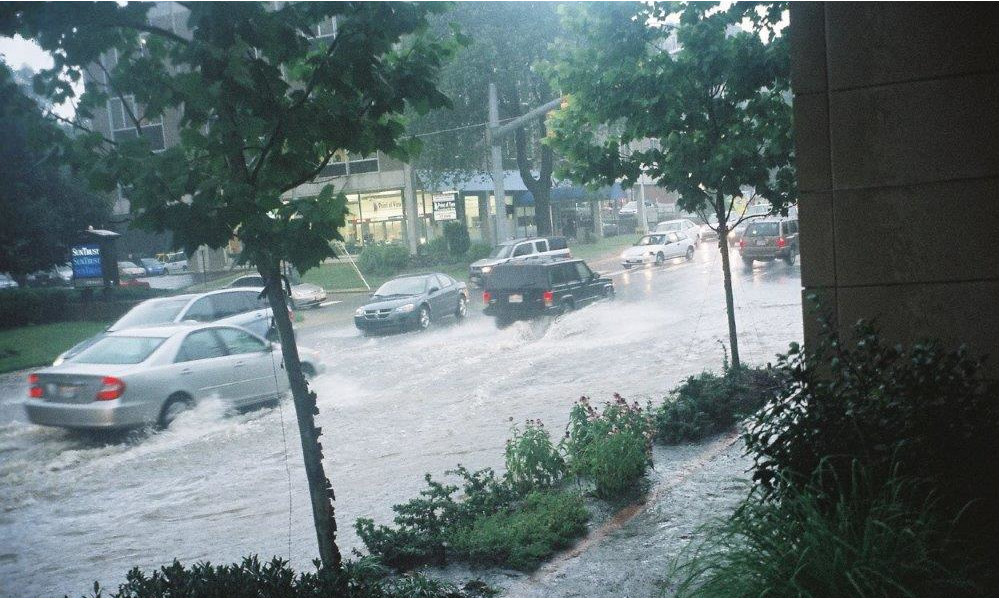
The entire northern section of the Coe Branch watershed collects in front of the Broadway before making its way under Broad Street to empty into the stream at Howard Herman Park. Broadway resident Fred Thompson, who represented the condo owners in discussions with Madison Homes, said that single collection point is overwhelmed after sustained heavy rains with water rising to the top of the manhole cover. Their concern was that the loss of the existing water retention area in the rear of the Lee Park II properties would result in higher stormwater runoff rates that overwhelm the storm drains.
When the drains are overwhelmed, stormwater can backflow into the Broadway building, resulting in considerable damage. In past instances, the pressure was high enough to push the water up to the second-floor units. Condominium owners have spent about $370,000 over the last 20 years on structures to mitigate flood risks, including a rooftop stormwater retention system. The investments have so far worked to protect their building, but owners were concerned that the Lee Park II development would increase their flood risk once more.
Madison Homes proposes a stormwater retention tank
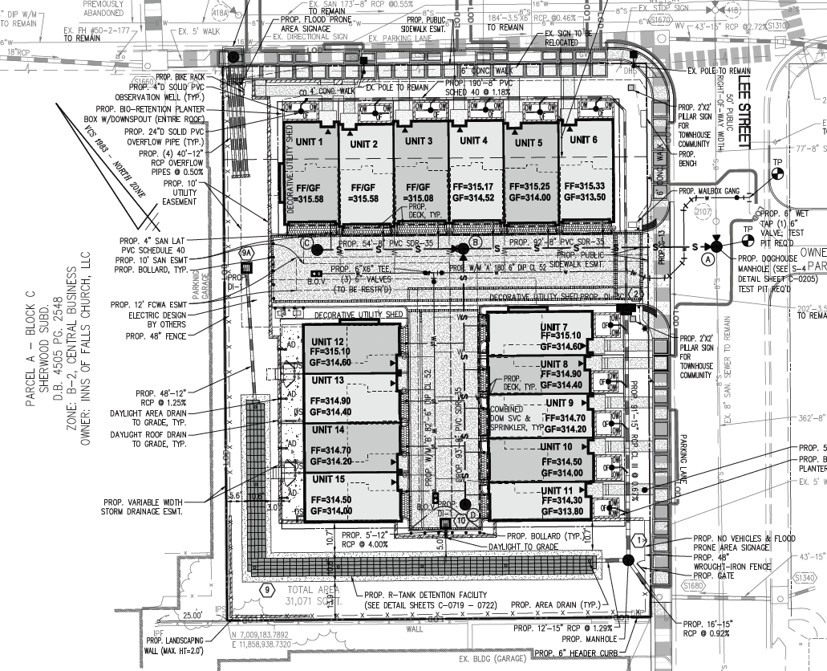
Madison Homes consulted with Kimley Horn on stormwater management for Lee Park II. They were able to capitalize on the City’s model to focus, specifically on this site. After running through several scenarios, a decision was made to install a large L-shaped subterranean stormwater retention tank around the southern end of the property. The ground above would also be slightly lowered to create a channel that can also hold stormwater and reduce the risk of overflows into the adjacent properties. In addition to the bioretention planter boxes, this site would achieve a 13% reduction over the existing stormwater runoff.
The bioretention planter boxes and the stormwater tanks will be managed by the townhome homeowners’ association (HOA). Madison Homes also proposed a stormwater easement covering the open area adjacent to the Kensington and the Hilton Gardens. There will be gates installed at Park Avenue and North Lee Street to prevent public access. City Planner Henry Zhang explained that the landscaping has been reduced to accommodate the stormwater tanks. This project still claims 10% tree canopy, the minimum required by code.
Krasner warns about the limitations of allowing by-right developments
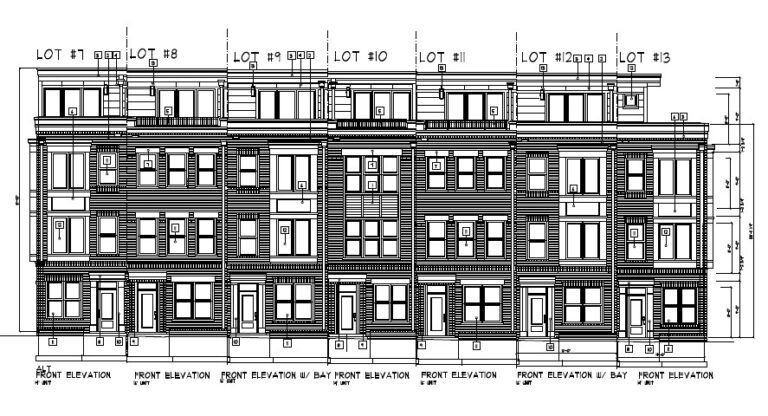
Commissioner Brent Krasner spoke to his fellow commissioners saying, “We were debating the other night [about] by-right development. … I hope my fellow commissioners use this as a good example that all the concerns that people are bringing up are all very legitimate. The ability to have any real impact on those concerns is very limited. … Even [for] the staff, it’s an administrative process. They have a very tight time frame and, substantively, they’re not going to get big changes. So, like trees [and] green space, [developers] are going to meet the bare minimum of the code. … But they’re not going to do anything beyond that… so I hope folks realize that [if] they have concerns about a project, you’re not going to be able to address them through a by-right process the way you would in a [special exception] process. … At least the front doors aren’t facing the parking garage.”
He added, “As a courtesy, staff can show us this [second site plan submission]. It’s nice that they do that, but we have zero input and, even before the [first] site plan came to us at a work session, we have zero actual authority and control.”
Next steps
A third submission is expected to resolve issues from the second review. Staff will be required to respond within 14 days of this next submission.
Reference
- Planning Commission meeting, June 17, 2026. YouTube video.
- Lee Park II Site Plan Selected Sheets, June 17, 2026.
- Preliminary and Final Plats of Subdivision, June 17, 2026.
- Approved PC Recommendation Memo and Motion Lee Park II. Planning Commission recommendations to the City’s designated agent on site plan approval, the Planning Director.