Council Delays Virginia Village RFP Release Until June 22
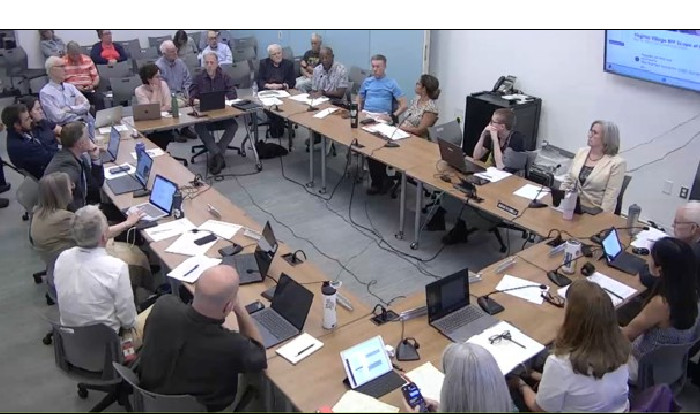
Above: May 18, 2026, City Council work session on Virginia Village with the Planning Commission, the Economic Development Authority, and City staff
Summary
- Following a joint work session with the Planning Commission and the Economic Development Authority, the City Council and staff agreed to delay for a month issuing a request for proposals (RFP) to identify a partner to redevelop Virginia Village in an effort to expand affordable housing.
- At issue during the meeting were whether yet-to-be-determined zoning code changes to permit moderate density of up to 7 stories in Virginia Village need to precede releasing the RFP, as well as revisions to the RFP itself.
- The RFP presents three scenarios that include full renovation/rehabilitation of the nine City-owned quadplexes, full renovation/rehab with bump-outs, additions, or partial demolition replaced with small infill development (3 to 4 stories), and demolition with more substantial infill development (5 to 7 stories). The RFP may be revised to include a fourth scenario.
- At its meeting on June 22, the Council will consider first reading on Comprehensive Plan and Small Area Plan amendments as well as zoning code updates and determine whether to release the RFP.
Recent Virginia Village updates
- Real estate consulting services: On April 27, 2026, the City Council approved the execution of a contract for up to $175,000 with the firm Jones Lang LaSalle (JLL) for real estate advisory services to facilitate the search for a development partner for Virginia Village. According to the May 18 staff report to Council, “The consultant will aid the City by providing strategic and financial analysis, procurement guidance and support, transaction advisory services, and implementation support related to potential future development or repositioning of the Virginia Village Project.”
- City—Economic Development Authority (EDA) agreement: The City and the EDA also concluded a Memorandum of Agreement (MOA) that was approved by City Council on May 11 for the management of Virginia Village properties. Funding for JLL’s services as well as the cost of the request for proposals will be covered by rent incomes generated from the nine properties the EDA owns, uses of those funds permitted under the MOA.
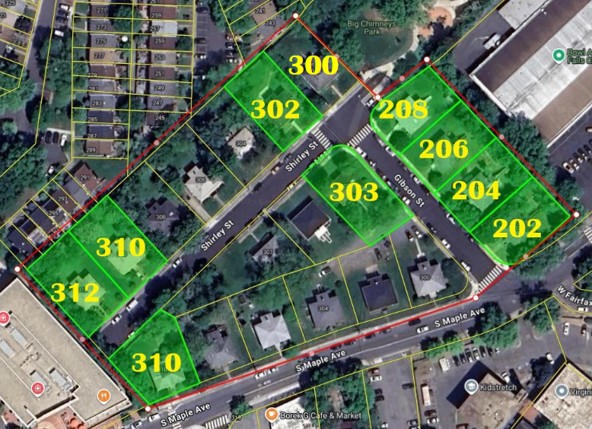
- Support from a 10th property: According to the draft Virginia Village Affordable Housing Opportunity Request for Proposals, the property owner of 300 Shirley Street, which abuts the Winter Hill neighborhood and Big Chimneys Park, has expressed support for participating in any affordable housing opportunities on this site.
Background
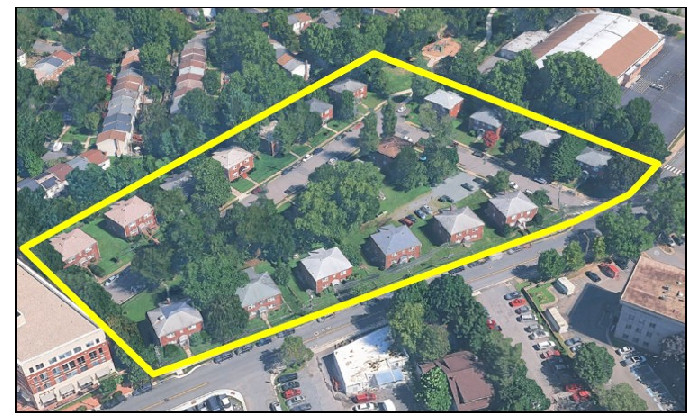
At a City Council joint work session on May 18, 2026, the City staff continued to move forward with plans to redevelop Virginia Village, the neighborhood of 20 1940s-era quadplexes bound by S Maple Avenue and Gibson Street that currently provides 80 affordable housing units.
Members of the Planning Commission and the EDA joined the Council for a discussion of possible Small Area Plan and Zoning Code amendments and review of the staff’s draft “competitive Request for Proposals (RFP) to identify a development partner to implement a strategy of preserving and expanding affordable housing opportunities on EDA-owned properties within the Virginia Village area” that staff sought to issue by May 28.
[For further background on the current Virginia Village initiative, see the recent Pulse posts City Plans to Select Virginia Village Developer by August, March 19, 2026, and Community Feedback on Virginia Village Heats Up, April 19, 2026.]
Zoning changes
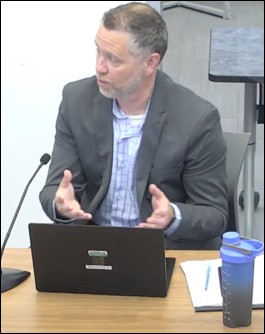
Planning Director Matt Mattauszek introduced the Virginia Village discussion by describing the purposes of the planning and RFP efforts. These include preserving and expanding affordable housing opportunities in this neighborhood and the City as a whole to meet adopted policy goals, reviewing previous guidance for Virginia Village in the two Small Area Plans (SAPs) that include the neighborhood, and ensuring that all stakeholders are informed of the current process and next steps.
The staff has also enlisted the help of real estate consultant Jones Lang LaSalle (JLL) and seeks input from the broader development community through the RFP to further define what Mr. Mattauszek characterized as a “generational opportunity.”
Senior Planner Jack Trainor described the interplay among the City’s Comprehensive Plan, its SAPs, and the zoning ordinance in the context of the Virginia Village project.
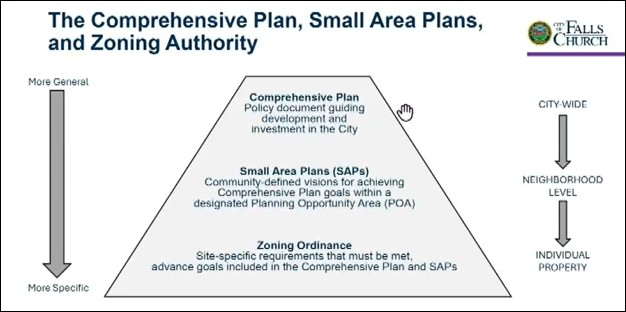
The proposed RFP notes that Virginia Village is currently split zoned between B-2 (central business) for the 0.7 acres northeast of Gibson Street, and R-M (multifamily residential) for the remaining 3.5 acres of the property. In addition, the City’s Future Land Use Plan identifies the site as a MUR (Mixed-Use Overlay District).
Mr. Trainer said that the current zoning tools do not align with the goals and objectives of the Comprehensive Plan and proposed updated SAP guidance from the community regarding such elements as minimum lot area, prescriptive use and parking ratios, and setbacks and heights. The staff recommends establishing a new zoning district intended to regulate redevelopment, preservation, or expansion of existing buildings within the Virginia Village neighborhood.
Though not yet defined, the new district’s goals “largely focus on achieving affordable housing goals within a moderate-density context with appropriate height and use intensity transitions and buffering of nearby low-density residential neighborhoods and public park,” the staff report on initiating the zoning amendment said. “Rather than amend existing zoning districts that currently regulate the Virginia Village area, staff is proposing exploring new zoning tools to accomplish this objective, likely as a new overlay or floating district on top of the underlying districts which would remain in place.”
Accordingly, the RFP anticipates that the site will be rezoned “to facilitate the selected proposal.” The document further asserts that the staff “has completed the necessary public engagement to establish the updated development criteria” outlined in the RFP and detailed below. The draft concludes, “The new zoning will provide for a streamlined and predictable entitlement process, including parking reductions justified by the site’s transit-rich environment.”
Community feedback
City staff presented the following summary of community feedback received during a series of public meetings in March and April and this input’s implications for SAP and zoning code amendments as well as the draft RFP for a Virginia Village developer.
| What City Staff Heard | Proposed SAP Amendments | Related Code Amendments |
| Building Scale and Density Transitions | ||
| Require height and intensity transitions that are respectful of nearby neighborhoods | No major amendments given current level of detail; additional transitional design recommendations, such as step-backs and height guidance may be added for moderate density redevelopment | Introduce a sliding-scale height allowance relative to property line; require minimum setbacks and setbacks for appropriate height and use transitions |
| Utilize buffering and screening between new development and Winter Hill community | No major amendments given current level of detail; update language where needed to emphasize creative integration of green space and buffers | Introduce a green buffer requirement suitable to support a variety of shade trees and vegetative screening between Virginia Village and Winter Hill |
| Housing and Affordability | ||
| Protect current renters by maintaining existing level of affordability in perpetuity | Amend SAP redevelopment guidance prioritizing affordable housing on-site | Introduce area median income (AMI) band minimums for redevelopment |
| Include a mix of housing types and bedroom counts supportive for a variety of household sizes | Align SAP guidance with Comprehensive Plan vision for a mix of housing types and bedroom counts supportive for households at varying life stages (e.g., first-time homebuyers to downsizers) | Permit a variety of housing types that are reflective of the City’s current needs |
| Open Space and Connectivity | ||
| Make Big Chimneys Park a more central feature of the neighborhood | Amend guidance to increase connectivity to existing park with nearby trails and commercial areas by integrating historical walks, creative design features, and public seating into newly created “Green Link” paths; include integrated green space with redevelopment | Include minimum open space requirements and vegetative buffers that can support park connections and possible expansions |
| Preserve sunlight and prevent overshadowing of Winter Hill and Big Chimneys Park | Recommend a variety of building design techniques in order to specifically prevent encroaching shadows onto the park and Winter Hill neighborhood | |
| Ensure adequate parking is included to support any redevelopment | No amendments necessary | Require compliance with City parking standards with options for reductions based on stated need and project viability |
| Complimentary Uses | ||
| Encourage residential complimentary uses, such as childcare, adult supportive services, and civic/historical uses | Encourage neighborhood serving retail and services (such as childcare) as commercial component for redevelopment | Permit certain commercial uses alongside affordable housing developments; do not permit undesired uses |
| Include ground-floor retail or small commercial bays rather than larger restaurant and high-traffic uses | Recommend smaller retail spaces as opposed to larger ones commonly found in other mixed-use developments across the City | |
Three scenarios
The draft RFP requests bids that reflect one of three scenarios or a hybrid of these possibilities. If a developer finds none of what the City has proposed to be workable, the planning staff asks bidders to explain why and offer alternatives.
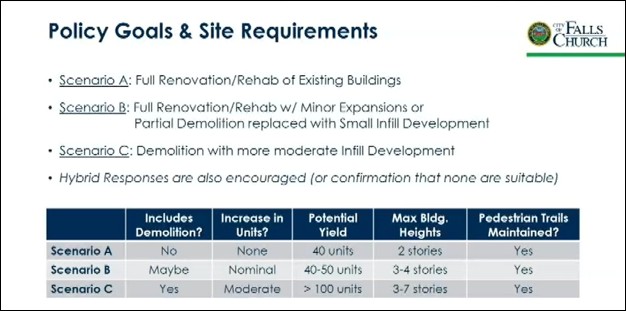
- Scenario A: Full Renovation/Rehab of Existing City-Owned Buildings (“No Build”). This scenario would renovate all 10 buildings, each with four units, with necessary utilities, appliances, plumbing fixtures, interior finishes, windows, or roofs, and other upgrades needed to address overall livability. Noting that the buildings are 85 years old, the RFP provides assessments of their current state, indicating that some structures will require “more significant rehabilitation” than others.
Among the listed issues are “active or historical termite activity, chronic moisture intrusion, deteriorated roofing and drainage conditions, aging plumbing and electrical systems, damaged decks and stairs, crawlspace dampness, mold-like discoloration, and widespread deferred maintenance” as well as “deteriorated railings, water damage, electrical deficiencies, and safety concerns associated with stairs, lighting, smoke detection, and egress.”
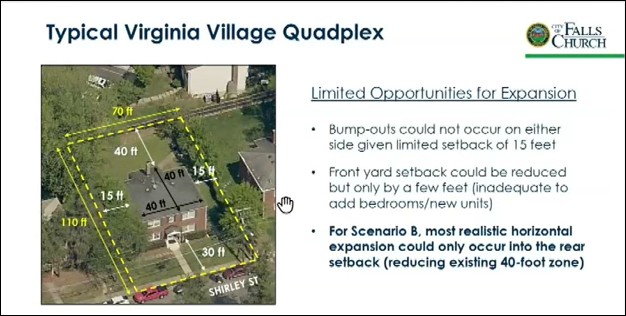
- Scenario B: Full Renovation with Minor Expansions of Each Quadplex Building. In this scenario, the quadplexes would be fully renovated and include minor bump-outs in the rear of the buildings with the goal of increasing bedroom sizes to better serve larger households. A third floor could be added if it would provide additional affordable units.
This scenario might also consider partial demolition of the existing quadplexes if it creates opportunities to introduce low-rise residential development (3-4 stories in height), resulting in a modest increase of affordable units. Any infill development scenarios would need to comply with design guidance expressed in Scenario C below.
For Scenarios A and B and in keeping with the City’s Affordable Living Policy (ALP) adopted in last August, once renovated and/or expanded, the City-owned units should continue to accommodate the same levels of affordability for current tenants, and target rent structures described in Scenario C below for new tenants, upon income verification. Newly added units should aim to address gaps in the City’s affordable housing inventory.
- Scenario C: Larger Infill Redevelopment (Demolition of Existing City-owned Buildings). The RFPindicates that this scenario is responsive to the goals, objectives, and policies identified in the Small Area Plans that govern the Virginia Village site as well as to the City’s ALP.
The RFP anticipates that the following criteria will replace the existing zoning regulations for the site and that these criteria are based on the City staff’s recent community engagement efforts.
- Height, Density, and Neighborhood Compatibility:
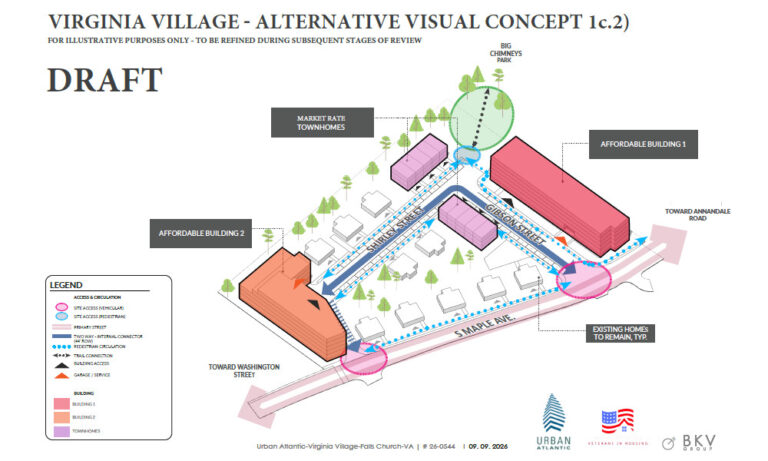
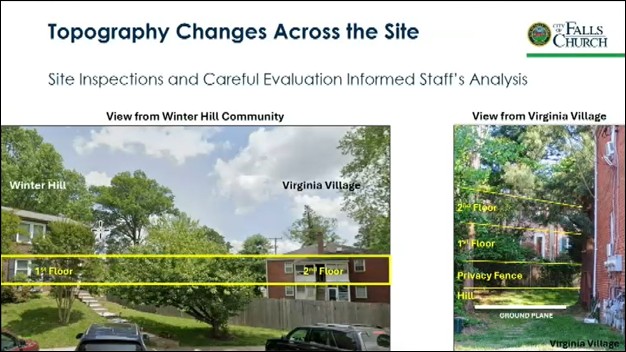
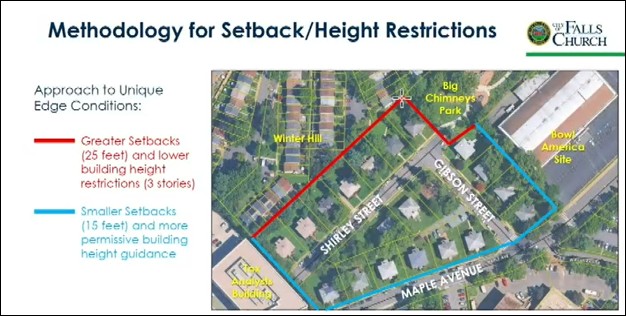
- A 25-foot, natural buffer, including vegetation and shade trees to screen the Virginia Village site from its boundary with Winter Hill and Big Chimneys Park; a similar 15-foot, green buffer at the site’s boundaries with the Tax Analysts and Bowl America buildings.
- Building heights that step down toward the Winter Hill community and the park to achieve better transitions. Heights of up to 3 stories closest to these edges may gradually increase without exceeding a 45-degree plane measured further into the site. Height transitions along the boundary with the adjacent Tax Analysts building and Bowl America site can be more flexible.
- Portions of the site located along Shirley Street and Maple Avenue can reach 5-7 stories in height, with the greatest heights concentrated along Maple Avenue and portions of the site adjacent to the Bowl America site.
- High-quality designed placemaking opportunities where people can live, work, and play.
- Open Space:
- Pedestrian accessibility should be prioritized through the Virginia Village site by maintaining/relocating/introducing new trails or pathways with access between Maple Avenue, the Virginia Village site, and Big Chimneys Park.
- Wayfinding signage, lighting, and biophilic design elements should be incorporated to make the site more porous and inviting to the public.
- Multifamily, Ground-floor Building Uses:
- Redevelopment should prioritize the most feasible combination of residential supporting uses that include some combination of daycare facilities, supportive housing services, and civic spaces that help celebrate and activate the adjacent Tinner Hill Historic and Cultural District.
With regard to the Affordable Living Policy, Scenario C must ensure 1) a minimum of 100 Committed Affordable Units ranging in affordability for renters earning between 30-80% of the area median income (AMI); 2) a minimum of 30% of the total new units are affordable to households earning 50% AMI or less; and 3) most of the 80% AMI units are 2-bedroom units that can accommodate larger households.
Additional goals and preferences
In addition to these scenarios, the draft RFP invites developers to consider making portions of the site market rate with a variety of housing types and including both rental and ownership opportunities. The document states the City’s desire to maximize the delivery of affordable housing while minimizing public investment, noting a cap of $100,000 per committed affordable unit and no guarantee of any public subsidy. And the RFP encourages in-unit, high-speed broadband internet sufficient for households to participate in remote learning, work, telehealth, and other community related activities.
The RFP requires that developers’ submissions prove the economic viability of the construction and operation of their proposed projects, including a 15-year operating pro forma by project phase, along with a project schedule with key milestone dates.
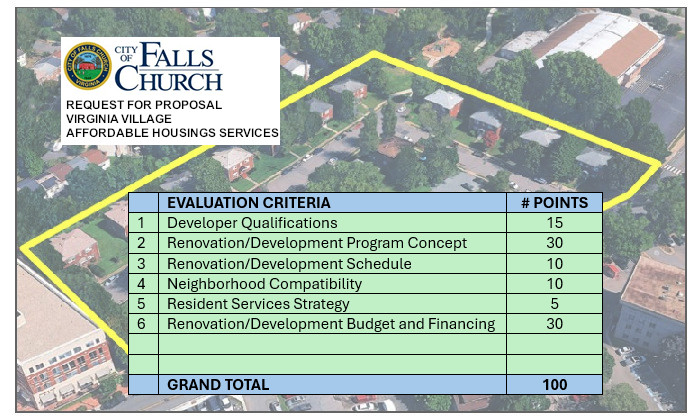
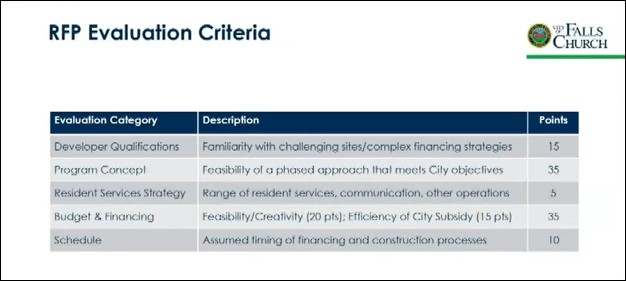
The City plans to appoint a five-member selection committee to evaluate the proposals it receives. The City Manager has proposed that he assemble the committee with a representative from each of the following: the City Council, the EDA, the Planning Commission, the Housing Commission, and the City staff. The committee would be supported in its work by Jones Lang LaSalle, the outside real estate consultant, and will use the evaluation criteria described in the slide below.
Should zoning changes precede issuing the RFP?
City Council and EDA members expressed concern that developers will not be able to respond meaningfully to the RFP without knowing what the final zoning will be. They also asked about the implications of any zoning changes for the remaining Virginia Village properties not owned by the City.
“I’m very uncomfortable with the RFP driving the City strategy” regarding zoning, Council Member Arthur Agin said. Council Member Erin Flynn reflected Mr. Agin’s unease. She said that while the City Council has focused on the timing of the RFP and the need for SAP amendments, the body has yet to discuss specific setbacks and heights that have been incorporated in the draft RFP or the zoning changes that would support them. “To me, this is out of order sequencing wise; it’s out of order process wise; it’s out of order in terms of people in this community having buy in,” Ms. Flynn said.

EDA Member Alan Brangman also objected to the sequencing. Once a developer himself, Mr. Brangman said, “One of the worst things you can do is give developers a document and ask them to respond to it, and it’s not clear exactly what they are responding to. And that’s the sense I’ve gotten from the fact that we do not have the appropriate zoning in place to give them a clear message of what is possible, what is not possible.”
He also echoed an issue raised by Planning Commissioner Tim Stevens that the staff’s proposal could be “spot zoning.” “What other districts or property in the City would this overlay apply to?” Mr. Brangman asked, “because if it’s only this specific piece of property, we have a problem.” He likened the suggested zoning to gerrymandering for development of the Virginia Village site. Mr. Brangman added that his assumption for the RFP was that the City was looking for ideas for what could be done with this property with respect to affordable housing.
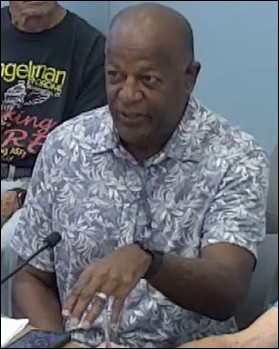
However, “when I read this RFP, it essentially gives the developer the right to develop that property [as the developer sees fit],” he said. “That’s not where I thought we were. I don’t think the community thought we were there. We just need to slow down, fix the zoning issue, and then come back and deal with the RFP process.”
Planning Director Mattauszek pushed back on the idea that “until we finalize the zoning, the RFP can’t go out. The development community…has more than enough to respond to this [RFP],” he said. “I don’t want to go through [zoning] code changes for something that can’t be built. The RFP allows us to get a lot of education to make the best code changes possible. This is where the free advice comes in,” he continued, “as opposed to us pretending like we have it all figured out, getting the code changes in place, and being surprised why nobody’s building it.”
Asked by Ms. Flynn why a developer would spend time and money to give the City free advice on this project, Mr. Mattauszek responded, “It’s called marketing.” He said there is “a high demand to get in the door and work with us.”
Mayor Letty Hardi supported Mr. Mattauszek’s approach to the RFP and zoning changes. “It’s been a year since we passed [the accessory dwelling] ordinance, and we have zero submitted and permitted. So, I think getting market feedback is realistic,” she said. While Ms. Hardi acknowledged that “all the comments about the right sequencing are fair,” she maintained that community feedback is what is driving the proposed changes in the SAPs, potential code changes in the zoning ordinance, and the RFP.
Commenting on the RFP
Discussion about the request for proposals itself focused on whether renovation of the City-owned quadplexes is more than a throwaway. “Between these three options, what’s realistic and fiscally responsible in terms of return on investment? Is Scenario A feasible?” asked Planning Chair Andrea Caumont.
Mr. Mattauszek responded that he wants the proposed options to represent the feedback staff has received. He believes the process will show the costs of preserving and renovating what is there today and will “inform Scenario C,” which calls for demolition of the existing buildings and larger infill development.
Planning Commissioner Robert Kravinsky suggested combining Scenarios A and B (renovation plus expanding the quadplexes) and creating an option that would involve demolition and a lower rise (3- to 4-story) building, leading Mr. Mattauszek to suggest the RFP might be revised to include a fourth scenario.
Regarding the RFP minimum of at least 100 affordable units, Commissioner Phil Duncan said he wants “to aim closer to the number of units that we’re going to be losing in the next four to five years”—approximately 160. He said he “would trade density and height for 160 units if we had the whole site.”
Mr. Mattauszek replied that the City has not been able to convince other Virginia Village owners to sell. He believes there is a path to 100 units with Scenario C offering more two- and three-room bedroom units.
Referencing the public feedback he and others have received thus far, City Council Member David Snyder said, “I’m concerned about starting down the road on a project like this that could potentially cost $10 million or more of taxpayer money without the kind of consensus that I think we really need to have.”
He observed that the RFP’s 100-unit requirement drives toward Scenario C and that the document “is not clear enough that we expect significant transition to Winter Hill,” which is also one of the most affordable areas of the City in which to live. Mr. Snyder further suggested that this not so much an RFP as a request for information and would be more appropriately issued as an RFI.
“The view in the community is that this is a win/lose,” Mr. Snyder said, including Virginia Village’s current residents. He quoted one Virginia Village resident who said during a City community outreach session that the people currently living in that neighborhood “are the missing middle.”
“I’m out for a win/win,” Mr. Snyder continued, “but we aren’t there yet. Right now, we are facing a divided community.”
In response to Council Member Marybeth Connelly’s suggestion that the staff consider conducting a feasibility study, Planning Director Mattauszek said, “That’s what the RFP is for—feasibility.” Staff’s initial analysis “assumed we would have access to the whole site—that’s not going to happen. College students can’t solve this for us,” he added, referring to a suggestion some weeks ago from EDA Member Brangman.
Mr. Mattauszek concluded, “Some people just don’t want to have change here,” prompting rebuttals from Council Members Connelly and Snyder. “It’s not that people don’t want affordable housing,” Ms. Connelly said.
Calling JLL “a preeminent real estate consultant,” Mr. Brangman urged Mr. Mattauszek and the planning staff to make maximum use of the firm. “Put JLL to work,” he said, adding, “I agree with David and Art, this [document] should be informational” rather than a request for proposals. Ms. Flynn, too, supports issuing the document as an RFI.
“People have been very clear; they don’t want us to be a Ballston or a Tyson’s,” Council Member Agin said. He suggested not specifying a minimum number of units; instead, “specify other things like 100% affordable. Make it clear that what we get back will be [the developer’s] starting position.” He added that Scenario B should allow the combination of quadplexes and urged that a reconfiguration of the streets in Virginia Village be permitted.
Council Member Flynn said she did not want to lose 40 ADUs to disrepair. She asked the staff to ensure that they “stay in the [affordable housing] portfolio as habitable structures.”She further commented that Scenarios B and C require rezoning. “The RFP clearly says what’s preferred,” Ms. Flynn said. “There is an evident thumb on the scale” for Scenario C.
Vice Mayor Laura Downs said she knows that the Council supports affordable housing. “I would love to see this Council be unanimous on the RFP. I worry that if we don’t have the whole Council, it sends the wrong message.”
The Council and staff agreed that the RFP would not be issued as originally scheduled, pending further discussions about the zoning and RFP issues.
Public reaction to the RFP
In the course of their discussion, Council members noted that they had received some 30 letters commenting on the proposed RFP. They asked that these comments be made part of the record and so available to the public. Mayor Hardi also requested that a letter from the Housing Commission, supportive of the process as outlined to meet pressing affordable housing needs, be included for the record.
Among the comments provided to the Pulse are thoughts on Virginia Village from the Village Preservation and Improvement Society (VPIS) and from neighbors who reside in the adjoining Winter Hill neighborhood.
In its May 18, 2026, letter, VPIS applauded the staff’s “concerted efforts to obtain public input on how best to preserve and expand the current affordable living units within Virginia Village” and acknowledged the need for speed in the process to apply for low-income Federal tax credits for any renovation or redevelopment of the City-owned properties.
“We nevertheless caution the need for having a secure financial back-up plan and enforceable developer commitments if the effort falls short,” wrote VPIS President Bonnie Murphy.
“We strongly support affordable housing within the City,” Ms. Murphy continued, but asked that City Council and the Planning Commission consider several issues as the process proceeds. Those issues include:
- the cost impacts of Virginia Village redevelopment on expiring affordable dwelling units (ADUs) in other buildings throughout the City;
- the need to seriously consider expanding as well as renovating the existing Virginia Village homes rather than demolishing them and displacing their residents, even temporarily;
- the importance of shadow studies to assess the effect on green space appreciated by Virginia Village and Winter Hill residents of reducing the current backyard setbacks in Virginia Village from 40 feet to 25 feet; and
- the impact of an overlay or “floating” zoning district for the City’s properties that would permit buildings taller than 3 stories without the restrictions required in the current R-M district coupled with the consequence of the RFP’s proposed minimum of 100 affordable units on height and density for this area of the City.
“The RFP establishes 100 affordable units as a minimum floor, which requires a development program of a scale that drives the site’s zoning and massing—rather than sound planning standards determining what scale of redevelopment can responsibly fit the site. The process is inverted,” Winter Hill residents said in their more specific feedback. They asked that the 100-unit minimum be deleted.
In addition, Winter Hill residents requested that RFP proposals preserve a minimum 40-foot landscaped and building-free transition area along the Winter Hill boundary and Big Chimneys Park edge, or that the RFP require proportional setbacks that scale with building height. In an alternative, a 3-story building should require a buffer greater than the existing 40 feet, they said.
Winter Hill residents prefer, however, that building heights closest to Winter Hill and Big Chimneys Park be limited to 2 stories. Any additional height should be located farther into the site and “require meaningful step-backs, cross-sections, massing diagrams, and shadow analysis demonstrating compatibility with adjacent homes and parkland.”
Like VPIS, Winter Hill residents want to see shadow studies as well as visual-impact analysis. They also want proposals to be evaluated on how they protect and enhance open space, Big Chimneys Park, and surrounding residential areas.
Next steps through July 2026
Since the May 18 work session, the Council has set the following schedule for further consideration of Virginia Village.
- May 26 – City Council Action Meeting to approve Initiating Resolution for Chapter 48 (Zoning) Code Amendments; roadmap for Virginia Village and Selection Committee to choose the developer partner addressed during the City Manager’s report
- June 1 – City Council Work Session on RFP, Comprehensive Plan Chapter 4—Land Use, Small Area Plan (SAP) amendments, Zoning Code updates, and Selection Committee
- June 11 – City Planning staff meeting with Virginia Village residents
- June 15 – City Council Work Session including Planning Commission recommendations on Comprehensive Plan, SAP amendments, and Zoning Code updates as well as Tenant Relocation Policy
- June 22 – City Council Action Meeting with first reading on Comprehensive Plan and SAP amendments, and Zoning Code updates; authorize release of RFP
- July 13 – City Council Meeting with public hearing on Virginia Village and second reading on Comprehensive Plan and Small Area Plan amendments
References
- City Council Work Session, May 18, 2026. This official video will not display properly on a small screen as it includes the agenda. The discussion of the Virginia Village redevelopment begins at timestamp 0:2:04 and ends at timestamp 2:39:00.
- Virginia Village Zoning Amendments Initiating Resolution Staff Report, May 18, 2026.
- Virginia Village Small Area Plan Amendments Work Session Staff Report, May 18, 2026.
- 2024 Zoning Map.
- 2024 Future Land Use Map.
- Virginia Village RFP Development Partner Staff Report, May 18, 2026.
- Virginia Village Affordable Housing Opportunity RFP Scope of Work, May 18, 2026.