City Wrestles With New Site Plan Approval Process
Summary
- Two recent site plan submissions highlight the challenges facing staff and the Planning Commission as they adjust to the tight 40-day time frame for their review and subsequent plan approvals by the City’s designated agent, Planning Director Matt Mattauszek. A state law passed last year removed site plan approval authority from the Planning Commission, assigning it to the designated agent.
- The Planning Commission requested, and the City Council voted to include in its legislative agenda the restoration of the commission’s site plan authority during the 2026 General Assembly session in Richmond. However, the legislature failed to advance bills introduced in the House of Delegates and the Senate that would have accomplished this goal.
- Accordingly, the site plan review and approval process outlined by the Planning Division and affirmed by the City Council last fall will have to serve the City for the next year, at least.
- The best source for the status of a specific site plan is the lead planner assigned to shepherd it through the approval process. Documents for smaller site plans are currently only available for public review in print at the Permit Counter in City Hall.
Failed efforts to amend the new statute
A new Virginia law with the stated intent of increasing affordable housing removed the Falls Church Planning Commission from approving site plans for commercial and residential development, transferring that authority to “a designated agent” as of July 1, 2025. The law also shortened the site plan review period for initial applications from 60 to 40 days and review of resubmissions from 45 to 30 days. [For background, see Pulse posts New State Law Guts Public Input on Site Plans, June 28, 2025, and Council Advocates Return of Site Plan Authority to Planning Commission, December 19, 2025.]
Companion bills—HB535 and SB755—would have allowed any locality with a population of 20,000 or less to use its planning commission as the designated agent for purposes of reviewing and acting on subdivision plats, site plans, and plans of development. Currently, only localities with a population of 5,000 or less are permitted to use their planning commissions for these purposes.
Council Member and Legislative Committee Chair David Snyder testified in favor of these measures before the Senate Local Government Committee in February in an effort to return the site plan approval role to the Falls Church Planning Commission, given the City’s population of just over 15,000. Because it is specified in the City Charter, the Planning Commission has retained the authority to approve subdivisions. However, neither bill advanced out of committee.
A third bill, HB135, introduced by the City’s representative Delegate Marcus B. Simon did pass and has been signed by the Governor. This measure extends by one year the efforts of a work group established by the Virginia Code Commission to review existing provisions of the law related to the submission, review, and approval of subdivision plats and site plans.
The work group, which consists of representatives from the Home Builders Association of Virginia, Virginia Association for Commercial Real Estate, Virginia REALTORS®, Virginia Municipal League, Virginia Association of Counties, Virginia Chapter of the American Planning Association (APA), and other relevant stakeholders, must submit its report to the General Assembly by November 1, 2026. The APA, in particular, hopes to return site plan approvals to the planning commissions of smaller jurisdictions throughout the Commonwealth.
Meantime, based on recent Planning Commission meetings, application of the new site plan review and approval process is a work in progress.
Proposals on N Washington and W Broad Streets and the new process
Two initial site plan submissions have recently been reviewed under the new process by the staff, the Architectural Advisory Board (AAB), the Planning Commission, and, in one instance, the Historic Architectural Review Board (HARB). Their comments and recommendations are advisory and are made to Planning Director Matt Mattauszek as the designated agent, who determines whether to approve or deny site plans.
One proposal, named Park Washington, would build a three-story, eight-residential unit addition to an historic single-family farmhouse at 258 N Washington Street, which is zoned T1, Transitional District. [For background, see the Pulse post Proposal to Redevelop T-Zone Historic Home at 258 N Washington St into Nine Condos, May 2, 2026.]
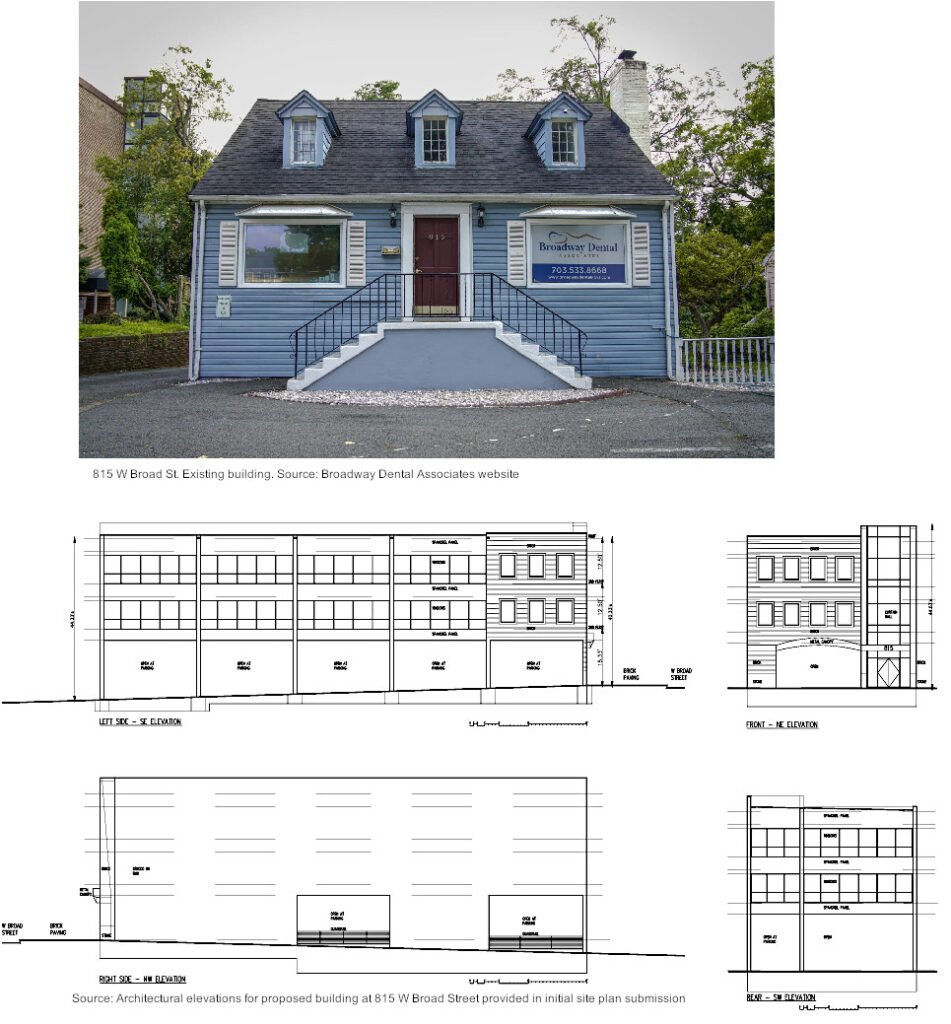
A second site plan proposal would demolish a one-and-a-half-story, 915.5-square foot residential style building and surface parking at 815 W Broad Street and replace it with a three-story, 10,466-square foot office building to house an expanded Broadway Dental Associates business. This property is zoned B1, Limited Business.
Because of the site’s narrow and long shape, the ground floor of the new structure would consist of surface parking with two stories of office space above, as indicated in the drawings below. The Planning Commission reviewed and made comments on this site plan at its April 15, 2026, meeting.
Clarity, detail wanting
While the Planning Commission welcomed both by-right development proposals—258 N Washington Street for the additional housing it would bring to the City and 815 W Broad Street for the expansion of an existing small business—commissioners expressed confusion, frustration, and even dismay at the lack of detail and clarity in these initial site plan submissions.
Among the elements lacking were clear parking layouts and landscaping plans, design integration and building materials issues, and stormwater and sewer considerations. Commissioners also wanted to know that the applicants had considered the City’s Comprehensive Plan and applicable Small Area Plans.
Commissioners asked what the developer envisions for restoration of the historic house at 258 N Washington so that it “speaks to the new [addition].” Otherwise, said Planning Commission Chair Andrea Caumont, the site plan “feels a little half-baked.” They wanted to see a mural of some kind on the blank wall on the right side, northwest elevation of the proposed structure at 815 W Broad (blank in anticipation of future development on neighboring sites) and a roof plan to mitigate stormwater issues and the building’s heat island effect.
Commissioner Phil Duncan said of the Park Washington application that it needs to “be mindful” of deliveries and housekeeping services, among other, non-resident parking requirements, and of the proposed dental office building that the developer should “provide evidence that the number of spaces is correct.”
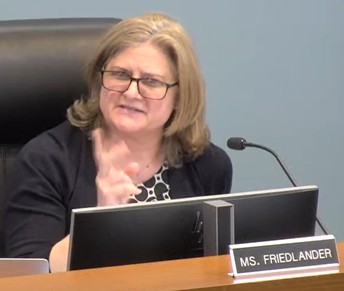
Overall, Commissioner Sharon Friedlander urged the site plan applicants to “be clear about what the designated agent is approving” and “the intent of what’s approved,” making sure there are no deviations in the documents. She said she was “challenged to understand [the 815 W Broad] site plan until I got the staff letter to the applicant.” Ms. Caumont said she also had difficulty with the Broad Street submission and so used Claude, Anthropic’s artificial intelligence assistant, to analyze it.
In response to a question from Chair Caumont, Senior Planner Jeff Hollern confirmed that the Commission will no longer receive staff reports about site plans; copies of letters to applicants (and AI) will have to suffice.
Clear and complete site plan submissions are essential, Ms. Friedlander emphasized. “It’s really important that even if the site plan is for by-right development, it has to have basic information if it’s to get through first review. We need clarity about what we are actually reviewing.” Without the necessary detail, these reviews become “a waste of everybody’s time,” she said.
Time: The enemy of good
Asked about notice to neighboring property owners of new developments, Mr. Hollern stated that “everything within 200 feet of a site is noticed.” In the case of the site plan for 815 W Broad, he said Broadway Dental Associates neighbor Botanologica would receive notice the day after the April 15 Planning Commission meeting.
The Pulse sought clarification of the City’s notice requirements and practices under the new site review process. Responding via email, Mr. Mattauszek said, “Under the updated Virginia Code governing the Designated Agent’s approval authority of site plans, the Commonwealth did not establish any notice requirements. However, as a long‑standing practice, Planning staff has been continuing to send Adjacent Property Owner Notification (APON) letters and posting yard signs on subject sites to inform the public and adjacent property owners of site plan filings.”
“The City’s notification efforts help emphasize the 40‑day site plan review period and identify any Planning Commission meetings where the site plan may be reviewed,” he added. In addition, Planning Commission meetings where Commissioners discuss site plans on an advisory basis and provide their recommendations to the designated agent are open to the public and offer opportunities for public testimony, he said.
When Mr. Duncan inquired whether the Commission would see these or future site plans again, Planner Hollern noted that any resubmission must be addressed in 30 rather than 40 days. That clock starts as soon as the site plan is resubmitted and another fee is paid. If there are many changes, the Planning Department “will try to come back [to the Planning Commission], if time permits,” he said. However, “I can’t guarantee that we will have staff comments back to you.”
Mr. Hollern added that the state law and resulting new City process prohibit the staff from raising new issues in their comments on a resubmitted site plan.
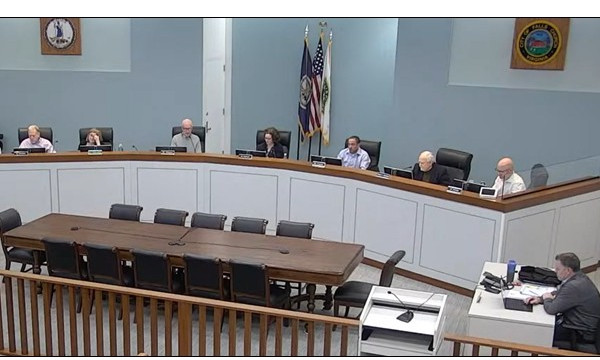
In the interest of time, the Commissioners summarized their recommendations on these two site plans for Mr. Hollern during their March and April meetings, drafting their memos to the designated agent in real time. During this group editing process, they expressed their appreciation for the constraints under which the staff are operating.
Additional process improvements needed
Commissioner Robert Kravinsky suggested that additional guidance be created as an aid to the designated agent in making site plan decisions. For example, Mr. Kravinsky said he is confused about the criteria Mr. Mattauszek will use in determining whether to grant parking waivers or variances. “If we are going to give that authority to the designated agent, we may want the code to be more specific as the landscaping code is.”
Chair Caumont asked the staff “for a way the Planning Commission can know how things are proceeding…a protocol for keeping [us] in the loop.” For example, she said at the Commission’s April 15 meeting that she and her colleagues did not know the outcome of the Planning Director’s decision about the 258 N Washington Street site plan, which was due earlier in the month.
Senior Planner Henry Zhang responded to a Pulse inquiry that Designated Agent Mattauszek disapproved the 258 N Washington Street site plan on April 2. He must rule on the 815 W Broad Street application by May 5. Based on Mr. Hollern’s assessment that a long list of comments made that site plan “not approvable,” it will likely be disapproved as well. A resubmission in either case will trigger the 30-day review-and-response deadline.
Limited public availability of site plan documents
Asked whether his decisions and supporting documentation on site plans will be made publicly available, Mr. Mattauszek said, “While the City already hosts documents associated with all of its major developments, it is currently developing a website to also host the smaller site plans that are subject to the new review and approval process. In the interim, all case‑related information remains available for public review at the Permit Counter in City Hall in print versions.”
“Regarding the availability of site plans and project documents on the City’s website,” he added, “there is an important technical requirement to note. To ensure our digital content is accessible to all residents, all documents—including site plans—must meet WCAG 2.1 Level AA accessibility standards before they can be posted for direct download.”
[Editor’s Note: WCAG 2.1 Level AA standards are internationally recognized, mid-range digital accessibility guidelines intended to ensure that websites and apps are Perceivable, Operable, Understandable, and Robust (POUR). Compliance focuses on contrast, keyboard navigation, and content adaptability. The US Department of Justice has designated WCAG 2.1 Level AA as the technical standard for state and local government websites and mobile apps.]
Mr. Mattauszek encouraged any resident with questions or concerns about a specific site plan, including the designated agent’s decision, to contact the assigned lead planner for each site plan. “Staff’s contact information is provided in both the APON letters and on the posted yard signs for each site plan,” he said.
References
- 258 N Washington Street Initial Submittal, March 4, 2026.
- City Staff Letter to 258 N Washington Street Applicant, March 11, 2026.
- Planning Commission Meeting, March 18, 2026. YouTube video. 258 N Washington Street submission is discussed from timestamp 00:43:00 to timestamp 2:07:15.
- 815 W Broad Street Site Plan Submission #1, April 2, 2026.
- City Staff Letter to 815 W Broad Street Applicant, April 14, 2026.
- Planning Commission Meeting, April 15, 2026. YouTube video. 815 W Broad Street submission is discussed from timestamp 00:14:30 to timestamp 1:50:00.