Major Revisions Proposed to the Revenue Sharing Agreement Between the City and the FCCPS School Board for FY2028 and Beyond
Summary
- An informal, administrative revenue sharing agreement between the City and the schools has specified how much money the Falls Church City Public Schools (FCCPS) receive from the City each year since the agreement was first put in place in FY2019. The accord has led to a smoother, more predictable budgeting process for both the City and the School Board, which governs FCCPS. This agreement is being renegotiated.
- In recent years, the City Council has faced increased funding needs to maintain and upgrade aging infrastructure to keep up with population growth and increasing density, while school enrollment has grown more slowly than expected. As a result, earlier this year City Council sought flexibility to depart from the agreed 50/50 revenue split to address the City’s overall requirements more effectively.
- A working group of City Council members, School Board members, and City staff negotiated changes and additions to the revenue sharing agreement over the summer. The third version of the agreement was finalized during the Council’s Budget and Finance Committee meeting on October 16, 2026, and discussed by the entire School Board and City Council at the end of October. The revised agreement will take effect for the 2027-2028 fiscal year.
- Beginning in FY2028, revenue shortfalls will be shared equally. In the past, shortfalls were only shared during challenging times. In addition, the City will pay for new debt service before splitting the revenues.
- The School Board supports the updated revenue sharing agreement, although some Board members are wary of the circumstances that would lead to a deviation from a 50/50 split.
- City Council members discussed how to clearly define the needs of the City and the schools—the “maintenance of effort”—so that disproportionate needs can be identified to help determine how funds are best allocated.
Background
In recent budget discussions, it has become apparent to the City Council that the City is behind on basic maintenance of its infrastructure—roads, traffic systems, stormwater systems, vehicles, and the property yard, for example. Many pieces of the City’s infrastructure need upgrades to handle the City’s increased population.
On the other hand, the City’s school facilities are in much better shape. Also, the student population is growing slowly, if at all. The only big new developments expected to be completed in the next five years are two senior housing projects—one at West Falls and the other the Quinn project between S Washington Street and S Maple Avenue. Further, neither of these developments are expected to contribute more students to the Falls Church City Public Schools (FCCPS).
The demands of a denser City on aging and inadequate City infrastructure require that the City Council balance the priorities of the school system and the capital investments that must be made without overly burdening taxpayers. Striking this balance will require flexibility in how revenues are shared with the School Board.
Over the summer, a working group that included School Board Chair Kathleen Tysse, School Board Vice Chair Anne Sherwood, Mayor Letty Hardi, and Council Member Erin Flynn negotiated major changes to the administrative revenue sharing agreement in preparation for the FY2028 budget.
The group discussed the third, and close to final, version of the document at the City Council Budget and Finance Committee meeting on October 16, 2026. The School Board then reviewed this version at its October 20 work session, and the City Council discussed it at its October 26 action meeting.
Revenue sharing allows for a smoother budgeting process
The revenue sharing agreement is an informal agreement between the City and the School Board on how tax revenues will be shared between them. Prior to this agreement, setting the annual budget was a contentious process. Since FY2019 when the agreement was first put in place, the budgeting process has been smoother and considered a vast improvement by both parties.
The existing agreement dictates a 50/50 split of all local tax revenues, including year-end surpluses. There have been nominal deviations to this arrangement, such as during the COVID-19 pandemic.
Arlington, Prince William, and Loudon Counties follow some variant of a revenue sharing agreement with their school systems. However, Fairfax County has not adopted this practice.
Unlike neighboring jurisdictions, though, the FCCPS School Board budget does not include major capital expenditures. Instead, the City’s Capital Improvements Program (CIP) covers school assets. Funds for school and City CIP projects also come from the City’s share of the revenue split.
Why revise the revenue sharing agreement?
At the October 16, 2026 Budget and Finance Committee meeting, City Manager Seth Hendler-Voss summarized the motivations for revising the revenue sharing agreement:
- To continue having a guideline for a smooth budget-setting process;
- To have the flexibility needed to consider current issues, some of which may be out of the control of the City and the School Board; and
- To decide how debt service factors into revenue sharing.
Neither City Council nor the School Board voted to approve the original accord, and neither will formally approve the revised agreement. Instead, its approval is implied in Council budget votes and public comment on proposed budgets. Going forward, the City Council, the School Board, and the public would all have input if budget proposals depart from the 50/50 revenue split.
Deviating from the 50/50 split
For budget planning, the 50/50 revenue sharing is considered a starting point. The City Council wants the flexibility to deviate from the agreed 50/50 split in some years, but affirms that in such instances, the parties “will endeavor to return to equal shares.”
The revised agreement does not address the circumstances that will result in an unequal split. Discussions during the meetings suggest that such circumstances might include disproportionate needs or unexpected and unplanned requirements.
Pay for any new debt service before revenue sharing
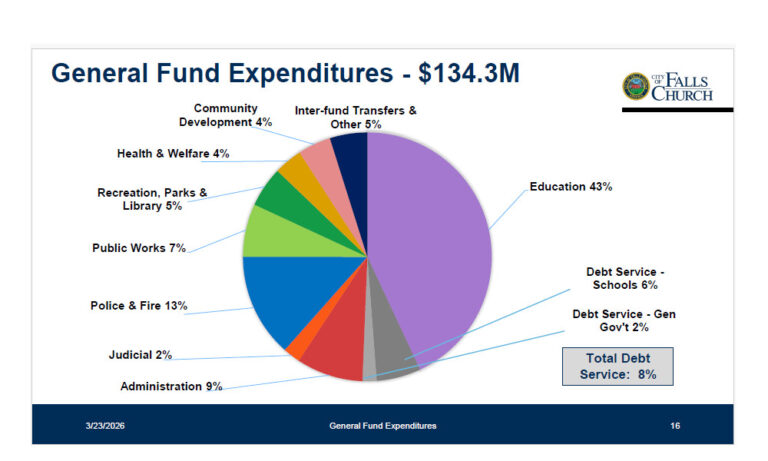
Currently, only the lease payments and real estate taxes from the West Falls development are excluded from revenue sharing to pay for debt service. The rest of the $10 million annual debt service is paid from the City’s share of revenues.
While this agreement does not affect how existing debt service is treated, the revised arrangement states that “new debt service will be covered first before revenue growth is shared.”
City needs include a new property yard, estimated at $30 million. The City is also awaiting the results of a facilities condition assessment that will direct future capital investments. The Police Chief has spoken about the need for a new Police headquarters. There is also a stormwater infrastructure assessment in the works that will inform the investments required to accommodate a growing population. These projects are expected to be funded by issuing new debt. The new agreement ensures that any new debt service is covered before revenue sharing is considered.
No change in which revenues are shared
The revised agreement does not change the definition of revenues available to be shared. Revenues received directly by FCCPS are excluded.
Also excluded from shared revenues are:
- Special purpose revenues, such as charges for services (culture and recreation, Aurora House, ambulance fees),
- Designated state revenues for the library, public safety, public works, etc.,
- Licenses and permit fees,
- Grant funding for specific projects,
- Revenues designated for debt service, and
- Restricted revenues for specific purposes, such as solid waste fees and any future Commercial & Industrial (C&I) tax revenues.
The document does not specify how investment income, fines, and forfeitures would be treated. In the past, these elements have not been part of shared revenues.
Equal sharing of year-end shortfalls as well as surpluses
In the past, only year-end tax surpluses were shared. According to the existing agreement, shortfalls are only shared during challenging times. Last year, FY2025 ended with a $466,000 tax revenue shortfall, but the City received $1.6 million more in non-tax revenues from investments and traffic fines that year so that there was a net budget surplus. The School Board was not asked to share the tax revenue shortfall, and the City did not share the non-tax revenue surplus, much to the chagrin of the School Board.
Under the new agreement, revenue shortfalls are shared in good times and bad. The new agreement simply states: “Year-end revenue surplus is shared after accounting for necessary contributions to unassigned fund balance to comply with City Financial Policy. Revenue shortfalls are absorbed equitably as well.”
If FY2025 had operated under the revised agreement, it is unclear whether the School Board would have been required to absorb the tax revenue shortfall or been able to partake in the net budget surplus.
An agreed budget process
The revenue sharing agreement lays out the guidelines for the budget process for the first time:
“Throughout the budgeting process GG [General Government] and FCCPS staff will share information on key budget drivers evaluated through the lenses of maintenance of effort costs and level of service changes.”
The City Council will consider these budget drivers in their final budget guidance and propose deviations from the 50/50 split, if needed. A schedule is laid out for the budget process, starting in December and ending with final approval in May.
“Maintenance of effort”
A key aspect of the budgeting process is the definition of “maintenance of effort.” This term describes “all expenses necessary to maintain the current level of service, inclusive of operational and capital costs.”
Examples include funding to maintain existing services and programs, adding or reducing school staff to accommodate growth or decline in the student population or public safety officers for the general population, building and infrastructure maintenance, and staff benefits and cost of living, or COLA, increases.
At the October 26 City Council meeting, Council Member Flynn highlighted the difficulties of defining “maintenance of effort.” “If maintenance of effort is the status quo, we may have starting points that are disproportionate,” she said. “How do we grapple with areas that have not been appropriately funded in the past? How do we grade the current level of service? …There are some things [where] we really need to bring up the level of service in order to then start a maintenance-of-effort conversation.”
School Board discussion
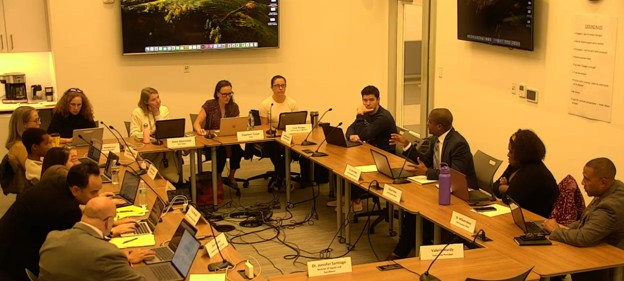
The School Board discussed the revised revenue sharing agreement at its October 20 work session.
“City Council wants flexibility in principal and as a starting point. … but that does cut both ways. If we were to have an unexpected increase in enrollment, we would expect a larger share,” Board Member Jerrod Anderson said.
Mr. Anderson expressed concern about basing revenue sharing flexibility on Council priorities. “The way it is written and the way it is discussed on the City Council side is that the flexibility they want is not just on extreme contingencies, but on policy priorities,” he said. “They want flexibility to reduce the school’s share if they have a change in priorities.”
According to his analysis, the School Board’s share of revenues has gone from 53% on average from 2019 to 2022, to 50% from 2023 to 2026. He sees the schools’ share falling below 50% in the future.
School Board Chair Tysse and Vice Chair Sherwoodboth acknowledged that City Council has the many needs of the entire City to balance, not just those of the schools. They supported maintaining the 50/50 split and the predictability of the process but stressed the importance of defining what “maintenance of effort” covers. They said that the revised agreement does not address all their concerns; nonetheless, they consider it a major improvement.
Board Member MK Hughes agreed that the “maintenance of effort” language needs to be clarified. She values the predictability from the process and the relationship and trust the agreement has forged.
City Council discussion
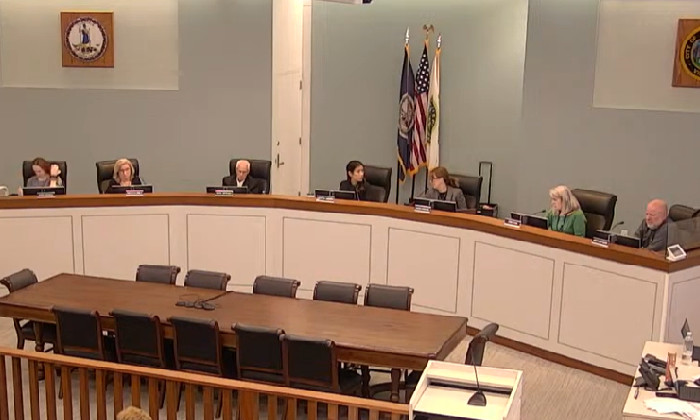
The City Council discussed the revised revenue sharing agreement at its October 26 action meeting, noting that the current version of the agreement does not describe the circumstances for deviating from 50/50 revenue sharing. The School Board would like to limit any deviations to unexpected circumstances. Mayor Hardi and Council Member Flynn shared their concerns about inserting that language.
“When I have grappled with exercising the right kind of flexibility on Council, in terms of what the 50/50 split looks like relative to overall revenue growth, it’s been in the context of thinking about where there are disproportionate needs–what we have seen on the schools’ side of the budget and the Council side of the budget,” Ms. Flynn said.
Mayor Hardi added, “At the end of the day, we are the ones with the fiscal and statutory responsibility [for] setting the tax rates. Our job is to figure out how to balance the needs across the entire City … and figure out the right split to fund all those competing priorities.”
Council Member Justine Underhill asked why the schools could not be funded based on their student population, perhaps using some “formula” with several factors to account for the mix of students.
Council Member Marybeth Connelly, who is employed by FCCPS as Director, Strategic Planning and Community Engagement, replied, “Every School Board member would probably be happy to tell you why [basing schools’ share on student population size] would never work. There are cost of living increases. … or if you get ten more 10th graders and you may have to add another chemistry teacher. But if you get eight more tenth graders you don’t have to. There are lots of these little variations.”
Mayor Hardi said, “It would be nice if the budgets were…tied to school enrollment, even if it’s not a pure formula per se, and it hasn’t been.”
Vice Mayor Laura Downs, who is a former School Board chair, commented that the revenue sharing agreement has made the budgeting process more predictable for the schools. She noted that before the agreement, “It was basically war every year. … It was always rallying the troops, and it was just exhausting.” But she recognizes the need for flexibility to deviate from the 50/50 split, as needed.
Council Member David Snyder observed that there are no easy answers. “I originally wasn’t a fan of [revenue sharing], but the more that I’ve seen it work, the better I feel about it. I also think that there does need to be flexibility, as everybody has said.”
Mr. Snyder added, “We have to be perhaps better at advocating in a convincing way to the schools that there are times when we need to adjust—just as they would be very effective at advocating with us. … We should move forward on [defining “maintenance of effort”]. How does the City define that, and where are we really falling behind? I think we should be able to take that to the schools and say, well, this year [the split] may be 51/49, or it may end up being a little bit different [than the agreement prescribes] based on some really significant needs that have to be met.”
References
- Existing Revenue Sharing Agreement, June 18, 2024.
- City Council Budget and Finance Committee meeting, October 16, 2026.This official video will not display properly on a small screen as it contains the agenda.
- Revenue Share Version 3, October 16, 2026.
- Falls Church City School Board Work Session, October 20, 2026.
- City Council Action Meeting, October 26, 2026. YouTube video.