City Readies MOU with Virginia Village Developer
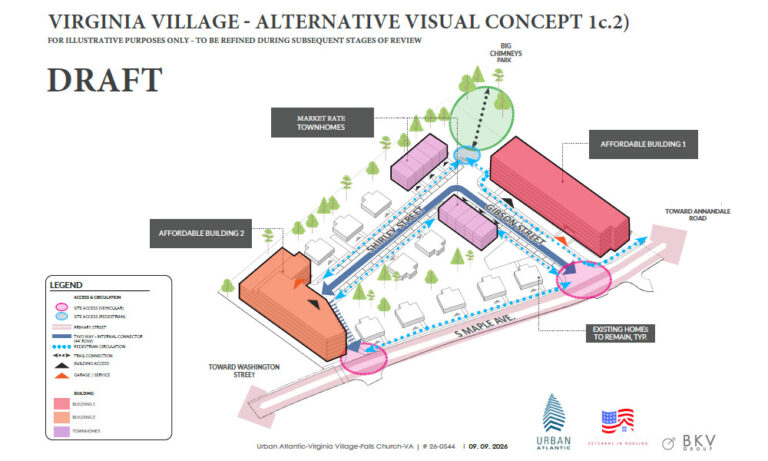
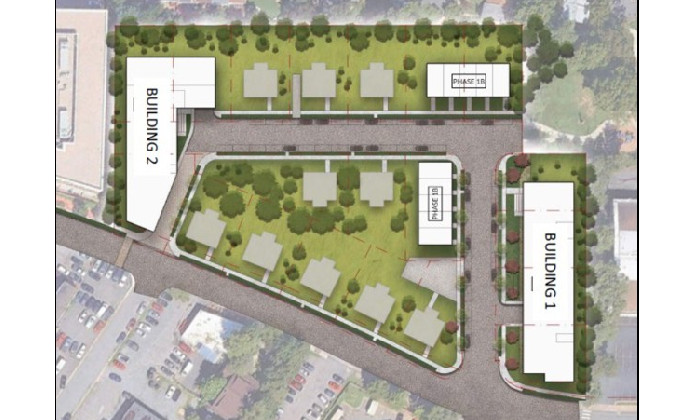
Source of graphic above: Draft Memorandum of Understanding Between the City of Falls Church and Urban Atlantic Development LLC, Schedule A-1, November 2, 2026
Summary
- The City largely made public and publicly discussed its draft Memorandum of Understanding (MOU) with Urban Atlantic Development LLC, the company and its team selected to redevelop Virginia Village as affordable housing. Portions of three areas of the MOU regarding site plan review, townhome properties, and mutual termination of the agreement were redacted.
- The MOU outlines Urban Atlantic’s plans for building and financing the project, which envisions construction beginning in mid-2028 of 132 affordable rental units in two mid-rise buildings. The project also includes 10 for-sale townhome lots, which are key to financing the affordable housing.
- At City Council’s November 2, 2026, work session, Council members sought protections for neighboring Winter Hill homes during construction, limits on the City’s financial risk, continued community input, adequate parking, and the right to return for existing Virginia Village residents.
- The Council appeared poised to approve the MOU at its November 23, 2026, action meeting.
The agreement
The project as described in the draft Memorandum of Understanding (MOU) between the City and its chosen developer, Urban Atlantic Development LLC, calls for “a 100% affordable rental community of approximately 132 units in two mid-rise buildings, plus for-sale townhome lots on City-owned land.” [For background on the City’s choice of Virginia Village developer, see the Pulse post Urban Atlantic Approved As Virginia Village Developer, September 17, 2026.]
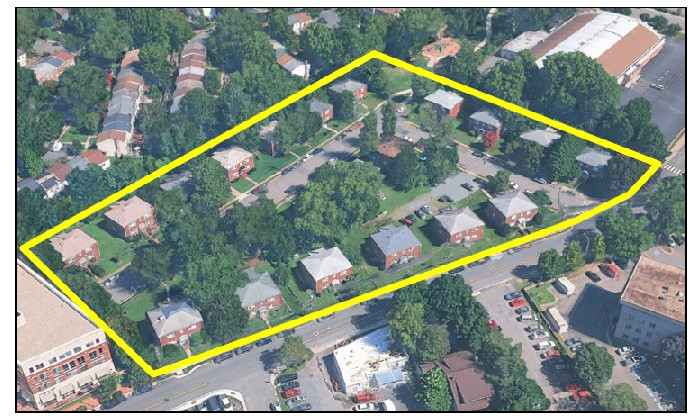
This redevelopment of half of the 20 1940s era Virginia Village quadplexes will be financed with 4% federal Low-Income Housing Tax Credit (LIHTC)/tax-exempt bonds, Virginia state funding, and proceeds from the sale of 10 townhome lots on the site. Construction will take place in one or more phases, depending on the available financing.
For its part, the City will contribute the land for $1 via a 99-year ground lease and provide the resulting development of affordable housing with a full real estate tax exemption. The ground lease and tax exemption would not apply to the townhome lots.
The City also must complete its acquisition of 300 Shirley Street, the tenth quadplex it would then own through the Economic Development Authority (EDA), and finalize zoning for the Virginia Village Affordable Housing District, which is not addressed in any detail in the proposed MOU. [For more information on the current status of the proposed zoning amendments, see the Pulse post Council Backpedals on Proposed Virginia Village Zoning, October 5, 2026.]
Project details
As shown in the diagram above, one 5-story building over a podium (Building 1) would be located on Gibson Street and S Maple Avenue and provide approximately 72 affordable rental units, while the second 3-to-5-story building over a podium (Building 2) would be bound by Shirley Street and S Maple and include about 60 affordable rental units. The 10 proposed townhome lots would front Shirley and Gibson Streets.
Urban Atlantic’s proposal calls for both buildings to include parking either below or partially-below grade that would be entered from an internal two-way connector. There would be no additional surface parking beyond what already exists.
Massing would be held toward S Maple and Gibson and stepped down toward the adjacent Winter Hill neighborhood. The developer expects to preserve or improve the existing street grid and pedestrian routes to Big Chimneys Park.
Urban Atlantic plans wood-frame residential construction with Enterprise Green Communities certification and US Department of Energy Zero Energy Ready Home (DOE Efficient New Homes), that would be verified by an independent Residential Energy Services Network (RESNET) rater.
The 132 affordable units would include approximately 53 one-bedroom, 44 two-bedroom, and 35 three-bedroom apartments. At least 60% of all units would be family-sized, defined as two or more bedrooms. Each unit will include at least 0.6 on-site parking spaces, not counting existing on-street parking.
All of these residential units will be affordable at 30% to 80% Area Median Income (AMI), with at least 30% of the units at or below 50% AMI. Most of the 80% AMI units will be two-bedrooms or larger. The MOU calls for final AMI distribution to assume income averaging of 60% AMI and to establish this distribution in a Comprehensive Agreement to be finalized no later than June 30, 2027. The right of existing Virginia Village residents to return to newly developed housing will be maintained.
Who is Urban Atlantic?
The City Council first met in closed session with Urban Atlantic Chief Executive Officer Brant Snyder and Project Executive Pam Frentzel-Beyme at Council’s November 2, 2026, work session before returning to a public meeting that included discussion of the proposed MOU.
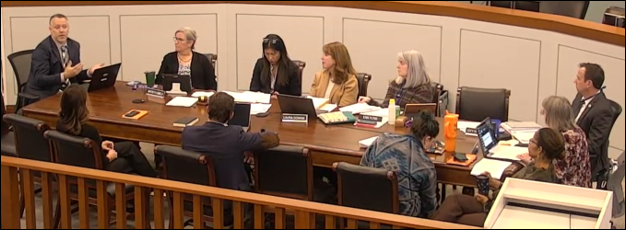
CEO Snyder described his 30-year-old, Bethesda, Maryland-based company as “a for-profit developer” that is also “a mission-oriented developer.” He noted that the original founding partners are still with the firm and that most of Urban Atlantic’s work is in the Washington, DC metro area.
The company has developed more than $3 billion in real estate over the course of its lifespan, including building more than 10,000 residential units—over half of which are in the affordable housing space, Mr. Snyder said. He added that much of Urban Atlantic’s work involves public-private partnerships with such organizations as Metro and jurisdictions as the District of Columbia.
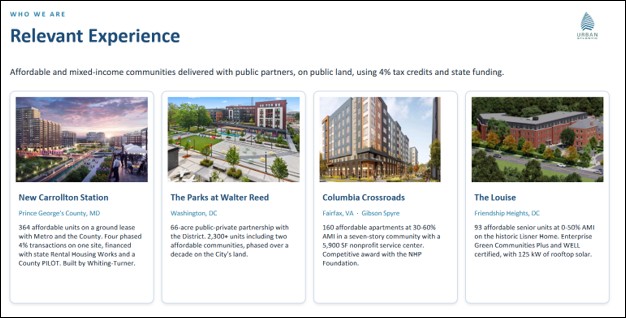
Among the firm’s projects are The Parks at Walter Reed, the US Army medical hospital, the New Carrollton Station Metro project, and The Louise, a senior housing project in DC, with affordable components as detailed in the graphic below.
The Urban Atlantic team
“Development is a team sport,” CEO Snyder said, and “who you are working with is key.” Urban Atlantic’s partners in the Virginia Village redevelopment include Thomas Gibson, president of Gibson Spyre, who is a former board chair of Virginia Housing, as well as architect BKV Group, Falls Church-based civil engineer Walter L. Phillips, land use counsel Walsh Colucci Lubeley & Walsh represented by Andrew Painter, preconstruction consultant Whiting-Turner, and property manager Cushman & Wakefield. BKV Group, Walter L. Phillips, and Walsh Colucci Lubeley & Walsh have worked with the City on past development projects.
In addition, “the City is our partner here; this is very much a public-private partnership,” Mr. Snyder said. “We have aligned goals. The MOU establishes those goals. That’s exceedingly important to set the vision and the objectives and how we actually execute this project.”
During his presentation, Mr. Snyder emphasized the importance to the project’s financing of the land value that Urban Atlantic can generate from the sale of the townhome lots. He noted that “in affordable housing, solving for the gap [in funding] is always the biggest issue.”
Mr. Snyder further stressed that the building plan, including wood framing and below-grade parking, “is the most efficient construction type [and] minimum cost possible.”
Construction protection for neighbors
Council Member David Snyder began the round of Council member comments on the MOU, asking about protections for the neighborhood during construction, clarification that the soon-to-be-acquired property at 300 Shirley Street would be one of the 10 townhome lots, continued opportunities for community interaction with the City staff and the developer, and the degree to which the City is assuming an unreasonable financial risk.
Urban Atlantic CEO Snyder affirmed his company’s belief that the proposed development of buildings of 5 and fewer stories “is appropriately sized for the density” of the site and construction. He noted the considerable work City staff and the community have spent on creating appropriate setbacks, although these parameters have yet to be approved and are now scheduled for final Council consideration on December 14.
“We will seek to minimize construction disruption,” Mr. Snyder said, beginning with site surveys of neighbors most affected by the construction. He explained that this detail will be included in the master development, or Comprehensive Agreement, rather than the MOU.
Urban Atlantic’s Snyder added that the level of disruption will not be what the City has experienced from other larger development projects. He said that Building 2 will be much smaller—no more than 20% as large as the nearby Pearson Square building, and so “much less impactful than that building by virtue of its size.” Winter Hill neighbors have reported damage to their townhomes from the 2006-2007 construction of Pearson Square.
Council Member Erin Flynn and Mayor Letty Hardi asked whether Urban Atlantic would be open to including an expectation of protective construction measures for the community in the MOU, and Project Manager Frentzel-Beyme pledged that the developer “will find a way to do this.”
“The community’s concerns are fair and reasonable” regarding construction disruptions, Ms. Hardi said.
300 Shirley Street and the acquisition of more properties
About the designation of 300 Shirley in the MOU as part of the affordable housing building on Gibson Street and Maple Avenue rather than as a townhome lot, Community Relations & Legislative Affairs Director/ADA Coordinator Cindy Mester sought and received confirmation from Urban Atlantic that that property is mislabeled and should be listed as a townhome lot.
Mayor Hardi asked if the City’s acquisition of additional Virginia Village properties would be governed by the MOU and whether more properties would necessitate changes to Urban Atlantic’s development plan. Mr. Snyder responded that he doesn’t foresee any major acquisitions or changes that would alter the plan as outlined in the MOU.
City Community Planning Director Matt Mattauszek added that the City can’t continue to acquire additional Virginia Village lots. The deadline for doing so is March 31, 2027, he said. The City and developer teams “are aligned on the priorities,” he said. “At some point, we have to put pencils down,” and proceed with the project. Meantime, Mr. Mattauszek indicated that Ms. Mester is pursuing possible acquisitions until the deadline next spring.
Urban Atlantic assumes the risk
In response to Council Member Snyder’s concern about financial risk to the City, CEO Snyder said, “Ultimately, we’re in the risk-taking business. The City has taken its risks by acquiring the properties, selecting a developer, and entering into an MOU. We are now taking the risk. The City isn’t an equity investor. Your risk is us performing, and the agreement will protect you accordingly. The primary objective is to deliver this affordable housing.”
Continued community input
Council Member Flynn returned to the issue of community input into the developer’s plan. Mr. Snyder replied, “We always expect a robust community engagement process in any of our projects. City staff has created that framework, and we will work within it.”
The Urban Atlantic CEO added, however, that seeking input “can’t go on forever. We won’t make everybody happy, but we can clearly identify the objectives, the priorities, the sacrifices that have to be made.” The developer’s goal will be to seek balance, he said. “We’ll be transparent. We’ll be honest. We will seek to explain why certain decisions need to be made.” For example, deeper levels of affordability at Virginia Village may require more funding, Mr. Snyder explained.
Urban Atlantic’s compensation
Ms. Flynn asked how Urban Atlantic would be compensated, particularly for the townhome lots. Mr. Snyder said that his company’s intent is to serve as the master developer, with a fee paid for master planning, development of the Comprehensive Agreement and the site plan, and the agreement with a selected home builder based on their purchase price for the townhome lots.
“The City-owned land will be subdivided. It’s ultimately our obligation to get the most for that land,” he replied. “We’re compensated for the work we are doing for the City. There will be 10 [townhome] lots and a purchase price [from the home builder] for each lot; we’re getting 15% of that.”
Parking versus more affordable units
Vice Mayor Laura Downs asked about parking and encouraged Urban Atlantic to look for offsite parking in public garages. Mayor Hardi cited as Council’s shared priority the achievement of deeper levels of AMI—at 30% and 40%—at Virginia Village, making rightsized parking critical. She said she would be interested in trading parking for more affordable units.
Mr. Snyder said that while the developer will look for underutilized parking elsewhere, “we want to make sure that we are rightsizing parking within the buildings. The buildings have to work for our residents. As much as we want a walkable place, people still need cars.”
Commenting on parking, Council Member Arthur Agin reinforced Mr. Snyder’s view, saying “As long as we are meeting the demand, we can be flexible as to how we supply that demand. But I don’t like shortchanging real-world demand.”
Returning residents and long-term affordability
Regarding Mr. Agin’s question about returning Virginia Village residents, Mr. Snyder said his expectation is that Urban Atlantic will develop a plan for these residents, and City staff will have an opportunity to review and sign off on it.
Mayor Hardi added her desire that the affordability period for Virginia Village run for the same 99 years as the ground lease to the developer.
Development timing
The Council will vote on November 23, 2026, whether to approve the MOU between the City and its selected Virginia Village developer.
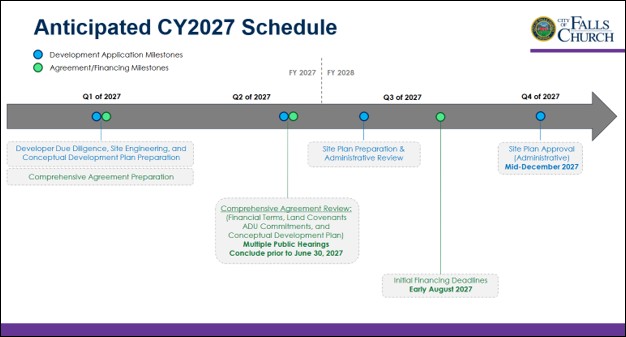
Ms. Frentzel-Beyme said that once the MOU is executed, the developer will move into design and feasibility with the goals of creating conceptual and site plans and executing the Comprehensive Agreement with the City by the end of next June. The site plan is now anticipated to be completed and approved by the end of December 2027. Urban Atlantic expects to have financial plans in place early in 2028 and to begin construction in the middle of that year.
City Community Planning Director Matt Mattauszek affirmed this schedule, clarifying that what was previously referred to as the Interim Agreement is now the MOU. He said that once approved by City Council, this 30-page document will govern the Virginia Village project for the next eight to nine months.
Immediate next steps include a November 9 briefing of the MOU to the EDA, a November 18 public hearing on proposed Virginia Village zoning changes at the Planning Commission, the November 23 vote by Council on the MOU, and Council’s second reading of the new Virginia Village Affordable Housing District on December 14. Mr. Mattauszek added that the zoning changes deadlines have now shifted six months to the end of 2027.
The Planning Director said he anticipates further public conversations about Virginia Village in the spring of 2027. He provided that schedule in the graphic below.
References
- City Council Work Session, November 2, 2026. This official video will not display properly on a small screen as it includes the agenda. Discussion of Virginia Village begins at timestamp 2:06:00 and ends at timestamp 3:20:00.
- City Council Work Session, November 2, 2026. YouTube video.
- Resolution to Approve a Memorandum of Understanding (MOU) Between the City of Falls Church and Urban Atlantic Development LLC for the Redevelopment of the City-Controlled Properties Located in Virginia Village and Authorize the City Manager to Execute the MOU on Behalf of the City, November 2, 2026.
- Draft Memorandum of Understanding Between the City of Falls Church and Urban Atlantic Development LLC, November 2, 2026.
- Virginia Village MOU Staff Presentation, November 2, 2026.
- Urban Atlantic Council Work Session Presentation, November 2, 2026.