Grove Avenue’s Growing Safety Concerns Raise Questions About Traffic in Falls Church
By the Residents of Grove Avenue
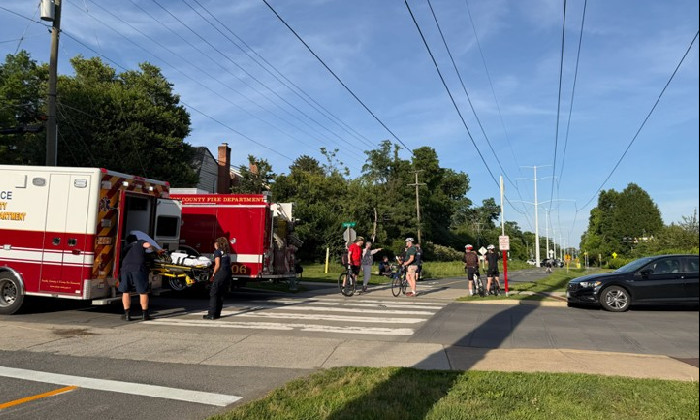
(Photo: Emergency vehicles responding to an accident at the Grove Avenue W&OD Trail crossing.)
Summary
- Grove Avenue residents say traffic volumes and unsafe driving have increased significantly over the past several years.
- Seven reported crashes involving cars and cyclists/pedestrians have occurred at the Grove Avenue/W&OD Trail crossing within the past year.
- Four of the crashes occurred within two months, involving two minors, and many requiring emergency medical response.
- Grove Avenue/W&OD Trail crossing lacks the traffic calming measures seen at other trail crossings in the City.
- Residents have spent nearly two years working with City officials, NOVA Parks, the Department of Public Works, the Citizens Advisory Committee on Transportation, and the police to improve safety.
- Some improvements have already been made or are planned, but many neighbors believe additional measures are necessary before a more serious crash occurs.
Crashes at Grove Avenue and the W&OD Trail
Falls Church City has long promoted itself as The Little City—a place where people can comfortably walk, bike, and travel through connected neighborhoods. That reputation is one of the reasons many families choose to live here.
But on Grove Avenue, some residents are asking whether that reputation still matches reality.
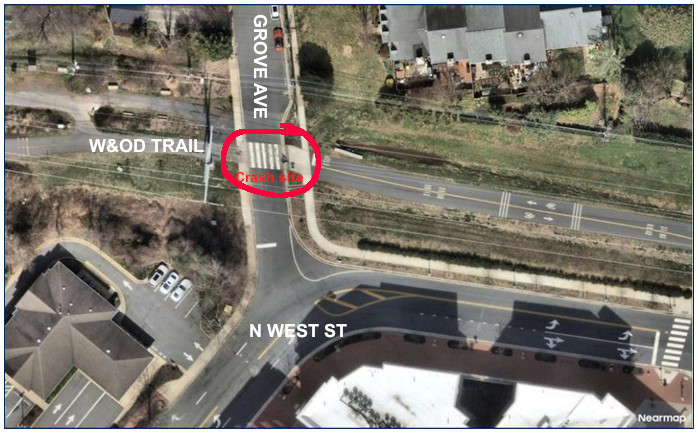
In just two months, neighbors have witnessed four car accidents involving cyclists or pedestrians at the intersection of Grove Avenue and the Washington & Old Dominion (W&OD) Trail. Over the past year, there have been seven crashes at the crossing.
The four most recent incidents involved three cyclists and one pedestrian. Two of those involved minors. Fortunately, none of the crashes were fatal, but many required emergency medical response.
For many Falls Church residents, those numbers are surprising. For the people who live on Grove Avenue, they are not. Instead, many neighbors say they are surprised there have not been more.
Since the fall of 2024, residents representing roughly 54 households and 40 students have organized around one goal: improving safety on their street before someone is seriously injured.
A residential street that became a through route
Grove Avenue was designed as a residential street, but today it functions as something much more. Located by Broad Street and West Street near Founders Row, Grove Avenue connects downtown Falls Church and the Founder’s Row development to Haycock Road, West Falls, and the Falls Church City Public Schools secondary campus. Drivers are also now using it to bypass congestion and traffic signals on Broad Street.
The result Is a steady stream of vehicles down Grove Avenue throughout much of the day.
The road itself encourages speed. It is relatively wide, mostly straight, and slopes downhill from Fairfax County into Falls Church. The speed limit is 20 mph, and Grove Avenue has no stop signs along its length. Four speed humps are intended to slow traffic, but residents say many drivers accelerate between them before slowing again.
The street also intersects with one of the busiest sections of the W&OD Trail, just beyond the pedestrian bridge over Broad Street. Unlike other trail crossings in the City, the Grove Avenue crossing lacks any traffic calming measures. Most of the other crossings have 4-way stops, medians, trail and road demarcation, and lane narrowing, but Grove Avenue does not.
That combination—higher traffic volumes, vehicle speeds, and frequent trail users—has become the center of resident’’ concerns.
Four issues continue to surface
Residents generally describe the problem as having four interconnected parts: increasing traffic volume, speeding and reckless driving, limited enforcement of existing traffic laws, and the design of the W&OD Trail crossing.
1. More cars on a neighborhood street
Residents say traffic has steadily increased as development has expanded around Broad Street and West Falls.
Parents driving students to school, commuters avoiding Broad Street congestion, delivery vehicles, and drivers using navigation apps all contribute to heavier traffic on what was intended to be a neighborhood street.
By November 2024, traffic had become concerning enough that families relocated the neighborhood school bus stop to the opposite side of the street. According to residents, drivers frequently failed to slow as children waited for the bus, creating several close calls.
The move provided additional space and visibility, but neighbors viewed it as a temporary solution rather than a fix.
2. Speeding remains a longstanding concern
Speeding on Grove Avenue is not a new issue. Residents recall that in the early 1990s, neighbors borrowed radar equipment from the Falls Church City Police Department to document vehicle speeds. Their efforts eventually led to the installation of speed humps.
More than three decades later, many residents believe the underlying problem persists. Although the speed humps encourage drivers to slow at specific locations, neighbors say vehicles often accelerate immediately afterward. Parents have installed brightly colored “Slow Dow” signs throughout the neighborhood in hopes of catching driver’’ attention.
Residents also regularly report speeding to the Police Department’s non-emergency line. Police have periodically deployed speed trailers and increased enforcement, which residents say temporarily improves driver behavior. Once those measures are removed, however, many believe traffic quickly returns to previous patterns.
3. Enforcement challenges
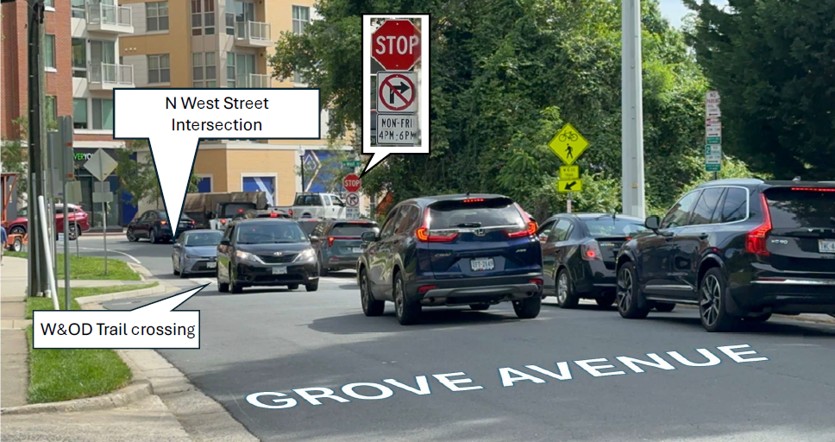
Residents also point to inconsistent compliance with existing traffic restrictions. Two turn restrictions are intended to reduce cut-through traffic: no left turns from West Street onto Grove Avenue between 7:00 and 9:00 a.m., and no right turns from Grove Avenue onto West Street between 4:00 and 6:00 p.m. Nonetheless, neighbors say these restrictions are routinely ignored.
Residents acknowledge that Falls Church Police must respond to traffic concerns throughout the City and cannot maintain a constant presence on one street. At the same time, they argue that consistent enforcement of existing regulations would encourage better driver behavior and reduce cut-through traffic.
4. The W&OD Trail crossing design
Perhaps the greatest concern is where Grove Avenue crosses the W&OD Trail. The trail carries heavy pedestrian and bicycle traffic throughout the day and serves as a major route for students traveling to and from the secondary campus as well as the FCCPS elementary “bike bus” where students at Oak Street Elementary School are encouraged to ride their bikes to school.
Residents say the trail crossing at Grove Avenue differs from many others in Falls Church City, where drivers encounter more noticeable traffic-calming features such as raised crossings, textured pavement, lane narrowing, pedestrian refuges, highly visible warning signs, or all-way stops.
At Grove Avenue, the crossing relies primarily on pavement crosswalk markings and stop signs for the pedestrians, but not for the cars.
Neighbors also cite visibility concerns. Cyclists descending from the Broad Street pedestrian bridge can approach the intersection quickly, while drivers traveling on Grove Avenue have limited reaction time. Residents describe a situation in which drivers, cyclists, and pedestrians often make different assumptions about who will yield. They believe those conflicting expectations have contributed to the recent crashes.
Nearly two years of advocacy
Residents have not simply voiced concerns—they have actively engaged with City leaders.
Since 2024, neighbors have met with Mayor Letty Hardi during office hours, invited City Council members David Snyder and Erin Flynn to walk the neighborhood, attended Citizens Advisory Committee on Transportation (CACT) meetings, worked with the Department of Public Works (DPW), consulted with local bicycle and pedestrian advocacy organizations, communicated with NOVA Parks, requested additional police enforcement, and asked the City to conduct a traffic-calming study.
Residents have also proposed potential design changes rather than waiting for recommendations from others. Their message has remained consistent: improve safety before a tragedy occurs.
Progress, but more work ahead
Residents acknowledge that government agencies have taken meaningful steps. The City initiated a traffic-calming study and installed traffic-counting equipment to collect data. However, Grove Avenue’s study, along with several others, has been delayed while the DPW figures out their process flow.
NOVA Parks has improved vegetation management to increase visibility, installed additional signage and pavement markings, and added rumble strips approaching the crossing.
DPW has agreed to relocate a parking sign that obstructed sight lines near the trail. DPW also plans to install a painted red crosswalk similar but not exact to those used elsewhere in the City. White flexible delineator posts are also planned for the turn from North West Street onto Grove Avenue to help discourage unsafe turning movements.
Residents appreciate these improvements and view them as important first steps. Many also believe they are unlikely to address the larger issues of vehicle speed, traffic volume, and the interaction between motorists and trail users.
The conversation continues
As discussions continue, residents have identified several additional ideas they hope the City will evaluate.
Among them are additional traffic-calming measures, raised medians, enhanced trail-crossing treatments comparable to other Falls Church crossings, roadway design changes, increased enforcement during peak travel periods, a four-way stop, and the possible use of technology already deployed through the City’s Smart City initiatives.
Those ideas—and others—are a continual conversation the residents on Grove Avenue have with CACT and DPW.
No single solution has emerged, and residents recognize that transportation decisions involve engineering, budgets, emergency access, regional traffic patterns, and competing community priorities.
Still, they believe the recent crashes demonstrate that maintaining the status quo carries its own risks.
More than one neighborhood’s concern
Although Grove Avenue residents have led the conversation, the issues raised on this street extend well beyond one road.
Every day, students walk and bike to school. Families use the W&OD Trail for recreation. Cyclists commute through the City. Drivers travel between neighborhoods, schools, businesses, and surrounding jurisdictions. The Grove Avenue crossing serves all of them.
As Falls Church continues to grow, balancing mobility with safety will become increasingly important. New housing, redevelopment, and changing travel patterns bring new opportunities, but they also place greater demands on streets that were designed decades ago.
For Grove Avenue residents, the question is no longer whether improvements are needed. The question is what combination of engineering, enforcement, education, and planning will best protect everyone who uses the corridor.
The recent crashes have focused attention on one intersection, but they also raise a broader question for the community: as Falls Church evolves, how can it preserve the safe, walkable character that has long defined The Little City?
That conversation is now underway, and many residents hope it leads to meaningful action before another collision brings renewed urgency to the issue.