New State Law Guts Public Input on Site Plans
Summary
- A new Virginia law with the stated intent of increasing affordable housing would remove the Planning Commission from approving site plans for commercial and residential development, transferring that authority to “a designated agent” as of July 1, 2025.
- Accordingly, to meet the deadline for implementing the law and on the staff’s recommendation, the City Council during its June 16, 2025, meeting named the Planning Director as the designated agent to review and approve site plans.
- The law also shortens the site plan review period for initial applications from 60 to 40 days and review of resubmissions from 45 to 30 days.
- Council members and Planning commissioners alike expressed concern about losing Planning Commission and citizen input on development applications and the significantly shortened review timelines. Staff agreed to work on a process that would retain Planning Commission review and comment on an advisory basis along with some form of public input to the extent possible.
- Council members further advocated changes or adjustments to this law during the 2026 Virginia General Assembly. The City’s planning staff will track the impact of the new law on site plan approvals in preparation for asking the state legislature either to amend this statute to allow more smaller localities to retain Planning Commission jurisdiction over site plans, or to revise the City’s Charter to explicitly grant site plan authority to the Falls Church Planning Commission.
Background
A new law with the stated intent of increasing affordable housing removes the authority of planning commissions and governing bodies across Virginia to approve subdivisions and site plans. In their place, the law assigns that authority to “a designated agent” defined as “any agent employed or authorized by a locality and designated by the governing body to review and act on subdivision plats, site plans, and plans of development.” The law specifies that the designated agent cannot be the local planning commission.
In Falls Church, the City Charter takes precedence over State law with regard to “platting,” or subdivision, authority. As a result, the Planning Commission will retain this responsibility. However, the Charter does not authorize the Planning Commission to administer and approve site plans, as it does for subdivision plats, and therefore the State code takes precedence and requires the City Council to designate an agent for this work. Staff recommended that that agent be the City’s Planning Director.
In addition, the law reduces the maximum review time for site plans, subdivision plats, and plans of development involving parcels of commercial or residential uses from 60 days to 40 days. The bill further reduces the review of resubmitted plats, site plans, and plans of development from 45 days to 30 days. The staff report indicates that these changes do not apply to review times for mixed-use site plans, subdivision plats, and their associated plans of development.
The law, which was supported by the City’s representatives in Richmond, Delegate Marcus B. Simon and Senator Saddam Azlan Salim, goes into effect on July 1, 2025, and some 60 changes to the City’s code to align it with this new State code are scheduled to be approved by the Council in September 2025. Due to the law’s effective July 1 date, the City Council accepted the staff’s recommendation and named the Planning Director the City’s designated agent at its June 16, 2025, meeting.
As a result, the City’s incoming Planning Director Maciej (Matt) Mattauszek will be the designated agent when he begins his work for Falls Church on July 14, 2025. Mr. Mattauszek comes to the City from the Department of Community Planning, Housing, and Development in the Arlington County Government.
The law’s impact
The net effect of this legislation risks requiring the City to terminate input from the Planning Commission and the public regarding future site plans for such developments as Stratford Gardens Restaurant, Econize Closet and Blinds, and the new townhouses now under construction on Park Avenue unless the City Council and staff can find a way to continue to include the Commission and the public in the approval process. [For more on these particular developments and the role the Planning Commission played, see Pulse posts Stratford Gardens Restaurant – Site Plan Approved, December 20, 2023; Approved! A New Showroom Planned for Econize Closet at W Broad and S Spring, April 23, 2025; Lee Park Townhomes is Approved, Planning Commissioners Reflect on the T-Zone Ordinance, September 26, 2024; and OakPark Townhomes – The First T-Zone Project on Park Avenue, May 1, 2024.]
With its shortened timelines for approving site plans, the new law also forces the planning staff “to do everything twice as fast” for the City to comply with it, said Gary Fuller, Acting Planning Director. This is true both for initial and resubmitted applications. Timing is the limiting factor where any Planning Commission or public input is concerned, he added. “Forty days is really tight.”
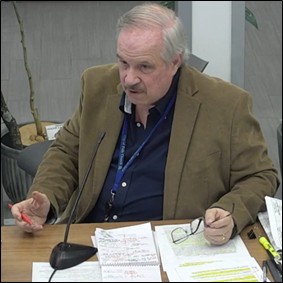
Mr. Fuller clarified that properties within 150 feet of a proposed commercial or residential development will continue to receive notice in the form of a letter, and signs will still be posted on these sites to indicate that something is happening on them. However, with the Planning Commission removed from the site approval process, there will be no public hearings where citizens can comment on development proposals. Absent the development of a new process, “members of the public will need to come to the [Permits] counter to see the file,” Mr. Fuller said.
Council members affirm the roles of the Planning Commission and the public
City Council members expressed concern that the law removes the Planning Commission and citizens from the approval process and sought ways to include their input, at least on an advisory basis.“We get some really valuable comments from the Planning Commission, so I would like to see that continue,” said Council Member Justine Underhill. Council Member David Snyder urged that City staff work to create “a mandatory advisory role for the Planning Commission that can be built into the process.” Council Member Erin Flynn added her support for “keeping the Planning Commission involved in some advisory capacity. Otherwise, there is essentially no public insight into this at all,” resulting in internal planning staff review alone.
Ms. Flynn wondered if some form of presubmission review by the Planning Commission ahead of formal application submission might be possible. However, Deputy City Manager Andy Young said he is concerned about the City’s practical ability to shorten the review window and still involve the Planning Commission.
Planning commissioners agreed with City Council members’ assessment of the new law’s negative impact on Falls Church. “In consultation with our City Attorney, there may be creative ways that we can work around [this law] – even in the interim,” said Commissioner Brent Krasner during the Planning Commission’s June 4, 2025, meeting. “Just because we’re not the approving authority doesn’t mean we can’t provide input,” through a work session or in an informational item on the Commission’s agenda.
Legislative history of the new law
Council Member Snyder said he would like to know the legislative history of Senate Bill (SB) 974, “because it just reeks of special interest legislation. It removes citizen input, and I don’t recall discussing it in [the City Council’s] Legislative Committee.” By reducing the time for site plan reviews from 60 to 40 days, the staff will need to provide more waivers to meet the deadline, he added, calling the result “a pro-developer outcome.”
Council Member Laura Downs also asked what drove the legislation. She said she understood that “Delegate Simon supported the reduced time frame to increase housing, but I don’t understand why you would pull the Planning Commission out of site plan approval.”
Community Relations and Legislative Affairs Director Cindy Mester said this legislation “went through very quietly and with…unanimous votes.” She explained that the shortened review time frames were intended to support housing and to require localities that don’t process development applications more efficiently to do so.
Ms. Mester added that there is controversy in other jurisdictions between planning commissions and their communities. She noted that when she attended the Northern Virginia Regional Commission Chief Administrative Officers meeting on the 2025 legislative session, she learned that “the larger localities hadn’t picked up on this either.”
Seeking changes to the law
Ms. Mester suggested that the City could seek to adjust or change the law during the 2026 General Assembly to address “its unintended consequences on us.”
Council Members Snyder, Downs, and Flynn supported pursuit of an amendment to the law or a change to the City’s Charter to include site plans along with subdivisions in the Planning Commission’s responsibilities.
One way or the other, “we need to take this up as a legislative priority in the next session,” Mr. Snyder said. Meantime, he asked that staff “not react to this in a way that reduces public input to the extent you possibly can. Please don’t feel that now you have to give developers even more leeway than they already have because you can’t meet the deadline unless you do that.”
“Punished by Richmond”
Mayor Letty Hardi said, “Other jurisdictions are probably not like Falls Church…and aren’t doing enough on getting development through the process. We often hear from applicants that spending five years on the process costs them a lot of money, and it just becomes untenable. So I understand the legislative intent.”
Planning Commissioner Phil Duncan was less forgiving. “We’re basically being punished by Richmond for doing things the way they should be done. I’m sorry that some other jurisdictions have been slow about it, or anti-development, or whatever. We’ve struck a good balance here between public input and progress and preservation,” he asserted.
Commissioner Krasner added that the new law “really shows a lack of understanding of how smaller jurisdictions work. In a small jurisdiction like ours where we [have fewer staff and] only have a handful of site plans per year, there’s a real benefit to having [Planning Commission] involvement.”
Mayor Hardi recommended that the staff monitor the number of projects that they ultimately must reject because the time frame for review is so short. Providing this information then becomes “a useful conversation with the General Assembly versus saying we just don’t like it,” she added.
At the Council’s June 16 meeting, Mr. Fuller committed to tracking the impact of the law on site plan reviews beginning with the one application in the pipeline now for Yasini Jewelers on W Broad Street.
References
- City Council Meeting, June 16, 2025. Discussion of and vote on the designated agent for review and approval of site plan applications begins at timestamp 2:55:20 and ends at timestamp 3:01:05. This official video will not display properly on a small screen as it includes the agenda.
- City Council Meeting, June 16, 2025. YouTube video.
- City Council Work Session, June 2, 2025. Discussion of the Subdivision and Site Plan Code Changes and Interim Designation of Site Plan Review Agent begins at timestamp 2:40 and ends at timestamp 3:14. This official video will not display properly on a small screen as it includes the agenda.
- City Council Work Session, June 2, 2025. YouTube video.
- Site Plan & Subdivision Regulation Update Staff Report, June 2, 2025.
- TR25-17-1 Chapter 594A VA Code Amendment – Subdivision ordinance; designated agent.
- TR25-17-2 Chapter 100 – Subdivision ordinance; shortens timeframe for local approvals.
- TR25-15-0 Site Plan Designated Agent Staff Report, June 2, 2025.
- TR25-15 Resolution to Designate the Planning Director As the City’s “Designated Agent” for Review and Approval of Site Plan Applications, June 16, 2025.
- City of Falls Church Planning Commission Meeting June 4, 2025. Discussion begins at timestamp 1:45 and ends at timestamp 2:07.