FY2027 Proposed Budget Expenditures Maintain Operations at Current Levels
Summary
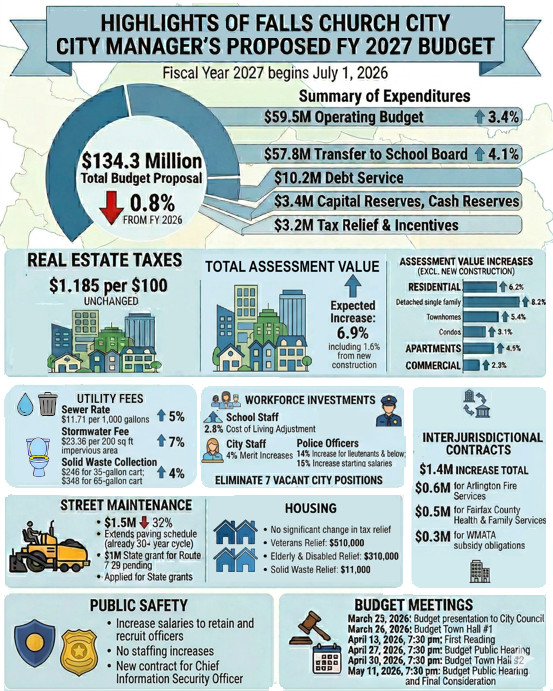
Assuming real estate taxes remain unchanged, the $5 million increase in real estate taxes projected from increased assessments and smaller increases in other taxes provided sufficient funds for the School Board and the General Government to maintain services and staffing at current levels.
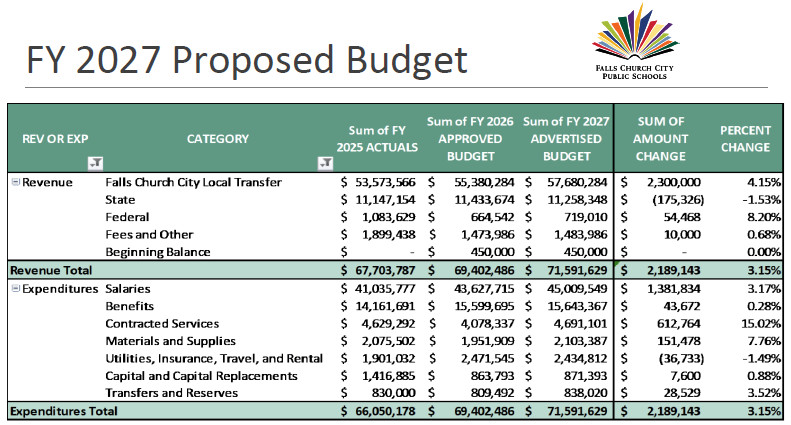
The School Board expenditures increased 3.15%. School staff will receive a 2.8% cost of living adjustment (COLA) as agreed during contract negotiations. Health insurance premiums were also higher than expected.
On the City side, the operating budget increased 3.4%, excluding debt service, fund transfers, and other expenses not related to operations. Money is set aside for a 4% merit increase for staff except police officers. To address recruitment and retention issues, salaries for officers who are lieutenants and lower ranks will increase 14%.
Investment returns and lease payments typically fund capital expenses and affordable housing. Both sources of revenues are considerably lower leading to lower investments in infrastructure maintenance and affordable housing programs this year. The street maintenance expenditure that includes paving is reduced by $700,000 from last year. The City is falling further behind on its paving schedule. Affordable housing will receive $200,000, less than half the amount last year.
Background
The City Manager and the School Board Chair presented their FY2027 budget proposals at the City Council’s March 23, 2026, meeting. This presentation set the stage for discussions in the coming weeks that will determine the real estate tax rate and other fees. The first reading of the budget for approval is scheduled for April 27, and final approval is set for May 11.
City staff convened a budget town hall on March 26 and will hold a second town hall April 30 at 7:00 pm in Council Chambers. Another opportunity for public comment on the budget is scheduled for the City Council work session on April 27.
The 361-page budget includes the Capital Improvements Program (CIP) for FY2027 to FY2031. An earlier Pulse post covers the CIP, $162M FY2027-2032 CIP Invests in Sewer and Stormwater Capacity Expansion, Delays Property Yard Replacement, March 13, 2026.
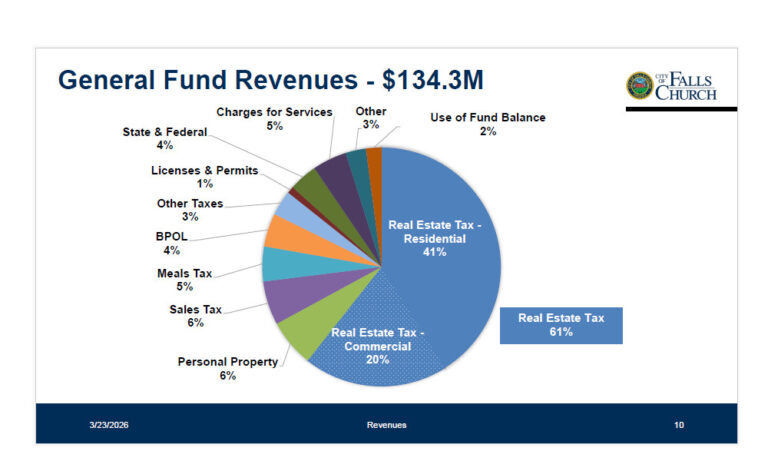
Another post, Revenues From a 6.9% Assessment Increase Funds the FY2027 Budget, April 1, 2026, focuses on the revenues funding the $134.3 million budget. This post looks at the expenditures proposed by the City Manager.
Budgeting expenditures to maintain the status quo
Given the current economic climate, the theme of both the School Board and the City Manager was to maintain the current levels of service with noo significant expansion or reduction of staff or departments, and definitely no ambitious projects. A secondary concern was staff retention.
The revenue sharing agreement between the School Board and the City equally divides certain local tax revenues between them. The West Falls real estate taxes are excluded as they are designated for servicing the debt issued before the construction of Meridian High School. The budget exercise involved forecasting the increase in revenues, assuming no tax rate changes, and allocating that increase between the School Board and the City. Each party then adjusted their FY2026 expenditures to accommodate their share of the increase.
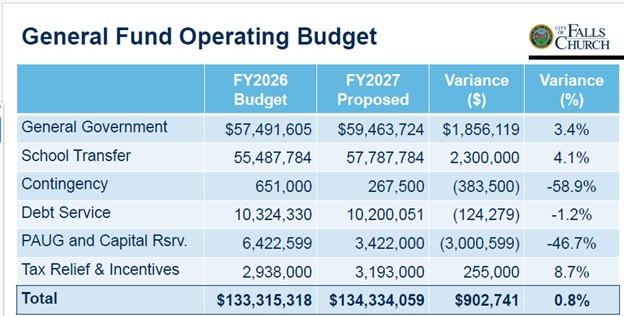
The School Board’s share of the local taxes increased by $2.3 million, 4.1% more than FY2026. The total operating budget including state and federal funding increased 3.15%. This was used to cover higher health insurance costs and the contractually agreed salary increases. A smaller than anticipated increase in enrollment alleviated the need for more teachers. The School Board’s budget does not include debt service for the School bonds or funds for capital projects. These expenses are in the City’s general funds budget.
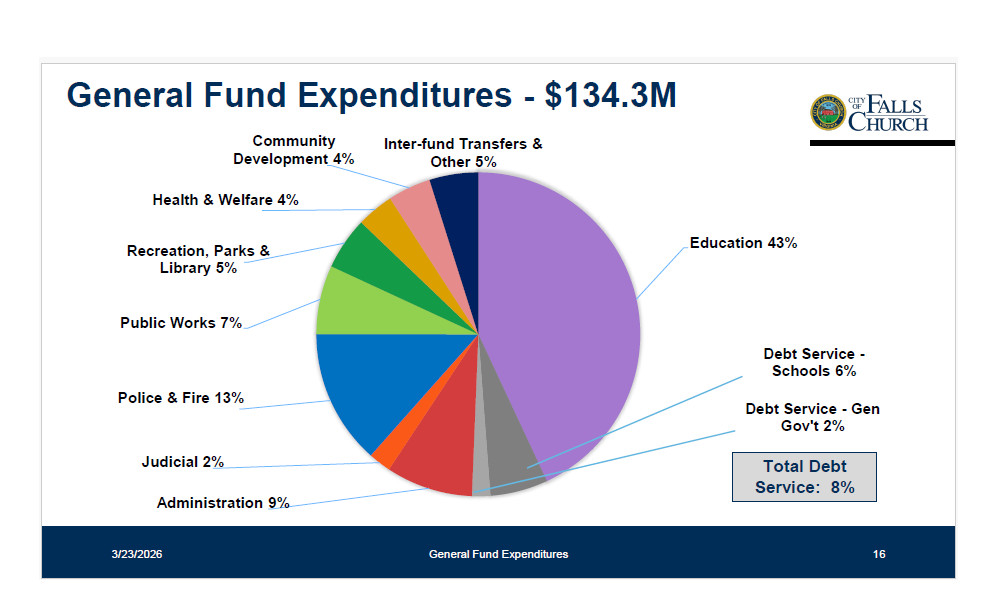
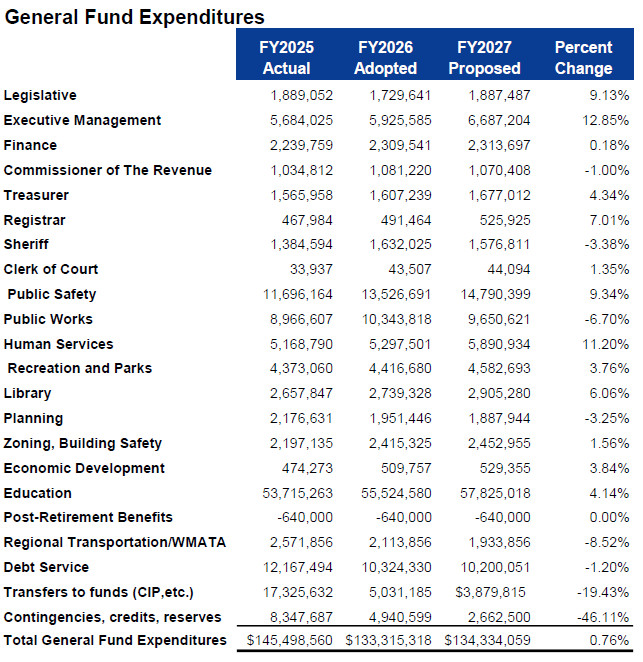
The City’s share of tax revenue increased by $2.5 million and includes revenues not shared with the School Board and covers debt service. The operating budget for the General Government, excluding debt service, fund transfers, and capital expenses, is $59.5 million, an increase of $1.9 million or 3.4%. Below are the summary expenditures for the School Board and the General Government.
Staffing and salary decisions
School Board Chair Kathleen Tysse told Council that “our average salaries are lower than most of the region, and our starting salaries are mid-range at best.” Contractual agreements provide a 2.8% COLA for teachers. Ms. Tysse also said that health insurance premiums came in higher than expected.
City Manager Wyatt Shields proposed a 4% merit increase for General Government staff as an “investment in our workforce.” Following difficulties recruiting and retaining police officers, their salaries will increase 14% for those at the lieutenant rank and below. Our neighboring jurisdictions are also facing similar issues in law enforcement that are attributed to competition from the expansion in the numbers of federal immigration officers.
To alleviate some of these salary increases, Mr. Shields proposes to eliminate seven positions that have not been filled, although he admitted that some of the vacant positions will be contracted out. A chief information security officer will also be contracted to harden the City’s information systems against cyber attacks.
Reduced funds for paving and other City infrastructure and affordable housing
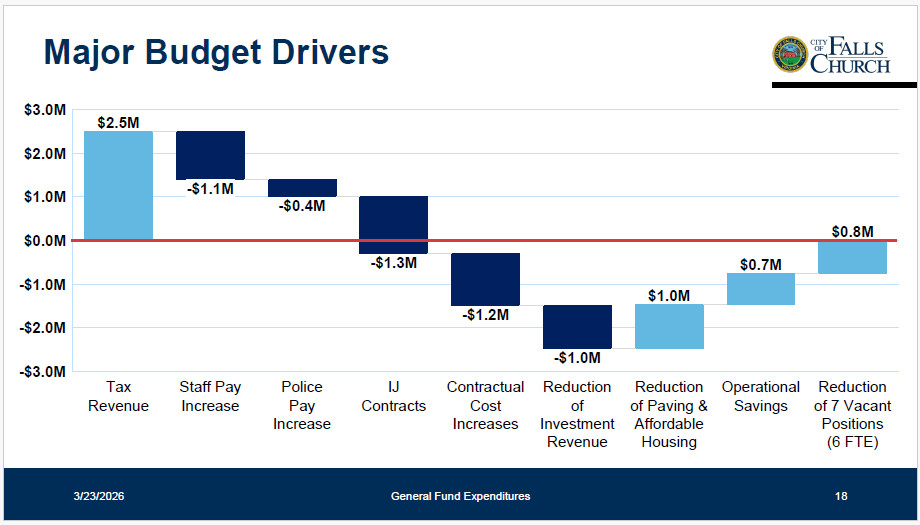
The City augments tax revenues with non-tax revenues such as leases and investment returns to pay for fleet replacement, facilities, and infrastructure maintenance. This budget year, the estimated non-tax revenues are lower. Investment returns are expected to decrease as the City draws down previously allocated funds for capital projects. Investment returns are expected to be less by $1 millionAnd about $200,000 is expected from West Falls.
Hoffman & Associates, the developers of West Falls, recently informed the City that they will not go forward with Phase II of the project, which eliminates $800,000 from FY2027 revenues and a $10 million lease long term. The Phase II lots have been returned to the City as a result.
Consequently, the budget for paving and maintenance of other City infrastructure has been adversely affected. The street maintenance budget of $1.5 million is a $700,000 reduction from FY2026. The City’s current paving cycle is about 30-35 years, far longer than the 5-10 year life of a 2-inch repaving. Even the more expensive roadbase reconstruction has a 20+ year life. Mr. Shields is hopeful that the City will receive a $1 million grant to pave central Routes 7 and 29, which are the City’s responsibility.
The City has previously used some of its investment income to support affordable housing programs; $300,000 alone was provided last year. No such allocation will be made this year, although the City will continue to provide $200,000 from general funds. Mr. Shields said that the City has applied for $1.8 million in federal grants for affordable housing.
Other expenditures
The City contracts with Arlington County and Fairfax County for services that are not provided directly by the City, such as judicial services and fire and emergency services. The cost of these interjurisdictional contracts are increasing by $1.3 million. Last year, they rose $900,000.
Watch Night is back by popular demand. After an outcry from local businesses and City residents over the cancellation of Watch Night, the City has set aside funds for the New Year’s Eve celebration this year. The amount proposed was not given. The waterfall chart below shows how the $2.5 million increased share of revenues for the General Government is proposed to be spent along with the additional savings needed to balance the budget.
A note on end-of-year budget surpluses
At the end of each fiscal year, any budget surplus is used to cover “one-time” expenditures such as paving, fleet replacements, capital expenses. These are typically for items that were left unfunded during the prior budget cycle. Surpluses are usually due to sales and meals taxes, fines and investment returns coming in higher than expected. (Real estate taxes are quite precisely forecasted as they are based on known assessments.) Should FY2026 end with a surplus, City Council may have an opportunity to add funds to street maintenance and affordable housing.
The budget schedule
An up-to-date schedule may be found on the City’s budget webpage. The public is invited to attend the public meetings and submit questions by sending emails to City Council and staff at CityClerk@fallschurchva.gov or Budget@fallschurchva.gov.
The following meetings have been announced:
- Monday April 6, 2026, 7:30 pm Budget Work Session, Dogwood Room
- Monday, April 13, 2026, 7:30 pm, First Reading of Budget, Tax, and Fee Ordinances
- Monday April 20, 2026, 7:30 pm, Budget Work Session, Dogwood Room
- Monday, April 27, 2026, 7:30 pm: Budget Public Hearing, Council Chambers
- Thursday, April 30, 2026, 7:30 pm: Budget Town Hall #2, Council Chambers & Online
- Monday May 4, 2026, 7:30 pm: Budget Work Session
- Monday May 11, 2026, 7:30 pm: Budget Public Hearing and Final Consideration
- July 1, 2026: Fiscal Year 2027 Budget goes into effect
References
- FY2027 Proposed Budget City webpage.
- City Council meeting, March 23, 2026. This official video will not display properly on a small screen as it contains the agenda.
- City Council meeting, March 23, 2026. YouTube video.
- FY 2027 School Board Budget Presentation for CC 3.23.26.
- City Manager’s FY2027 Budget Presentation, March 23, 2026.
- Budget Town Hall #1 – March 26, 2026. Video.
- FY2027 Proposed Budget Document. 361 pages.