Proposal to Redevelop T-Zone Historic Home at 258 N Washington St into Nine Condos
Summary
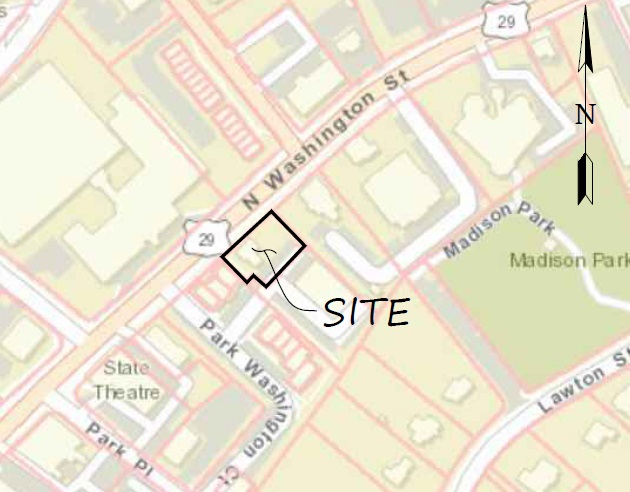
A site plan was submitted on February 23, 2026, for the 9,410 sq ft historic property at 258 N Washington Street. The proposal takes advantage of the revised transition zoning (T-Zone) ordinance that makes it easier to develop denser and taller residential buildings by right.
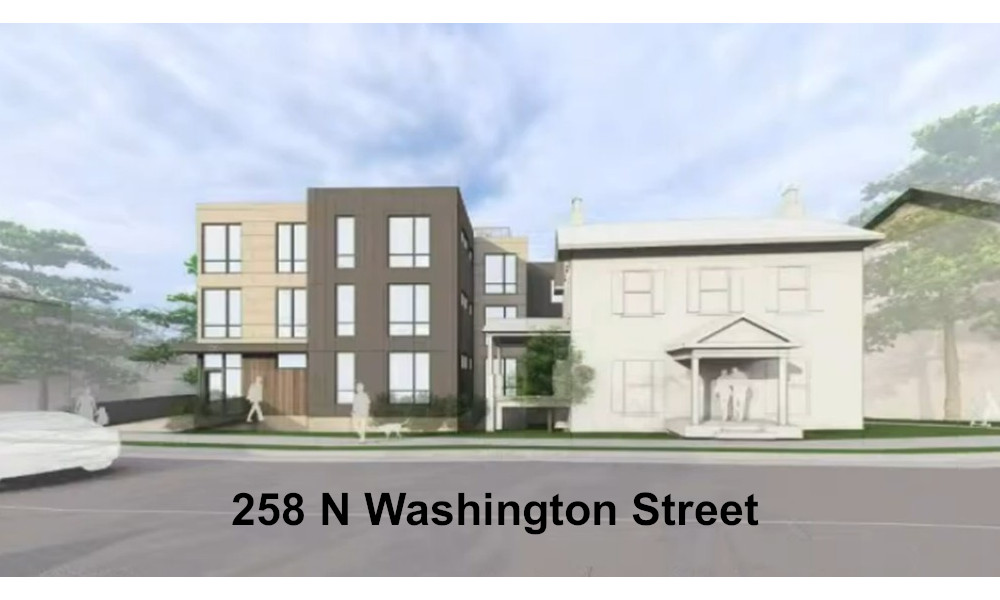
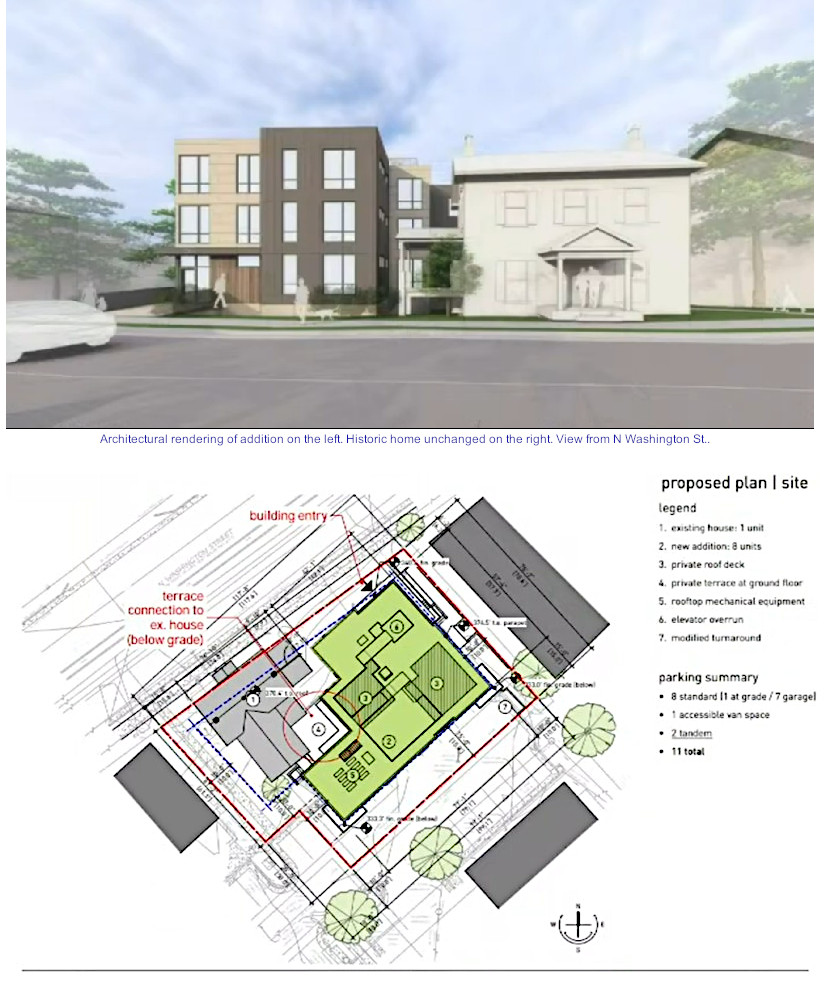
An addition containing eight luxury condominiums with one-to-three bedrooms, is proposed that will connect to the historic home on the lower level but appear as a separate structure along N Washington Street. The historic home will not be altered or restored at this time but will form the ninth condo in this development.
Staff have identified a number of issues with this application that will need to be addressed in the developer’s next submission. These issues include additional analysis on stormwater runoff, sanitary sewer capacity, and fire safety. Staff also indicated that the proposal does not satisfy the goals of the City’s Downtown Small Area Plan on preserving the character of the historic property.
The Historic Architectural Review Board approved the proposal on a vote of 3-1 because it preserves the historic home. The Architectural Advisory Board (AAB) unanimously recommended rejecting the site plan, citing among its reasons “insufficient architectural integration with the historic house” and inconsistency with the Small Area Plan.
The Planning Commission raised many of the same concerns about the design and massing of the addition as the AAB and made additional recommendations to the Planning Director, who has approval authority, that include a review of the parking and vehicle access, landscaping, and EV charging.
Background
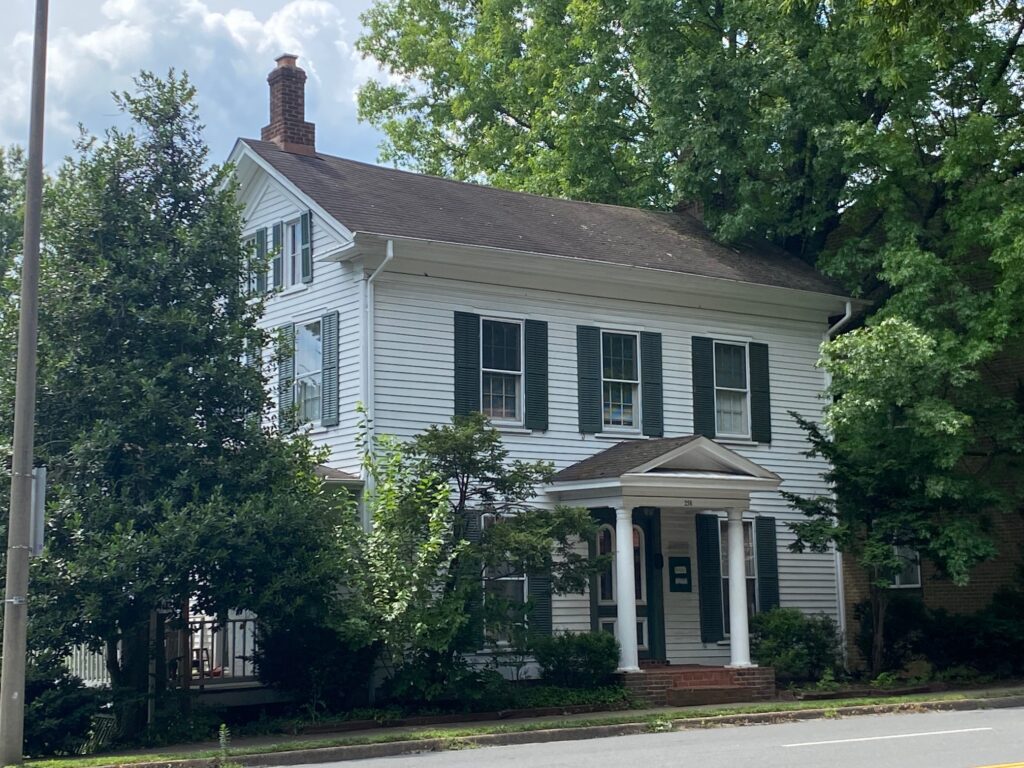
The 2023 revision of the T1 zoning code, also called T-Zone or transition zone, to accommodate the needs of housing developers has sparked a mini housing boom on T1 lots. While the primary targets of the code change were properties along Park Avenue, the City’s Historic Architectural Review Board (HARB) warned when it was being considered that the new code would put four historic properties at risk of being redeveloped. Within a year, the owner of the historic home at 258 N Washington Street, built in 1874, brought a proposal before HARB to redevelop the property to accommodate eight housing units plus the historic home.
The owner returned to HARB on January 29, 2026, with revised plans. With HARB’s approval, a site plan application was submitted to the City on February 23. Under the new site plan process, the Planning Director, as designated agent, is responsible for approving the site plan, with recommendations from the Planning Commission (March 18) and the Architectural Advisory Board (AAB) (March 11). This post summarizes the results of these reviews.
Editor’s note: In a change from past practice, the City no longer makes recent site plan submissions publicly available on its website, saying “The site plans and other related documents are not available for direct download as the documents are not in an ADA-compliant format.” The public is instructed to contact the planner in charge. We were only able to write this post using documents linked to meeting agendas.
The historic home today
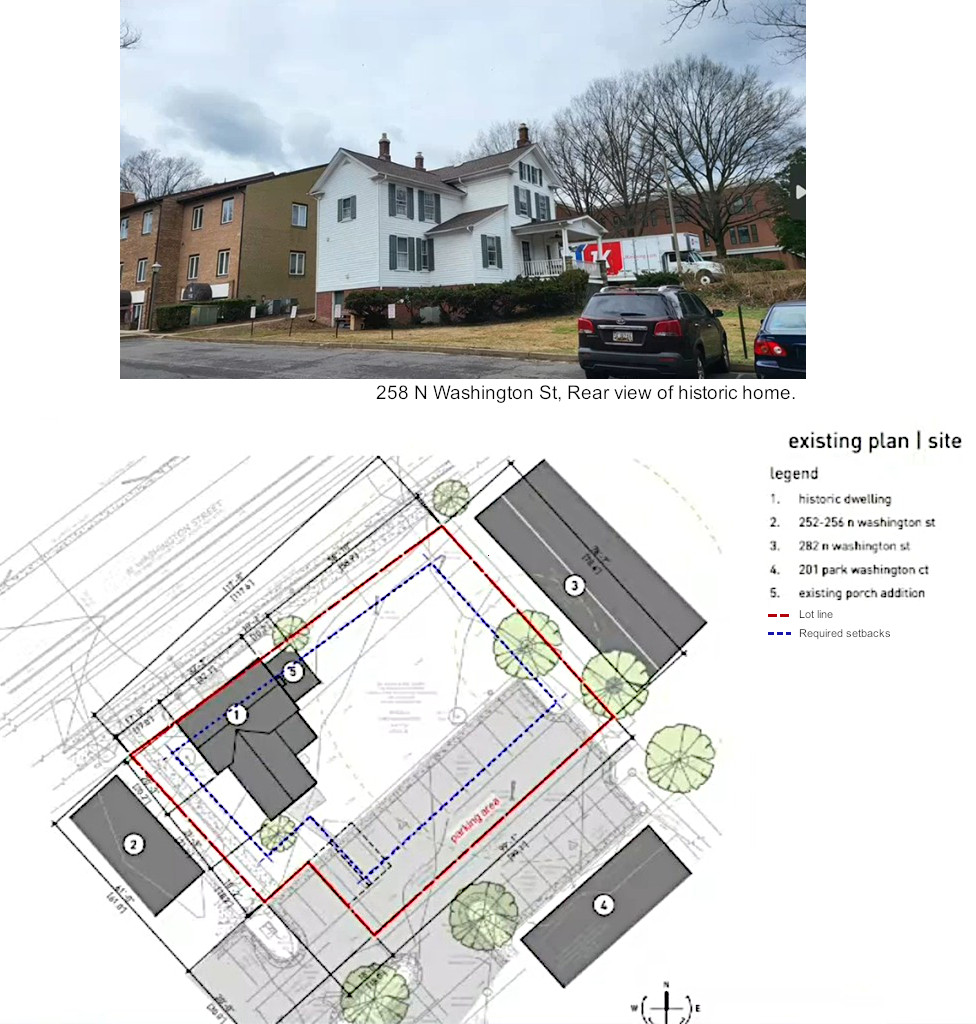
The historic home sits on 0.216 acres (9,410 sq ft). The expansion of N Washington Street over the years brought the road so close to the property that its front porch is less than 10 feet from the curb. Its neighbors to the east and south are also T1 zoned properties while the neighbor to the west is zoned B1 for limited business. The house is currently rented out as a single-family home.
The proposed redevelopment of 258 N Washington
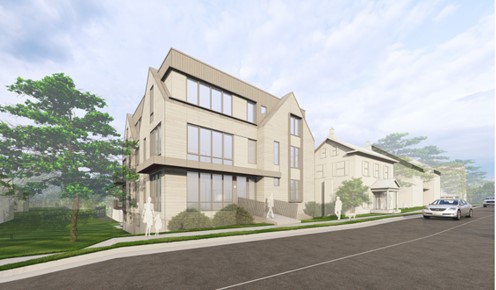
This is a by-right development that does not require any waivers. The site plan shows a three-story building addition that appears separate from the main house above ground. The addition has a parking garage on the lower level that is below ground along N Washington Street but at ground level in the rear due to the slope of the land. This lower level connects to the historic home.
There will be eight condominium units in the addition, and the historic home will form the ninth condo. Under the T-Zone code, the higher density of units on the site requires that there be one affordable dwelling unit (ADU) in the development. The applicant plans to make a one-bedroom unit available at 80% average median income (AMI). Top floor units will have access to the green rooftop.
The units in the new addition are:
- 2 one-bedroom, one-bathroom units, 751 sq ft on the second and third floors.
- 5 two-bedroom, two-bathroom unis, 1,065 – 1,248 sq ft on all three floors.
- 1 three-bedroom, three-bathroom unit, 1,999 sq ft on the ground floor.
The site plan indicates that there are 11 parking spaces, but two are tandem spaces. Excluding the tandem spaces, there are nine parking spaces, the minimum required of one space per residential unit. Access to parking in the lower level garage would be from the rear of the addition through Park Washington Court.
Zoning requirements
The table, taken from the site plan submission, shows how the development satisfies the T-Zone code requirements. The T-Zone ordinance allows the front setback to be measured from the curb, not the lot line. Note that the parking tabulation in the submission is inconsistent with the site plan summary.
| Zoning Tabulation | Permitted by Code | Provided |
| Lot Area | 6,000 SF min. | 9,410 SF or 0.2160 AC |
| Max. Building Height | 45’ 4 stories | 43.1’ 3 stories |
| Min. Yard Requirements | — | — |
| Front | 20’ | 20’ |
| Side | 10’ | 10’ |
| Rear | 15’ | 15’ |
| Impervious Surface | 80% (7,528 SF) | 7,138 SF (75.8%) |
| Building Coverage | 60% (5,646 SF) | 54.4% (5,117 SF) |
| Tree Canopy | 10% (941 SF) | 11.6% (1,093.5 SF) |
| Average Unit Size | 1,500 SF max. | 1,272 SF |
| Density | ||
| Minimum | 14 DU/AC | 40 DU/AC |
| Maximum | 40 DU/AC (bonus) | 40 DU/AC |
| Minimum Unit Size | 700 SF | 1,272 SF |
| Off-Street Parking | 1 per dwelling unit (9 total) | 13 total (1.4 per dwelling unit) |
Staff review
Although there were no zoning issues that require waivers, staff identified a number of issues that need to be addressed in a second submission.
- Senior Planner Jeff Hollern wrote “Project conflicts with the Comprehensive Plan and Downtown Small Area Plan in that it does not match scale or incorporate any architectural features of existing historic structures. ‘Architects must seek to enhance, rather than challenge, the historic nature of the area through building design.’”
- Staff have requested more information on the stormwater runoff and sanitary sewer analyses.
- The Fire Protection Engineer required a sprinkler system to be installed and asked for a review of the exits in what has been designed as a single-staircase building.
- The transportation engineer asked about trash service, delivery, and fire truck access, and whether using a Ford Escape to model access meets code requirements.
Historic Architectural Review Board discussion
In the 2024 proposal for this development, HARB questioned whether the project was an alteration of the historic house or an addition to it. Only an alteration to an historic structure would need approval from HARB. The City zoning administrator ruled that the proposal needed HARB approval as it touches the historic structure in the proposed parking garage.
HARB members pointed out that the new building is almost a distinct project from the restoration of the historic house. The applicant said that the house, including porches, would not be altered or restored until after the completion of the new addition as the required renovations are substantial. Members appreciated the separation of the historic home from the new building in this revision, although some had issues with the size of the new building relative to the historic home.
HARB approved the project by a 3-1 vote focusing only on the preservation of the historic home.
Architectural Advisory Board discussion
The AAB raised concerns that the current proposal conflicts with the Falls Church Downtown Small Area Plan, which emphasizes architectural compatibility with surrounding structures and preserving historic character. Key concerns included:
- The scale and massing of the proposed building behind the historic home.
- Lack of architectural transition between the historic house and the new structure.
- The building’s appearance resembling office or industrial rather than residential architecture.
- The garage façade and roll-up doors, which appeared industrial.
- Minimal architectural detailing and variation.
The AAB unanimously decided that the current proposal was not ready for approval.
Planning Commission discussion
The Planning Commission agreed with many of the concerns raised by the AAB regarding the size and proportions of the proposed addition and compatibility with the Small Area Plan.
Commissioner Brent Krasner noted that this was the first T-Zone project with an historic structure on the lot and recognized that under the new ordinance, the Commission, boards, and staff can only make recommendations and “a developer could choose to completely ignore them and build whatever they want as long as it meets the requirements in the ordinance.”
Commissioner Sharon Friedlander, the sole architect on the Planning Commission, appreciated the “dynamic tension” of the modern design of the addition and the historic structure, but found the addition to be out of scale with the historic home. She suggested the architects look at the massing of the addition, possibly stepping back on the side closest to the historic home and using windows to adjust the proportionality of the two structures. “This particular view makes [the addition] seem very chunky rather than more broken up and delicate and … talking to the historic structure a little bit more,” Ms. Friedlander said.
Mr. Krasner pointed out that some of the parking spaces are tandems and should be indicated as such in the parking tabulation. Ms. Friedlander also asked about the lack of support structures in the underground garage, which made it difficult to visualize accessibility to the parking spaces. There was also concern about signage and accessibility to the property by delivery trucks, Ubers, and visiting vehicles.
Commissioner Phil Duncan asked the applicant to consider designating a two- or three-bedroom unit as the affordable dwelling unit (ADU), instead of the one-bedroom unit proposed, as there is a great need in the City for larger ADUs to accommodate families.
Commissioner Tim Stevens asked that the garage be pre-wired for EV chargers and that the project achieve above-code energy efficiency.
Ms. Friedlander noted that the City Arborist’s review is missing and recommended a review of the proposed trees to ensure their viability. Commissioners asked for a landscaping plan, in particular between the historic home and the new addition.
Planning Commission wants assurance of clarity and consistency in final submission documents
Ms. Friedlander asked staff to ensure that the complete site plan submission has no inconsistencies when it receives final approval. She indicated that in this submission, the site plan and the proportions in the renderings are inconsistent with each other. She noted that in the past, discrepancies within sets of submitted documents have led to differences between the developers and the City as to what was approved, often after a project is completed.
Ms. Friedlander said that the Planning Commission has ignored inconsistencies in previous project documents, thinking “the applicant really didn’t mean it…Then we see after the applicant moves in that there are actually curb cuts still there, and it was because [they were] on the original document, and it never got cleaned up. [Those issues] then became part of the intent of what was approved.” She continued, “I want to be clear about what the designated agent is approving.”
What happens next
On April 2nd, the site plan was disapproved because the applicant did not address the City’s review comments by the March 23 deadline under the new site plan review requirements. A resubmission could be given to the City in the next several months once the applicant responds to the comments received from the City, the AAB, the HARB, and the Planning Commission.
The second review schedule may not allow for another AAB or Planning Commission review. The City has 30 days to respond to either approve or disapprove a second submission and cannot introduce any new issues in the process.
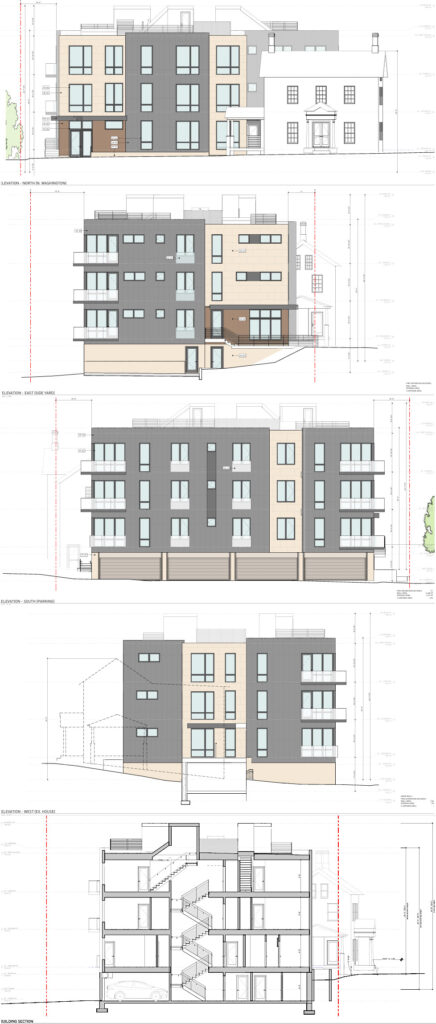
Architectural drawings – building elevations and cross-section
Reference
- Planning Commission meeting, March 18, 2026. YouTube video.
- Historic Architectural Review Board meeting, January 29, 2026. Official City video will not display properly on a small screen because it contains the agenda.
- Architectural Advisory Board meeting, March 11, 2026. Official City video will not display properly on a small screen because it contains the agenda.
- 2026-02-03_Initial Submittal_258 N Washington Street. Site plan.
- Site Plan Architectural Sheets.
- 258 N Wash DRC Comment Letter Sub 1 3.11.26.
- ALL COMMENTS DRC Comment Response Table. Staff review of site plan submission.