Virginia Village Zoning, RFP Evaluation, Tenant Relocation Readied for Council Votes
Summary
- The City Council plans to put an abbreviated special exception (SE) rather than a by-right process in place to govern redevelopment of Virginia Village properties beginning July 1, 2027. Staff urged that any accepted proposals in response to the Virginia Village Affordable Housing Opportunity Request for Proposals (RFP) for the redevelopment of the site currently with prospective developers would proceed by right.
- City Manager Wyatt Shields asked the Council to formally approve the Evaluation Committee that will be privy to all RFP proposal details and will recommend a development approach and partner to the legislative body for its final approval. Under purchasing rules triggered by the RFP process, meetings of the committee and the Council regarding the proposals will take place behind closed doors. Only executive summaries of the proposals received will be available to the public.
- The City’s housing staff presented a tenant relocation policy to the Council that they hope will apply throughout Falls Church as well as to Virginia Village. Council members expressed concern that some Virginia Village tenants who will have to move due to redevelopment of the City-owned properties may not be able to return to the neighborhood if their incomes exceed qualifying amounts to live in new affordable units constructed on the site.
A special exception process, an evaluation committee, and a tenant relocation policy
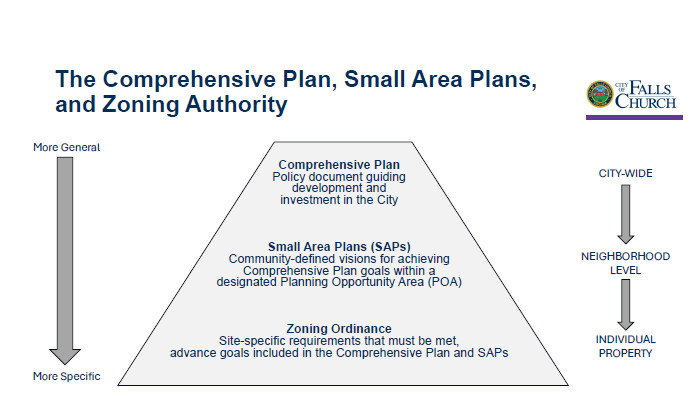
The City Council met in a work session on July 20, 2026, to discuss proposed revisions to zoning amendments designed to govern redevelopment of 1940s-era Virginia Village affordable housing. Last month, the Council asked the planning staff to develop a special exception (SE) review process as an alternative to by-right development of the neighborhood. [See the Pulse post Council Moves Virginia Village Redevelopment Forward, Issues RFP, June 24, 2026.] The Council is scheduled to vote a new first reading of the zoning amendments at its July 27 action meeting.
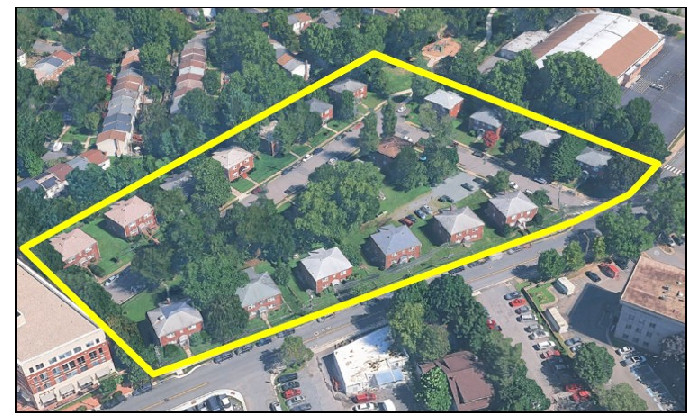
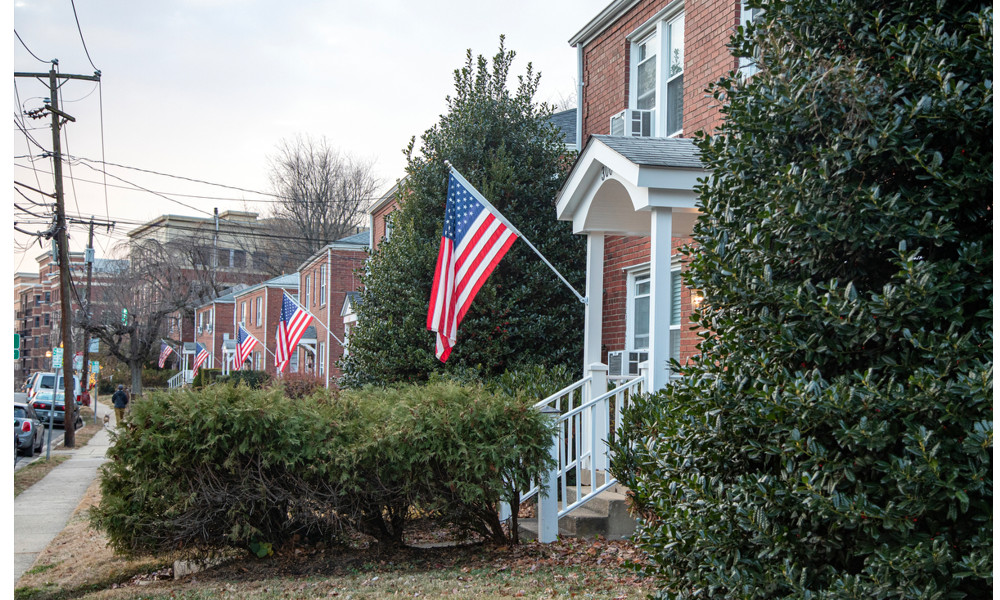
In addition, the legislative body discussed the evaluation committee that will be formed to review submissions in response to a request for proposals (RFP) to redevelop the nine City-owned Virginia Village quadplexes out of the total of 20 properties. The committee will make recommendations to the Council for its final decision on a development concept and partner by early September.
The Council also received a presentation on the City’s tenant relocation policy, which will apply not only to residents of Virginia Village, but also to tenants living throughout Falls Church who are temporarily or permanently displaced due to the demolition, rehabilitation, or sale of their building or as a result of termination of subsidies or set asides.
Revisions to zoning text amendments
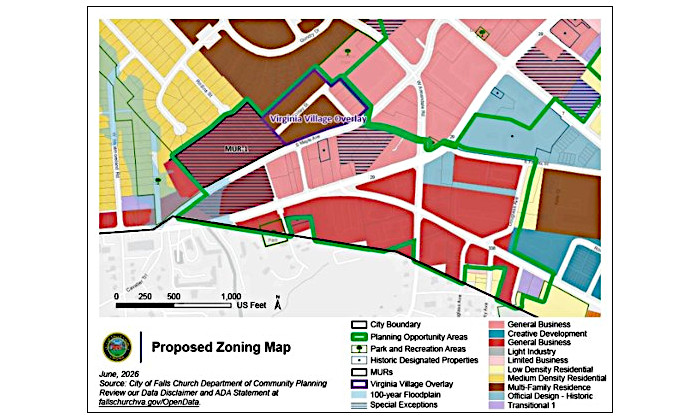
Following a closed session on July 13, 2026, to consult with the City Attorney, the City Council requested the development of a limited SE process that would be required for all applications that seek to leverage the Virginia Village Overlay District, beginning July 1, 2027. Until July 1 next year, all development in the overlay district would be by right. The SE process, which was outlined during the July 20 work session and is scheduled to be approved by Council in a new first reading of the zoning ordinance on July 27, 2026, would require that the Council review and approve any such proposals within 60 days.
The proposed SE process specifies review of the following criteria: affordable housing or open space, building design, Streetscape Design Standards compliance, and mitigation of impacts on surrounding properties in such areas as traffic, lighting, and parking. The staff said they recommended “a narrow review scope” and the 60-day timeline to reflect what will likely be smaller developments than the SE projects the City typically considers.
The staff also recommended retaining the by-right review option to accommodate the existing RFP review process, asserting that “the RFP offers additional guardrails with opportunities for broader discussions” and so does not require the control Council seeks over the development of the remaining 11 privately owned Virginia Village properties.
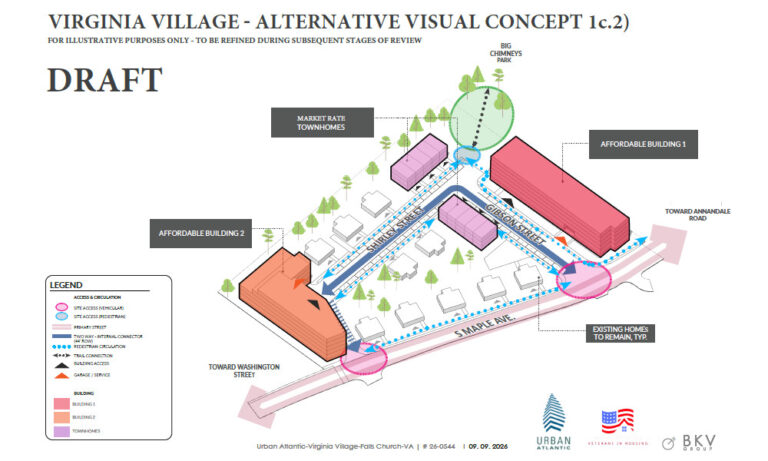
The revised zoning amendments also make changes to building height and screening and setback requirements. The changes would have the proposed overlay district drop the 40-foot building height maximum within 150 feet of Gundry Drive properties, specifying only that renovated or new buildings be no more than 4 stories. “40 feet is not equivalent to 4 stories, and therefore staff updated two references to more clearly express [the] intent of this guidance,” the staff report said. Further, “the maximum building height now reflects the height map,” which shows 4 stories, and the height of the upper floor, 10-foot step-back is now reduced to the 3-story threshold.
The staff also added evergreen requirements to the vegetation screening between Virginia Village redevelopment and existing single-family homes in Winter Hill to ensure year-round coverage and specified two permissible fence options – either masonry wall or wood.
In an effort to make Big Chimneys Park a more central feature of the neighborhood, a minimum of four evergreen trees has been included to buffering and screening requirements between the abutting Virginia Village and Winter Hill residential districts.
The revised draft zoning amendments also require a minimum 60% public open space contribution as an alternative to affordable housing to qualify for the overlay district. Previously, this requirement was 50%.
Lastly, the latest zoning amendments add “neighborhood serving retail as accessory uses to principal residential uses” to the list of complementary uses permitted on the Virginia Village site.
Standing up the Evaluation Committee
During the work session, City Manager Wyatt Shields asked the City Council to approve at its July 27 meeting a resolution establishing a Virginia Village Proposal Evaluation Committee to review the proposals generated by the RFP and make recommendations to Council for its final approval of the redevelopment concept and partner.
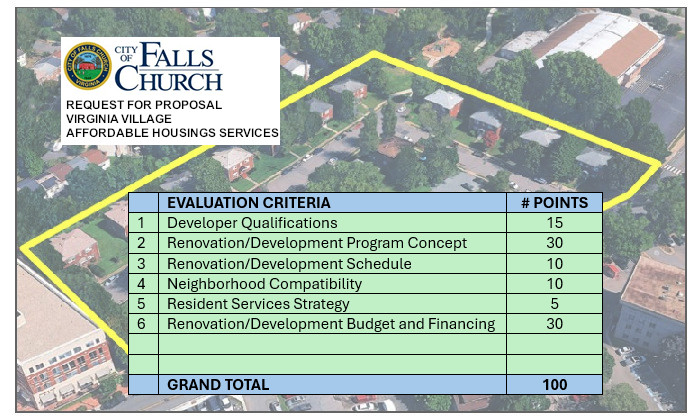
According to the draft resolution, the committee will review the proposals using the evaluation criteria established in the RFP, consider the relative strengths and limitations of each response, and develop a recommended ranking. The City’s Commercial Real Estate Advisor, Jones Lang LaSalle, will assist the committee in its work.
The committee will present its evaluation and ranking of the proposals to the City Council on September 8, 2026. Its work will be advisory. The City Council retains final authority to determine the ranking of proposals and to select the top-ranked respondent. The Council could elect not to choose any of the proposals.
The seven-member committee will include representatives from the City Council, the Planning Commission, the Economic Development Authority (EDA), the Housing Commission, and three members of City staff chosen by Mr. Shields. Thus far, comments made during public meetings indicate that Council Member Marybeth Connelly will serve as the Council representative, Planning Commissioner Phil Duncan will represent that body, and Authority Vice Chair Jim Coyle will be the Evaluation Committee’s EDA member. Mr. Shields said on July 20 that he has yet to finalize the staff members on the committee.
Staff and other Council members were not receptive to Council Member David Snyder’s suggestion that representatives from affected neighborhoods, such as Virginia Village and Winter Hill, be included on the Evaluation Committee.
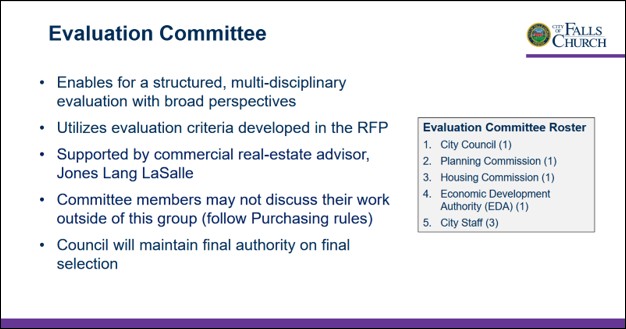
July 20, 2026
The committee is being created for the limited purpose of completing this proposal evaluation, Mr. Shields said. It will sunset when the Council selects a respondent to the RFP.
At that point, the City Manager or the Manager’s designee will negotiate an interim public-private agreement with the developer. Lasting a few months, the interim agreement will address the terms and conditions necessary to guide the early phases of design, site due diligence, and project financial feasibility and will be presented to the City Council for its review and ultimate approval, said Planning Director Matt Mattauszek. He added that pre-development costs are typically borne by the developer.
A long-term comprehensive agreement lasting several years would then authorize actual construction of an approved project as well as its operation, long-term maintenance, and financing. This agreement would lock in the project budget, cost-sharing, and deliverables. Mr. Mattauszek said the comprehensive agreement would not be put in place until the site plan for the project is approved.
The planning staff presented the following schedule from July 2026 through March 2027 when applications for federal Low-Income Housing Tax Credits (LITEC) are due. The schedule includes the parallel planning/zoning milestones and the RFP/agreement milestones.
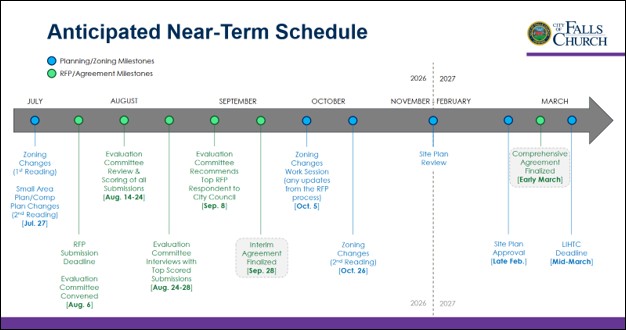
July 20, 2026
Tenant relocation policy
Also covered during the July 20 work session was the City housing staff’s proposed tenant relocation policy. While not exclusively a Virginia Village item on the agenda, this policy would govern the relocation of current residents of City-owned properties on the site before, during, and after any redevelopment.
Housing Specialist Kayleen Mark presented the staff report, which asks Council to adopt the “City of Falls Church Residential Tenant Relocation Policy,” updated in July 2026, “to establish a standardized framework for assisting residential tenants in the City of Falls Church who are temporarily or permanently displaced as a result of demolition, rehabilitation, termination of subsidy or set-asides, or sale requiring an empty building.”
The City has had a voluntary tenant relocation policy in place since 2013, but it was never formally adopted by the City Council. The policy then and as revised now follows federal and state relocation policies, according to Ms. Mark. “The staff wants one adopted policy for the entire City,” she said.
Section II of the policy titled “Applicability” defines when compliance with the Tenant Relocation Policy is required. This policy “applies to projects where the owner has accepted City or EDA funding, where the owner has committed Affordable Dwelling Units as part of a legislative land use approval, or where the owner has committed to comply with this policy by contract, voluntary concession, or proffer,” the staff report said.
The key components of the policy, which is “designed to minimize displacement impacts, promote housing stability and ensure transparency throughout a relocation process,” are as follows:
- Tenant Survey—summarizes information received on all households.
- Tenant Notification Requirements—establishes timelines for providing advance written notice to residents prior to displacement.
- Relocation Assistance Plan—includes relocation benefits such as moving cost assistance and rental assistance for replacement housing and measures to be taken to retain existing tenants.
- Right to Return—gives priority for tenants that are displaced to have the opportunity to return to a renovated or redeveloped property, based on established program eligibility requirements.
- Uniform Relocation Act (URA)—a federal law administered by the U.S. Department of Housing and Urban Development (HUD), which is referred to in the City’s policy as a framework for determining the amount of relocation monetary assistance, including eligible expenses for displaced households.
Council Members Connelly and Erin Flynn and Vice Mayor Laura Downs expressed concern that some Virginia Village residents who are displaced due to redevelopment might not be able to return to renovated or new buildings because their income would then be too high to meet the City’s area median income (AMI) requirements for the site. They asked if these residents might be grandfathered into the redeveloped site in some way.
Both Ms. Mark and Director of Housing and Human Services Dana Jones stressed the importance of adhering to the City’s affordable housing policies. “We have over 300 people on the waiting list,” Ms. Jones noted, clarifying earlier higher references to the number of people in the City who are seeking affordable dwelling units (ADUs).
She and Ms. Mark said income will not be the only criterion for qualifying for affordable housing in Virginia Village, citing lease and occupancy requirements that tenants must follow and that aren’t always being met at Virginia Village today. At the same time, “we will work with people to determine what their best options are,” if they are not able to return to Virginia Village, Ms. Mark said.
Council Member Flynn recommended that the staff consider the priority return frameworks of such nearby jurisdictions as Arlington and Fairfax. She further urged additional notices to Virginia Village tenants to ensure they are kept up to date on what is happening at the site, a minimum of weekly listings of available units within a defined radius of the City, and a smaller radius of no more than 5 miles rather than the 10 miles proposed in the draft policy. Ms. Flynn thought that even 5 miles might be too far from where displaced tenants have relationships and support systems, such as medical care.
Based on Council member recommendations, City Manager Shields said he would delay asking Council to approve the tenant relocation policy from July 27 to sometime in August.
References
- City Council Work Session, July 20, 2026. This official video will not display properly on a small screen as it includes the agenda. The discussion of the tenant relocation policy followed by Virginia Village items begins at about timestamp 2:30:00 and ends with the meeting at about timestamp 4:40:00.
- City Council Work Session, July 20, 2026. YouTube video.
- Virginia Village Zoning Text Amendments Staff Report, July 20, 2026.
- Virginia Village Presentation July 20 CC Work Session.
- Resolution to Create a Virginia Village Proposal Evaluation Committee, July 20, 2026.
- Staff Report Residential Tenant Relocation Policy, July 20, 2026.
- Tenant Relocation Policy posted 7.14.26.
- Uniform Relocation Assistance 2021 Payment Schedule.