Proposed Bike Lanes on East Broad Street Study Gets Mixed Reviews from the Planning Commission
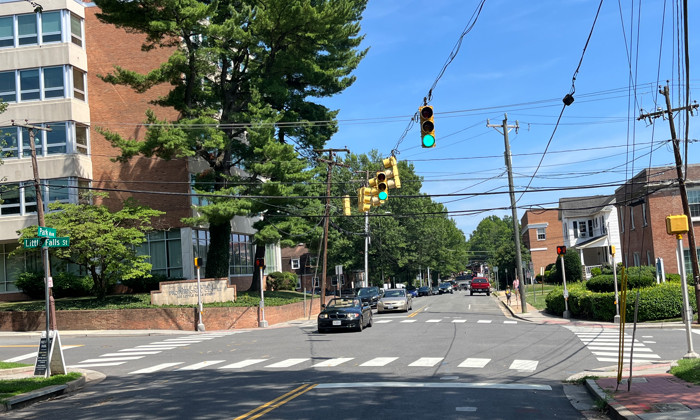
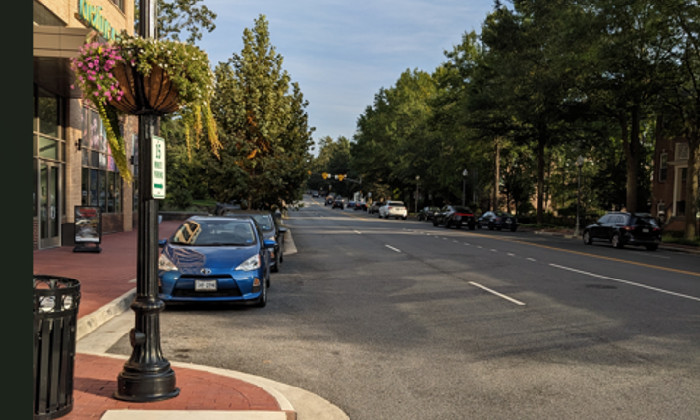
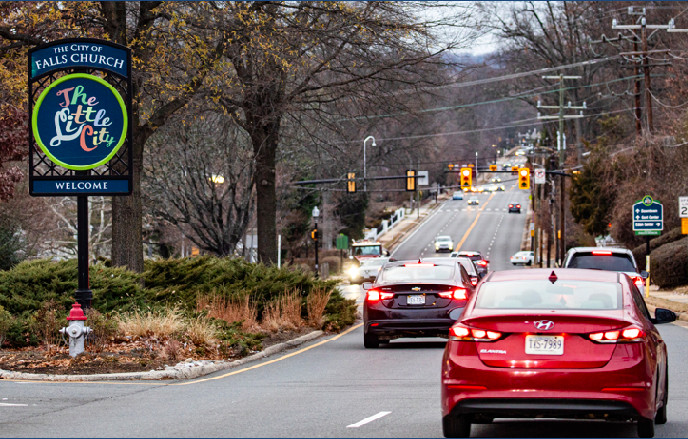
Photo: E Broad Street near N Washington St.
Summary
On September 16, 2026, the Planning Commission discussed a Virginia State consultant’s study on potential options for bike lanes on East Broad Street between Washington and South Roosevelt Streets, a stretch of 0.8 miles. The City of Falls Church requested the study, which was published by the state in July.
The East Broad Street Multimodal Improvement Study focuses on enhancing movement for multiple modes: vehicles, bicycles, walking, and public transport. Its primary emphasis is on enabling bicycles to move safely along the corridor through the creation of separate bicycle lanes, while reducing the number of lanes for vehicles from four to two, with a center turning lane.
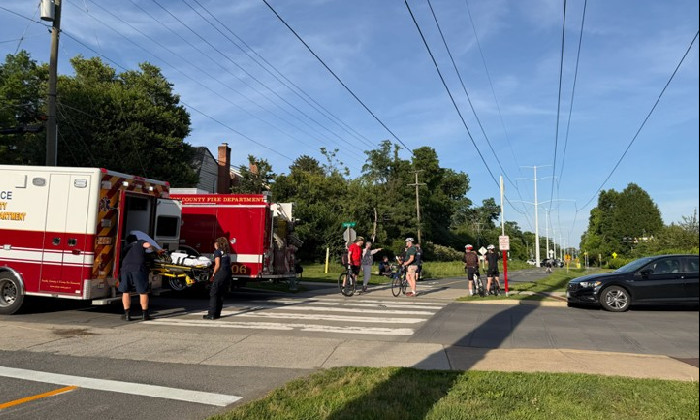
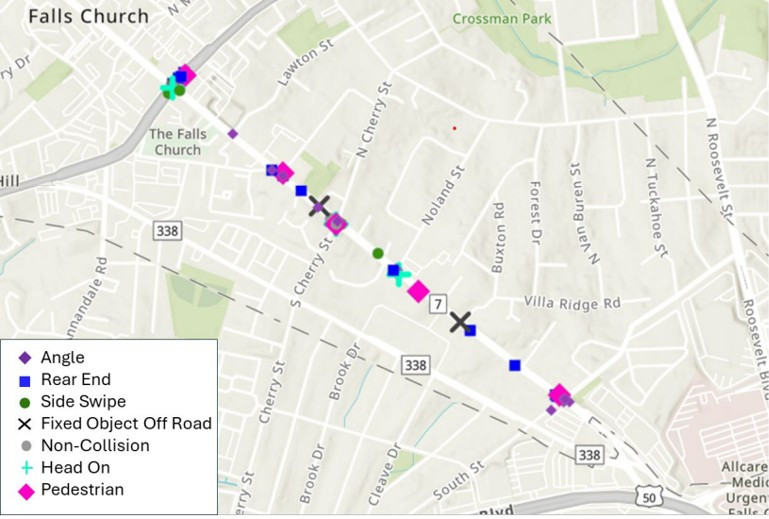
As a Statewide Top 1% Segment, the study indicated that additional bicycle and pedestrian safety measures are warranted in this corridor. On average, there have been 10-11 crashes per year in this portion of East Broad Street since 2020, primarily at the Washington, Cherry, and South Roosevelt intersections.
Four options were proposed:
- A shared use path for bikes and pedestrians on both sides of the street
- A dedicated cycle track for bikes going in both directions
- Bike lanes on either side of the street
- A raised median
Two Planning Commissioners—Chair Andrea Caumont and Tim Stevens—favored a letter to Council supporting option #3 in the near term and #1 over the longer term, emphasizing the goal of getting people out of cars and easing the bike connection to the Eden Center.
Commissioners Robert Kravinsky and Daniel Polinsky didn’t see any value in adding bike lanes on East Broad, which would reconfigure the road to one car lane in each direction. They preferred the existing bike lanes on Hillwood for getting to Seven Corners or the Eden Center.
Bike Falls Church sent in a letter indicating its preference for protected bike lanes, suggesting starting with option #3 as soon as possible and moving to option #4 over time.
Background
The recent Planning Commission discussion on the options for bicycle lanes on East Broad Street, as proposed in the recent study, comes in advance of any public engagement or priority-setting by City Council. The introduction of bike lanes on East Broad would be the first such use on any portion of the two primary corridors through the City, Broad and Washington Streets.
There is currently no proposal for bike lanes on West Broad Street, where the present focus is on widening the sidewalks from 4-5 feet to 10 feet, upgrading intersections between Virginia Avenue and West Street, and installing a new Hawk signal. Securing the temporary and permanent easements for this work has taken several years.
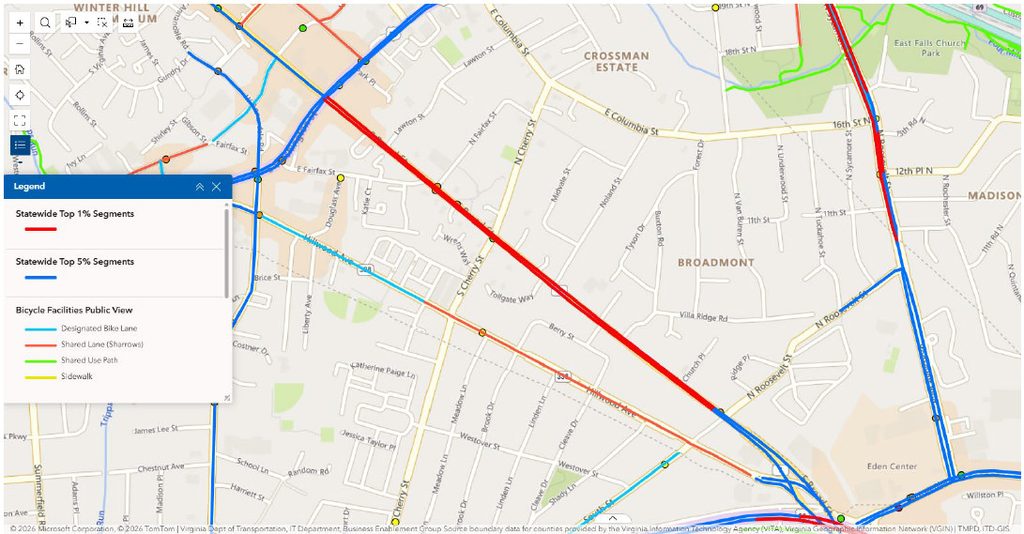
The Northern Virginia Transportation Authority (NVTA) has focused on West Broad Street, the Washington Street Corridor, and the East End for multimodal improvements for both pedestrians and bicyclists. The Virginia Department of Transportation’s (VDOT’s) Pedestrian and Bike Safety Action Plan 5.0 characterizes road segments according to pedestrian and bicycle crashes that occurred between 2020 and 2024, and other factors.
The roadway segments are grouped into two categories:
- Statewide Priority – Top 1%, shown in red, which represent the segments that score in the top 1% of all scored, public nonfreeway roadways in the state.
- Statewide Priority – Top 5%, shown in blue, which represent the segments that score in the top 5% of all scored, public nonfreeway roadways in the state.
Broad Street is a Statewide Top 1% Segment, indicating that additional bicycle and pedestrian safety measures are warranted.
The East Broad Street Multimodal Improvements Study
To support the NVTA vision, the City has sought to evaluate the existing right-of-way along East Broad Street and to identify opportunities to accommodate additional travel modes. EPR, PC prepared this report to “evaluate existing traffic operations, safety, and land use conditions, and to develop recommendations for incorporating multimodal improvements within the study corridor.”
Virginia’s Office of Intermodal Planning and Investment, through its Growth and Accessibility Planning Technical Assistance Program (GAP-TA) published the requested “Falls Church, East Broad Street Multimodal Improvement Alternatives Report” in July 2026. Consultant services were provided by a team from EPR with assistance from Community Planning and Economic Development Service staff from the Falls Church City government.
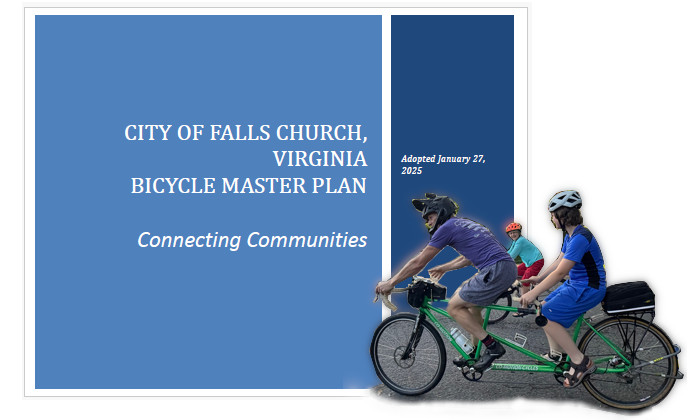
Summary information on the City’s Master Bicycle Plan, which forms a general framework for future bicycle trails within the City, can be found at the Pulse post Elements of the Falls Church 2025 Master Bicycle Plan. The plan, which was approved by City Council on January 27, 2025, requires careful consultation with affected neighborhoods prior to any Council decisions.
The current situation
East Broad Street is primarily bordered by single-family residences and 4–5-foot sidewalks, with significant development and 8–12-foot sidewalks at the Washington Street end, and additional development just beyond Roosevelt Street.
There are traffic signals at Washington, Cherry, and Roosevelt Streets with pedestrian crosswalks. Hawk signals for pedestrian crossing have been installed at both East Fairfax and Buxton Streets. Eight intersections with smaller streets line both sides of East Broad Street. There are churches and a park, and access to multifamily and residential townhouse developments along the corridor.
The street width is 85 feet at the Washington Street end and 62 feet for the rest of its length. Four travel lanes extend from one end of the corridor to the other, although there are parking cutouts and a turning lane near Washington Street.
Between May 2020 and April 2025, 56 crashes occurred along this portion of Broad, including five involving pedestrians, three of which caused severe injuries.
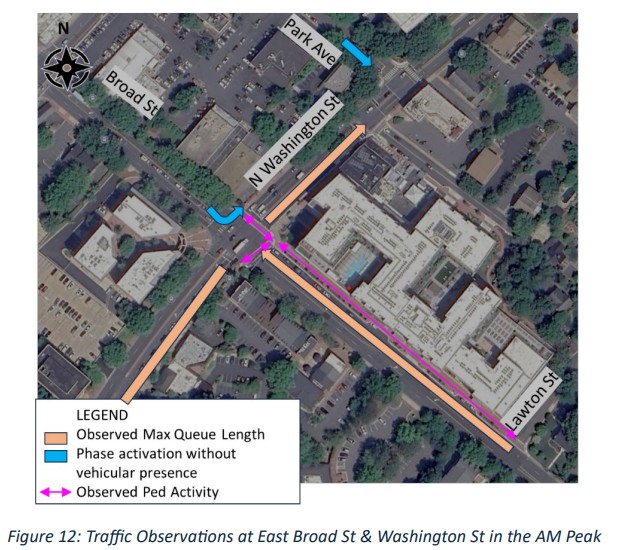
Travel time averaged 2-2.5 minutes eastbound and 3.3 minutes westbound during rush hour, due to delays at the Washington Street intersection, with average speeds of 20-28 miles per hour and heavier use of the outside lanes (de facto three-lane operation).
Queues at the Washington Street intersection tend to be extensive in rush hour. Future traffic delays are projected to increase nominally, with worse impacts at the Tollgate, Noland, and Berry intersections.
Bicyclists currently use Cherry Street primarily.
Proposal options to reduce East Broad St to single lanes
The multimodal study proposes reducing the vehicle traffic lanes from four to two in all options for the roadway between Roosevelt and Lawton Street. Its options are as follows:
- Shared Use Path: with 12–14-foot sidewalks, including trees, on either side for use by both bicycles and pedestrians.
- Dedicated Cycle Track: with 7–8-foot sidewalks on both sides and a 12-foot protected lane for bicycles going in both directions.
- Bike Lanes: separate bike lanes on each side of the street and 7–8-foot sidewalks.
- Raised Median: a 6-foot wide median, 7–8-foot sidewalks, and a protected 5-7- foot bike lane on one side.
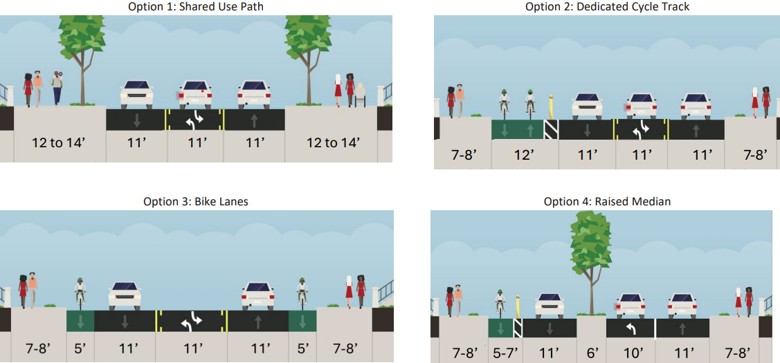
City staff advised dropping options 2 and 4 as requiring difficult and lengthy negotiations on right-of-way use and utility issues. The report didn’t offer any further discussion of the options or their relative benefits or shortcomings, or any information on the potential costs.
Planning Commission discussion
City staff indicated that these were just ideas at this point and said that Council is not looking seriously at doing any of them.
Commissioner Tim Stevens noted that he had requested a discussion of the report by the Planning Commission, indicating we would have to have cost estimates before getting into details. He recognized that the downside of Option 3 is that the bike path would still be next to cars.
To address this, Bike Falls Church had proposed installing pollards for more safety for bicyclists. The goal would be to get people out of cars by using other modes of transportation. Bicycle lanes on East Broad could provide an alternative means of getting to the Eden Center.
Chair Caumont suggested that Option 3 could be a good bridge for near term action, moving toward Option 1 over time. She underscored that it would benefit the East Broad residential area. There are no buses currently serving this area, and East Broad is a good candidate for bike lanes. In short, she said we “can’t wait” and urged having the Planning Commission send a letter indicating its support for Option 3.
Commissioner Kravinsky expressed a number of concerns about the proposals, especially that they would offer bike lanes “to nowhere.”
He suggested the need for more information on the proposed Ring Road around Seven Corners first, which is not currently bike friendly.
He couldn’t see a commuting benefit for the proposals. They would basically merge two lanes to one at both Washington Street and Seven Corners.
He pointed out that Alexandria is the only location on Route 7, which includes Broad Street, for single lanes in both directions. Moreover, there are already bike lanes on Hillwood or shared travel on East Columbia to get to Seven Corners and the Eden Center. School bus, Uber, and FedEx stops would disrupt traffic if there is only one travel lane available.
Commissioner Polinsky shared his view that bicyclists can use the Hillwood bike lanes to get to the gym at Seven Corners.
Writing for Bike/Walk/Roll Falls Church, Andrew Olesen contended that introducing a “road diet” on E Broad would not have a material impact on traffic, would reduce speeding and unsafe driving, and would slow traffic turns at crosswalks while substantially reducing crashes. A center lane would reduce stress for drivers trying to make a turn. He urged that Option 3 be adopted quickly, suggesting providing additional safety for bikers through flexible pollards and concrete bars rather than just a painted buffer. Over time, funding could be sought for Option 4, he said.
References
- Planning Commission Meeting, September 16, 2026. This official video will not display properly on a small screen as it includes the agenda.
- Letter to the Planning Commission from Andrew Olesen for Bike/Walk/Roll Falls Church.
- Falls Church East Broad Street Multimodal Improvements, prepared for the City of Falls Church, July 2026.
- City of Falls Church, Virginia, Bicycle Master Plan, adopted January 27, 2025.
- City Council Work Session, September 22, 2026. This official video will not display properly on a small screen as it includes the agenda.