The Fiscal Impacts of the City’s Mixed-Use Development Projects Have Yet to Meet Expectations
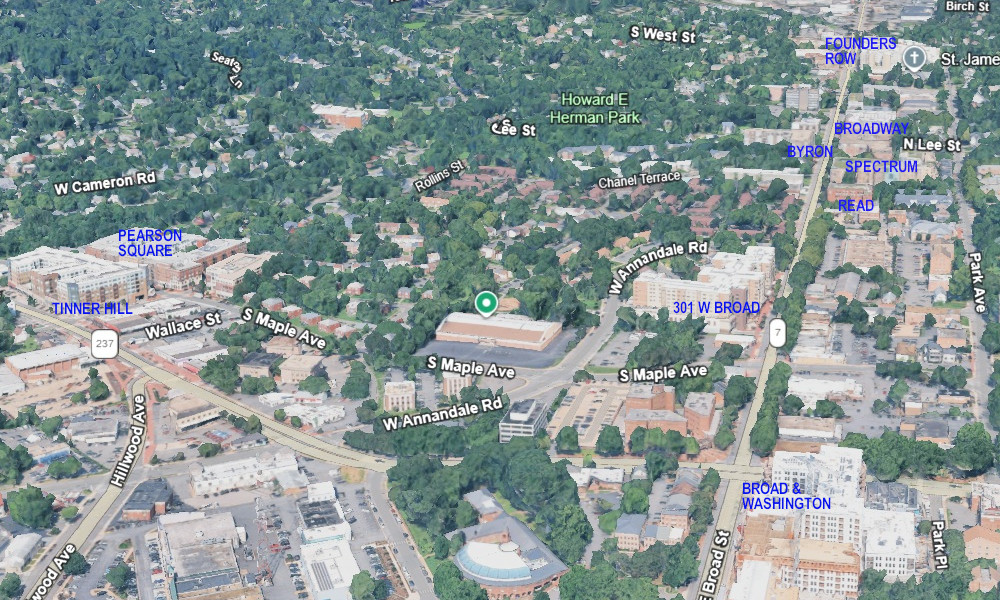
Photo: Google Earth image of Falls Church City.
Summary
Twenty-five years after Falls Church City moved to permit residential over commercial development projects, the fiscal impacts from the first 10 mixed-use developments have now been released.
- Real estate values for these projects have increased from $568 to $873 million between Calendar Year (CY) 2020 and 2024.
- Gross tax revenues have expanded from $10.8 to $15.7 million over this period.
- However, at $4.5 million, net fiscal benefits for the City, have so far fallen far short of original estimates especially if inflation is taken into account. This picture should change, though, as recent projects mature and new ones come on stream.
Delays in opening major lynchpin commercial entities and the loss of several businesses over time have all played a role. Efforts to help sustain our small businesses and avoid excessive competition may be needed in the future.
Despite deep concern over the fiscal cost of students that might be generated – and numbers that far exceeded expectations at Pearson Square – City adjustments in their negotiations with developers have helped keep the totals close to the low end of original projections.
Still, it is clear that the off-repeated promise of mixed-use development proponents that “growth will pay for growth” hasn’t materialized. Instead, the City’s infrastructure costs continue to be borne chiefly by single-family homeowners. Real-estate taxes and investments in the sewer system provide primary examples.
Background
It has been a quarter century since City Council adopted a “Special Exception” process within the City Code to enhance prospects for development of the City’s commercial corridors. The new approach permitting residential uses over first-floor commercial in the business districts has resulted in the completion of 10 mixed-use projects through 2024, with three more either approved and underway or pending construction.
The original objectives are cited in the City’s Code of Ordinances, Section 48-90:
“to allow for the consideration of all opportunities to revitalize the office, retail, hotel, and other commercial areas of the City. Residential uses will be considered if they contribute significant positive net revenue benefits to the City and create a vibrant, walkable, environmentally sustainable and inclusive community.”
Primary criteria were subsequently amended to require “significant new or renovated commercial space,” as “net new” became problematic for some projects.
How well have the projects met these objectives?
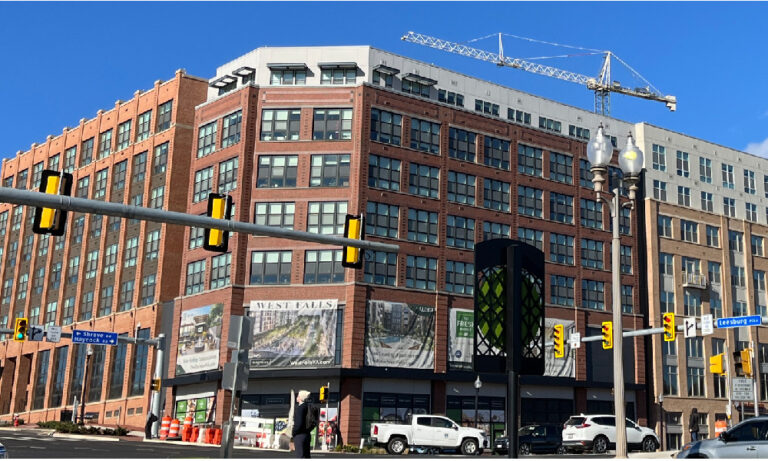
Certainly, the face of the City has changed, with the elimination of numerous parking lots and vacant buildings, and the rejuvenation of commercial lots along the major corridors, including lots of new restaurants, several new grocery stores, and additional retail storefronts on the first floor of multiple-story condo and apartment buildings. The City is more vibrant and walkable. And affordable dwelling or workforce units have been included in all of the projects, expanding inclusivity.
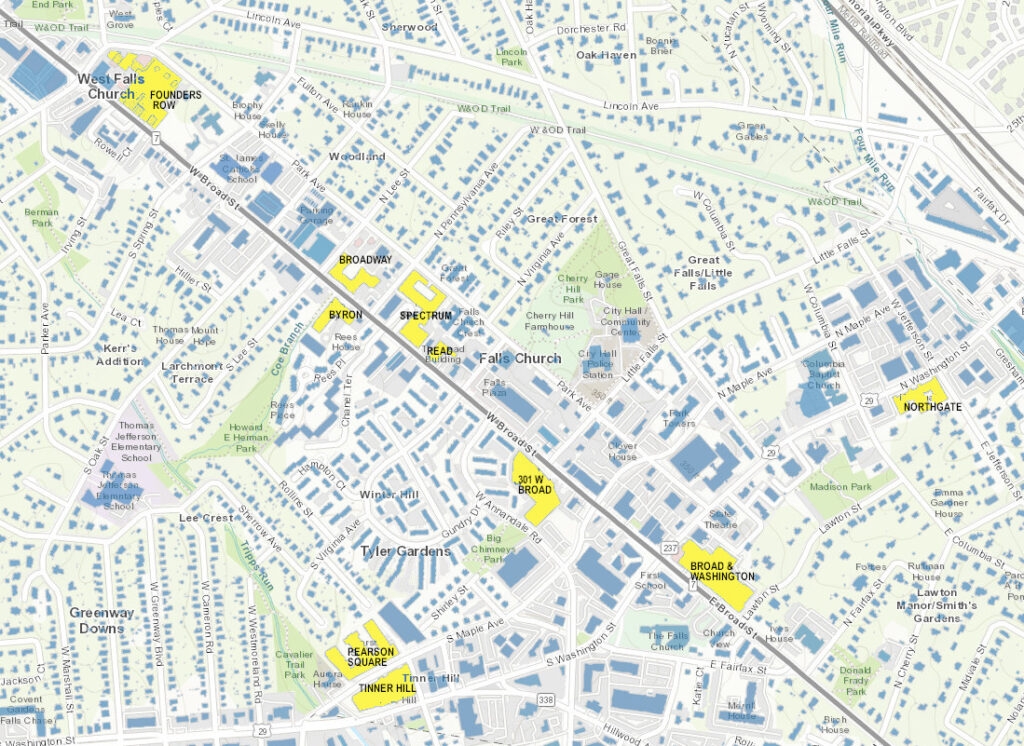
The projects
The Broadway, an 80-unit condo building, was the first new project, approved in 2001 and completed in 2004. This was followed by the Byron, completed in 2006, Pearson Square and the Read Building in 2007 – both designed as condo buildings, but subsequently converted to apartments following construction as the market changed. The Spectrum also came in, and remained, as a condo building in 2008.
Thereafter, developers would only build apartment buildings: Northgate in 2014, 301 West Broad and Tinner Hill completed in 2016, and Founders Row I completed in 2021. Broad and Washington submitted its first application in 2015 and won approval from the City Council in 2018. But the process had to begin again with a totally new proposal following the loss of a key partner. The current project was finally approved in 2021, and construction was completed in late 2024.
A total of 359 condos and 728 apartments were built over this 23-year period in buildings ranging from four to eight stories tall, with height bonuses approved through the Special Exception process. A further 280 apartments have now been completed at Founders Row II, and at West Falls, 400 apartments and 125 condos have been added.
An additional 215 senior living units are currently under construction at West Falls. Heights for these projects range from 7 to 15 stories, a new panorama for Falls Church. Finally, the 10-story Quinn-Homestretch project was approved for downtown Falls Church in February 2024, and its site plan was completed in March 2025, with 233 senior living units, medical offices, a restaurant and retail spaces, plus a public park. [See the Pulse post Falls Church Mixed-Use Development Projects, October 31, 2023.]
The City is currently considering further development options at Virginia Village to expand affordable living units and potentially include a mixed-use building.
And the fiscal benefits?
The net fiscal benefits have been reviewed in City Fiscal Impact Reports produced most recently for calendar years 2020, 2022, and 2024. Due to lags in key data accumulation, the latest report was released in January 2026. In addition to the time required for construction following extended review of applications by the City Council, the Planning Commission, and other boards and commissions, it may take another several years for stabilization of revenues from these newer projects.
The residential components of the eight projects completed in 2004 through 2016 have stabilized, and as of January 2026, 94 percent of commercial spaces in the 10 completed projects have been leased, owned, or occupied. However, several developments are still experiencing changes in their commercial components, as businesses have in several cases failed to sustain sufficient customers.
Founders Row I and Broad and Washington have succeeded in attracting high residential occupancies, but only opened their largest commercial lynchpins, the Paragon Theatres and Whole Foods, as well as the Creative Cauldron Stage, in 2025. Hence, Broad and Washington as of calendar year 2024 had no commercial revenues paid to the City. The fiscal benefits of these projects should be more fully reported in the next fiscal impact report in two years. As of early 2026, each of these projects still had an unleased retail unit.
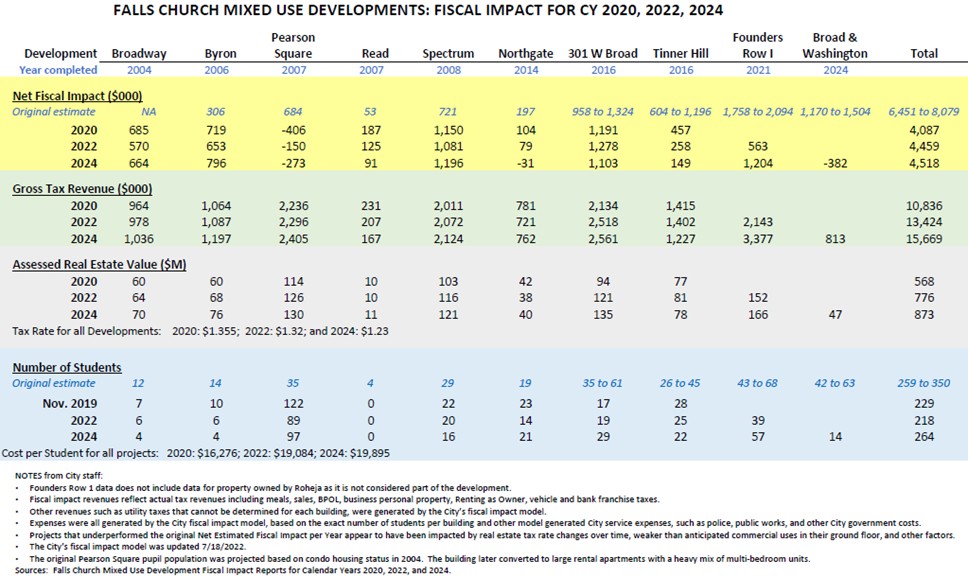
The table below summarizes the net and gross fiscal benefits to the City of the first 10 mixed-use development projects, their assessed valuations, and student populations for calendar years 2020, 2022, and 2024. Note that original estimates were made at the time of project approval and can be some years before completion. The chart is in absolute dollars and disregards inflation.
Real estate assessments and gross tax revenues
Real estate assessments for the first eight projects increased from $568 million to $660 million from 2020 to 2024, a growth of 16 percent. 301 West Broad was the outlier at 44% value growth over the four-year period. The other projects had smaller increases in assessments, although Northgate’s assessment declined. Founders Row I, at $166 million, has had the highest real estate value through 2024.
Real estate taxes, based on assessed real estate values, account for the lion’s share of gross tax revenues: 65 percent for 301 West Broad, and 83 percent for the Broadway in 2024.
As seen in the chart, gross tax revenues from all sources, based on actual revenues and the City’s fiscal impact model, rose from $10.8 million in 2020 to $11.5 million in 2024 for the first eight projects. These were a huge boost from the annual tax revenues from pre-development uses of just $571K for these properties. Once it opened, Founders Row I added $3.4 million in gross tax revenues in 2024. Broad and Washington construction was completed in December 2024, adding a further $0.8 million in gross tax revenues that year, with no commercial uses then in place.
A 12.5-cent decline in City real estate tax rates per $100 of assessed value over this period helped temper gross tax revenues, but did not reduce them for most, given the increase in assessment values. For 301 W. Broad, real estate taxes still rose by nearly $400K, or 31 %.
Also included in gross tax revenues are taxes on meals, sales, BPOL (annual Business, Professional, and License taxes, based on gross receipts), businesses personal property, Renting as Owner, vehicle and bank franchise taxes. Additional taxes that cannot be determined for each building, including utility taxes, were generated by the City’s fiscal impact model. The City provides these data as aggregates for each development project, but considers the individual elements confidential.
While gross tax revenues rose for most projects between 2020 and 2024, they fell for Read, Northgate, and Tinner Hill, due in significant part to weaker than anticipated commercial uses on their ground floors.
- The Read Building’s drive-thru bank space remained vacant throughout Calendar Year (CY) 2024. However, the space technically remains leased, and PNC bank continues to pay rent for the remaining lease term.
- Northgate lost three tenants during this period. Commercial uses appear not to have been strong enough to achieve long-term net positive fiscal results.
- At Tinner Hill, the former Target space was vacant in CY2024; Grocery Outlet replaced it in February 2026. The Grill Marx restaurant only opened in 2025.
- At Pearson Square, Pizzeria Orso closed in the Tax Analysts building in February 2024, replaced by Dolan Uyghur very late that year.
The last two projects were also missing their lynchpins for commercial tax revenues.
- There were no commercial tenants in Founders Row 1 in 2022; three opened in 2023, and six in 2024. The Paragon Theaters that opened in 2025 will have reduced revenues for the City because of tax incentives from the City.
- Similarly, neither Whole Foods nor Creative Cauldron in the Broad and Washington building opened until 2025, impairing total gross tax revenue receipts.
These two projects each continue to have one unfilled retail space in 2026.
Expenses
Proportional annual City operating expenses for each building were generated by the City fiscal impact model in order to assess the net fiscal benefit to the City. An example of these expenses for the Broadway was included in the 2022 fiscal impact report:
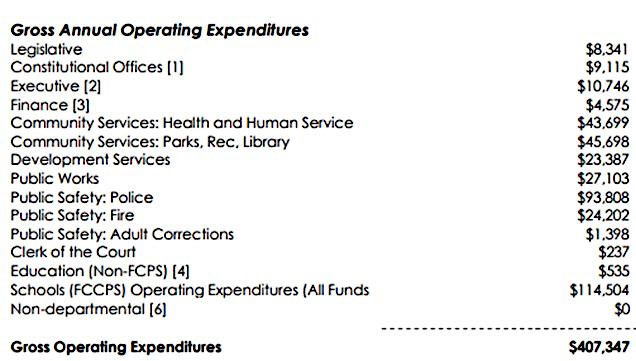
The largest share (28%) of these expenses was for school student costs at $19,084 per student for 6 students at the Broadway, or $114,504.
Gross tax revenues for the Broadway in 2022 were $977,660; after subtracting its share of estimated City operational expenses, the net fiscal impact that year for the Broadway was $570,313, a significant cut from gross tax revenues.
Student numbers
Student school expenses have been a key issue for both developers and the City. Although families with students are warmly welcomed, the fiscal cost of large numbers of students in new development projects can sharply diminish the City’s net fiscal benefit. Early condo buildings (the Broadway, Byron, and Read) did not result in many families with students, but Pearson Square, originally built as a condo building, was subsequently converted to apartments. Its large number of two- and three-bedroom and two-bedroom with den units worked well for large families and yielded a substantial number of students.
By Fiscal Year (FY) 2012, Pearson Square had 70 students, growing to 122 by FY2020, as compared to an original estimate of 35 students when the project was first approved. The large number of students coming from Pearson forced City planners to give deeper consideration to student numbers as part of their fiscal analyses of the City’s benefits from later projects. The experience with Pearson Square proved daunting: Pearson Square’s net fiscal benefit to the City plummeted to a negative $406K in 2020.
By 2015, the total number of students in Falls Church schools had grown 31.5 percent over 2005, with a projection of 50% cumulative growth by 2020. A 2016 analysis showed that 22 percent of the new students from all types of residences were coming from the new mixed-use developments.
The cost of school operations per student was also growing, rising from $16,276 per student in 2020 to $19,985 in 2020. As time passed, it became apparent that the City only had a modicum of “control” over the new student potential, and the eventual fiscal impact of mixed-use developments in the future, by focusing primarily on bedroom configurations and the type of commercial entities that would be approved within these development projects. The City Council increasingly emphasized the importance of grocery stores and restaurants as large tax revenue generators.
An evolving fiscal impact model
TischlerBise was hired to develop a fiscal impact model that initially focused on student generation rates based on type of residence (single-family detached homes, townhouses, condos, and apartments) and for apartment buildings specifically looking at the number of bedrooms per unit. Early ratios projected per apartment bedroom configurations were:
- 0.02 students for studio and one-bedroom apartments;
- 0.05 students for one-bedroom plus den units;
- 0.3 students for two-bedroom units;
- 0.9 students for two-bedrooms plus den apartments; and
- 1.3 students for three-bedrooms and three-bedroom plus den units.
These numbers were regularly revised in advance of consideration of new projects and their potential fiscal impact, since students posed a significant factor in that analysis.
The methodology also changed over time as the City gained experience with the new projects. City staff, in negotiations with the developers, became increasingly focused on nailing down in their agreements the number of bedrooms per unit that would be constructed. As time passed, the bedroom configurations shifted:
- The Broadway – 100% two- and three-bedroom units
- The Byron – 78% two and three bedrooms
- The Spectrum – 79% two bedrooms
- Northgate – 47% two- and three bedrooms
- 301 West Broad – 38% two bedrooms
- Tinner Hill – 31% two bedrooms
- Founders Row – 36% two bedrooms
- Broad and Washington – 29% two bedrooms
The City’s practice of a single estimate for numbers of students for pending applications of mixed-use projects, and for the resulting net fiscal estimates, was challenged by the Village Preservation and Improvement Society (VPIS) as the 301 West Broad project was under discussion in City Council. City staff subsequently agreed to use a range for their estimates. The City did not, however, agree to include potential capital costs for schools as part of the cost of new students, as requested by VPIS.
The total number of students in the 10 projects comes in slightly over the minimum 259 total projected, with potentially more to come as Broad and Washington stabilizes. The 97 students in Pearson Square’s 230 apartments in 2024 continue to swamp the numbers from all other projects, followed by 57 students at Founders Row 1 (322 multifamily units) and 29 at 301 West Broad (285 apartments).
While the 301 West Broad student count was substantially overestimated at both ends of the range, the net fiscal benefit has proven to be within the projected range, probably due to growth in tax revenues from the Harris Teeter grocery store. For Tinner Hill, student estimates at the lower end came closer to the actual numbers, but the net fiscal results were well below even the minimum estimate, largely due to poorer commercial results. Founders Row has come in within the student estimate range, but remained far below the net fiscal estimates through 2024 as its commercial spaces continued to be leased.
With significant caveats, the net fiscal impact of the 10 mixed-use projects has increased slowly since 2020 to a total of $4.5 million in 2024, as compared with an original projected annual net impact of $6.5 to $8 million. This shortfall is due, in part, to the delay in Founders Row I and Broad and Washington commercial entity openings, commercial closures at Tinner Hill, Northgate, Read, and the Tax Analysts building, and the conversion of Pearson Square from condos to apartments, yielding substantially more student costs.
Other City benefits
The City also includes other substantial benefits in its fiscal reports from voluntary concessions offered by the developers. Key among these were:
- 133 affordable dwelling units (ADUs) and nine workforce units
- $8.9 million in one-time capital contributions to the schools for the first nine projects
(Broad and Washington offered $2.3 million for the schools, which was traded off to increase its ADUs from 6% to 10% of all apartments)
- Utility undergrounding and green roofs for several projects
- Library, parks, public art, and stormwater contributions
- LEED Silver and Gold environmental commitments
Although the early projects only promised a 20-year life for their ADU commitments, the later ones agreed to permanent commitments.
Mixed-use developments have yet to meet expectations and have added costs
In sum, while they have added to the City’s revenue base and made Falls Church a more interesting place in which to live, mixed-use developments have not yet fulfilled their promise. Further, they have raised infrastructure costs that are chiefly shouldered by single-family homeowners through real estate taxes and higher sewer and stormwater costs.
References
- Mixed Use Development Fiscal Impact Report for Calendar Year 2024, January 28, 2025.
- Mixed Use Development Fiscal Impact Report for Calendar Year 2022, October 5, 2023.
- Mixed Use Development Fiscal Impact Report – 2020.
- Mixed Use Development Fiscal Impact Report – 2012.
- Cumulative 10 Year Growth + 5 Year Projection: Falls Church City vs. FCCPS, UVA-Weldon Cooper Center for Public Service.
- FCCPS Students by Dwelling Unit, 12/2/2021
- TischlerBise: City of Falls Church Fiscal Impact Model, Presentation to Falls Church Planning Commission, November 19, 2018.
- Broad and Washington As Built Approval, December 18, 2024, Part 1 of 3:
- Founders Row I Conceptual Development Plan